[This is an ABC podcast]
ALICE BRENNAN: Hey there, Alice Brennan here, and welcome to the third and final season of Background Briefing for the year. We have some incredible investigative content prepared for you over the next 12 to 13 weeks so stay tuned.
Just a bit of a warning before we start this episode contains some disturbing material and for our Aboriginal and Torres Strait Islander listeners, it also contains the names of some deceased people.
So we're off to the south west corner of the country... to hear a very personal story that reflects something that's happening very slowly all over Australia.
It's this reconsideration of our history, of the statues that represent it, and of the parts of it that we don't really talk about very much.
Reporter, novelist and songwriter Sam Carmody joins us for this episode. Hey there Sam.
SAM CARMODY: Hi Alice.
ALICE BRENNAN: So Sam your family is from that beautiful corner of WA near Busselton, it's the same area as the famous surf and wineries all around Margaret River?
SAM CARMODY: Yeah
ALICE BRENNAN: And this story starts there with a little bit of a weird moment over a Christmas lunch?
SAM CARMODY: Yeah so, all my family are there, we've all travelled home. Um there's my brother and sister, all the partners and the kids, we're all sitting around the table eating this beautiful meal and the conversation turns to local history.
ALICE BRENNAN: So why are you discussing history at Christmas lunch?
SAM CARMODY: Well, yeah, it's kind of a thing in my family. So my great great great grandfather he was one of the first settlers in the area.
His name was John Garret Bussell. The town of Busselton for example that's named after him.
ALICE: Right. So your family has always been proud of John Garret Bussell?
SAM CARMODY: Yeah, like from all reports he seemed like a fairly decent person and a pretty benign figure, I guess as far as colonial figures go.
So around the Christmas crackers and the champagne and the food, a poem that John wrote is being recited.
It's kind of a daggy thing, but everyone in our family genuinely knows this poem by heart.
[POEM]: The earth he held alike to self and stranger free, what time the vessel speeds before the gale and leaves us lonely on an unknown coast.
HOLII: At the time, I'd heard the poem recounted a lot of times around the dinner table.
ALICE BRENNAN: Ok so who's this?
SAM CARMODY: That's my sister-in-law. Holii. Holii is one of these people who tells it exactly as it is. Like my brother says, you know, you'll never die wondering what Holii thinks. Which is honestly a refreshing quality, particularly around our you know sometimes very super-polite family dynamic.
Anyway, Holii said she recently found out something about our family history, and she was burning to share it...
HOLII: Yeah, so somebody posted on Facebook something about they thought they should change the name of Busselton because one of the Bussell's had um shot and killed an Aboriginal girl and was fined a shilling. I didn't know if anyone knew of this. So I asked, had anyone heard that this John Garrett Bussell had actually killed an Aboriginal girl?
ALICE BRENNAN: Oh that's horrible, so what happened when Holli brought this up?
SAM CARMODY: Basically everyone just went quiet.
HOLII: yeah, pretty much everybody denied that it happened. I don't think anybody at the table really wanted to face up to the fact that that he'd actually done something bad as well as being like had this legacy that everyone was really proud of.
SAM CARMODY: The social media post Holii had seen said the girl who was shot was only seven years old.
ALICE BRENNAN: Seven years old...that seems barbaric.
SAM CARMODY: Yeah, and I'd never heard this story and it didn't appear like anyone else in my family had either.
ALICE BRENNAN: So that moment at Christmas lunch obviously stuck with you?
SAM CARMODY: Yeah it really did and I... I straight away wanted to know more about this and I started investigating all of this history.
What I found out it just shocked me, and completely changed the way I feel about the place where my family is from.
It's a history that I think the South West of WA hasn't yet confronted. I found accounts of unimaginably cruel events... events that have no plaque, no sign, there's no obvious recognition in this area that I thought I knew really well.
ALICE BRENNAN: So where did you start the process of finding out about all this ?
SAM CARMODY: I wasn't really sure where to start. One thing I knew I needed to do was speak to Noongar writers and scholars who might have investigated this history of settler violence.
CLAIRE COLEMAN: It happened all over the place. And it is so embedded in the landscape of Australia that there's actually places called names like Massacre Creek and Poison Waterholes. Researchers have acknowledged over 300 massacres on Australian soil.
SAM CARMODY: Claire G. Coleman recently wrote a book about the violence of colonisation. It's called 'Lies, Damned Lies'.
If this area where my family history runs deep was also the site of violence... I asked Claire how it could be that I hadn't heard of it... and most other people hadn't either.
SAM CARMODY: People in the area largely don't seem to know about or don't talk about the very least.
CLAIRE COLEMAN: The only way to hide that much stuff in plain sight is if the people you're hiding it from don't want to see it. Really, if you think about it. The way to hide the massacres, is to be in a country where the populace don't want to know about the massacres, therefore, you can just put a sheet in front of it and no one will look behind it.
SAM CARMODY: Claire hasn't studied the area my family's from specifically but she tells me that even a quick search starts to turn up some disturbing information. So I guess for me, it's time to look behind the sheet.
CLAIRE COLEMAN: I think everyone should look into the history of their own family. Aboriginal people, do it all the time we look into our histories to try and find out what happened to us. And I don't think it's too much to expect that colonisers do the same thing, look into and make the effort to find out what's in their past. I don't think it should just be the job of Aboriginal people to unpack the past.
SAM CARMODY: I decide I need to do just that... find out exactly what's in my family's past and I want to take my microphone with me, so that others can hear what I find out too.
I call Noongar man Len Collard, a Professor at the University of Western Australia.
SAM CARMODY: Hi Len it's Sam from the ABC here.
Len says the country I'm asking about isn't his to speak for, so he doesn't want our conversation recorded but he has done research on the area and he warns me about what I might find when I start digging.
He says, ultimately, this is not a national matter, or even a state matter.
It's a family matter. That it's time that Settler families finally sit down with the Noongar families in the area and set the record straight.
So I pack the car, and I drive south, back to the place where my family's from.
All right, so on the Bussell Highway heading south towards Busselton I don't know, how many times I've done this drive as a kid in the backseat of mom and dad's car or after high school, with mates... surfboards on the roof, that sort of thing.
Even the highway I'm driving on - the Bussell highway - is named after my family.
I remember that feeling really cool as a... as a young person. It was something to be really proud of and there was nothing ever a kind of sinister about that name at all, you know, it was just my family name, you know, belonged to this figure, John Garrett Bussell...someone to look up to and be really proud of, like a very proud legacy.
I pull in at Busselton, the portside town that is my family's claim to fame. It has the feel of a place proud of its history, almost like a museum.
Busselton's big attraction is probably it's jetty. It's over 150 years old and almost two kilometres long and on the main street, tourists stand about in the sun, posing for photographs next to bronze statues of early Settlers.
This is where I meet Emma-Clare.
EMMA-CLARE: The early pioneers would have landed straight down there and walked up hacking their way through bushes and trees to sort of get somewhere inland a bit so they could make a little camp, which I believe is up there near that post-box.
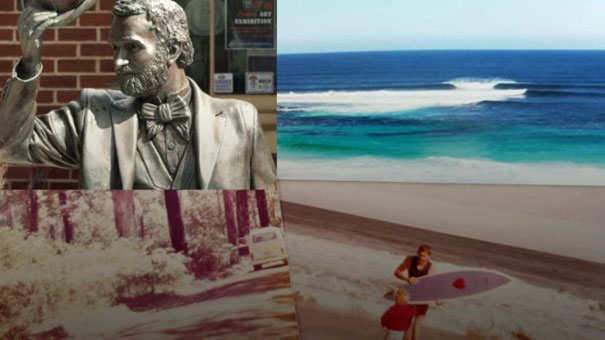
SAM CARMODY: Emma-Clare is another descendent of the Bussell brothers. We've met smack bang in the centre of town and standing right in front of us, tipping his hat, is a statue of our ancestor.
SAM CARMODY: Okay so this guy...this is the first time I've actually seen this statue, but yeah who are we looking at here?
EMMA-CLARE: Oh wow, this is John Garrett Bussell and he was the oldest of the Bussell family to come out to Western Australia.
SAM CARMODY: It is strange to look at him, my great great great grandfather. He is a similar height to me and we don't look unalike.
SAM CARMODY: So he's not the tallest guy.
EMMA-CLARE: He's not hey!
SAM CARMODY: As Emma-Clare talks about the Bussell history, there's pride in her voice
EMMA-CLARE: there's a lot of admiration for him because the success of the Bussel family is largely due to John Garrett's hard work, I think. And his ... his efforts to try to, you know, bring a lot of peace to relationships with indigenous people, at least initially.
SAM CARMODY: Emma-Clare tells me about early interactions between settlers and the Wardandi people, described in the diaries of John Garrett Bussell, that give the sense of a peaceful, almost cooperative relationship. John writes about being guided to water. The Settlers in turn sharing some of their rations.
But when Emma-Clare and I leave the main street and wander through a nearby gallery, the mood changes a bit.
She tells me how in recent years, Wikipedia pages of local settler families like the Bussells, and the Molloys, have been substantially edited.
EMMA-CLARE: All the information that used to be there about the Bussells coming to Augusta from England, the different people within the Bussell family and the things that happened has been replaced with... the very nasty things about frontier warfare and the times that were really difficult.
SAM CARMODY: Later, I look at the history of the edits to the Wikipedia page. the history wasn't so much replaced as added to but I ask Emma Clare what she thinks about these wikipedia updates and their assertions that the Bussells were involved in violence.
EMMA-CLARE: You know, I read that and it does confront me and it does make me cringe but I think that comes with the territory of being me, because that's always happened growing up in Busselton and being from the Bussell family, you wear a lot of that.
SAM CARMODY: She tells me about times where people have confronted her.
EMMA-CLARE: Things have happened so many times. I mean, I've been at different groups or attending different events around the district, and I'll introduce myself and someone will go, 'Oh oh no. I'm so sorry for you. You're from that family. Oh, that's terrible. They're terrible people'.
SAM CARMODY: I ask Emma-Clare what she knows about settler violence in the area.
EMMA-CLARE: We can't exactly pin down the exact story. There's a lot of different stories around it but we know something happened and I think there's a willingness to look at that. I don't think there's anything to hide. I think there's an understanding that that was the context of the 1800s. That obviously has a legacy into the now but I think there's nothing to be scared of to have the conversation and if people want to sit down and talk, great, you know just keep talking.
SAM CARMODY: It's clear how much pride still exists in the family and how personal all this is for someone like Emma-Clare.
But there's clearly two different versions of the Bussell history. On the one hand, the version that I grew up with, the proud account of brave pioneers and on the other hand... this 'terrible family' as the people confronting Emma-Clare describe it.
I hit the road again, and head to my parents' place, just south of Busselton.
Normally coming down to the southwest and Busselton and Yallingup and Margaret River...it's always a great time. It's a beautiful place. It's where my family live. Uh...this time does feel different you know there's real trepidation, I suppose...
I'm staying at mum and dad's house while I research this story. They live on a property a few kms back from the ocean.
Since I started diving into all this, dad has been been pulling out the old history books on the family. We sit out on the back verandah going through them.
STEPHEN CARMODY: I think the one that probably said the most was this Cattle Chosen, it was called, by EO G. Shann, who was uh... was pretty well researched and lots of letters and lots and lots and lots of letters
SAM CARMODY: The version of the Bussell history I've grown up with goes like this.
My great great great grandfather John Garrett Bussell was a bookish guy. He was a poet.
When he was young he studied at Oxford. He was apparently planning on becoming an Anglican priest.
But instead, when he was in his mid 20s, his family fell on hard times and he was sent to Australia to make some money with his three younger brothers.
Governor James Stirling, sent them to the most south-westerly tip of the Australian continent, near present-day Augusta.
But when they landed there, things were really grim. The trees were too hard to clear. Their house burnt down. A ship bringing them supplies sank.
After four hellish years, they decided to start afresh.They landed on a beach a bit further north and began to cut through the bush to the river.
That track became the main street of Busselton, where that statue of him is now. They established a farm called Cattle Chosen.
[READ] "John gloried in his self-reliance and had a hand in everything: he created wheels for a truck, dosed sick Aboriginals, hunted kangaroos, tanned leather, read philosophy, managed everyone and wrote Latin verse."
At the new farm, they found their feet. This is how the Australian Dictionary of Biography describes my ancestor, John Bussell
[READ] "A sense of duty to his family made John Bussell a pioneer, but scholarship remained his first love. He was short and slight, brown-haired and blue-eyed, gentle and pleasant."
SAM CARMODY: Those words were written by my grandmother. Dad's mum.
STEPHEN CARMODY: Well, she was a historian anyway. She was an author and a historian. So she know she published a couple of historical novels and she worked with the WA Historical Society, so she was always interested in that history.
SAM CARMODY: Because of grandma, Dad grew up surrounded by this history but one day something happened that gave him a sense that he might not have heard the full story.
Dad was still a teenager, and it was the late 70s. He and mum who were dating at the time... they were both working in this shelter in Perth, and there was this older Noongar man who also worked there.
Dad says he looked up to him that he was solid and straight shooting. His name was Olman.
STEPHEN CARMODY: I was just talking to him at the sink one day and I said, oh, look, I'm actually related to the Bussells. I don't know how we got in that conversation. But that was what I said. He said "they killed our people". And I said, "oh, that's bullshit Olman" and I got quite wound up. I was quite young. He said, no, it's true. Anyway, I was really offended by it. Anyway, I came home and I said to my mum, you know, I told her the whole circumstance and she said, well, you know....and she said, "yeah look, there were some shootings down there at that time", and it's a patchy history, but it's there. And so I thought, oh, God. Okay.
SAM CARMODY: My grandma does write about tensions between the Settlers and Noongar people. She says the tensions all culminated in this one incident at the neighbour's place, a short way from the Bussells farm.
[READ]: "The spearing of a neighbour, George Layman, by the chief, Gaywal, in 1841 brought a serious clash between settlers and natives, resulting in the death of the murderer and arrest of his sons, and finally bringing peace."
A serious clash, as my grandma put it, between settlers and Wardandi people, in 1841.
So after this neighbour George Layman was speared, what exactly happened? And how were the Bussells involved?
I would love to ask my grandmother more questions. But she died when I was fifteen.
STEPHEN CARMODY: It's just too patchy, the western versions, to, you know, be definitive about what really happened. So we're living in the sort of... there may be more to the story than we ... we know.
SAM CARMODY: I wonder if this is what Olman, the Noongar man at the shelter, was trying to tell my dad. What exactly did he mean when he said our family killed his people?
When I speak to members of the local Noongar community, they confirm what Olman said. They believe the Bussells were involved in some terrible things.
But no-one is keen to be interviewed. They all say to get the details I need to speak to the local Wardandi elder Wayne Webb.
When I make contact with him. He says that this subject is really important...that we should meet, and that there's a lot he wants to share about what happened in 1841.
As the day of our meeting comes closer, I feel a bit nervous, but I also feel like it's past time I learned more about this story.
The date we agreed on finally arrives. We meet at the beach....the sun's out.... Wayne is incredibly polite, and generous.
But things don't quite go how I'd expect.
All right, so it's pretty late at night and I'm just sitting outside at mom and dad's place on the... on the veranda. Um, today was a really big day. A lot happened, um, I met with Wayne Webb, an elder and his son, Zach. Anyway, when it came time to sort of say. All right, should we maybe record an interview now and...and put some things to tape, Wayne Webb kind of just said, look, you know, I kind of politely but just was firm about, look, no. We want to work out what we want to say. And the biggest part of it was we don't want to upset people, we don't want to upset other settler families, we don't want to blow up, I suppose, this reconciliation process ...uh...that they're hoping for
This is a story they want to tell carefully. They want to tell it on their terms, and in their own time and understandably, they want to sound me out first.
But anyway, we sat down again and we talked for another couple hours and I kind of laid it all out and they agreed, um, Wayne's wife Toni said, let's sit down tomorrow come over one o'clock, you know, we'll be there. Let's record something so, kind of a big relief, but also I don't know what I might hear... um... yeah.