COLD OUT. Streaks of sunshine splashing over Queens. On Saturday morning, Nov. 15, John Sommese settled into a rented hearse, eased into the sparse traffic and drove to the morgue. He owns Simonson Funeral Home. At age 73, he remained a working owner in a city of dwindling deaths.
At the morgue, an attendant withdrew the body from the drawer, and both medical examiner and undertaker checked the identity tag. Using a hydraulic lift, the attendant swung the body into the wooden coffin. George Bell was at last going to his eternal home.
The coffin was wheeled out and guided into the back of the hearse. Mr. Sommese smoothed an American flag over it. The armed forces had passed on a military burial, but George Bell’s years in the Army Reserves were good enough for the funeral director, and he abided by military custom.
Next stop was U.S. Columbarium at Fresh Pond Crematory in Middle Village, for the cremation. Mr. Sommese made good time along the loud streets lined with shedding trees. The volume on the radio was muted; the dashboard said Queen’s “You’re My Best Friend” was playing.
While the undertaker said he didn’t dwell much on the strangers he transported, he allowed how instances like this saddened him — a person dies and nobody shows up, no service, no one from the clergy to say a few kind words, to say rest in peace.
The undertaker was a Christian, and believed that George Bell was already in another place, a better place, but still. “I don’t think everyone should have an elaborate funeral,” he said in a soft voice. “But I think burial or cremation should be with respect, or else what is society about? I think about this man. I believe we’re all connected. We’re all products of the same God. Does it matter that this man should be cremated with respect? Yes, it does.”
He consulted the mirror and blended into the next lane. “You can have a fancy funeral, but people don’t pay for kindness,” he went on. “They don’t pay for understanding. They don’t pay for caring. This man is getting caring. I care about this man.”
At U.S. Columbarium, he steered around to the rear, to the unloading dock. Another hearse stood there. Yes — a line at the crematory.
Squinting in the sun, Mr. Sommese paced in the motionless air. After 15 minutes, the dock opened up and the undertaker angled the hearse in. Workers took the coffin. Mr. Sommese kept the flag. Normally, it would go to the next of kin. There being none, the undertaker folded it up to use again.
The cremation process, what U.S. Columbarium calls the “journey,” consumed nearly three hours. Typically, cremains are ready for pickup in a couple of days. For an extra $180, the columbarium provides same-day express service, which was unneeded in this case.
Some 40,000 cremains were stored at the columbarium, almost all of them tucked into handsome individual wall niches, viewable through glass. Downstairs was a storage area near the bathrooms with a bronze tree affixed to the door. This was the Community Tree. Behind the door cremains were stacked up and stored out of sight. The budget alternative. Names were etched on the tree leaves. Some time ago, when the leaves filled up, doves were added.
Several days after the cremation, the superintendent stacked an urn shaped like a small shoe box inside the storage area. Then he nailed a metal dove, wings spread, above the right edge of the tree. It identified the new addition: “George M. Bell Jr. 1942-2014.”
ON ALTERNATE TUESDAYS, David R. Maltz & Company, in Central Islip, N.Y., auctions off 100 to 150 cars; other days, it auctions real estate, jewelry and pretty much everything else. It has sold the Woodcrest Country Club in Muttontown, N.Y., four engines from an automobile shredder, 22 KFC franchises. Items arrive from bankruptcies, repossessions and estates, including a regular stream from the Queens public administrator.
In the frosty gloom of Dec. 30, as a hissing wind spun litter through the air, the Maltz company had among its cars a 2011 Mustang convertible, multiple Mercedes-Benzes, two cars that didn’t even run and George Bell’s 2005 Toyota. Despite its age, it had just over 3,000 miles on it, brightening its appeal.
In a one-minute bidding spasm — “3,000 the bid, 3,500, 35 the bid, 4,000…” — the car went for $9,500, beating expectations. After expenses, $8,631.50 was added to the estate. The buyer was Sam Maloof, a regular, who runs a used car dealership, Beltway Motor Sales, in Brooklyn and planned to resell it. After he brought it back, his sister and secretary, Janet Maloof, adored it. She had the same 2005 model, same color, burdened with over 100,000 miles. So, feeling the holiday spirit, he gave her George Bell’s car.
In a couple of weeks, the only other valuable possession extracted from the apartment, the Relic watch, came up for sale at a Maltz auction of jewelry, wine, art and collectibles. The auction was dominated by 42 estates put up by the Queens public administrator, the thinnest by far being George Bell’s. Bidding on the watch began at $1 and finished at $3. The winner was a creaky, unemployed man named Tony Nik. He was in a sulky mood, mumbling after his triumph that he liked the slim price.
Again after expenses, another $2.31 trickled into the Bell estate.
On a sun-kindled day a week later, six muscled men from GreenEx, a junk removal business, arrived to empty the cluttered Queens apartment. Dispassionately, they scooped up the dusty traces of George Bell’s life and shoveled them into trash cans and bags. They broke apart the furniture with hammers. Tinny music poured from a portable radio.
Eyeing the bottomless thickets, puzzling over what heartbreak they told of, one of the men said: “Depression, I think. People get depressed and then, Lord help them, forget about it.”
Seven hours they went at it, flinging everything into trucks destined for a Bronx dump where the rates were good.
Some nuggets they salvaged for themselves. One man fancied a set of Marilyn Monroe porcelain plates. Another worker plucked up an unopened jumbo package of Nike socks, some model cars and some brand-new sponges. Yet another claimed the television and an unused carbon monoxide detector. Gatherings from a life, all worth more than that $3 watch.
A spindly worker with taut arms crouched down to inspect some never-worn tan work boots, still snug in their box. They were a size big, but he slid them on and liked the fit.
He cleaned George Bell’s apartment wearing the dead man’s boots.
THE PEOPLE NAMED to split the assets in the will were known as the legatees. Over 30 years had passed since George Bell chose them: Martin Westbrook, Frank Murzi, Albert Schober and Eleanore Albert. Plus, there was a beneficiary on two bank accounts: Thomas Higginbotham.
Elizabeth Rooney, a kinship investigator in the office of Gerard Sweeney, the public administrator’s counsel, set out to help find them. By law, she also had to hunt for the next of kin, down to a first cousin once removed, the furthest relative eligible to lay claim to an estate. They had to be notified, should they choose to contest the will.
There was time, for George Bell’s assets could not be distributed until seven months after the public administrator had been appointed, the period state law specifies for creditors to step forward.
Prowling the Internet, Ms. Rooney learned that Mr. Murzi and Mr. Schober were dead. Mr. Westbrook was in Sprakers and Mr. Higginbotham in Lynchburg, Va. Ms. Rooney found Ms. Albert, now going by the name Flemm, upstate in Worcester.
They were surprised to learn that George Bell had left them money. Ms. Flemm had spoken to him by phone a few weeks before he died; the others had not been in touch for years.
A core piece of Ms. Rooney’s job was drafting a family tree going back three generations. Using the genealogy company Ancestry.com, she compiled evidence with things like census records and ship manifests, showing Bell relatives arriving from Scotland. Her office once produced a family tree that was six feet long. Another time it traced a family back to Daniel Boone.
Ms. Rooney created paternal and maternal trees, each with dozens of names. She found five living relatives: two first cousins on his mother’s side, one living in Edina, Minn., and the other in Henderson, Nev. Neither had been in contact with George Bell in decades, and didn’t know what he did for a living.
On the paternal side, Ms. Rooney identified two first cousins, one in Scotland and another in England, as well as a third whose whereabouts proved elusive.
When that cousin, Janet Bell, was not found, protocol dictated that a notice be published in a newspaper for four weeks, a gesture intended to alert unlocated relatives. With sizable estates, the court chooses The New York Law Journal, where the bill for the notice can run about $4,000. In this instance the court picked The Wave, a Queens weekly with a print circulation of 12,000, at a cost of $247.
The cousin might have been in Tajikistan or in Hog Jaw, Ark., or even on Staten Island, and the odds of her spotting the notice were approximately zero. Among thousands of such ads that Mr. Sweeney has placed, he is still awaiting his first response.
Word came that Eleanore Flemm had died of a heart attack, on Feb. 3 at 66. Since she had outlived Mr. Bell, her estate would receive her proceeds. Her heirs were her brother, James Albert, a private detective on Long Island who barely remembered the Bell name, along with a nephew and two nieces in Florida. One did not know George Bell had existed.
Death, though, isn’t social. It’s business. No need to have known someone to get his money.
On Feb. 20, a Queens real estate broker listed the Bell apartment at $219,000. It was the final asset to liquidate. Three potential buyers toured it the next day, and one woman’s offer of $225,000 was accepted.
Three months later, the building’s board said no. A middle-aged couple who lived down the block entered the picture, and, at $215,000, was approved. Their plan was to fix up the marred apartment, turn their own place over to their grown-up son and then move in, overwriting George Bell’s life.
Meanwhile, Mr. Sweeney appeared in Surrogate’s Court to request probate of the will. Besides the two known beneficiaries, he listed the possibility of unknown relatives and the unfound cousin. The court appointed a so-called guardian ad litem to review the will on behalf of these people, who might, in fact, be phantoms.
In September, Mr. Sweeney submitted a final accounting, the hard math of the estate, for court approval. No objections arrived. Tallied up, George Bell’s assets amounted to roughly $540,000. Bank accounts holding $215,000 listed Mr. Higginbotham as the sole beneficiary, and he got that directly. Proceeds from the apartment, other accounts, a life insurance policy, the car and the watch went to the estate: around $324,000.
A commission of $13,726 went to the city, a $3,238 fee to the public administrator, $19,453 to Mr. Sweeney.
Other expenses included things like the apartment maintenance, at $7,360; a funeral bill of $4,873; $2,800 for the cleanout company; $1,663 for the kinship investigator; a $222 parking ticket; a $704 Fire Department bill for ambulance service; $750 for the guardian ad litem; and $12.50 for an appraisal of the watch that sold for $3.
That left about $264,000 to be split between Mr. Westbrook and the heirs of Ms. Flemm. Some 14 months after a man died, his estate was settled and the proceeds were good to go.
For the recipients, George Bell had stepped out of eternity and united them by bestowing his money. No one in the drawn-out process knew why he had chosen them, nor did they need to. They only needed to know him in the quietude of death, as a man whose heart had stopped beating in Queens. But he had been like anyone, a human being who had built a life on this earth.
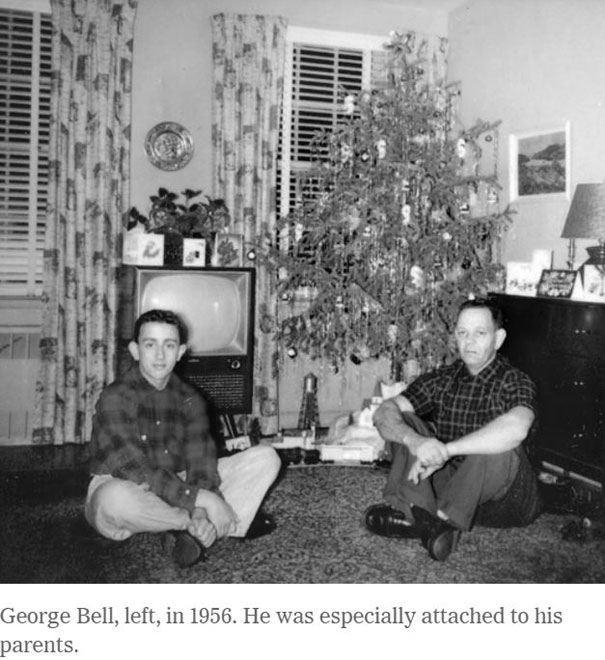
HIS LIFE BEGAN small and plain. George Bell was especially attached to his parents. He slept on the pullout sofa in the living room, while his parents claimed the bedroom, and he continued to sleep there even after they died. Both parents came from Scotland. His father was a tool-and-die machinist, and his mother worked for a time as a seamstress in the toy industry.
After high school, he joined his father as an apprentice. In 1961, he made an acquaintance at a local bar, a moving man. They became friends, and the moving man pulled George Bell into the moving business. His name was Tom Higginbotham. Three fellow movers also became friends: Frank Murzi, Albert Schober and Martin Westbrook. The men in the will. They mainly moved business offices, and they all guzzled booze, in titanic proportions.
“We were a bunch of drunks,” Mr. Westbrook said. “I’m a juicer. But George put me to shame. He was a real nice guy, kind of a hermit. Boy, we had some good times.”
In the words of Mr. Higginbotham: “We were great friends. I don’t know if you can say it this way, but we were men who loved each other.”
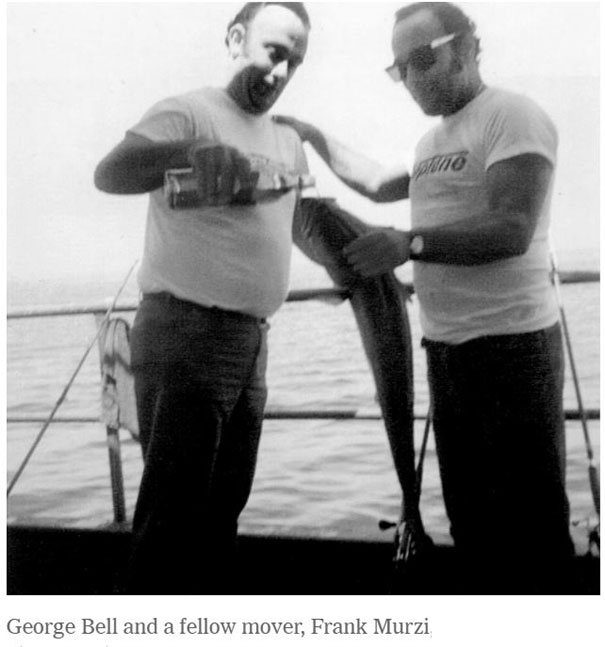
They called him Big George, for he was a thickset, brawny man, weighing perhaps 210 pounds. Later, his ravenous appetite had him pushing 350.
He had a puckish streak. Once a woman invited him and Mr. Higginbotham to a party at her parents’ house. Her father kept tropical fish. She showed George Bell the tank. When he admired a distinctive fish, she said, “Oh, that’s an expensive one.” He picked up a net, caught the fish and swallowed it.
One day the friends were moving a financial firm. After they had fitted the desks into the new offices, George Bell slid notes into the drawers, writing things like: “I’m madly in love with you. Meet me at the water cooler.” Or: “There’s a bomb under your chair. Your next move might be your last.”
Dumb pranks. Big George being Big George.
Friends, though, found him difficult to crack open. There were things inside no one could get out. You learned to suppress your questions around him.
He had his burdens. His father died young. As she aged, his mother became crippled by arthritis. He cared for her, fetching her food and bathing her until her death.
He was fastidious about his money, only trusted banks for his savings. There was a woman he began dating when she was 19 and he was 25. “We got real keen on each other,” she said later. “He made me feel special.”
A marriage was planned. They spoke to a wedding hall. He bought a suit. Then, he told friends, the woman’s mother had wanted him to sign a prenuptial agreement to protect her daughter if the marriage should break apart. He ended the engagement, and never had another serious relationship.
That woman was Eleanore Albert, the fourth name in the will.
Some years later, she married an older man who made equipment for a party supply company, and moved upstate to become Ms. Flemm. In 2002, her husband died.
Distance and time never dampened the emotional affinity between her and George Bell. They spoke on the phone and exchanged cards. “We had something for each other that never got used up,” she said. She had sent him a Valentine’s Day card just last year: “George, think of you often with love.”
And unbeknown to her, he had put her in his will and kept her there.
Her life finished up a lot like his. She lived alone, in a trailer. She died of a heart attack. A neighbor who cleared her snow found her. She had gotten obese. Her brother had her cremated.
A difference was that she left behind debt, owed to the bank and to credit card companies. All that she would pass on was tens of thousands of dollars of George Bell’s money, money that she never got to touch.
Some would filter down to her brother, who had no plans for it. A slice went to Michael Garber, her nephew, who drives a bus at Disney World. A friend of his aunt’s had owned a Camaro convertible that she relished, and he might buy a used Camaro in her honor.
Some more would go to Sarah Teta, a niece, retired and living in Altamonte Springs, Fla., who plans to save it for a rainy day. “You always hear about people you don’t know dying and leaving you money,” she said. “I never thought it would happen to me.”
And some would funnel down to Eleanore Flemm’s other niece, Dorothy Gardiner, a retired waitress and home health care aide. She lives in Apopka, Fla., never heard of George Bell. She has survived two cancers and has several thousand dollars in medical bills that could finally disappear. “I’ve been paying off $25 a month, what I can,” she said. “I never would have expected this. It’s crazy.”
IN 1996, GEORGE BELL hurt his left shoulder and spine lifting a desk on a moving job, and his life took a different shape. He received approval for workers’ compensation and Social Security disability payments and began collecting a pension from the Teamsters. Though he never worked again, he had all the income he needed.
He used to have buddies over to watch television and he would cook for them. Then he stopped having anyone over. No one knew why.
Old friends had drifted away, and with them some of the fire in George Bell’s life. Of his moving man colleagues, Mr. Murzi retired in 1994 and died in 2011. Mr. Schober retired in 1996 and moved to Brooklyn, losing touch. He died in 2002.
Mr. Higginbotham quit the moving business, and moved upstate in 1973 to work for the state as an environmental scientist.
He is now 74, retired and living alone in Virginia. The last time he spoke to George Bell was 10 years ago. He used a code of ringing and hanging up to get him to answer his phone, but in time, he got no answer. He sent cards, beseeched him to come and visit, but he wouldn’t. It was two months before Mr. Higginbotham found out George Bell had died.
It has been hard for him to reconcile the way George Bell’s money came to him. “I’ve been stressed about this,” he said. “I haven’t been sleeping. My stomach hurts. My blood pressure is up. I argued with him time and again to get out of that apartment and spend his money and enjoy life. I sent him so many brochures on places to go. I thought I understood George. Now I realize I didn’t understand him at all.”
Mr. Higginbotham was content with the fundaments of his own life: his modest one-bedroom apartment, his 15-year-old truck. He put the inheritance into mutual funds and figures it will help his three grandchildren through college. George Bell’s money educating the future.
In 1994, Mr. Westbrook hurt his knee and left the moving business. He moved to Sprakers, where he had a cattle farm. When he got older and his marriage dissolved, he sold the farm but still lives nearby. He is 74. It was several years ago that he last spoke to George Bell on the phone. Mr. Bell told him he did not get out much.
He has three grandchildren and wants to move to a mellower climate. He plans to give some of the money to Mr. Murzi’s widow, because Mr. Murzi had been his best friend.
“My sister needs some dental work,” he said. “I need some dental work. I need hearing aids. The golden age ain’t so cheap. Big George’s money will make my old age easier.”
He felt awful about his dying alone, nobody knowing. “Yeah, that’ll happen to me,” he said. “I’m a loner, too. There’s maybe four or five people up here I talk to.”
In his final years, with the moving men gone, George Bell’s life had become emptier. Neighbors nodded to him on the street and he smiled. He told lively stories to the young woman next door, who lived with her parents, when he bumped into her. She recently became a police officer, and she was the one who had smelled what she knew was death.
But in the end, George Bell seemed to keep just one true friend.
He had been a fixture at a neighborhood pub called Budds Bar. He showed up in his cutoff blue sweatshirt so often that some regulars called him Sweatshirt Bell. At one point, he eased up on his drinking, then, worried about his health, quit. But he still went to Budds, ordering club soda.
In April 2005, Budds closed. Many regulars gravitated to another bar, Legends. George Bell went a few times, then transferred his allegiance to Bantry Bay Publick House in Long Island City. He would meet his friend there.
THE SIGN at the entrance to Bantry Bay says, “Enter as Strangers, Leave as Friends.” Squished in near the window was Frank Bertone, sipping soup and nursing a drink. He is known as the Dude. George Bell’s last good friend.
In the early 1980s, not long after moving to Jackson Heights, he stopped in at Budds in need of a restroom. A big man had bellowed, “Have a beer.”
That was George Bell. In time, a friendship was spawned, deepening during the 15 years that remained of George Bell’s life. They met on Saturdays at Bantry Bay. They fished in the Rockaways and at Jones Beach, sometimes with others. Mr. Bell bought a car to get out to the good spots, but the car otherwise mostly sat. They passed time meandering around, the days bleeding into one another.
“Where did we go?” Mr. Bertone said. “No place. One time we sat for hours in the parking lot of Bed Bath & Beyond. What did we talk about? The world’s problems. Just like that, the two of us solved the world’s problems.”
Mr. Bertone is 67, a retired inspector for Consolidated Edison. Over the last decade, he had spent more time with George Bell than anyone, but he didn’t feel he truly knew him.
“One thing about George is he didn’t get personal,” he said. “Not ever.”
He knew he had never married. He spoke of girlfriends, but Mr. Bertone never met any. The two had even swapped views on wills and what happens to your money in the end, though Mr. Bertone did not know George Bell had drafted a will before they met.
Mr. Bertone would invite him to his place, but he would beg off. George Bell never had him over.
Once, some eight years ago, Mr. Bertone trooped out there when he hadn’t heard from him in a while. George Bell cracked open the door, shooed him away. A curtain draped inside the entryway had camouflaged the chaos. Mr. Bertone had no idea that at some point, George Bell had begun keeping everything.
The Dude, Mr. Bertone, told a story. A few years ago, George Bell was going into the hospital for his heart and had asked him to hold onto some money. Gave him a fat envelope. Inside was $55,000.
Mike Kerins, a bartender, interrupted: “Two things about George. He gave me $100 every Christmas, and he never went out to eat.” He had confessed he was too embarrassed because he would have required three entrees.
George Bell had diabetes and complained about a shoulder pain. He took pills but skipped them during the day, saying they made him feel like an idiot.
Both the Dude and Mr. Kerins sensed he felt he had been bullied too hard by life. “George was in a lot of pain,” Mr. Kerins said. “I think he was just waiting to die, had lived enough.”
It was as if sadness had killed George Bell.
His days had become predictable, an endless loop. He stayed cloistered inside. Neighbors heard the regular parade of deliverymen who brought him his takeout meals.
The last time the Dude saw George Bell was about a week before his body was found. Frozen shrimp was on sale at the shopping center. George Bell got some, to take back to the kitchen he did not use.
Mr. Bertone didn’t realize he had died until someone came to Legends with the news. Mr. Kerins was there and he told the Dude. They made some calls to find out more, but got nowhere.
Why did he die alone, no one knowing?
The Dude thought on that. “I don’t know, man,” he said. “I wish I could tell you. But I don’t know.”
On the televisions above the busy bar, a woman was promoting a cleaning product. In the dim light, Mr. Bertone emptied his drink. “You know, I miss him,” he said. “I would have liked to see George one more time. He was my friend. One more time.”