The Vampire Ship
By Alexander Clapp
 |
|
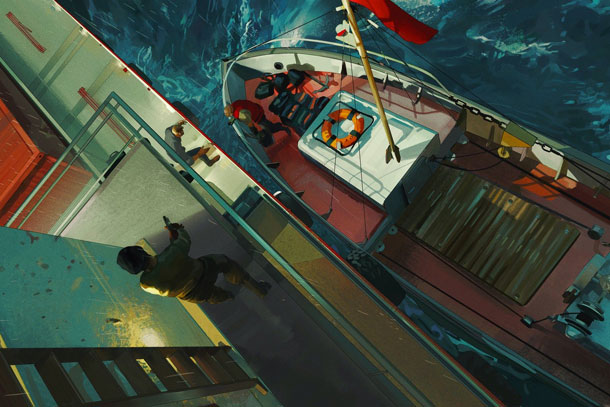
On April 28, 2014, a fishing trawler intercepted an oil tanker in the Gulf of Oman, a day after the tanker had left Dubai for Greece. Three men climbed aboard the tanker and spent the night packing hundreds of small sacks of heroin, weighing at least two metric tons in total, into its ballast boxes. After they finished, two of the men sailed back to the coast. One stayed behind. He carried a handgun and ordered the tanker’s crew to keep sailing. By late May, the tanker, which was called the Noor One, had passed through the Suez Canal. Early on the morning of June 6, it nosed into Elefsina, a grimy port just west of Athens. The next afternoon, four Kurdish men in a black Mercedes SUV pulled up in front of the ship, hauled the sacks of heroin out of the Noor One’s ballasts, and began transporting them toward Athens. The Kurds had spent years preparing for the heroin’s arrival. They had negotiated to pay more than $20 million for the Plaza Resort on the Attic Riviera, planning to use the tourist destination as a money-laundering site for proceeds from its sale. They had leased a warehouse and an industrial chicken coop in the olive groves near Athens International Airport; here, the Noor One’s heroin would be diluted with more than five tons of marble dust from a quarry on nearby Mount Pentelikon. To transport the shipment, they had purchased a forklift and several hundred canvas bags stamped “Pakistan White Sugar.” In early May, an associate from Belgium had arrived in a cargo truck outfitted with secret compartments. The truck was supposed to move most of the heroin to a port in northwest Greece, then across the Adriatic by ferry to Italy. From there, it would be distributed to the street corners of Belgium and the Netherlands, kicking back hundreds of millions of euros to its owners. All the pieces were in place, in other words, for a latter-day Mediterranean sequel to The French Connection. But as was the fate of that famed heroin transaction, the Noor One deal quickly unraveled. Four days after the oil tanker reached the port at Elefsina, a figure on the fringe of the operation, unnerved by the idea of trafficking heroin, entered a police station. He explained that somewhere outside Athens a huge haul of drugs was being prepared for export. The next day, Georgios Katsoulis, the head of the Piraeus branch of Greece’s coast guard, was informed—on the basis of this insider’s testimony—that “half a ton” was to be found in a small town east of the capital. On June 11, Katsoulis sent five of his men to observe the squat cinderblock warehouse where the heroin was supposed to be held. The next evening, at around 9 p.m., Katsoulis dispatched 30 armed agents to surround the building.? “We got some sense of what we were dealing with when the dogs went berserk,” Katsoulis told me. “Normally they sniff the heroin and move right toward it. But in this case, there was so much heroin, the dogs didn’t know where to go. They just started convulsing and barking violently.”? Inside the warehouse were six Kurds and Greeks, 500 kilograms of uncut heroin, and a handgun. Katsoulis’s team arrested the men without struggle and took them to Piraeus. At approximately the same time, another coast guard squad raided a mansion in the lush Athenian suburb of Filothei and found another half-ton of heroin stacked in its garage. Over the next several days, the plotline shifted from The French Connection to The Wire: Greek intelligence services picked up one member of the operation after another and flipped them. To hide the identity of the original informant, the police also arrested him or her; at the same time, they allowed others with known ties to the operation to escape. “It was important to make it unclear who’d talked and who hadn’t,” an officer told me. On June 22, acting on information from one of these sources, Katsoulis’s officers stormed the chicken coop near Athens airport and discovered another ton of heroin. In Elefsina, thanks to a tip from a different source, they swarmed the Noor One and arrested its crew members. Another source eventually led them to Dubai. By August, 33 people were in custody. Greek authorities had disrupted the largest known movement of heroin in European history.? But that was just the beginning of the story. The seizure of the drugs shipped on the Noor One has triggered a long series of seismic aftershocks in Greece and around the world. The planners of the smuggling operation have turned on one another in a war of retribution that has left at least 17 people dead on three continents. Phone records are exposing scores of police whom the smugglers bought off, from Turkey to the United Arab Emirates. In Greece, an investigation into the Noor One captivated the national press—and then spurred a new wave of public interest in the case via a preliminary criminal trial and the rise of a new media magnate. The country’s current prime minister and one of his predecessors have accused each other of having connections to the heroin. And an ongoing investigation into who funded the Noor One threatens to ensnare Greek oligarch Evangelos Marinakis, one of the most powerful figures in global shipping and soccer. The killings represent the most straightforward part of the saga—even if sleuthing them hasn’t been. They began three months after the Noor One was seized. Early on in the criminal investigation, authorities in Greece had allowed the most crucial figure in the operation to escape: the driver of the black SUV that had picked up the heroin when it arrived in Elefsina in June 2014. An Iranian Kurd, he sometimes went by the name Mohammed Diesel. Fearing arrest, Diesel had flown to Istanbul and pleaded with a childhood friend named Naji Sharifi Zindashti to smuggle him to safety into Dubai. Thirty years earlier, Zindashti and Diesel had been sentenced to execution in Tehran on heroin trafficking charges. Together they broke out of Evin Prison by killing a guard. Diesel fled for Pakistan, Zindashti for Istanbul. Over time, Zindashti came to occupy a remarkable place in the maelstrom of Turkish politics. It is widely believed that in the mid-2000s he brokered ties with a political cell called Ergenekon. Members of the group—including many police and army officers—plotted to overthrow then-Prime Minister Recep Tayyip Erdo?an’s government and restore a hard-line nationalist regime to power. Zindashti was imprisoned again for heroin trafficking in 2007, but was released early for allegedly informing against the most prominent members of Ergenekon. His Turkish police file claims that as soon as Zindashti was released from prison, he slipped back into the underworld, this time channeling cash into the Gülen movement—the transnational Islamic organization that fueled dissident activity against Erdo?an—possibly in exchange for immunity offered by judiciary and security services aligned with that movement.? The planners of the smuggling operation have launched a war of retribution that has left at least 17 people dead on three continents. Sources with underground connections from Amsterdam to Istanbul told me that Zindashti owned hundreds of kilos of the Noor One’s heroin. Other figures who owned stakes were Diesel and at least four other Kurdish gangsters—men based in Dubai, Amsterdam, and Brussels. The timing of the Noor One’s departure for Greece, in April 2014, meant that their heroin had almost certainly been synthesized and purchased the prior autumn. At least 20 million euros cash was paid to Iranian or Afghan producers. They entrusted their product to a Greek oil broker whose incentive for the job—perhaps a large fee, perhaps a cut of the cargo—remains a mystery. At the time of the Noor One’s seizure, all that the far-flung network of gangsters aligned behind the deal knew was that someone had ratted on them. They also knew that someone with a history of informing existed in their ranks: Zindashti. “You spoiled our plans, you spoke against us, you stole from us, you made fools of us,” one of these gangsters wrote to Zindashti in September 2014, in an email retrieved years later by Turkish police. The barely concealed threat in this message was anything but idle. Two weeks after Zindashti received that email, his white Porsche was rolling down an Istanbul boulevard when rounds of bullets ripped through its doors, killing the driver and passenger. Zindashti himself was not in the car. The driver was his nephew, the passenger his daughter; both were on their way to classes at Istanbul University. “You couldn’t manage a simple cleanup job,” one of the Noor One’s funders in Belgium texted the gunmen, after the bungled assassination attempt. “I was expecting something like this,” Zindashti uttered coldly at his daughter’s funeral. “And I know exactly who did it.” But if the other funders of the Noor One weren’t absolutely certain that Zindashti had been the rat, Zindashti couldn’t tell for sure which of those funders had attempted to murder him. One grim fact is indisputable, though: Over the next four years, more and more people who were potentially connected to the failed assassination attempt and the death of Zindashti’s daughter started turning up dead. In late December 2014, on the European coast of Istanbul, the men alleged by Turkish police to have killed Zindashti’s daughter and nephew were shot by an unknown assassin. Three days later, an Amsterdam-based cocaine lord who owned a chunk of the Noor One’s heroin was shot in the head as his black Bentley sat at an Istanbul traffic light. Before the year had ended, the mangled corpse of Mohammed Diesel—Zindashti’s partner in crime, who had initially helped set all this carnage in motion—was reportedly fished out of the Sea of Marmara, peppered with gunshots and chained to an anchor. “I punished ... him,” Zindashti informed a partner, in a text message later reprinted in a Turkish newspaper, apparently convinced Diesel had played some role in his daughter’s murder. “I killed him.”? The body count continued to rise. The following spring, Cetin Koç, a gangster involved in the Noor One deal—and another former inmate at Evin Prison with Diesel and Zindashti three decades earlier—was gunned down by three men as he was sitting in his sports car on a street in Dubai. Days after the killing, United Arab Emirates authorities informed their Canadian counterparts that the assassins had flown to British Columbia. A week after that, a farmer was strolling through his blueberry patch an hour east of Vancouver when he stumbled upon the body of one of those alleged assassins, chewed through with bullets. Days later, the body of the other was found in a burnt-out car several miles away. In January 2015, Dutch newspapers reported the shooting of a cocaine trafficker with ties to a Noor One funder in Panama City. Two years later, the brother of the gangster killed in Dubai was kidnapped from his house in Tehran and executed in a dog pen in southeastern Turkey. Nine months after that, the prominent attorney of another funder was gunned down with an Uzi while out to breakfast with his family in Istanbul. Just 17 days earlier, he had warned a courtroom, “I might not make it to another hearing.”? By April 2018, 13 people connected to the Noor One had been assassinated. Four others had died in suspicious circumstances. “Zindashti is a person who kills his enemies without hesitation,” Zehra Özdilek, a journalist who has covered the turf war for the Turkish newspaper Cumhuriyet, told me. Despite these claims, Zindashti has never been successfully convicted for a single murder. Police were regular visitors to his Istanbul villa as the killings were being carried out. Greece, where the Noor One remained docked all this time, was to be the most consequential source of conflict over the deal once the bloodletting started to abate. The criminal case that gradually took shape around Europe’s largest-ever drug bust became a national obsession in a Greek social order already roiled by other forces of globalization—the European Union’s bailout of the flailing, debt-ridden Greek economy on the one hand, and the political crisis over refugees on the other. Amid such convulsions, the case of the Noor One offered a gruesomely cathartic distraction from the country’s other troubles. In Greek newspapers, the Noor One is known as the “vampire ship”; the fallout from its bust gets reported in conspiratorial and, indeed, almost supernatural terms. Whenever the Noor One appears about to fade from national headlines, the story seems to will its way back into the fore. News flutters in of another strange murder, another inexplicable resignation of a prosecutor, another bomb in the mail. “THE NOOR ONE KILLS AGAIN,” read an Efimerida ton Syntakton headline in November 2019, after the death of the sixteenth person tied to the ship.? Against the backdrop of the extraordinary sacrifices the EU has exacted on Greece’s economy and political system for continued membership in the union, the Noor One saga also invites no small amount of introspection about exactly what kind of country a decade of financial austerity and technocratic tinkering has produced. Greece still—barely—claims membership in the all-business EU trading bloc, but it’s also a place where police get stalked and threatened, witnesses die in jail, and powerful interests can marionette the legal system with impunity.? ?Such, at any rate, was the dominant impression left by the official Greek investigation into the Noor One deal. From the outset of the inquiry in the fall of 2014, police efforts in Greece were dogged by a bizarre series of disruptions. Three weeks after the seizure, a 24-year-old Dutch national, Ebru Tok, arrived in Piraeus and visited the Kurds in prison, claiming to be their legal counsel. It wasn’t until the following year, after her phone was tapped by Dutch authorities, that Greek intelligence was informed that this woman was a money carrier for the Kurdish mafia—and discovered that she had left behind as much as €200,000 in cash in Greece during her stay. Perhaps she’d given money to the imprisoned Kurdish men to keep them quiet, or she may have left them with instructions about how best to keep mum on the details of the deal when they were interrogated about it. But Greek investigators know one thing for sure: After this visit, anything the accused Kurds told police—about the critical question of who owned the heroin, for instance—could no longer be trusted.? Within a year, some of the accused could no longer tell the police anything: They, too, began to die off, albeit in less overtly violent fashion. In July 2015, one of the Kurds who had unloaded the heroin from the Noor One was transferred from the prison where he was held to an Athens hospital, where he died of heart failure; the autopsy attributed his death to a stroke resulting from a pulmonary edema. Prison authorities did not open any investigation. It became harder to explain how, nine months later, the Noor One’s mechanic complained to his prison guards about an upset stomach, was rushed to a Piraeus hospital, then pronounced dead on arrival. That autopsy also indicated heart failure.? What was happening? In October 2015, the trial began against the 33 defendants arrested in connection to the Noor One, with charges ranging from drug trafficking to evidence tampering. Before the proceedings could start, a witness escaped to Kiev with a laptop, said to contain crucial correspondences regarding the ship’s funding, that was never seen again. Weeks into the trial, the presiding judge was forced to step down. In the coming years, three prosecutors would also abruptly step down from the state’s legal team.? Soon enough, the maelstrom stretched beyond procedural matters into the realm of physical threats. In May 2017, a prosecutor on the case was granted round-the-clock security after a couple of men were spotted on security cameras breaking into her apartment building and secretly observing her comings and goings. Several members of the judiciary and coast guard received letter bombs or bullets in the mail. In June 2018, the police informant who had pointed Greek authorities to Dubai was killed in a suspicious car crash.? It also seemed that Greek journalists reporting on the story had been targeted. In June 2016, the charred remains of Panagiotis Mavrikos, a reporter investigating the ship, were found in his burnt-out Porsche on a highway north of Athens. In March 2018, an unidentified assailant pulled a handgun on another journalist in the Hilton Athens as he arrived for an interview about the Noor One. Gradually, one key figure came to occupy a central role in all the intrigue. For two years following the bust, Greek investigators and prosecutors dug into the backstory of an Athenian named Efthymios Yiannousakis, who had begun leasing the Noor One in 2012. A swaggering oil broker who owned a fleet of convertibles, Yiannousakis had inherited a handful of nightclubs from his father, who had been beaten to death outside his own bar in 2009. Two years later, Yiannousakis relocated to Dubai. Weeks after acquiring the Noor One, he outfitted it with a Togolese flag—thereby granting the ship and anything that happened aboard it immunity from most international jurisdictions—and had it sailed from Piraeus to the Persian Gulf. In 2014, six days after the Noor One reached Elefsina, Katsoulis’s agents found half a ton of its heroin in a mansion in Filothei that belonged to Yiannousakis’s ex-wife.? In August 2016, Yiannousakis received a life sentence on drug trafficking charges. When I met him at Korydallos Prison last July, he told me that one of the first contacts he made in Dubai was with the Iranian Kurd who called himself Mohammed Diesel. They started doing jobs together. Yiannousakis would dispatch the Noor One to Iran, where it would pick up contraband fuel from fishermen; he sold this fuel to Diesel, who found additional buyers at higher prices. In early 2013, after a year devoted to the fuel scheme, they decided to move into heroin trafficking. “Diesel had many contacts in Pakistan in the heroin business,” Yiannousakis told me. “And he had this friend called Zindashti who had clients in Europe.” Diesel made several trips that summer to Istanbul to pool some €20 million from those Kurdish funders who, apart from Zindashti, are all now dead. “I had no idea who these guys were,” Yiannousakis told me. “If you showed me a photo of them, maybe I’d recognize them. But I don’t know anything—I couldn’t tell you right now how much a kilogram of heroin costs.” According to Greek prosecutors, in 2013 Yiannousakis’s business partner in Piraeus had licensed an offshore company with the eventual aim of using it to launder profits from the Noor One. That same year, the relatives of a funder in Belgium set up additional front companies to buy the marble dust and Pakistan White Sugar bags. The next spring, Yiannousakis hired a crew of Indian men whom he arranged to pay through a network of shipping agencies.? From January to March 2014, Yiannousakis told me, a series of sit-downs between key figures—including Diesel, Zindashti, and Yiannousakis himself—took place “in hotel lobbies around Palm Jumeirah” in Dubai. At these confabs, Yiannousakis said, the partners arranged to divide the profits and to distribute the heroin across Western Europe from its Greek landing point. Despite claims to the contrary, Yiannousakis was no stranger to the heroin business, as investigators into the Noor One case soon learned. “They procure big quantities of hard drugs from Albania, which they then send to other countries,” reads a 2010 Cypriot police file on Yiannousakis and his brother. Four years later, months before the fateful departure of the Noor One, Yiannousakis’s tugboat was passing through the Red Sea when Egyptian authorities attempted to inspect it; Yiannousakis ordered that craft, the Calisto, to be burned before it could be boarded.? Based on Yiannousakis’s equivocal track record in the narcotics trade, it’s likely he did some fast talking at these Dubai planning sessions to arrange for the resource commitments necessary to pull off a deal on such a staggering scale. Consider the logistics alone: The Noor One’s passage through the Suez Canal required a $40,000 toll. Investigators are not convinced Yiannousakis paid it, speculating that his limited cash reserves at the time couldn’t absorb the fee. It stood to reason, in other words, that another player was likely making the bigger connections and arrangements necessary to pull off the Noor One deal—someone covertly overseeing the ship’s provisions, holding collateral for its cargo, and perhaps profiting off it behind the scenes, with Yiannousakis acting as a stand-in for the silent partner. “The true owners of the Noor One are being hidden,” Katsoulis repeated three times in courtroom testimony delivered in May 2019. Indeed, by that time, Greek investigators could demonstrate that at least one other person—apart from Zindashti and the members of the operation who were subsequently jailed or assassinated—had known about the Noor One before it departed Dubai for Greece. This figure was one of the richest and most influential men in Greece. Evangelos Marinakis is a huge man, encircled almost everywhere he goes by bodyguards clad in black. He’s also someone very much used to having his way. A gallery owner in downtown Athens once told reporters the story of a valuable painting Marinakis wished to purchase from her. She claimed not to have it for sale. Two days later, a group of men stormed the gallery with cups of yogurt, which they tossed on her. By 2012, 13 years after inheriting a fleet of tankers from his father—Miltiadis Marinakis, a shipowner born into a clan of Cretan bell makers—he had taken full ownership of one of Greece’s most famous soccer teams, Olympiacos. He began converting Piraeus, the Mediterranean’s second-largest container port, into a virtual feudal holding. He bought up blocks of its real estate. He sponsored food drives for refugees disembarking at its quays. He adorned its streets with statues of Greek heroes. He put himself forward as the patron of its working class. |