Jane Fonda and Lily Tomlin: A hilarious celebration of lifelong female friendship |
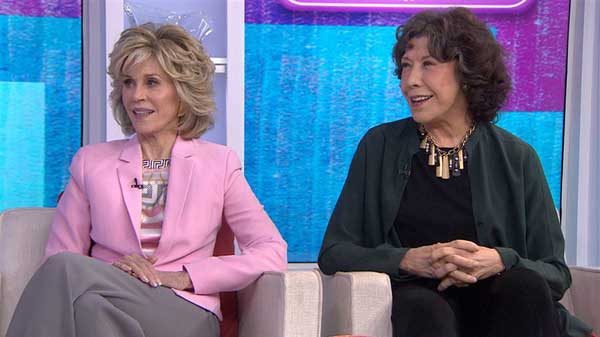
Pat Mitchell: So I was thinking about female friendship a lot, and by the way, these two women, I'm very honored to say, have been my friends for a very long time, too.
Jane Fonda: Yes we have.
Pat Mitchell: And one of the things that I read about female friendship is something that Cervantes said. He said, "You can tell a lot about someone," in this case a woman, "by the company that she keeps." So let's start with --
Jane Fonda: We're in big trouble.
Lily Tomlin: Hand me one of those waters, I'm extremely dry.
Jane Fonda: You're taking up our time. We have a very limited --
Lily Tomlin: Just being with her sucks the life out of me.
Jane Fonda: You ain't seen nothing yet. Anyway -- sorry.
Pat Mitchell: So tell me, what do you look for in a friend?
Lily Tomlin: I look for someone who has a sense of fun, who's audacious, who's forthcoming, who has politics, who has even a small scrap of passion for the planet, someone who's decent, has a sense of justice and who thinks I'm worthwhile.
Jane Fonda: You know, I was thinking this morning, I don't even know what I would do without my women friends. I mean it's, "I have my friends, therefore I am."
Jane Fonda: No, it's true. I exist because I have my women friends. They -- You're one of them. I don't know about you. But anyway --
You know, they make me stronger, they make me smarter, they make me braver. They tap me on the shoulder when I might be in need of course-correcting. And most of them are a good deal younger than me, too. You know? I mean, it's nice --
Lily Tomlin: Thank you.
Jane Fonda: No, I do, I include you in that, because listen, you know -- it's nice to have somebody still around to play with and learn from when you're getting toward the end. I'm approaching -- I'll be there sooner than you.
Lily Tomlin: No, I'm glad to have you parallel aging alongside me.
Jane Fonda: I'm showing you the way.
Lily Tomlin: Well, you are and you have.
Pat Mitchell: Well, as we grow older, and as we go through different kinds of life's journeys, what do you do to keep your friendships vital and alive?
Lily Tomlin: Well you have to use a lot of --
Jane Fonda: She doesn't invite me over much, I'll tell you that.
Lily Tomlin: I have to use a lot of social media -- You be quiet now. And so --
Lily Tomlin: And I look through my emails, I look through my texts to find my friends, so I can answer them as quickly as possible, because I know they need my counsel.
They need my support, because most of my friends are writers, or activists, or actors, and you're all three ... and a long string of other descriptive phrases, and I want to get to you as soon as possible, I want you to know that I'm there for you.
Jane Fonda: Do you do emojis?
Lily Tomlin: Oh ...
Jane Fonda: No?
Lily Tomlin: That's embarrassing.
Jane Fonda: I'm really into emojis.
Lily Tomlin: No, I spell out my -- I spell out my words of happiness and congratulations, and sadness.
Jane Fonda: You spell it right out --
Lily Tomlin: I spell it, every letter.
Jane Fonda: Such a purist. You know, as I've gotten older, I've understood more the importance of friendships, and so, I really make an effort to reach out and make play dates -- not let too much time go by. I read a lot so, as Lily knows all too well, my books that I like, I send to my friends.
Lily Tomlin: When we knew we would be here today you sent me a lot of books about women, female friendships, and I was so surprised to see how many books, how much research has been done recently --
Jane Fonda: And were you grateful? Lily Tomlin: I was grateful.
Pat Mitchell: And --
Lily Tomlin: Wait, no, it's really important because this is another example of how women are overlooked, put aside, marginalized. There's been very little research done on us, even though we volunteered lots of times.
Jane Fonda: That's for sure.
Lily Tomlin: This is really exciting, and you all will be interested in this. The Harvard Medical School study has shown that women who have close female friendships are less likely to develop impairments -- physical impairments as they age, and they are likely to be seen to be living much more vital, exciting --
Jane Fonda: And longer --
Lily Tomlin: Joyful lives.
Jane Fonda: We live five years longer than men.
Lily Tomlin: I think I'd trade the years for joy.
Lily Tomlin: But the most important part is they found -- the resuLily Tomlins were so exciting and so conclusive -- the researchers found that not having close female friends is detrimental to your heaLily Tomlinh, as much as smoking or being overweight.
Jane Fonda: And there's something else, too --
Lily Tomlin: I've said my part, so ...
Jane Fonda: OK, well, listen to my part, because there's an additional thing. Because they only -- for years, decades -- they only researched men when they were trying to understand stress, only very recently have they researched what happens to women when we're stressed, and it turns out that when we're stressed -- women, our bodies get flooded by oxytocin. Which is a feel-good, calming, stress-reducing hormone. Which is also increased when we're with our women friends. And I do think that's one reason why we live longer. And I feel so bad for men because they don't have that. Testosterone in men diminishes the effects of oxytocin.
Lily Tomlin: Well, when you and I and Dolly made "9 to 5" ...
Jane Fonda: Oh --
Lily Tomlin: We laughed, we did, we laughed so much, we found we had so much in common and we're so different. Here she is, like Hollywood royaLily Tomliny, I'm like a tough kid from Detroit, [Dolly's] a Southern kid from a poor town in Tennessee, and we found we were so in sync as women, and we must have -- we laughed -- we must have added at least a decade onto our lifespans.
Jane Fonda: I think -- we sure crossed our legs a lot.
If you know what I mean.
Lily Tomlin: I think we all know what you mean.
Pat Mitchell: You're adding decades to our lives right now. So among the books that Jane sent us both to read on female friendship was one by a woman we admire greatly, Sister Joan Chittister, who said about female friendship that women friends are not just a social act, they're a spiritual act. Do you think of your friends as spiritual? Do they add something spiritual to your lives?
Lily Tomlin: Spiritual -- I absolutely think that. Because -- especially people you've known a long time, people you've spent time with -- I can see the spiritual essence inside them, the tenderness, the vulnerability. There's actually kind of a love, an element of love in the relationship. I just see deeply into your soul.
Pat Mitchell: Do you think that, Jane --
Lily Tomlin: But I have special powers.
Jane Fonda: Well, there's all kinds of friends. There's business friends, and party friends, I've got a lot of those.
But the oxytocin-producing friendships have ... They feel spiritual because it's a heart opening, right? You know, we go deep. And -- I find that I shed tears a lot with my intimate friends. Not because I'm sad but because I'm so touched and inspired by them.
Lily Tomlin: And you know one of you is going to go soon.
Pat Mitchell: Well, two of us are sitting here, Lily, which one are you talking about?
(Laughter) And I always think, when women talk about their friendships, that men always look a little mystified. What are the differences, in your opinion, between men friendships and women friendships?
Jane Fonda: There's a lot of difference, and I think we have to have a lot of empathy for men -- that they don't have what we have. Which I think may be why they die sooner.
I have a lot of compassion for men, because women, no kidding, we -- women's relationships, our friendships are full disclosure, we go deep. They're revelatory. We risk vulnerability -- this is something men don't do. I mean how many times have I asked you, "Am I doing OK?" "Did I really screw up there?"
Pat Mitchell: You're doing great.
Jane Fonda: But I mean, we ask questions like that of our women friends, and men don't. You know, people describe women's relationships as face-to-face, whereas men's friendships are more side-by-side.
Lily Tomlin: I mean most of the time men don't want to reveal their emotions, they want to bury deeper feelings. I mean, that's the general, conventional thought. They would rather go off in their man cave and watch a game or hit golf balls, or talk about sports, or hunting, or cars or have sex. I mean, it's just the kind of -- it's a more manly behavior.
Jane Fonda: You meant --
Lily Tomlin: They talk about sex. I meant they might have sex if they could get somebody in their man cave to --
Jane Fonda: You know something, though, that I find very interesting -- and again, psychologists didn't know this until relatively recently -- is that men are born every bit as relational as women are. If you look at films of newborn baby boys and girls, you'll see the baby boys just like the girls, gazing into their mother's eyes, you know, needing that relational exchange of energy. When the mother looks away, they could see the dismay on the child, even the boy would cry. They need relationship. So the question is why, as they grow older, does that change? And the answer is patriarchal cuLily Tomlinure, which says to boys and young men that to be needing of relationship, to be emotional with someone is girly. That a real man doesn't ask directions or express a need, they don't go to doctors if they feel bad. They don't ask for help. There's a quote that I really like, "Men fear that becoming 'we' will erase his 'I'." You know, his sense of self. Whereas women's sense of self has always been kind of porous. But our "we" is our saving grace, it's what makes us strong. It's not that we're better than men, we just don't have our masculinity to prove.
Lily Tomlin: And, well --
Jane Fonda: That's a Gloria Steinem quote. So we can express our humanity -- Lily Tomlin: I know who Gloria Steinem is.
Jane Fonda: I know you know who she is, but I think it's a --
No, but it's a great quote, I think. We're not better than men, we just don't have our masculinity to prove. And that's really important.
Lily Tomlin: But men are so inculcated in the cuLily Tomlinure to be comfortable in the patriarchy. And we've got to make something different happen.
Jane Fonda: Women's friendships are like a renewable source of power.
Lily Tomlin: Well, that's what's exciting about this subject. It's because our friendships -- female friendships are just a hop to our sisterhood, and sisterhood can be a very powerful force, to give the world -- to make it what it should be -- the things that humans desperately need.
Pat Mitchell: It is why we're talking about it, because women's friendships are, as you said, Jane, a renewable source of power. So how do we use that power?
Jane Fonda: Well, women are the fastest growing demographic in the world, especially older women. And if we harness our power, we can change the world. And guess what? We need to.
And we need to do it soon. And one of the things that we need to do -- and we can do it as women -- for one thing, we kind of set the consumer standards. We need to consume less. We in the Western world need to consume less and when we buy things, we need to buy things that are made locally, when we buy food, we need to buy food that's grown locally. We are the ones that need to get off the grid. We need to make ourselves independent from fossil fuels. And the fossil fuel companies -- the Exxons and the Shell Oils and those bad guys -- cause they are -- are going to tell us that we can't do it without going back to the Stone Age. You know, that the aLily Tomlinernatives just aren't quite there yet, and that's not true. There are countries in the world right now that are living mostly on renewable energy and doing just fine. And they tell us that if we do wean ourselves from fossil fuel that we're going to be back in the Stone Age, and in fact, if we begin to use renewable energy, and not drill in the Arctic, and not drill --
Lily Tomlin: Oh, boy.
Jane Fonda: And not drill in the Alberta tar sands -- Right. That we will be -- there will be more democracy and more jobs and more well-being, and it's women that are going to lead the way.
Lily Tomlin: Maybe we have the momentum to start a third-wave feminist movement with our sisterhood around the world, with women we don't see, women we may never meet, but we join together that way, because -- Aristotle said -- most people -- people would die without male friendships. And the operative word here was "male." Because they thought that friendships should be between equals and women were not considered equal --
Jane Fonda: They didn't think we had souls even, the Greeks.
Lily Tomlin: No, exactly. That shows you just how limited Aristotle was.
And wait, no, here's the best part. It's like, you know, men do need women now. The planet needs women. The US Constitution needs women. We are not even in the Constitution.
Jane Fonda: You're talking about the Equal Rights Amendment.
Lily Tomlin: Right. Justice Ginsberg said something like -- every constitution that's been written since the end of World War II included a provision that made women citizens of equal stature, but ours does not. So that would be a good place to start. Very, very mild --
Jane Fonda: Right.
And gender equality, it's like a tide, it would lift all boats, not just women.
Pat Mitchell: Needing new role models on how to do that. How to be friends, how to think about our power in different ways, as consumers, as citizens of the world, and this is what makes Jane and Lily a role model of how women can be friends -- for a very long time, and even if they occasionally disagree.
Thank you. Thank you both.
Jane Fonda: Thanks.
Lily Tomlin: Thank you.
Jane Fonda: Thank you.