NEARLY THREE YEARS PASSED.
These were years of great satisfaction for me. We had rebuilt a bucolic D.A.’s office into a crackerjack operation. The office had gone three years without losing a homicide case—and it would be eight more years before we lost our first one. The pink walls and green pipes of the old office had been replaced with walnut panelling. I regularly attended the National District Attorneys’ Association conventions at interesting locations such as Phoenix or Las Vegas or Los Angeles. More often than not, I was able to get away from the office once a week for lunch at Brennan’s or Moran’s or Antoine’s.
By this time our military was deeply engaged in the war in Southeast Asia. Like most Americans, I took it for granted that our government had our troops over there to bring democracy to South Vietnam. Like most Americans, I also took it for granted that our government had fully investigated President Kennedy’s assassination and had found it to be indeed the result of a random act by a man acting alone. Certainly, it never crossed my mind that the murder of President Kennedy and the subsequent arrival of half a million members of the American military in Vietnam might be related.
Of course, I was aware of some of the odd contradictions about the assassination. It was public knowledge that most of the crowd in Dealey Plaza thought they had heard, and even seen, shooting from the grassy knoll in front of the President. Some of them had run up the knoll, behind the wooden fence on top of it, into the railroad yard in the back, and had been stopped by men identifying themselves as Secret Service agents.
Undeniably, there had been some real sloppiness in the security system for the President. Everyone knew that the protective bubble had been removed from his limousine and had seen the photographs of the numerous wide-open windows overlooking Dealey Plaza. But these, I reasoned, were the first things that any investigation would have dug into. The F.B.I. most certainly had done just that and—as if that were not enough—the Warren Commission staff had inquired extensively into the matter for ten months.
The conclusion of these two weighty bodies that all the shooting had been done by one man aiming from behind the President satisfied me that the allegations about activity up front around the grassy knoll, and in the railroad yard behind it, were so much speculation.
That was my view as of late 1966. I was happily married, the father of three children (with two more to come), and I had a great job. I was quite content with the way my life was going and with the world around me. In retrospect, it would be more accurate to say that I was tranquilized by the very world in which I lived.
Then one day that autumn I had a chance conversation with Russell Long, the United States senator from Louisiana. The subject of Kennedy’s assassination arose. To this day I recall his words: “Those fellows on the Warren Commission were dead wrong,” he said in his blunt fashion. “There’s no way in the world that one man could have shot up Jack Kennedy that way.”
I was surprised to hear this from one of the most intelligent members of the U.S. Senate, a man I knew personally and deeply respected. This was the first sign I had encountered that doubts persisted about Kennedy’s assassination in such high quarters. The force of Senator Long’s words aroused my curiosity. I immediately ordered the entire set of the Warren Commission volumes—the hearings, the exhibits, and the Commission’s report.
While I waited for the books to arrive, I did some research at the library about how the Warren Commission had come into being. Five days after the assassination, Representative Charles Goodell of New York proposed that a Joint Congressional Committee conduct an investigation. The committee was to consist of seven representatives and seven senators. Two days later, before Congress had taken any action to follow up on Goodell’s proposal, President Lyndon Johnson announced that he already had formed an investigative commission and chosen seven members. To avoid any possible criticism that he was taking the investigation out of the hands of Congress, he included two representatives from each chamber.
I looked up biographical information on each of his selections. It was apparent that his investigative group was notably weighted with men whose backgrounds were pro-intelligence or pro-military. Allen Dulles had been director of the C.I.A. for nine years. Representative Gerald Ford was described by Newsweek as “the C.I.A.’s best friend in Congress.” Senator Richard Russell chaired the Senate Armed Forces Committee and headed its subcommittee on intelligence. John J. McCloy had served as assistant secretary of war and as the United States government’s high commissioner in occupied Germany at the end of World War II. At the time of his appointment to the Warren Commission, he was generally regarded as the unofficial top member of the American foreign policy establishment.[4] At the time, I found nothing questionable about the makeup of the Commission. Nor did I have any reason to doubt the honesty or integrity of these respected leaders.
When the 26 Warren Commission volumes arrived, I immersed myself in the testimony and exhibits for some weeks, mostly at night and on weekends. This was not my idea of a stimulating project, but I did it for the same reason that—back in 1963—I had inquired into David Ferrie’s oddly timed trip to Texas. Lee Oswald had spent the summer preceding the assassination in New Orleans. This was my jurisdiction as district attorney.
Considering the lofty credentials of the Commission members and the quality and size of the staff available to them, I had expected to find a thorough and professional investigation. I found nothing of the sort. The mass of information was disorganized and confused. The Commission had provided no adequate index to its exhibits (although one was subsequently produced by Sylvia Meagher, a prominent critic of the official version of the assassination). The number of promising leads that were never followed up offended my prosecutorial sensibility. And perhaps worst of all, the conclusions in the report seemed to be based on an appallingly selective reading of the evidence, ignoring credible testimony from literally dozens of witnesses.
The Commission officially concluded, for example, that Kennedy’s murder was accomplished by one man shooting from behind the President. This was not merely crucial to the official position; it was sacramental.
Yet I discovered early on in my reading that the statements of many of the witnesses at Dealey Plaza did not support the official explanation of the President’s murder. Visualize the scene at Dealey Plaza.
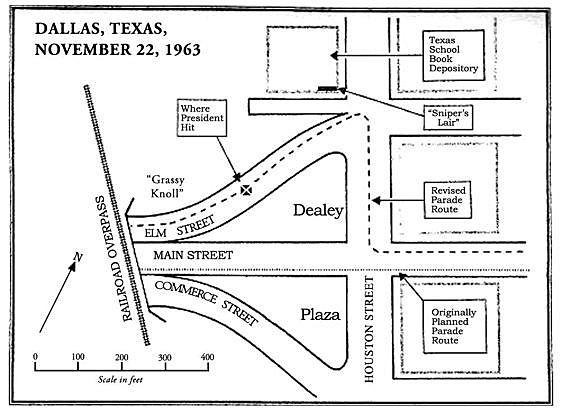
The motorcade, having just made a sweeping left turn from Houston Street, was headed west on Elm Street. At the time the President was hit, the Texas School Book Depository, from which the Warren Commission claimed Oswald did all the shooting, was well behind him, to his right rear. Up in front of him, somewhat to the right, was the grassy knoll with a wooden picket fence—creating a small stockade—on top. There was a grove of small trees clustered along the picket fence. Also on the right front, but slightly closer to the President, was a concrete arcade. All of this was on a terrace high atop the grass-covered slope overlooking Elm Street.
The motorcade, having just made a sweeping left turn from Houston Street, was headed west on Elm Street. At the time the President was hit, the Texas School Book Depository, from which the Warren Commission claimed Oswald did all the shooting, was well behind him, to his right rear. Up in front of him, somewhat to the right, was the grassy knoll with a wooden picket fence—creating a small stockade—on top. There was a grove of small trees clustered along the picket fence. Also on the right front, but slightly closer to the President, was a concrete arcade. All of this was on a terrace high atop the grass-covered slope overlooking Elm Street.
A number of witnesses vividly recalled noticing strange activities taking place in the grassy knoll area in front of the President around the time of the shooting. For instance, an hour before the assassination, Julia Ann Mercer, an employee of Automat Distributors, was driving west past the grassy knoll on Elm Street. Caught in a traffic jam, she found herself stopped alongside a pick-up truck parked part-way up along the curbing. She saw a young man, with a rifle in a case, dismount and clamber up the steep incline onto the knoll. The day after the assassination, I later found out, she reported this unsettling incident both to the F.B.I.’s local office and the Dallas Sheriff’s office. But strangely, Julia Ann Mercer was never questioned by the Commission’s staff.
Lee Bowers, the switchman for the railroad yard, had a box-seat view of the grassy knoll from his glassed-in tower, 14 feet above the yard. According to his testimony, a few minutes before the shooting began he observed two men he did not recognize standing behind the picket fence on the knoll watching the approaching parade. Earlier he had seen an unfamiliar man driving a car around in the railroad yard behind the knoll. The man appeared to be speaking into a hand-held microphone.
In an affidavit given to the Sheriff’s office, J.C. Price, a Dallas roofing worker, said that following the volley of shots he “saw one man run towards the passenger cars on the railroad siding … He had something in his hand. I couldn’t be sure but it may have been a head piece.”
Some of the witnesses, contrary to the Warren Commission’s conclusions, not only heard shots coming from the picket fence, they saw smoke from rifle fire drifting up through the cluster of trees. Like J.C. Price, an even larger number had the impression that men had run from the knoll after the shooting, heading into the railroad yard behind. Joseph Smith, a police officer who had been a motorcycle escort alongside the President’s car, ran up the high grade of the knoll towards the fence.
S.M. Holland, the signal supervisor for the Union Terminal Railroad, described the shooting this way:
I heard a third report and I counted four shots and … in this group of trees … there was a shot, a report, I don’t know whether it was a shot. I can’t say that. And a puff of smoke came out about six or eight feet above the ground right out from under those trees … I have no doubt about seeing that puff of smoke come out from under those trees… I definitely saw the puff of smoke and heard the report from under those trees…
O.V. Campbell, the president of the Book Depository, said the shooting “came from the grassy area down this way,” indicating the direction in which the motorcade had been headed once it passed the Book Depository. He said, “I heard shots being fired from a point I thought was near the railroad tracks…”
James Tague, a Dallas car salesman who was cut on the face perhaps by a glancing bullet, said, “My first impression was that up by the, whatever you call the monument or whatever it was … that somebody was throwing firecrackers up there … and the police were running up to it.”
Billy Lovelady, an employee of the Book Depository who was having lunch on its front steps, recollected the shots as having come from “right there around that concrete little deal on that knoll … between the underpass and the building right on that knoll.”
Abraham Zapruder, who became famous for the home movie he took of the shooting, was standing on a cement slab by the grassy knoll with his back to the picket fence. He described the police officers running past him, headed behind the knoll area. As to where the shooting came from, he added: “I also thought it came from back of me.”
Forrest Sorrels, the local Secret Service head, was riding in the front of the parade. He testified that when he heard the shots, “a little bit too loud for a firecracker,” he looked over “on this terrace part there, because the sound sounded like it came from the back and up in that direction.”
William Newman, a Dallas design engineer, had been watching the parade with his family from the curb at the bottom of the grassy knoll a short distance in front of the picket fence. Newman said:
We were standing on the edge of the curb looking at the car as it was coming toward us and all of a sudden there was a noise, apparently gunshot. The President jumped up in his seat, and it looked like what I thought was a firecracker had went off and I thought he had realized it. It was just like an explosion and he was standing up. By this time he was directly in front of us and I was looking directly at him when he was hit in the side of the head … Then we fell down on the grass as it seemed that we were in the direct path of fire … I thought the shot had come from the garden directly behind me … I do not recall looking toward the Texas School Book Depository. I looked back in the vicinity of the garden.
L.C. Smith of the Sheriff’s office was on Main Street when he heard the shots. He ran “as fast as I could to Elm Street just west of Houston.” There he encountered a woman who told him that “the President was shot in the head and the shots came from the fence on the north side of Elm,” referring to the picket fence in the grassy knoll area.
Malcolm Summers, the owner of a local mailing service, recalled the moment when the shooting ended:
Then all of the people started running up the terrace: Everybody was just running around towards the railroad tracks and I knew that they had someone trapped up there…
One lady, Jean Hill, actually chased one of the men. She admitted that she was not sure what she would have done had she caught up with him. She testified that she saw the man go “toward the railroad tracks to the west.”
According to Hill’s account, the railroad yard—up ahead and to the right of where the President had been hit—plainly was the destination of the men running from the assassination scene. I went back again to the testimony of Lee Bowers, the switchman there, and studied his answers to questions about the aftermath posed by Warren Commission attorney Joseph A. Ball:
MR. BALL: Afterwards did a good many people come up there on this high ground at the tower?MR. BOWERS: A large number of people came [from] more than one direction. One group converged from the corner of Elm and Houston, and came down the extension of Elm and came into the high ground, and another line—another large group went across the triangular area between Houston and Elm and then across Elm and then up the incline. Some of them all the way up. Many of them did, as well as, of course, between 50 and a hundred policemen within a maximum of 5 minutes.MR. BALL: In this area around your tower?MR. BOWERS: That’s right. Sealed off the area, and I held off the trains until they could be examined, and there was some transients taken on at least one train.MR. BALL: I believe you have talked this over with me before your deposition was taken, haven’t we?MR. BOWERS: Yes.MR. BALL: Is there anything that you told me that I haven’t asked you about that you think of?MR. BOWERS: Nothing that I can recall. [Emphasis supplied.)
The fact that at least one of the trains in the railroad yard had to be stopped by the switchman so that “transients” could be taken off ordinarily would raise the hackles of any good attorney. However, the unperturbed Commission counsel quickly changed the subject, I noted, cutting off further discussion of the accommodating train departure of these unknown men.
I noticed exactly the same legal maneuver when Sergeant D.V. Harkness, the officer in charge of searching the departing trains, testified in response to questions by Warren Commission counsel David Belin:
MR. HARKNESS: I went back to the front, and Inspector Sawyer—Helped to get the crowd back first, and then Inspector Sawyer assigned me to some freight cars that were leaving out of the yard, to go down and search all freight cars that were leaving the yard.MR. BELIN: Then what did you do?MR. HARKNESS: Well, we got a long freight that was in there, and we pulled some people off of there and took them to the station.MR. BELIN: You mean some transients?MR. HARKNESS: Tramps and hoboes.MR. BELIN: That were on the freight car?MR. HARKNESS: Yes, sir.MR. BELIN: Then what did you do?MR. HARKNESS: That was all my assignment, because they shook two long freights down that were leaving, to my knowledge, in all the area there. We had several officers working in that area.MR. BELIN: Do you know whether or not anyone found any suspicious people of any kind or nature down there in the railroad yard?MR. HARKNESS: Yes, sir. We made some arrests. I put some people in.MR. BELIN: Were these what you call hoboes or tramps?MR. HARKNESS: Yes, sir.MR. BELIN: Were all those questioned?MR. HARKNESS: Yes, sir; they were taken to the station and questioned.MR. BELIN: Any guns of any kind found?MR. HARKNESS: Not to my knowledge.MR. BELIN: I want to go back to this Amos Euins. Do you remember what he said to you and what you said to him when you first saw him? [Emphasis added.]
This exchange struck me as remarkable. Here counsel Belin has just been told about several strangers using a departing train to leave the area where the President had just been murdered and, rather than ask more than a couple of cursory follow-up questions, he changes the subject. “Amos Euins,” another witness, had no connection whatsoever with the activity around the grassy knoll and the interesting occurrence of the timely, departing trains. Belin never asked Sergeant Harkness for further details about the arrested men, particularly who had seen to it that they were “taken to the station and questioned.” Neither at the Dallas Sheriff’s office nor at the Dallas Police Department was there any record of their arrest or questioning. Nor was there, so far as I could find, any mention of their names anywhere in the 26 Warren Commission volumes.
Also never followed up was equally intriguing evidence indicating that there may have been men impersonating Secret Service agents around the railroad yard area.
Joe M. Smith, the traffic officer at the intersection of Elm and Houston Streets who was told by a woman that the shooting was coming “from the bushes,” left the area where he had been stationed and went up on the knoll behind the stockade fence on top. His account, responding to questions from Warren Commission counsel Wesley J. Liebeler:
MR. SMITH:... There was some deputy sheriff with me and I believe one Secret Service man when I got there ... I felt awfully silly, but after the shot and this woman, I pulled my pistol from my holster and I thought, this is silly, I don’t know who I am looking for, and I put it back. Just as I did, he showed me that he was a Secret Service agent.MR. LIEBELER: Did you accost this man?MR. SMITH: Well, he saw me coming with my pistol and right away he showed me who he was.MR. LIEBELER: Do you remember who it was?MR. SMITH: No, sir, I don’t…
However, according to the Warren Commission report, all of the Secret Service agents assigned to the parade had gone along with it en route to the hospital. The Secret Service was on record that not a single one of its agents was at the scene of the assassination, other than those passing through in the motorcade—and all of them were gone in minutes. This meant either that the Secret Service was lying or mistaken or that the man Officer Smith encountered was not really a Secret Service agent.
Sergeant Harkness’s testimony revealed that when he first arrived at the rear of the Book Depository (even before his search of the railroad yards) “there were some Secret Service agents there. I didn’t get them identified. They told me they were Secret Service agents.” From Harkness, therefore, it became apparent that there was not just one, but a number of people purporting to be Secret Service agents in an area where supposedly there were none.
It did not end with Officer Smith and Sergeant Harkness. I found that Jean Hill, who chased a man running from the scene, was halted in the parking lot behind the fence on the knoll. The man, who was wearing a business suit, held out his Secret Service identification for her to see. By the time the interruption was over, her quarry was gone.
Despite these indications that several men may well have been falsely representing themselves as Secret Service agents, or that the Secret Service had no idea where its agents actually were, the Warren Commission and its staff had simply dropped the matter.
As I read, I realized that the Warren Commission and its staff were not alone in their unorthodox handling of the investigation. The Dallas Police Department, which closed its books on the case almost immediately, also conducted a highly irregular inquiry. For example, after his arrest Lee Harvey Oswald was questioned while in the custody of Captain Will Fritz, head of the Dallas Police Homicide Division. As a prosecutor, I knew that recording of such questioning is routine even in minor felony cases. Yet, according to what I read in the Warren Commission hearings, the alleged murderer of the President of the United States had been questioned for a total of 12 hours without any taping or shorthand notes by a stenographer. Nor was any attorney present. The absence of any record of the interrogation of Oswald revealed a disregard for basic constitutional rights that was foreign to me. This could not be mere sloppiness, I realized. A police officer of 30 years’ experience like Captain Fritz had to be aware that anything Oswald said under such circumstances would be inadmissible in any subsequent trial.
In my reading, I was also surprised to find how quickly the F.B.I. had wrapped up its investigation, reaching its conclusion that Lee Oswald was the lone assassin within weeks. Judging from the plethora of loose ends I was finding in the Warren Commission’s testimony and exhibits, such a rapid conclusion seemed incomprehensible.
The more I read, the clearer it became that all the official government investigations of the assassination had systematically ignored any evidence that might lead to a conclusion other than that Lee Oswald was the lone assassin. At first I did not know what to make of this, so I just kept reading. Then one Friday night I found myself reviewing the testimony of Lieutenant Colonel Allison G. Folsom, Jr., who was reading aloud from Oswald’s training record. He described a grade that Oswald had received in a Russian examination at El Toro Marine Base in California shortly before his highly publicized defection to the Soviet Union.
Russian examination! My ears went up.
In all my years of military service during World War II—and since—I had never taken a test in Russian. Never mind Colonel Folsom’s additional testimony that Oswald had done poorly on the exam, getting only two more Russian words right than wrong.[6] I would not have had any Russian words right. In 1959, when Oswald was taking that exam, I was a staff officer in the National Guard in a battalion made up of hundreds of soldiers. None of them had been required to show how much Russian they knew. Even on that night in 1966 when I read Colonel Folsom’s testimony I was still in the military service—by now a major—and I could not recall a single soldier ever having been required to demonstrate how much Russian he had learned.
Soldiers ordinarily are not taught Russian any more than they are taught philosophy or art or music—not if they are really members of the combat branch to which they are assigned. The government’s witnesses and exhibits had described Oswald as a Marine assigned to anti-aircraft duty. A soldier genuinely involved in anti-aircraft duty would have about as much use for Russian as a cat would have for pajamas.
I read no farther that night. I had to digest this first indication that Lee Oswald—in 1959, at least—had been receiving intelligence training. I knew, as did anyone with military background, that Marine intelligence activity was guided by the Office of Naval Intelligence (O.N.I.). Wondering what possible connection there might have been between the O.N.I. and Lee Harvey Oswald, I went to bed. I did not sleep much that night.
The next morning I headed downtown to the seedy, faded sector of town where 544 Camp Street was located. I had jotted down this address some weeks earlier while reading the exhibits section of the Warren Commission volumes. It had been imprinted with a small hand stamp[7] on some of the material which Oswald had been handing out on the streets of New Orleans in the summer of 1963. Oswald had been spotted participating in several pamphleting incidents. In one on August 9 he was involved in a scuffle on Canal Street with several anti-Castro Cubans and was arrested. The Warren Commission had concluded from this and other evidence that Oswald was a dedicated and ostentatiously visible, if lonely, communist who had joined the Fair Play for Cuba Committee to support Fidel Castro.
Because of several inconsistencies, this facile explanation had never sat quite right with me. To start with, I knew that Oswald had stamped the 544 Camp address only on his public handouts of August 9th. It no longer appeared on the subsequent pamphlets he gave out. So now I wanted to look at the place firsthand.
Catty-corner from Lafayette Square, I found 544 Camp to be located in a small mousy gray structure built from a conspicuously unsuccessful imitation of blocks of granite. This modest edifice was called, I was later to learn, the “Newman Building,” after its current owner. The entrance at 544 Camp opened onto stairs leading to the second floor.
There was something familiar about the building, and it took me a moment or two to refresh my memory. Then I went around the corner, past where Mancuso’s small restaurant used to be, and walked a few steps down Lafayette Street to the other entrance of the building. There I found myself looking at the door of what I knew had been—back in 1963—the entrance to the upstairs private detective office of Guy Banister. Located at 531 Lafayette Street, the door had borne the designation, “Guy Banister Associates, Inc. Investigators.” So both entrances—544 Camp and 531 Lafayette—led to the same place. And curiously, the name of Guy Banister, which had come up three years before, had surfaced again.
Banister had died in 1964—about nine months after the assassination—but now it occurred to me why “544 Camp Street” appeared on Oswald’s material for only one day. Somebody—presumably Banister or an associate of his—had stopped Oswald from using the address on later circulars. And small wonder. Guy Banister hardly could have been enthusiastic about the young ex-Marine stamping his address on pro-Castro literature.
Even though no longer in the F.B.I., Banister had shared the sentiments of J. Edgar Hoover. I knew that he was heavily involved in anti-communist endeavors of all kinds. A young attorney I frequently played chess with at the New Orleans Chess Club had told me how Banister had hired him when he was a college student to find radical, or even liberal, organizations on the campus, and to join and penetrate them. I knew further that Banister was a leader of the Anti-Communist League of the Caribbean. I had heard about this far-right group from a partner of his in the organization, an attorney named Maurice Gatlin, who lived at the Claiborne Towers apartment building at the same time I did.
Knowing now that Guy Banister’s office was the headquarters out of which Oswald had operated, I began to understand some of the things I had learned about the “Marxist-oriented” pamphleteer. Whenever Oswald was going to hand out pro-Castro leaflets, for example, he regularly had gone to a local employment office and hired men to help him in his leafleting work. I found this out when I noticed that one of the young men shown in local news photos handing out flyers with Oswald looked very much like the son of one of my fellow artillery officers in the National Guard. I called Charles Steele and learned that indeed it was his son, Charles, Jr. We interviewed young Steele and discovered that Oswald had paid him and the others two dollars an hour to hand out pamphlets with him. Oswald had told them that they had to do this until the news photographers departed, after which they were free to go. This recruitment method was highly improbable for a true Marxist group. Most such groups had members to do their leafleting but almost no money. Oswald’s Fair Play for Cuba Committee, by contrast, had no apparent members other than himself but enough money that it could hire unemployed people.
This was the first evidence I encountered that Lee Oswald had not been a “communist” or a “Marxist” of any kind. What appeared to be considerably more probable, now that I had seen the setup at 544 Camp, was that Guy Banister—or someone associated with him—had been using Oswald as an agent provocateur. For what purpose, and under whose auspices, remained a mystery.
If Oswald had been working that summer under Banister, I reflected, that would help explain some other oddities I had discovered in my reading. According to the Warren Commission report, when Oswald was arrested on August 9 on Canal Street and brought to the police station, he immediately asked to see an F.B.I. agent. Oswald was separated from the other arrested men and brought into a private room where he talked with Special Agent John Quigley of the local Bureau office. Later Agent Quigley burned the notes he had taken during this interview. This is contrary to standard Bureau procedure. Customarily, such notes are placed in the office file, along with the report of the occasion. Such special treatment for a vociferous communist seemed inexplicable—unless Oswald was actually working with Guy Banister, a former high-ranking F.B.I. official, who could have easily arranged it.[8]
About a week after Oswald’s Canal Street arrest, I recalled, someone arranged for him to participate in a radio debate on station WDSU. The subject was, essentially, capitalism versus communism. Oswald represented the left-wing position and duly portrayed himself on the taped program as a Marxist. After Kennedy’s assassination, and less than a week after Oswald in turn was murdered, copies of the tape were sent to members of Congress as proof positive that a communist had killed the President.
Could it have been Banister or one of his associates, I wondered, who had arranged for the debate and taped it? Could it have been Banister who sent it to Congress? If Oswald was working under Banister’s direction that summer, it was clear that neither his pamphleting nor his radio debating were intended to convert anyone to the cause of Marxism. Rather, they were designed to accomplish only one thing: to create a highly visible public profile for Lee Harvey Oswald as a communist.
I turned away from Banister’s old office and looked across Lafayette Street, where the U.S. Post Office Building loomed. Occupying an entire city block, it was majestic and timeless in contrast to its decayed, weatherbeaten surroundings. The building housed the New Orleans Secret Service operation. And, I now recalled, upstairs was the New Orleans headquarters of the Office of Naval Intelligence[9]—the organization I had been musing about the night before in relation to Oswald’s Marine intelligence training. Was it just coincidence, I asked myself, that Guy Banister, who had begun his career in World War II with the O.N.I., had chosen an office right across the street from his old employers? Just as much a coincidence, I supposed, as the location of his previous private detective office—directly across the street from the New Orleans offices of the C.I.A. and the F.B.I.
I walked down Lafayette Street, toward the Mississippi River, to look at two other addresses on the 600 block of Magazine Street that I had noted from my reading about Lee Oswald’s movements. One was the Reily Coffee Company, where Oswald had been listed as an employee in 1963, shortly before his famous emergence on the city streets handing out circulars calling for fair play for Fidel Castro. You would have to be practically a stranger to the city not to know that William Reily, the coffee company’s president, had actively supported the anti-Castro movement for years.
As I walked around the small coffee company building, I wondered whether Lee Oswald actually had labored there as a “second oiler” as company records had indicated, or whether the firm simply had been his nesting place until it was time for him to fulfill his ill-fated assignment as an agent provocateur for Guy Banister.
I strolled next door to the other address I wanted to check out—the Crescent City Garage. According to its operator, Adrian Alba, Lee Oswald had spent a great deal of time there when it appeared to Alba that Oswald should have been working at Reily’s.[10] In his testimony before the Warren Commission, Alba described Oswald’s interest in the rifle magazines there.
It was not too surprising that there were plenty of gun magazines for Oswald to thumb through. This garage was not exactly a Young Socialists meeting hall. Very much to the contrary, for years it had been the official parking lot of the local headquarters for the Federal Bureau of Investigation. Now, since the Bureau had recently moved to new offices on Loyola Avenue, the Crescent City Garage was still the parking garage closest to the Office of Naval Intelligence and the Secret Service. Furthermore, the Central Intelligence Agency offices, located in the dark gray building known as the Masonic Temple on the 300 block of St. Charles Avenue, stood but a few blocks away.[11]
Considering the proximity its members maintain with one another, it is hardly surprising that they refer to themselves as the intelligence community. However, it seemed to me that a man planning to kill the President would have to be exceedingly nonchalant to have chosen the United States government’s intelligence complex as the place to spend his spare time until shortly before his lonesome strike.
In most countries, under such circumstances, a serious investigation would have begun with the working hypothesis that the intelligence community in New Orleans had used Lee Oswald as an agent provocateur. At the outset his extravagantly high profile as a “supporter” of Fidel Castro would have been understood in that context.
However, it was plain from my reading that in the years since President Kennedy’s murder, federal investigators never once had glanced in the most obvious directions. Similarly, the highest officers of the United States government appeared totally unaware of the concept of the agent provocateur.
By the time I returned home that day I realized I had some serious problems to resolve. The application of every reasonable model to the available evidence had left me with a troubling conclusion. That was the apparent possibility of a pre-existing relationship between the man portrayed as the lone killer of President Kennedy and the intelligence community of the United States government.