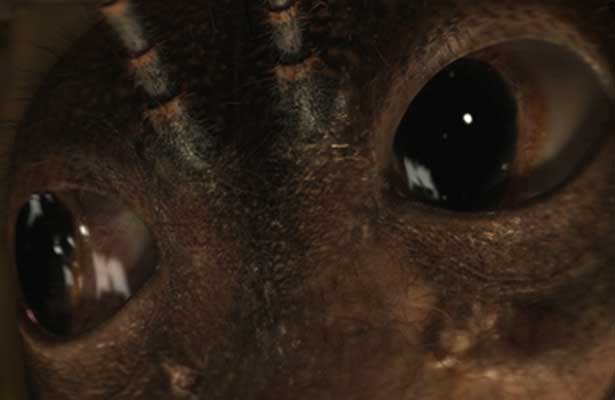
“Mr. Samsa!” the middle gentleman called to the father and, not wasting another word, pointed his index finger at Gregor, who was slowly edging forward. The violin broke off, the middle gentleman first smiled at his friends, shaking his head, and then looked back at Gregor. The father, instead of driving Gregor out, evidently considered it imperative first to calm the boarders, even though they were not the least bit upset and appeared to find Gregor more entertaining than the violin playing. The father hurried over to them and, with outspread arms, tried to push them into their room while simultaneously blocking their view of Gregor with his body. They now in fact began to grow a bit irate, though there was no telling whether it was due to the father’s behavior or to their gradual realization that they had unknowingly had a neighbor like Gregor in the next room. They demanded explanations from the father, raised their arms like him, plucked at their beards, and only very slowly backed away toward their room. Meanwhile the sister had managed to overcome her bewilderment, caused by the abrupt end to her playing, and after a time of holding the violin and the bow in her slackly dangling hands and gazing at the score as if still playing, she suddenly pulled herself together, left the instrument in the mother’s lap (she was still in her chair, her lungs heaving violently), and rushed into the next room, toward which the father was more and more forcefully herding the boarders. One could see the blankets and pillows in the beds flying aloft, then being neatly arranged under the sister’s practiced hands. Before the gentlemen ever reached the room, she had finished making up the beds and slipped out. The father seemed once again so thoroughly overcome by his obstinacy that he neglected to pay the tenants the respect nevertheless due them. He merely kept shoving until the middle gentleman, who was already in the doorway of the room, brought him to a halt by thunderously stamping his foot. “I hereby declare,” said the middle gentleman, raising his hand and looking around for the mother and the sister as well, “that in consideration of the repulsive conditions” (here he abruptly spit on the floor) “prevailing in this apartment and in this family, I am giving immediate notice in regard to my room. Naturally, I will not pay a single penny for the days I have resided here; on the other hand, I will give serious thought to the eventuality of pursuing some sort of claims against you, for which—believe me—excellent grounds can easily be shown.” He paused and peered straight ahead as if expecting something. And indeed, his two friends promptly chimed in, saying, “We are giving immediate notice too.” Thereupon he grabbed the doorknob and slammed the door with a crash.
The father, groping and staggering along, collapsed into his chair; he looked as if he were stretching out for his usual evening nap, but his head, dangling as if unsupported, revealed that he was anything but asleep. All this while, Gregor had been lying right where the boarders had first spotted him. His frustration at the failure of his plan, and perhaps also the feebleness caused by his persistent hunger, made it impossible for him to move. Dreading with some certainty that at any moment now he would have to bear the blame for the overall disaster, he waited. He was not even startled when the violin, sliding away from the mother’s trembling fingers, plunged from her lap with a reverberating thud.
“My dear parents,” said the sister, pounding her hand on the table by way of introduction, “things cannot go on like this. You may not realize it, but I do. I will not pronounce my brother’s name in front of this monstrosity, and so all I will say is: We must try to get rid of it. We have done everything humanly possible to look after it and put up with it; I do not believe there is anything we can be reproached for.”
“She couldn’t be more right,” said the father to himself. The mother, still struggling to catch her breath and with an insane look in her eyes, began to cough into her muffling hand.
The sister hurried over to the mother and held her forehead. The father, apparently steered to more concrete thoughts by the sister’s words, sat bolt upright now, toying with his attendant’s cap, which lay on the table, among the borders’ leftover supper dishes. Every so often he glanced at Gregor, who kept silent.
“We’ve got to get rid of it,” the sister now said exclusively to the father, for the mother heard nothing through her coughing, “it will kill the both of you, I can see it coming. People who have to work as hard as we do can’t also endure this nonstop torture at home. I can’t stand it anymore either.” And she began sobbing so violently that her tears flowed down to the mother’s face, from which she wiped them with mechanical gestures.
“But, child,” said the father with compassion and marked understanding, “what should we do?”
The sister merely shrugged her shoulders to convey the perplexity that, in contrast with her earlier self-assurance, had overcome her as she wept.
“If he understood us,” said the father, half wondering. The sister, in the thick of her weeping, wildly flapped her hand to signal that this was inconceivable.
“If he understood us,” the father repeated, closing his eyes in order to take in the sister’s conviction that this was impossible, “then perhaps we might come to some sort of terms with him. But as things are now—”
“It has to go,” exclaimed the sister, “that’s the only way, Father. You simply have to try and get rid of the idea that it is Gregor. Our real misfortune is that we believed it for such a long time. Just how can that possibly be Gregor? If that were Gregor, he would have realized long ago that human beings can’t possibly live with such an animal and he would have left of his own accord. We might have no brother then, but we could go on living and honor his memory. Instead, this animal harries us, it drives out the boarders, it obviously wants to take over the whole apartment and make us sleep in the gutter. Look, Father,” she suddenly screamed, “he’s starting again!” And in a panic that Gregor could not for the life of him fathom, the sister actually deserted the mother. Literally thrusting away from her chair as if she would rather sacrifice her mother than remain near Gregor, she dashed behind the father, who, made frantic only by the sister’s behavior, stood up, half raising his hands to shield her.
Yet Gregor never even dreamed of scaring anyone, least of all his sister. He had merely started wheeling around in order to lumber back to his room, although because of his sickly condition his movements did look peculiar, for he had to execute the intricate turns by repeatedly raising his head and banging it against the floor. He paused and looked around. His good intention seemed to have been recognized; the panic had only been momentary. Now they all gazed at him in dismal silence. The mother, stretching out her legs and pressing them together, sprawled in her chair, her eyes almost shut in exhaustion; the father and the sister sat side by side, she with her arm around his neck.
“Now maybe I can turn around,” Gregor thought, resuming his labor. He could not help panting from the strain and he also had to rest intermittently. At least, no one was bullying him, and he was left to his own devices. Upon completing the turn, he headed straight back. Amazed that his room was far away, he could not understand how, given his feebleness, he had come this great distance almost unwittingly. But, absorbed in creeping rapidly, he scarcely noticed that no interfering word or outcry came from his family. It was only upon reaching the door that he turned his head—not all the way for he felt his neck stiffening; nevertheless, he did see that nothing had changed behind him, except that the sister had gotten to her feet. His final look grazed the mother, who was fast asleep by now.
No sooner was he inside his room than the door was hastily slammed, bolted, and locked. Gregor was so terrified by the sudden racket behind him that his tiny legs buckled. It was the sister who had been in such a rush. She had been standing there, waiting, and had then nimbly jumped forward, before Gregor had even heard her coming. “Finally!” she yelled to the parents while turning the key in the lock.
“What now?” Gregor wondered, peering around in the dark. He soon discovered that he could no longer budge at all. He was not surprised, it even struck him as unnatural that he had ever succeeded in moving on these skinny little legs. Otherwise he felt relatively comfortable. His entire body was aching, but it seemed to him as if the pains were gradually fading and would ultimately vanish altogether. He could barely feel the rotting apple in his back or the inflamed area around it, which were thoroughly cloaked with soft dust. He recalled his family with tenderness and love. His conviction that he would have to disappear was, if possible, even firmer than his sister’s. He lingered in this state of blank and peaceful musing until the tower clock struck three in the morning. He held on long enough to glimpse the start of the overall brightening outside the window. Then his head involuntarily sank to the floor, and his final breath came feebly from his nostrils.
When the charwoman showed up early that morning (in her haste and sheer energy, and no matter how often she had been asked not to do it, she slammed all the doors so hard that once she walked in no peaceful sleep was possible anywhere in the apartment), and peeked in on Gregor as usual, she at first found nothing odd about him. Having credited him with goodness knows what brain power, she thought he was deliberately lying there so motionless, pretending to sulk. Since she happened to be clutching the long broom, she tried to tickle him from the doorway. This had no effect, and so she grew annoyed and began poking Gregor. It was only upon shoving him from his place but meeting no resistance that she became alert. When the true state of affairs now dawned on the charwoman, her eyes bulged in amazement and she whistled to herself. But instead of dawdling there, she yanked the bedroom door open and hollered into the darkness: “Go and look, it’s croaked; it’s lying there, absolutely croaked!”
Mr. and Mrs. Samsa sat upright in their matrimonial bed, trying to cope with the shock caused by the charwoman. When they managed to grasp what she meant, the two of them, one on either side, hastily clambered out of bed. Mr. Samsa threw the blanket over his shoulders, while Mrs. Samsa emerged in her nightgown; that was how they entered Gregor’s room. Meanwhile, the door to the parlor, where Grete had been sleeping since the arrival of the boarders, had likewise opened; she was fully dressed and her face was pale as if she had not slept.
“Dead?” said Mrs. Samsa, quizzically eyeing the charwoman even though she could have gone to check everything for herself, or could have surmised it without checking.
“You bet,” said the charwoman and by way of proof she thrust out the broom and pushed Gregor’s corpse somewhat further to the side. Mrs. Samsa made as if to hold back the broom, but then let it be.
“Well,” said Mr. Samsa, “now we can thank the Lord.” He crossed himself and the three women imitated his example. Grete, her eyes glued to the corpse, said: “Just look how skinny he was. Well, he stopped eating such a long time ago. The food came back out exactly as it went in.” And indeed, Gregor’s body was utterly flat and dry; they realized this only now when it was no longer raised on its tiny legs and nothing else diverted their eyes.
“Grete, come into our room for a bit,” said Mrs. Samsa, smiling wistfully, and Grete, not without looking back at the corpse, followed her parents into the bedroom. The charwoman closed the door to Gregor’s room and opened the window all the way. Though it was still early morning, there was a touch of warmth in the fresh air. It was already late March, after all.
The three boarders stepped out of their room and, astonished, cast about for their breakfast; they had been forgotten. “Where is breakfast?” the middle gentleman peevishly asked the charwoman. But putting her finger on her lips, she hastily and silently beckoned for the gentlemen to come into Gregor’s room. And come they did, and with their hands in the pockets of their somewhat threadbare jackets, they stood around Gregor’s corpse in the now sunlit room.
Next, the bedroom door opened, and Mr. Samsa, in his livery, appeared with his wife on one arm and his daughter on the other. Their eyes were all slightly tearstained; now and then, Grete pressed her face into the father’s arm.
“Leave my home at once!” Mr. Samsa told the three gentlemen, pointing at the door without releasing the women.
“What do you mean?” asked the middle gentleman, somewhat dismayed and with a sugary smile. The two other gentlemen held their hands behind their backs, incessantly rubbing them together as if gleefully looking forward to a grand argument that they were bound to win.
“I mean exactly what I said,” replied Mr. Samsa, and with his two companions he made a beeline toward the tenant. The latter at first stood his ground, eyeing the floor as if his thoughts were being rearranged to form a new pattern in his head.
“Well, then we’ll go,” he said, looking up at Mr. Samsa as if, in a sudden burst of humility, he were requesting sanction even for this decision. Mr. Samsa, with bulging eyes, merely vouchsafed him a few brief nods. Thereupon the gentleman strode right into the vestibule. His two friends, who had been listening for a short while with utterly calm hands, now quite literally hopped after him as if fearing that Mr. Samsa might precede them into the vestibule and might thrust himself between them and their leader. Once in the vestibule, all three boarders pulled their hats from the coat rack, their canes from the umbrella stand, bowed wordlessly, and left the apartment. Impelled by a suspicion that proved to be thoroughly groundless, Mr. Samsa and the two women stepped out on the landing. As they leaned on the banister, they watched the three gentlemen marching down the long stairway slowly but steadily, vanishing on every floor in the regular twist of the staircase, and popping up again several moments later. The lower the gentlemen got, the more the Samsa family lost interest in them, and as a butcher’s boy, proudly balancing a basket on his head, came toward the gentlemen and then mounted well beyond them, Mr. Samsa and the women left the banister, and as if relieved, they all returned to their apartment.
They decided to spend this day resting and strolling; not only had they earned this break from work, they absolutely needed it. And so they sat down at the table to write three letters of explanation: Mr. Samsa to his superiors, Mrs. Samsa to her customer, and Grete to her employer. As they were writing, the charwoman came in to tell them she was leaving, for her morning’s work was done. The three letter writers at first merely nodded without glancing up; it was only when she kept hovering that they looked up in annoyance. “Well?” asked Mr. Samsa. The charwoman stood beaming in the doorway as if she were about to announce some great windfall for the family, but would do so only if they dragged it out of her. On her hat, the small, almost erect ostrich plume, which had annoyed Mr. Samsa throughout her service here, swayed lightly in all directions. “What can we do for you?” asked Mrs. Samsa, whom the charwoman respected the most.
“Well,” the charwoman replied with such friendly chuckling that she had to break off, “listen, you don’t have to worry about getting rid of that stuff in the next room. It’s all been taken care of.”
Mrs. Samsa and Grete huddled over their letters as if to keep writing; Mr. Samsa, aware that the charwoman was on the verge of launching into a blow-by-blow description, resolutely stretched out his arm to ward her off. Not being allowed to tell her story, she suddenly remembered that she was in an awful hurry, and clearly offended, she called out: “So long, everybody.” She then vehemently whirled around and charged out of the apartment with a horrible slam of the door.
“She’ll be dismissed tonight,” said Mr. Samsa, receiving no answer from his wife or his daughter, for the charwoman had ruffled the peace and quiet that they had barely gained. Standing up, the two women went over to the window and remained there, clasped in each other’s arms. Mr. Samsa looked back from his chair and silently watched them for a while. Then he exclaimed: “Come on, get over here. Forget about the past once and for all. And show me a little consideration.” The women, promptly obeying him, hurried over, caressed him, and swiftly finished their letters.
Then all three of them left the apartment together, which they had not done in months, and took the trolley out to the countryside beyond the town. The streetcar, where they were the only passengers, was flooded with warm sunshine. Leaning back comfortably in their seats, they discussed their future prospects and concluded that, upon closer perusal, these were anything but bad; for while they had never actually asked one another for any details, their jobs were all exceedingly advantageous and also promising. Naturally, the greatest immediate improvement in their situation could easily be brought about by their moving; they hoped to rent a smaller and cheaper apartment, but with a better location and altogether more practical than their current place, which had been found by Gregor. As they were conversing, both Mr. and Mrs. Samsa, upon seeing the daughter becoming more and more vivacious, realized almost in unison that lately, despite all the sorrows that had left her cheeks pale, she had blossomed into a lovely and shapely girl. Lapsing into silence and communicating almost unconsciously with their eyes, they reflected that it was high time they found a decent husband for her. And it was like a confirmation of their new dreams and good intentions that at the end of their ride the daughter was the first to get up, stretching her young body.