III
Gregor’s serious injury, from which he suffered for over a month (since no one had the nerve to remove the apple, it stayed lodged in his flesh as a visible memento), apparently reminded even the father that Gregor, despite his now dismal and disgusting shape, was a member of the family and could not be treated like an enemy. Instead, familial obligations dictated that they swallow their repulsion and endure, simply endure.
Now Gregor’s injury may have cost him some mobility, no doubt for good, impelling him to take long, long minutes to shuffle across his room like an old war invalid (there was no question of his creeping up the walls). Still, this worsening of his condition was, to his mind, more than made up for by the fact that every evening the parlor door, which he would watch sharply for one or two hours in advance, was opened, so that he, lying in the darkness of his room and invisible from the parlor, was allowed to see the entire family at the illuminated table and, by general consent as it were, listen to their talks—rather, that is, than eavesdropping as before.
Of course, these were no longer the lively exchanges of earlier days, which Gregor had always somewhat wistfully mused about in the tiny hotel rooms whenever he had wearily collapsed into the damp bedding. Now, the evenings were usually very hushed. The father would doze off in his armchair shortly after supper; the mother and the sister would urge one another to keep still. The mother, hunched way over beneath the light, would be sewing fine lingerie for a fashion boutique; the sister, having found a job as salesgirl, was studying shorthand and French every evening in hopes of perhaps eventually obtaining a better position. Sometimes the father would wake up and, as if unaware that he had been sleeping, would say to the mother: “How long you’ve been sewing again today!” and doze off again while mother and sister smiled wearily at each other.
In a kind of obstinacy, the father refused to take off his attendant’s uniform at home; and while his robe dangled uselessly on the clothes hook, he would slumber in his chair, fully dressed, as if always on duty and at his superior’s beck and call even here. And so, despite all the painstaking efforts of mother and sister, the uniform, which had not been brandnew in the first place, grew less and less tidy, and Gregor would often spend entire evenings gazing at this soiled and spotted garment, which shone with its always polished gold buttons, while the old man slept a very uncomfortable and yet peaceful sleep.
The instant the clock struck ten, the mother, by speaking softly to the father, tried to awaken him and talk him into going to bed, for after all, this was no way to get proper sleep, which the father, who had to start work at six A.M., badly needed. But with the obstinacy that had gotten hold of him upon his becoming a bank attendant, he would always insist on remaining at the table a bit longer even though he invariably nodded out and, moreover, could then be coaxed only with the greatest difficulty to trade the chair for the bed. No matter how much the mother and the sister cajoled and gently admonished him, he would shake his head slowly for a quarter of an hour, keeping his eyes shut and refusing to stand up. The mother would tug at his sleeve, whispering honeyed words into his ear, and the sister would leave her homework to help the mother; but none of this had any effect on the father. He would merely sink deeper into his chair. It was only when the women lifted him under his armpits that he would open his eyes, glance to and fro between mother and sister, and say: “What a life. This is my rest in my old days.” And supporting himself on the two women, he would ponderously struggle to his feet as if being the greatest burden on himself, let the two women steer him to the door, wave them off upon arriving and trudge on unaided, while the mother hastily discarded her sewing and the daughter her pen in order to run after him and continue being helpful.
Who in this overworked and exhausted family had time to look after Gregor any more than was absolutely necessary? The household was reduced further; the maid was now dismissed after all, and a gigantic bony charwoman with white hair fluttering around her head would come every morning and evening to do the heaviest chores. Everything else was taken care of by the mother along with her great amount of needlework. It even happened that various items of family jewelry, which mother and sister had once blissfully sported at celebrations and festivities, were now being sold off, as Gregor learned in the evenings from the general discussions of the prices they had obtained. Their greatest persistent complaint, though, was that since they could hit on no way of moving Gregor, they could not give up this apartment, which was much too large for their present circumstances. Gregor, however, realized it was not just their consideration for him that held them back, for they could have easily transported him in a suitable crate with a couple of air holes in it. The main obstacle to the family’s relocation was their utter despair and their sense of being struck by a misfortune like no one else among their friends and relatives. Whatever the world demands of poor people, they carried out to an extreme: the father fetched breakfast for the minor bank tellers, the mother sacrificed herself to underwear for strangers, the sister, ordered around by customers, ran back and forth behind the counter. But those were the limits of the family’s strength. And the injury in Gregor’s back started hurting again whenever mother and sister, having returned from getting the father to bed, ignored their work as they huddled together cheek to cheek, and the mother, pointing toward Gregor’s room, now said: “Close that door, Grete,” so that Gregor was back in the dark, while the women in the next room mingled their tears or peered dry-eyed at the table.
Gregor spent his nights and days almost entirely without sleep. Occasionally he decided that the next time the door opened, he would take over the family’s affairs as in the past. Now, after a long absence, the director and the office manager reappeared in his thoughts, the clerks and the trainees, the dim-witted errand boy, two or three friends from other companies, a chambermaid in a provincial hotel, a dear, fleeting memory, a milliner’s cashier whom he had courted earnestly but too slowly—they all reappeared, mingling with strangers or forgotten people. Yet rather than helping him and his family, they were all unapproachable, and he was glad when they dwindled away. At other moments, he was in no mood to worry about his family—he was filled with sheer rage at being poorly looked after; and although unable to picture anything that might tempt his appetite, he did try to devise ways of getting into the pantry and, while not hungry, taking what was ultimately his due. No longer paying any heed to what might be a special treat for Gregor, the sister, before hurrying off to work in the morning and after lunch, would use her foot to shove some random food into Gregor’s room. Then, in the evening, indifferent as to whether the food had been merely tasted or—most often the case—left entirely untouched, she would sweep it out with a swing of the broom. She would now tidy up the room in the evening, and she could not have done it any faster. Grimy streaks lined the walls, knots of dust and filth littered the floor. In the beginning, when the sister arrived, Gregor would station himself in such particularly offensive corners as if to chide her. But he could have waited there for weeks on end without her making any improvement; she certainly saw the dirt as clearly as he did, but she had simply made up her mind to leave it there. Nevertheless, with a touchiness that aside from being quite novel for her had actually seized hold of the entire family, she made sure that this tidying-up remained her bailiwick. Once, the mother had subjected Gregor’s room to a major cleansing, which had required several buckets of water (the great dampness, of course, made Gregor ill, and afterwards he sprawled on the settee, embittered and immobile). But the mother’s punishment was not long in coming. For that evening, the instant the sister noticed the change in Gregor’s room, she ran, deeply offended, into the parlor, and even though the mother raised her hands beseechingly, the sister had a crying fit. The father was, naturally, startled out of his armchair, and both parents gaped, at first in helpless astonishment, until they too started in: the father upbraided the mother, on his right, for not leaving the cleaning to the sister and he yelled at the sister, on his left, warning her that she would never again be allowed to clean Gregor’s room. The mother tried to drag the father, who was beside himself with rage, into the bedroom; the sister, quaking with sobs, kept hammering the table with her little fists; and Gregor hissed loudly in his fury because no one thought of closing his door to shield him from this spectacle and commotion.
But even if the sister, exhausted from her work at the shop, was fed up with looking after Gregor as before, by no means did the mother have to step in to keep Gregor from being neglected. For now the charwoman was here. This old widow, who, with the help of her strong bone structure, must have managed to overcome the worst things in her long life, felt no actual repugnance toward Gregor. While not really snooping, she had once happened to open the door to his room and, at the sight of Gregor, who, completely caught off guard, began scrambling every which way even though no one was chasing him, she had halted in astonishment with her hands folded on her abdomen. Since then, she had never failed to quickly open the door a crack every morning and evening and peep in on him. Initially, she would even summon him with phrases that she must have considered friendly, like “C’mon over, you old dung beetle!” or “Just look at the old dung beetle!” But Gregor refused to respond to such overtures; he stayed motionless in his place as though the door had not been opened. If only they had ordered this charwoman to clean his room daily instead of letting her gratuitously disturb him whenever the mood struck her! Early one morning, when a violent rain, perhaps a sign of the coming spring, was pelting against the windowpanes, the charwoman launched into her phrases again. Gregor felt so bitterly provoked that he charged toward her as if to attack, albeit slowly and feebly. But the charwoman, undaunted, merely heaved up a chair by the door and stood there with her mouth wide open, obviously intending to close it only when the chair in her hand smashed down into Gregor’s back. “So that’s as far as you’re going?” she asked when he shifted away, and she calmly returned the chair to the corner.
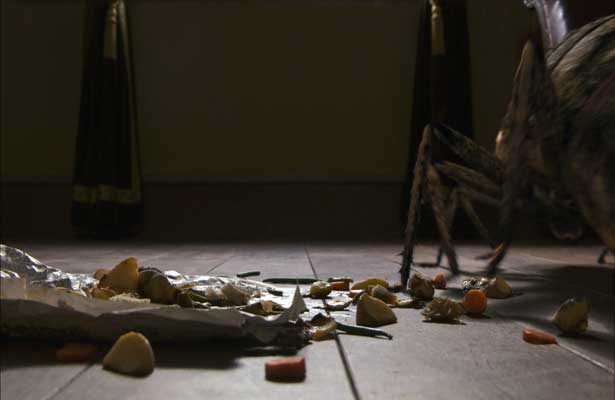
Gregor was now eating next to nothing. It was only when he happened to pass the food left for him that he would playfully take a morsel into his mouth, keep it in for hours and hours, and then usually spit it out again. At first, he thought that his anguish about the condition of his room was what kept him from eating, but he very soon came to terms with those very changes. The family had gotten used to storing things here that could not be put anywhere else, and now there were many such items here, for they had rented out one room of the apartment to three boarders. These earnest gentlemen—all three had full beards, as Gregor once ascertained through the crack of the door—were sticklers for order, not only in their room, but also, since they were lodging here, throughout the apartment, especially the kitchen. They could not endure useless, much less dirty refuse. Moreover, they had largely brought in their own household goods. For this reason, many of the family’s belongings had become superfluous; but while they had no prospects of selling them, they did not want to throw them out either. All these items wound up in Gregor’s room—as did the ash bucket and the garbage can from the kitchen. If anything was unusable at the moment, the charwoman, who was always in a mad rush, would simply toss it into Gregor’s room; luckily, he mostly saw only the object in question and the hand that held it. She may have intended to come for these things in her own good time or dump them all out in one fell swoop; but instead, they remained wherever they happened to land, unless Gregor twisted his way through the clutter, making it shift. At first, he had no choice, there being nowhere else for him to crawl; but later on it got to be more and more fun, even if, dead-tired and mournful after such treks, he would lie unstirring for hours on end.
Since the boarders sometimes also ate their supper at home in the common parlor, the door between that room and Gregor’s would remain shut on those evenings. But Gregor easily did without the open door—after all, there had been evenings when he had not even taken advantage of it; instead, unnoticed by the family, he had crouched in the darkest nook of his room. Once, however, the charwoman had left the parlor door ajar, and it remained ajar even when the boarders came in that evening and the light was turned on. Settling down at the head of the table, where the father, the mother, and Gregor had eaten in earlier times, they unfolded their napkins and took hold of their knives and forks. Instantly the mother appeared in the kitchen doorway with a platter of meat and, right behind her, the sister with a heaping platter of potatoes. The steaming food gave off thick fumes. The platters were set down in front of the boarders, who bent over them as if to test the food before eating it; and indeed the man sitting in the middle, and apparently looked up to as an authority by the two others, cut up a piece of meat on the platter, clearly in order to determine whether it was tender enough or should perhaps be sent back to the kitchen. He was satisfied, and so mother and sister, who had been watching in suspense, began to smile with sighs of relief.
The family itself ate in the kitchen. Nevertheless, before heading there, the father would stop off in the parlor, bowing once, with his cap in his hand, and circle the table. The boarders would all rise and mumble something into their beards. Then, by themselves again, they would eat in almost total silence. It struck Gregor as bizarre that amid all the various and sundry noises of eating, he kept making out the noise of their chewing as if he were being shown that one needed teeth for eating and that one could accomplish nothing with even the most wonderful toothless jaws. “I do have an appetite,” Gregor told himself, “but not for these foods. How well these boarders eat, and I’m starving to death!”
That very evening (Gregor could not recall hearing it all this time), the sound of the violin came from the kitchen. The boarders had already finished their supper. The middle one had pulled out a newspaper, giving the other two one page each; and now they were leaning back, reading and smoking. When the violin began to play, the boarders pricked up their ears, got to their feet, and tiptoed over to the vestibule doorway, crowding into it and remaining there.
They must have been overheard from the kitchen, for the father called: “Do you gentlemen mind the violin? We can stop it immediately.”
“Quite the contrary,” said the middle gentleman, “would the young lady care to come and play in this room, which is far more convenient and comfortable?”
“Oh, thank you,” called the father as if he were the violinist. The gentlemen came back into the parlor and waited. Soon the father arrived with the music stand, the mother with the sheet music, and the sister with the violin. The sister calmly prepared everything for the playing. The parents, having never rented out rooms before, which was why they were being so overly courteous to the boarders, did not dare sit in their own chairs. The father leaned against the door, slipping his right hand between two buttons of his buttoned-up uniform jacket; the mother, however, was offered a chair by one gentleman and, leaving it where he happened to place it, she sat off to the side, in a corner.
The sister began to play; the father and the mother, on either side, closely followed the motions of her hands. Gregor, drawn to the playing, had ventured a bit further out, so that his head was already sticking into the parlor. He was hardly aware of his recent lack of consideration toward the others, although earlier he had prided himself on being considerate. For now more than ever he had reason to hide, thoroughly coated as he was with the dust that shrouded everything in his room, flurrying about at the vaguest movement. Furthermore, threads, hairs, and scraps of leftover food were sticking to his back and his sides, for he had become much too apathetic to turn over and scour his back on the carpet as he used to do several times a day. And so, despite his present state, he had no qualms about advancing a bit across the spotless parlor floor.
Nor, to be sure, did anyone take any notice of him. The family was engrossed in the violin playing; the boarders, in contrast, their hands in their trouser pockets, had initially placed themselves much too close to the sister’s music stand so they could all read the score, which was bound to fluster her. As a result, half muttering with lowered heads, they soon retreated to the window, where they remained, with the father eyeing them uneasily. It now truly seemed more than obvious that their hope of listening to a lovely or entertaining violin recital had been dashed, that they had had enough of the performance, and that it was only out of sheer courtesy that they were allowing themselves to be put upon in their leisure. It was especially the manner in which they all blew their cigar smoke aloft through their mouths and noses that hinted at how fidgety they were. And yet the sister was playing so beautifully. Her face was leaning to the side, her sad, probing eyes were following the lines of notes. Gregor crawled a bit farther out, keeping his head close to the floor, so that their eyes might possibly meet. Was he a beast to be so moved by music? He felt as if he were being shown the path to the unknown food he was yearning for. He was determined to creep all the way over to the sister, tug at her skirt to suggest that she take her violin and come into his room, for no one here would reward her playing as he intended to reward it. He wanted to keep her there and never let her out, at least not in his lifetime. For once, his terrifying shape would be useful to him; he would be at all the doors of his room simultaneously, hissing at the attackers. His sister, however, should remain with him not by force, but of her own free will. She should sit next to him on the settee, leaning down to him and listening to him confide that he had been intent on sending her to the conservatory, and that if the misfortune had not interfered, he would have announced his plan to everyone last Christmas (Christmas was already past, wasn’t it?), absolutely refusing to take “no” for an answer. After his declaration, the sister would burst into tears of emotion, and Gregor would lift himself all the way up to her shoulder and kiss her throat, which she had been keeping free of any ribbon or collar since she had first started working.