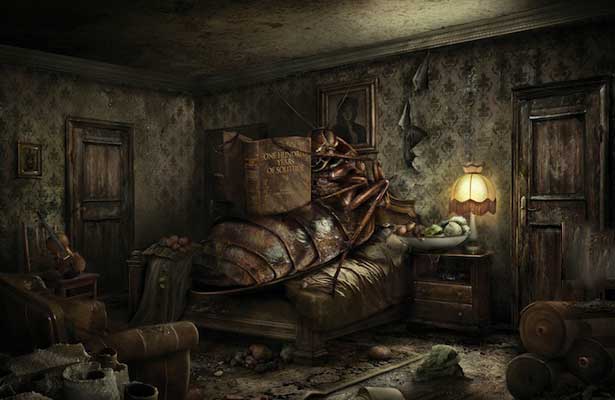
During the first two weeks, the parents could not get themselves to come into his room, and he often heard them expressing their great appreciation of the sister’s efforts, whereas earlier they had often been cross with her for being, they felt, a somewhat useless girl. But now both the father and the mother would frequently wait outside Gregor’s door while the sister tidied up inside, and upon reemerging, she promptly had to render a detailed account of what the room looked like, what Gregor had eaten, how he had behaved this time, and whether he was perhaps showing some slight improvement. The mother, incidentally, wanted to visit Gregor relatively soon. At first, the father and the sister tried to reason with her, and Gregor paid very close attention to their arguments, approving of them wholeheartedly. Later, however, the mother had to be held back forcibly, and when she then cried out, “Let me go to Gregor, he’s my unhappy son! Don’t you understand I have to go to him?” Gregor felt it might be a good idea if she did come in after all—not every day, naturally, but perhaps once a week: she was much better at everything than the sister, who, for all her courage, was still a child and might ultimately have taken on such a demanding task purely out of teenage capriciousness.
Gregor’s wish to see his mother came true shortly. During the day, if only out of consideration for his parents, he did not want to appear at the window. On the other hand, he could not creep very far around the few square meters of the floor, he found it hard to lie still even at night, and eating soon gave him no pleasure whatsoever. So, for amusement, he got into the habit of prowling crisscross over the walls and ceiling. He particularly liked hanging from the ceiling. It was quite different from lying on the floor: he could breathe more freely and a faint tingle quivered through his body. In his almost blissful woolgathering up there, Gregor might, to his own surprise, let go and crash down on the floor. But since he naturally now controlled his body far more effectively than before, he was never harmed by that great plunge. The sister instantly noticed the new entertainment that Gregor had found for himself—after all, when creeping, he occasionally left traces of his sticky substance behind. And so, taking it into her head to enable Gregor to crawl over the widest possible area, she decided to remove the obstructive furniture—especially the wardrobe and the desk. However, there was no way she could manage this alone. She did not dare ask her father for help, and the maid would most certainly not have pitched in; for while this girl, who was about sixteen, had been valiantly sticking it out since the cook’s departure, she had asked for the special favor of keeping the kitchen door locked all the time and opening it only when specifically called. As a result, the sister had no choice but to approach the mother one day during the father’s absence. And indeed, with cries of joyful excitement, the mother came over, although falling silent at the door to Gregor’s room. First, naturally, the sister checked inside to make sure everything was in order; only then did she let the mother enter. Gregor had hurriedly pulled the sheet lower and in tighter folds, truly making it look as if it had been tossed casually over the settee. This time, Gregor also refrained from peeping out from under the sheet: he would go without seeing the mother for now and was simply glad that she had come despite everything.
“Come on, he’s out of sight,” said the sister, evidently leading the mother by the hand. Gregor now heard the two delicate women pushing the very heavy old wardrobe from its place and the sister constantly insisting on doing the major share of the work, ignoring the warnings from the mother, who was afraid she would overexert herself. It took a very long time. After probably just a quarter hour of drudging, the mother said it would be better if they left the wardrobe here. For one thing, it was too heavy—they would not be done before the father’s arrival; and if the wardrobe stood in the middle of the room, it would block Gregor’s movements in all directions. Secondly, it was not at all certain that they were doing Gregor a favor by removing the furniture. She said that the opposite seemed to be the case, the sight of the bare wall literally made her heart bleed. And why wouldn’t Gregor respond in the same way since he was long accustomed to the furniture and would therefore feel desolate in the empty room? “And isn’t that,” the mother concluded very softly (in fact, she persistently almost whispered, as if, not knowing Gregor’s precise whereabouts, she wanted to keep him from hearing the very sound of her voice, convinced as she was that he did not understand the words), “and if we remove the furniture, isn’t that like showing him that we’ve given up all hope of his improvement and that we’re callously leaving him to his own devices? I believe it would be best if we tried to keep the room just as it was, so that when Gregor comes back to us he will find that nothing’s been changed and it will be much easier for him to forget what happened.”
Upon hearing the mother’s words, Gregor realized that in the course of these two months the lack of having anyone to converse with, plus the monotonous life in the midst of the family, must have befuddled his mind, for there was no other way to account for how he could have seriously longed to have his room emptied out. Did he really want the warm room, so cozily appointed with heirlooms, transformed into a lair, where he might, of course, be able to creep, unimpeded, in any direction, though forgetting his human past swiftly and totally? By now, he was already on the verge of forgetting, and had been brought up sharply only by the mother’s voice after not hearing it for a long time. Nothing should be removed, everything had to remain: he could not do without the positive effects of the furniture on his state of mind. And if the furniture interfered with his senselessly crawling about, then it was a great asset and no loss.
Unfortunately, the sister was of a different mind; in the discussions concerning Gregor, she had gotten into the habit—not without some justification, to be sure—of acting the great expert in front of the parents. So now the mother’s advice was again reason enough for the sister to demand that they remove not only the wardrobe and the desk, in line with her original plan, but all the furniture except for the indispensable settee. Her resoluteness was, naturally, prompted not just by childish defiance and the unexpected selfconfidence she had recently gained at such great cost. After all, she had observed that while he needed a lot of space to creep around in, Gregor, so far as could be seen, made no use whatsoever of the furniture. Perhaps, however, the enthusiasm of girls her age also played its part—an exuberance that they try to indulge every chance they get. It now inveigled Grete into making Gregor’s situation even more terrifying, so she could do even more for him than previously. For most likely no one but Grete would ever dare venture into a room where Gregor ruled the bare walls all alone.
And so she dug in her heels, refusing to give in to the mother, who, apparently quite anxious and uncertain of herself in this room, soon held her tongue and, to the best of her ability, helped the sister push out the wardrobe. Well, Gregor could, if necessary, do without the wardrobe, but the desk had to remain. And no sooner had the squeezing, groaning women shoved the wardrobe through the doorway than Gregor poked his head out from under the settee to judge how he could intervene as cautiously and considerately as possible. But alas, it was precisely the mother who was the first to return while Grete was still in the next room, holding her arms around the wardrobe and rocking it back and forth by herself without, of course, getting it to budge from the spot. The mother, however, was not used to the sight of Gregor—it might sicken her. And so Gregor, terrified, scuttered backwards to the other end of the settee, but was unable to prevent the front of the sheet from stirring slightly. That was enough to catch the mother’s eye. She halted, stood still for an instant, then went back to Grete.
Gregor kept telling himself that nothing out of the ordinary was happening, it was just some furniture being moved. But these comings and goings of the women, their soft calls to one another, the scraping of the furniture along the floor was, as he soon had to admit, like a huge rumpus pouring in on all sides. And no matter how snugly he pulled in his head and legs and pressed his body against the floor, he inevitably had to own up that he would not endure the hubbub much longer. They were clearing out his room, stripping him of everything he loved. They had already dragged away the wardrobe, which contained the fretsaw and other tools, and they were now unprying the solidly embedded desk, where he had done his assignments for business college, high school, why, even elementary school—and he really had no time to delve into the good intentions of the two women, whom, incidentally, he had almost forgotten about, for they were so exhausted that they were already laboring in silence, and all that could be heard was the heavy plodding of their feet.
And so, while the women were in the next room, leaning against the desk to catch their breath, he broke out, changing direction four times, for he was truly at a loss about what to rescue first—when he saw the picture of the woman clad in nothing but furs hanging blatantly on the otherwise empty wall. He quickly scrambled up to it and squeezed against the glass, which held him fast, soothing his hot belly. At least, with Gregor now covering it up, this picture would certainly not be carried off by anyone. He turned his head toward the parlor door, hoping to observe the women upon their return.
After granting themselves little rest, they were already coming back; Grete had put her arm around her mother, almost carrying her. “Well, what should we take next?” said Grete, looking around. At this point, her eyes met those of Gregor on the wall. It was no doubt only because of the mother’s presence that she maintained her composure. Bending her face toward the mother to keep her from peering about, she said, although trembling and without thinking: “Come on, why don’t we go back to the parlor for a moment?” It was obvious to Gregor that she wanted to get the mother to safety and then chase him down from the wall. Well, just let her try! He clung to his picture, refusing to surrender it. He would rather jump into Grete’s face.
But Grete’s words had truly unnerved the mother, who stepped aside, glimpsed the huge brown splotch on the flowered wallpaper, and cried out in a harsh, shrieking voice before actually realizing that this was Gregor, “Oh God, oh God!” With outspread arms as if giving up everything, she collapsed across the settee and remained motionless.
“Hey, Gregor!” the sister shouted with a raised fist and a penetrating glare. These were her first direct words to him since his metamorphosis. She ran into the next room to get some sort of essence for reviving the mother from her faint. Gregor also wanted to help (there was time enough to salvage the picture later), but he was stuck fast to the glass and had to wrench himself loose. He then also scurried into the next room as if he could give the sister some kind of advice as in earlier times, but then had to stand idly behind her while she rummaged through an array of vials. Upon spinning around, she was startled by the sight of him. A vial fell on the floor and shattered. A sliver of glass injured Gregor’s face, and some corrosive medicine oozed from the sliver. Grete, without further delay, grabbed as many vials as she could hold and dashed over to the mother, slamming the door with her foot. Gregor was thus cut off from the mother, who might have been dying because of him; he had to refrain from opening the door lest he frighten away the sister, who had to remain with the mother. There was nothing he could do but wait, and so, tortured by self-rebukes and worries, he began to creep about—he crept over everything, walls, furniture, and ceiling, and finally, in his despair, when the entire room began whirling around him, he plunged down to the middle of the large table.
A short while passed, with Gregor lying there worn out. The entire apartment was still, which was possibly a good sign. Then the doorbell rang. The maid was, naturally, locked up in her kitchen, and so Grete had to go and answer the door. The father had come.
“What’s happened?” were his first words; Grete’s face must have revealed everything. She replied in a muffled voice, obviously pressing her face into his chest: “Mother fainted, but she’s feeling better now. Gregor broke out.”
“I expected it,” said the father, “I kept telling you both, but you women refuse to listen.”
It was clear to Gregor that the father had misinterpreted Grete’s all-too-brief statement and leaped to the conclusion that Gregor had perpetrated some kind of violence. That was why he now had to try and placate the father, for he had neither the time nor the chance to enlighten him. He therefore fled to the door of his room, squeezing against it, so that the father, upon entering from the vestibule, could instantly see that Gregor had every intention of promptly returning to his room and that there was no need to force him back. All they had to do was open the door and he would vanish on the spot.
But the father was in no mood to catch such niceties. “Ah!” he roared upon entering, and his tone sounded both furious and elated. Gregor drew his head back from the door and raised it toward the father. He had really not pictured him as he was standing there now; naturally, because of his new habit of creeping around, Gregor had lately failed to concern himself with anything else going on in the apartment and he should actually have been prepared for some changes. And yet, and yet, was this still his father? The same man who used to lie buried in bed, exhausted, whenever Gregor started out on a business trip; who, whenever Gregor came home in the evening, would greet him, wearing a robe, in the armchair; who, being quite incapable of standing up, would only raise his arms as a sign of joy; and who, bundled up in his old overcoat, laboriously shuffled along during rare family strolls on a few Sundays during the year and on the highest holidays, always cautiously planting his cane, trudging a bit more slowly between Gregor and the mother (they were walking slowly as it was), and who, whenever he was about to say anything, nearly always halted and gathered the others around him? But now the father stood quite steady, in a snug blue uniform with gold buttons, such as attendants in banks wear; his heavy double chin unfurled over the high stiff collar of the jacket. From under his bushy eyebrows, the black eyes gazed fresh and alert; the once disheveled hair was now glossy, combed down, and meticulously parted. Removing his cap with its gold monogram, probably that of a bank, and pitching it in an arc the full length of the room over to the settee, he lunged toward Gregor, his face grim, his hands in his trouser pockets, the tails of his long uniform jacket swinging back. He himself most likely did not know what he had in mind; nevertheless he lifted his feet unusually high, and Gregor marveled at the gigantic size of his boot soles. But he did not dwell on this; after all, from the very first day of his new life, he had known that the father viewed only the utmost severity as appropriate for dealing with him. And so now Gregor scooted away, stopping only when the father halted, and skittering forward again the instant the father moved. In this way, they circled the room several times with nothing decisive happening; in fact, because of its slow tempo, the whole business did not even resemble a chase. That was why Gregor kept to the floor for now, especially since he feared that the father might view an escape to the walls or the ceiling as particularly wicked. Nevertheless, Gregor had to admit that he could not endure even this scurrying much longer, because for every step the father took, Gregor had to carry out an endless string of movements. He was already panting noticeably, just as his lungs had never been altogether reliable even in his earlier days. He was just barely staggering along, trying to focus all his strength on running, scarcely keeping his eyes open, feeling so numb that he could think of no other possible recourse than running, and almost forgetting that he was free to use the walls, which, however, were blocked here by intricately carved furniture bristling with sharp points and notches—when all at once a lightly tossed something flew down right next to him, barely missing him, and rolled on ahead of him. It was an apple. Instantly a second one flew after the first. Gregor halted, petrified. Any more running would be useless, for the father was dead set on bombarding him. He had filled his pockets with fruit from the bowl on the sideboard and, not taking sharp aim for the moment, was hurling apple after apple. Those small red apples ricocheted around the floor as if galvanized, colliding with one another. A weakly thrown apple grazed Gregor’s back, sliding off harmlessly. Another one, however, promptly following it, actually dug right into his back. Gregor wanted to keep dragging himself along as though this startling and incredible pain would vanish with a change of location, yet he felt nailed to the spot and so he stretched out with all his senses in utter derangement. It was only with his final glance that he saw the door to his room burst open. The mother, wearing only a chemise (for the sister had undressed her to let her breathe more freely while unconscious), hurried out in front of the screaming sister and dashed toward the father. Stumbling over her unfastened petticoats as they glided to the floor one by one, she pressed against the father, flung her arms around his neck in total union with him—but now Gregor’s eyesight failed entirely—and, with her hands clutching the back of the father’s head, she begged him to spare Gregor’s life.