II
It was almost dusk by the time Gregor emerged from his comatose sleep. He would certainly have awoken not much later even without being disturbed, for he felt sufficiently well rested; yet it seemed to him as if he had been aroused by fleeting steps and a cautious shutting of the vestibule door. The glow from the electric streetlamps produced pallid spots on the ceiling and the higher parts of the furniture, but down by Gregor it was dark. Slowly, still clumsily groping with his feelers, which he was just learning to appreciate, he lumbered toward the door to see what had been going on. His left side appeared to be one long, unpleasantly tightening scar, and he actually had to limp on his two rows of legs. One tiny leg, moreover, had been badly hurt during that morning’s events (it was almost miraculous that only one had been hurt) and it dragged along lifelessly.
Only upon reaching the door did Gregor discover what had actually enticed him: it was the smell of something edible. For there stood a bowl full of fresh milk with tiny slices of white bread floating in it. He practically chortled for joy, being even hungrier now than in the morning, and he promptly dunked his head into the milk until it was nearly over his eyes. Soon, however, he withdrew his head in disappointment. Not only did the bruises on his left side make it difficult for him to eat—he could eat only if his entire wheezing body joined in—but he did not care for the milk, even though it had always been his favorite beverage, which was no doubt why his sister had placed it in his room. As a matter of fact, he turned away from the bowl almost with loathing and crawled back to the middle of the room.
In the parlor, as Gregor could see through the door crack, the gaslight was lit. But while at this time of day his father would usually take up his newspaper, an afternoon daily, and read it in a raised voice to the mother and sometimes also to the sister, not a sound was to be heard. Well, perhaps this practice of reading aloud, which the sister had always told Gregor about and written him about, had recently been discarded altogether. Yet while the entire apartment was hushed, it was anything but deserted.
“My, what a quiet life the family used to lead,” Gregor thought to himself, and as he peered into the darkness, he felt a certain pride that he had managed to provide his parents and his sister with such a life in such a beautiful apartment. What if now all calm, all prosperity, all contentment should come to a horrifying end? Rather than lose himself in such ruminations, Gregor preferred to start moving, and so he crept up and down the room.
Once, during the long evening, one side door and then the other was opened a tiny crack and quickly shut again: somebody had apparently felt an urge to come in, but had then thought the better of it. Gregor halted right at the parlor door, determined to somehow bring in the hesitant visitor or at least find out who it was. But the door was not reopened, and Gregor waited in vain. That morning, when the doors had been locked, everybody had wanted to come in; but now that he had opened one door, and the rest had clearly been opened during the day, nobody came, and the keys were on the other side.
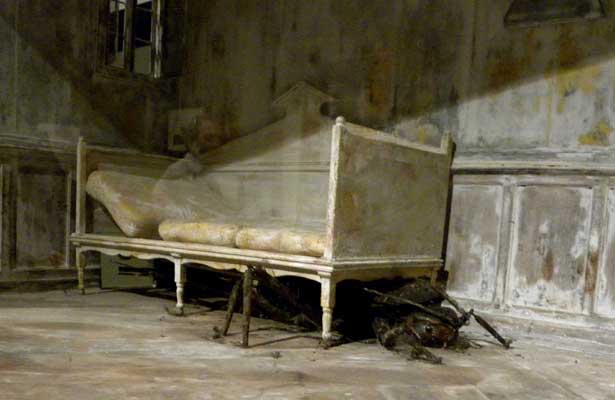
It was not until late at night that the light in the parlor was put out. Gregor could easily tell that the parents and the sister had stayed up this long, for, as he could clearly discern, all three of them were tiptoeing off. Since nobody would be visiting Gregor until morning, he had lots of time to reflect undisturbed and to figure out how to restructure his life. But the free, high-ceilinged room where he was forced to lie flat on the floor terrified him without his being able to pinpoint the cause; after all, it was his room and he had been living there for the last five years. Turning half involuntarily and not without a faint sense of embarrassment, he scurried under the settee, where, even though his back was a bit squashed and he could not lift his head, he instantly felt very cozy, regretting only that his body was too broad to squeeze in all the way.
There he remained for the rest of the night, either drowsing and repeatedly yanked awake by his hunger, or else fretting amid vague hopes, all of which, however, led to his concluding that for now he would have to lie low and, by being patient and utterly considerate, help the family endure the inconveniences that, as it happened, he was forced to cause them in his present state.
By early morning—it was still almost night—Gregor had a chance to test the strength of the resolutions he had just made, for the sister, almost fully dressed, opened the vestibule door and suspensefully peered in. She did not find him right away, but when she noticed him under the settee (goodness, he had to be somewhere, he couldn’t just have flown away), she was so startled that unable to control herself she slammed the door from the outside. But, apparently regretting her behavior, she instantly reopened the door and tiptoed in as if visiting a very sick patient or even a stranger. Gregor, having pushed his head forward to the very edge of the settee, was watching her. Would she notice that he had barely touched the milk, though by no means for lack of hunger, and would she bring in some other kind of food more to his taste? If she did not do so on her own, he would rather starve to death than point it out to her, even while he felt a tremendous urge to scoot out from under the settee, throw himself at her feet, and beg her for some good food. But the sister, with some surprise, instantly noticed the full bowl, from which only a little milk had splattered all around. She promptly picked up the bowl, though not with her bare hands, but with a rag, and carried it away. Gregor was extremely curious as to what she would replace it with, and all sorts of conjectures ran through his mind. But he would never have hit on what the sister actually did in the goodness of her heart. Hoping to check his likes and dislikes, she brought him a whole array of food, all spread out on an old newspaper. There were old, half-rotten vegetables, some bones left over from supper and coated with a solidified white sauce, a few raisins and almonds, some cheese that Gregor had declared inedible two days ago, dry bread, bread and butter, and salted bread and butter. Furthermore, along with all those things, she brought some water in the bowl, which had probably been assigned to Gregor for good. And sensing that Gregor would not eat in front of her, she discreetly hurried away, even turning the key, just to show him that he could make himself as comfortable as he wished. Gregor’s tiny legs whirred as he charged toward the food. His wounds, incidentally, must have healed up by now, he felt no handicap anymore, which was astonishing; for, as he recalled, after he had nicked his finger with a knife over a month ago, the injury had still been hurting the day before yesterday. “Am I less sensitive now?” he wondered, greedily sucking at the cheese, which had promptly exerted a more emphatic attraction on him than any of the other food. His eyes watered with contentment as he gulped down the cheese, the vegetables, and the sauce in rapid succession. By contrast, he did not relish the fresh foods, he could not even stand their smells, and he actually dragged the things he wanted to eat a short distance away. He was already done long since and was simply lazing in the same spot when the sister, to signal that he should withdraw, slowly turned the key. Startled, he jumped up though he was almost dozing, and scuttered back under the settee. However, it took a lot of self-control to remain there even during the few short moments that the sister spent in the room, for his body was slightly bloated from the ample food and he could scarcely breathe in that cramped space. Amid short fits of suffocation, he stared with somewhat bulging eyes while the unsuspecting sister, wielding a broom, swept up not only the leftovers but also the untouched food, as if this too were now unusable; she then hastily dumped everything into a pail, shutting its wooden lid and carrying everything out. No sooner had she turned her back than he skulked out from under the settee and began stretching and puffing up.
That was how Gregor received his food every day: once in the morning, when the parents and the maid were still asleep, and the second time after the family lunch, for the parents would then take a brief nap while the sister would send the maid out on some errand. While the parents certainly did not want Gregor to starve either, they may not have endured knowing more about his eating than from hearsay, or the sister may have wished to spare them some—perhaps only slight—grief, for they were really suffering enough as it was.
Gregor could not find out what excuses they had come up with to get the doctor and the locksmith out of the apartment; for since he was not understood, no one, including the sister, assumed that he could understand them. And so, whenever she was in his room, he had to content himself with occasionally hearing her sighs and her appeals to the saints. It was only later, when she had gotten a bit accustomed to everything (naturally there could be no question of her ever becoming fully accustomed), Gregor sometimes caught a remark that was meant to be friendly or might be interpreted as such. “He certainly enjoyed it today,” she would say when Gregor had polished off a good portion of the food; while in the opposite event, which was gradually becoming more and more frequent, she would say almost sadly: “Now once again nothing’s been touched.”
But while Gregor could learn no news directly, he would eavesdrop, picking up a few things from the adjacent rooms, and the instant he heard voices, he would promptly scuttle over to the appropriate door, squeezing his entire body against it. During the early period in particular, no conversation took place that was not somehow about him, even if only in secret. For two whole days, every single meal was filled with discussions about what they ought to do; but even between meals, they kept harping on the same theme, for there were always at least two family members in the apartment, since plainly nobody wished to stay home alone and they could by no means all go out at the same time. Furthermore, on the very first day, the maid—it was not quite clear how much she knew about what had occurred—had implored the mother on bended knees to dismiss her immediately. Then, saying goodbye a quarter hour later, she had tearfully thanked them for the dismissal as if it were the most benevolent deed that they had ever done for her; and without being asked, she had sworn a dreadful oath that she would never breathe a single word to anyone.
So now the sister, together with the mother, also had to do the cooking; but this was not much of a bother, for they ate next to nothing. Over and over, Gregor heard them urging one another to eat, though in vain, receiving no other answer than, “Thanks, I’ve had enough,” or something similar. They may not have drunk anything either. The sister would often ask the father if he would like some beer and she warmly offered to go and get it herself; when he failed to respond, she anticipated any misgivings on his part by saying she could also send the janitor’s wife. But then the father would finally utter an emphatic “No,” and the subject was no longer broached.
In the course of the very first day, the father laid out their overall financial circumstances and prospects to both the mother and the sister. From time to time, he rose from the table to fetch some document or notebook from his small strongbox, which he had salvaged after the collapse of his business five years earlier. They heard him opening the complicated lock and then shutting it again after removing whatever he had been looking for. The father’s explanations were to some extent the first pleasant news that Gregor got to hear since his imprisonment. He had been under the impression that the father had failed to rescue anything from his business—at least, the father had told him nothing to the contrary, nor, admittedly, had Gregor ever asked him. Gregor’s sole concern at that time had been to do whatever he could to make the family forget as quickly as possible the business catastrophe that had plunged them all into utter despair. And so he had thrown himself into his job with tremendous fervor, working his way up, almost overnight, from minor clerk to traveling salesman, who, naturally, had an altogether different earning potential and whose professional triumphs were instantly translated, by way of commissions, into cash, which could be placed on the table at home for the astonished and delighted family. Those had been lovely times, and they had never recurred, at least not with that same luster, even though Gregor was eventually earning so much money that he was able to cover and indeed did cover all the expenditures of the family. They had simply grown accustomed to this, both the family and Gregor; they accepted the money gratefully, he was glad to hand it over, but no great warmth came of it. Only the sister had remained close to Gregor; and since she, unlike Gregor, loved music and could play the violin poignantly, he was secretly planning to send her to the conservatory next year regardless of the great expense that it was bound to entail and that would certainly be made up for in some other way. During Gregor’s brief stays in the city, the conservatory was often mentioned in his talks with the sister, but only as a lovely dream that could never possibly be realized; nor did the parents care to hear these innocent references. But Gregor’s ideas on the subject were very definite and he intended to make the solemn announcement on Christmas Eve.
Such were the thoughts, quite futile in his present condition, that ran through his mind as he clung upright to the door, eavesdropping. Sometimes he was so thoroughly exhausted that he could no longer listen. His head would then inadvertently bump against the door, but he promptly pulled it erect again; for even that slight tap had been heard in the next room, causing everyone to stop talking. “What’s he up to now!?” the father would say after a while, obviously turning toward the door, and only then did the interrupted conversation gradually resume.
Gregor now learned precisely enough (for the father would often repeat his explanations, partly because he himself had not dealt with these matters in a long time and partly because the mother did not always understand everything right off) that despite the disaster, some assets, albeit a very tiny sum, had survived from the old days, growing bit by bit because of the untouched interest. Furthermore, since the money that Gregor had brought home every month (keeping only a little for himself) had never been fully spent, it had accumulated into a small principal. Gregor, behind his door, nodded eagerly, delighted at this unexpected thrift and prudence. Actually, he could have applied this surplus toward settling the father’s debt to the director, thereby bringing the day when he could have been rid of that job a lot closer; but now, the way the father had arranged things was better, no doubt.
Of course this sum was by no means large enough for the family to live off the interest; it might suffice to keep them going for one, at most two years, and that was all. It was simply money that really should not be drawn on and that ought to be put aside for emergencies, while the money to live on had to be earned. But the father, though still healthy, was an old man, who had not done a lick of work in five years and in any case could not be expected to take on very much. During those five years, his first vacation in an arduous and yet unsuccessful life, he had grown very fat, becoming rather clumsy. And should perhaps the old mother go to work—she, who suffered from asthma, who found it strenuous just walking through the apartment, and who spent every other day on the sofa, gasping for air by the open window? Or should the sister go to work—she, who was still a child at seventeen and should certainly keep enjoying her lifestyle, which consisted of dressing nicely, sleeping late, lending a hand with the housekeeping, going out to a few modest amusements, and above all, playing the violin? At first, whenever the conversation turned to this need to earn money, Gregor would always let go of the door and throw himself on the cool leather sofa nearby, for he felt quite hot with shame and grief.
Often he would lie there all through the long night, not getting a wink of sleep and merely scrabbling on the leather for hours on end. Or else, undaunted by the great effort, he would shove a chair over to the window, clamber up to the sill, and, propped on the chair, lean against the panes, obviously indulging in some vague memory of the freedom he had once found by gazing out the window. For actually, from day to day, even the things that were rather close were growing hazier and hazier; he could no longer even make out the hospital across the street, the all-too-frequent sight of which he used to curse. And if he had not known for sure that he lived on Charlotte Street, a quiet but entirely urban thoroughfare, he might have believed that he was staring at a wasteland in which gray sky and gray earth blurred together indistinguishably. Only twice had the observant sister needed to see the chair standing by the window; now, whenever she tidied up the room she would push the chair back to the window—indeed, from then on she would even leave the inside casement ajar.
If only Gregor could have spoken to her and thanked her for everything she had to do for him, he would have endured her kind actions more readily; but instead they caused him great suffering. Of course, she tried to surmount the overall embarrassment as much as possible, and naturally, as time wore by, she succeeded more and more. However, Gregor too eventually gained a sharper sense of things. Her very entrance was already terrible for him. No sooner had she stepped in than, without even taking time to close the door—careful as she usually was to protect everyone else from seeing Gregor’s room—she charged straight over to the window and, as if almost suffocating, yanked it open with hasty hands, lingering there briefly no matter how chilly the weather and inhaling deeply. This din and dashing terrified Gregor twice a day. Throughout her visits he would cower under the settee, fully realizing that she would certainly have preferred to spare him this disturbance if only she had been able to keep the window shut while staying in the same room with him.
Once—something like a month had passed since Gregor’s metamorphosis, and there was truly no special reason why the sister should still be alarmed by his appearance—she turned up a bit earlier than usual and caught Gregor staring out the window, motionless and terrifyingly erect. He would not have been surprised if she had refused to come in since his position prevented her from opening the window immediately. But not only did she not come in, she actually recoiled and closed the door; an outsider might have honestly thought that Gregor had meant to ambush her and bite her. Naturally he hid under the settee at once, but then had to wait until noon for his sister to return, and she seemed far more upset than usual. It thus dawned on him that his looks were still unbearable to her and were bound to remain unbearable, which meant that it must have taken a lot of self-control for her not to run away upon glimpsing even the tiny scrap of his body that protruded from under the settee. So one day, hoping to spare her even this sight—the job took him four hours—he got the sheet on his back and lugged it over to the settee, arranging it in such a way that it concealed him entirely, thereby preventing the sister from seeing him even when she stooped down. After all, if she considered the sheet unnecessary, she could have removed it, for it was plain that Gregor could not possibly enjoy cutting himself off so thoroughly. But she left the sheet just as it was, and once, he even believed he caught a grateful glance when he cautiously lifted it a smidgen with his head to see how his sister was taking this innovation.