Gregor, however, had grown much calmer. True, the others no longer understood what he said even though it sounded clear enough to him, clearer than before, perhaps because his ears had gotten used to it. But nevertheless, the others now believed there was something not quite right about him, and they were willing to help. His spirits were brightened by the aplomb and assurance with which their first few instructions had been carried out. He felt included once again in human society and, without really drawing a sharp distinction between the doctor and the locksmith, he expected magnificent and astonishing feats from both. Trying to make his voice as audible as he could for the crucial discussions about to take place, he coughed up a little, though taking pains to do so quite softly, since this noise too might sound different from human coughing, which he no longer felt capable of judging for himself. Meanwhile, the next room had become utterly hushed. Perhaps the parents and the office manager were sitting and whispering at the table, perhaps they were all leaning against the doors and eavesdropping.
Gregor slowly lumbered toward the door, shoving the chair along, let go of it upon arriving, tackled the door, held himself erect against it—the pads on his tiny feet were a bit sticky—and for a moment he rested from the strain. But then, using his mouth, he began twisting the key in the lock. Unfortunately he appeared to have no real teeth—now with what should he grasp the key?—but to make up for it his jaws were, of course, very powerful. They actually enabled him to get the key moving, whereby he ignored the likelihood of his harming himself in some way, for a brown liquid oozed from his mouth, flowing over the key and dripping to the floor.
“Listen,” said the office manager in the next room, “he’s turning the key.” This was very encouraging for Gregor; but everyone should have cheered him on, including the father and the mother. “Attaboy, Gregor!” they should have shouted. “Don’t let go, get that lock!” And imagining them all as suspensefully following his efforts, he obliviously bit into the key with all the strength he could muster. In tune with his progress in turning the key, he kept dancing around the lock, holding himself upright purely by his mouth and, as need be, either dangling from the key or pushing it down again with the full heft of his body. It was the sharper click of the lock finally snapping back that literally brought Gregor to. Sighing in relief, he told himself, “So I didn’t need the locksmith after all,” and he put his head on the handle in order to pull one wing of the double door all the way in.
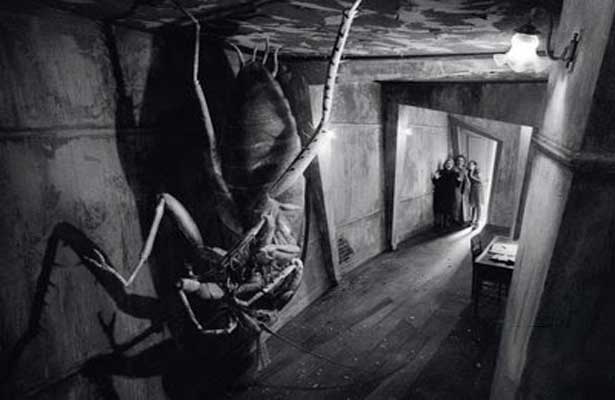
Since he had to stay on the same side as the key, the door actually swung back quite far without his becoming visible. He had to twist slowly around the one wing, and very gingerly at that, to avoid plopping over on his back before entering the next room. He was still busy performing this tricky maneuver, with no time to heed anything else, when he heard the office manager blurt out a loud “Oh!”—it sounded like a whoosh of wind—and now he also saw him, the person nearest to the door, pressing his hand to his open mouth and slowly shrinking back as if he were being ousted by some unseeable but relentless force. The mother, who, despite the office manager’s presence, stood there with her hair still undone and bristling, first gaped at the father, clasping her hands, then took two steps toward Gregor and collapsed, her petticoats flouncing out all around her and her face sinking quite undetectably into her breasts. The father clenched his fist, glaring at Gregor as if trying to shove him back into his room, then peered unsteadily around the parlor before covering his eyes with his hands and weeping so hard that his powerful chest began to quake.
Gregor did not step into the parlor after all; instead he leaned against his side of the firmly bolted second wing of the door, so that only half his body could be seen along with his head, which tilted sideways above it, peeping out at the others. Meanwhile the day had grown much lighter. Across the street, a portion of the endless, grayish black building (it was a hospital) stood out clearly with its regular windows harshly disrupting the façade. The rain was still falling, but only in large, visibly separate drops that were also literally hurled separately to the ground. The breakfast dishes still abundantly covered the table because breakfast was the most important meal of the day for Gregor’s father; and he would draw it out for hours on end by reading various newspapers. The opposite wall sported a photograph of Gregor from his military days: it showed him as a lieutenant, hand on sword, with a carefree smile, demanding respect for his bearing and his uniform. The vestibule door was open, and since the apartment door was open too, one could see all the way out to the landing and the top of the descending stairs.
“Well,” said Gregor, quite aware of being the only one who had kept calm, “I’ll be dressed in a minute, pack up my samples, and catch my train. Would you all, would you all let me go on the road? Well, sir, you can see I am not stubborn and I enjoy working. Traveling is arduous, but I could not live without it. Why, where are you going, sir? To the office? Right? Will you report all this accurately? A man may be temporarily incapacitated, but that is precisely the proper time to remember his past achievements and to bear in mind that later on, once the obstacle is eliminated, he is sure to work all the harder and more intently. After all, I am so deeply obligated to the director, you know that very well. And then, I have to take care of my parents and my sister. I’m in a tight spot, but still I’ll work my way out again. So please don’t make things more difficult for me than they already are. Put in a good word for me at the office! People don’t like a traveling salesman, I know. They think he makes barrels of money and has a wonderful life. They simply have no special reason to examine their prejudice. But you, sir, you have a better notion of what it’s all about than the rest of the staff, why, than even—this is strictly between us—a better notion than even the director, who, as owner of the firm, is easily swayed against an employee. You also know very well that a traveling salesman, being away from the office most of the year, can so easily fall victim to gossip, coincidences, and unwarranted complaints, and he cannot possibly defend himself since he almost never finds out about them, except perhaps when he returns from a trip, exhausted, and personally suffers their awful consequences at home without fathoming their inscrutable causes. Sir, please do not leave without saying something to show that you agree with me at least to some small extent!”
But the office manager had already turned away at Gregor’s very first words, and he only looked back at him over his twitching shoulder and with gaping lips. Indeed during Gregor’s speech, the manager did not halt for even an instant. Rather, without losing sight of Gregor, he retreated toward the door, but only very gradually, as if there were some secret ban on leaving the room. He was already in the vestibule, and to judge by his abrupt movement when he finally pulled his leg out of the parlor, one might have thought he had just burned the sole of his foot. In the vestibule, however, he stretched out his right hand very far, toward the staircase, as if some unearthly redemption were awaiting him there.
Gregor realized he must on no account allow the office manager to leave in this frame of mind; if he did, Gregor’s position at the office would be thoroughly compromised. The parents did not quite understand this. During these long years, they had become convinced that he was set up for life at this firm, and besides they were so preoccupied with their immediate problems as to have lost all sense of foresight. Gregor, however, did possess such foresight. The office manager had to be held back, calmed down, cajoled, and finally won over; Gregor’s future and that of his family hinged on it! If only the sister had been here! She was intelligent; she had already started to cry when Gregor was still lying calmly on his back. And the office manager, that ladies’ man, would certainly have let her take him in hand: she would have shut the apartment door, kept him in the vestibule, and talked him out of his terror. But the sister was not there, so Gregor had to act on his own. Forgetting that he was as yet unacquainted with his current powers of movement and also that once again his words had possibly, indeed probably, not been understood, he left the wing of the door and lumbered through the opening. He intended to head toward the office manager, who was ludicrously clutching the banister on the landing with both hands. But Gregor, fumbling for support, yelped as he flopped down upon his many tiny legs. The instant this happened, he felt a physical ease and comfort for the first time that morning. His tiny legs had solid ground underneath, and he was delighted to note that they were utterly obedient—they even strove to carry him off to wherever he wished; and he already believed that the final recovery from all sufferings was at hand. He lay on the floor, wobbling because of his checked movement, not that far from his mother, who seemed altogether self-absorbed. But at that same moment, she unexpectedly leaped up, stretched her arms far apart, splayed her fingers, and cried, “Help! For God’s sake, help!” Next she lowered her head as if to see Gregor more clearly, but then, in self-contradiction, she senselessly backed away, forgetting the covered table behind her, hurriedly sat down upon it without thinking, and apparently failed to notice that next to her the large coffeepot had been knocked over and was discharging a torrent of coffee full force upon the carpet.
“Mother, Mother,” Gregor murmured, looking up at her. For an instant, the office manager had entirely slipped his mind; on the other hand, Gregor could not help snapping his jaws a few times at the sight of the flowing coffee. This prompted the mother to scream again, flee from the table, and collapse into the father’s arms as he came dashing up to her. But Gregor had no time for his parents: the office manager was already on the stairs; with his chin on the banister, he took one final look back. Gregor broke into a run, doing his best to catch up with him. The office manager must have had an inkling of this, for he jumped down several steps at a time and disappeared. However, he did shout, “Ugh!” and his shout rang through the entire stairwell.
Unfortunately, the father, who so far had stayed relatively composed, seemed thoroughly bewildered by the office manager’s flight. For, instead of rushing after him or at least not preventing Gregor from pursuing him, the father, with his right hand, grabbed the cane that the office manager, together with a hat and overcoat, had forgotten on a chair and, with his left hand, took a large newspaper from the table. Stamping his feet, he brandished the cane and the newspaper at Gregor in order to drive him back into his room. No pleading from Gregor helped, indeed no pleading was understood; no matter how humbly Gregor turned his head, the father merely stamped his feet all the more forcefully. Across the room, the mother had flung open a window despite the cool weather, and leaning way out, she buried her face in her hands. A strong draft arose between the street and the stairwell, the window curtains flew up, the newspapers rustled on the table, stray pages wafted across the floor. The father charged pitilessly, spewing hisses like a savage. Since Gregor as yet had no practice in moving backwards, it was really slow going. Had he only been permitted to wheel around, he would have been inside his room at once. But he was afraid it would take too long, trying the father’s patience even more—and at any moment now the cane in the father’s hand threatened to deal the lethal blow to Gregor’s back or head. Ultimately, however, Gregor had no choice, for he realized with dismay that he did not even know how to stay the course when backing up. And so, while constantly darting fearful side glances at his father, he began rotating as swiftly as he could, though he was actually very slow. Perhaps the father sensed Gregor’s good intention, for he did not interfere—instead, he occasionally even steered the pivoting motion from a distance with the tip of his cane. If only the father would stop that unbearable hissing! It made Gregor lose his head altogether. He had swung around almost fully when, constantly distracted by those hisses, he actually miscalculated and briefly shifted the wrong way. And then, as soon as he finally managed to get his head to the doorway, his body proved too broad to squeeze through all that readily. Naturally, in the father’s present mood, it never even remotely crossed his mind to push back the other wing of the door and create a passage wide enough for Gregor. He was obsessed simply with forcing Gregor back into his room as fast as possible. Nor would he ever have stood for the intricate preparations that Gregor needed for hoisting himself on end and perhaps passing through the doorway in that posture. Instead, as if there were no hindrance, the father drove Gregor forward with a great uproar: behind Gregor the yelling no longer sounded like the voice of merely one father. Now it was do or die, and Gregor—come what might—jammed into the doorway. With one side of his body heaving up, he sprawled lopsided in the opening. His one flank was bruised raw, ugly splotches remained on the white door, and he was soon wedged in and unable to budge on his own. The tiny legs on his one side were dangling and trembling in midair and the tiny legs on his other side were painfully crushed against the floor. But now the father gave him a powerful shove from behind—a true deliverance. And Gregor, bleeding heavily, flew far into his room. The door was slammed shut with the cane, and then the apartment was still at last.