XII. The Schoolroom
WHILE Dr. Carey was making repairs on the car, Stuart went shopping. He decided that, since he was about to take a long motor trip, he should have the proper clothes. He went to a doll’s shop, where they had things which were the right size for him, and outfitted himself completely, with new luggage, suits, shirts, and accessories. He charged everything and was well pleased with his purchases. That night he slept at the Doctor’s apartment.
The next morning, Stuart started early, to avoid traffic. He thought it would be a good idea to get out on the road before there were too many cars and trucks. He drove through Central Park to One Hundred and Tenth Street, then over to the West Side Highway, then north to the Saw Mill River Parkway. The car ran beautifully and although people were inclined to stare at him, Stuart didn’t mind. He was very careful not to press the button which had caused so much trouble the day before. He made up his mind that he would never use that button again.
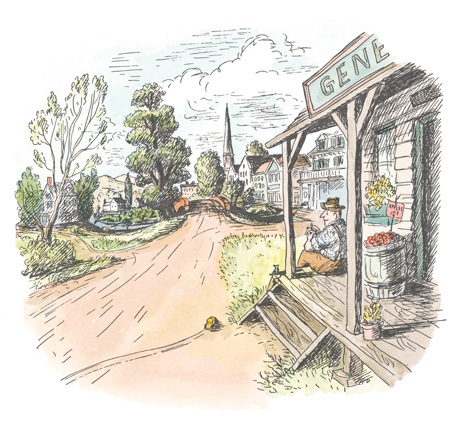
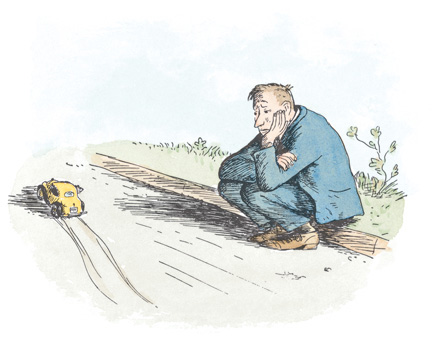
Just as the sun was coming up, Stuart saw a man seated in thought by the side of the road. Stuart steered his car alongside, stopped, and put his head out.
“You’re worried about something, aren’t you?” asked Stuart.
“Yes, I am,” said the man, who was tall and mild.
“Can I help you in any way?” asked Stuart in a friendly voice.
The man shook his head. “It’s an impossible situation, I guess,” he replied. “You see, I’m the Superintendent of Schools in this town.”
“That’s not an impossible situation,” said Stuart. “It’s bad, but it’s not impossible.”
“Well,” continued the man, “I’ve always got problems that I can’t solve. Today, for instance, one of my teachers is sick—Miss Gunderson her name is. She teaches Number Seven school. I’ve got to find a substitute for her, a teacher who will take her place.”
“What’s the matter with her?” asked Stuart.
“I don’t know, exactly. The doctor says she may have rhinestones,” replied the Superintendent.
“Can’t you find another teacher?” asked Stuart.
“No, that’s the trouble. There’s nobody in this town who knows anything; no spare teachers, no anything. School is supposed to begin in an hour.”
“I will be glad to take Miss Gunderson’s place for a day, if you would like,” suggested Stuart agreeably.
The Superintendent of Schools looked up.
“Really?”
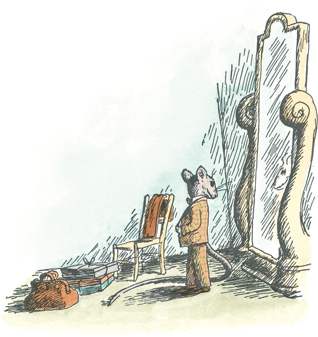
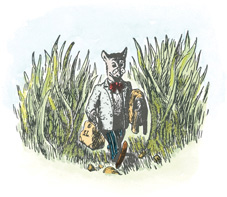
“Certainly,” said Stuart. “Glad to.” He opened the door of the little car and stepped out. Walking around to the rear, he opened the baggage compartment and took out his suitcase. “If I’m to conduct a class in a schoolroom, I’d better take off these motoring togs and get into something more suitable,” he said. Stuart climbed the bank, went into the bushes, and was back in a few minutes wearing a pepper-and-salt jacket, old striped trousers, a Windsor tie, and spectacles. He folded his other clothes and packed them away in the suitcase.
“Do you think you can maintain discipline?” asked the Superintendent.
“Of course I can,” replied Stuart. “I’ll make the work interesting and the discipline will take care of itself. Don’t worry about me.”
The man thanked him and they shook hands.
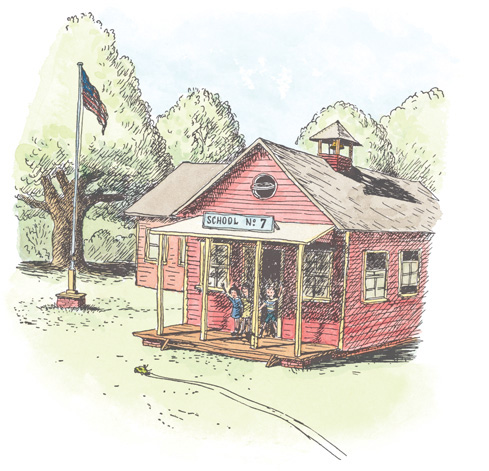
At quarter before nine the scholars had gathered in School Number Seven. When they missed Miss Gunderson and word got round that there would be a substitute, they were delighted.
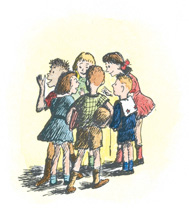
“A substitute!” somebody whispered to somebody else. “A substitute, a substitute!”
The news traveled fast, and soon everyone in the schoolroom knew that they were all to have a rest from Miss Gunderson for at least a day and were going to have the wonderful experience of being taught by a strange teacher whom nobody had ever seen before.
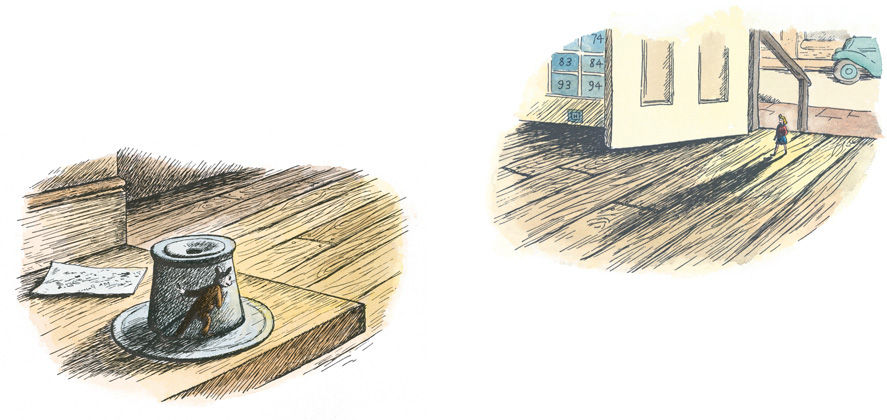
Stuart arrived at nine. He parked his car briskly at the door of the school, stalked boldly into the room, found a yardstick leaning against Miss Gunderson’s desk, and climbed hand-over-hand to the top. There he found an inkwell, a pointer, some pens and pencils, a bottle of ink, some chalk, a bell, two hairpins, and three or four books in a pile. Stuart scrambled nimbly up to the top of the stack of books and jumped for the button on the bell. His weight was enough to make it ring, and Stuart promptly slid down, walked to the front of the desk, and said:
“Let me have your attention, please!”
The boys and girls crowded around the desk to look at the substitute. Everyone talked at once, and they seemed to be very much pleased. The girls giggled and the boys laughed and everyone’s eyes lit up with excitement to see such a small and good-looking teacher, so appropriately dressed.
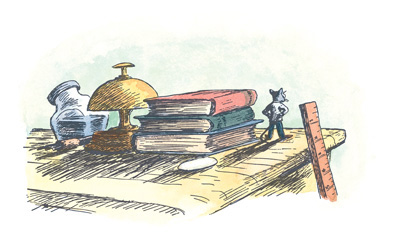
“Let me have your attention, please!” repeated Stuart. “As you know, Miss Gunderson is sick and I am taking her place.”
“What’s the matter with her?” asked Roy Hart, eagerly.
“Vitamin trouble,” replied Stuart. “She took Vitamin D when she needed A. She took B when she was short of C, and her system became overloaded with riboflavin, thiamine hydrochloride, and even with pyridoxine, the need for which in human nutrition has not been established. Let it be a lesson for all of us!” He glared fiercely at the children and they made no more inquiries about Miss Gunderson.
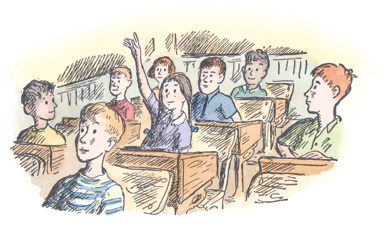
“Everyone will now take his or her seat!” commanded Stuart. The pupils filed obediently down the aisles and dropped into their seats, and in a moment there was silence in the classroom. Stuart cleared his throat. Seizing a coat lapel in either hand, to make himself look like a professor, Stuart began:
“Anybody absent?”
The scholars shook their heads.
They shook their heads.
“Very well,” said Stuart, “what’s the first subject you usually take up in the morning?”
“Arithmetic,” shouted the children.
“Bother arithmetic!” snapped Stuart. “Let’s skip it.”
There were wild shouts of enthusiasm at this suggestion. Everyone in the class seemed perfectly willing to skip arithmetic for one morning.
“What next do you study?” asked Stuart.
“Spelling,” cried the children.
“Well,” said Stuart, “a misspelled word is an abomination in the sight of everyone. I consider it a very fine thing to spell words correctly and I strongly urge every one of you to buy a Webster’s Collegiate Dictionary and consult it whenever you are in the slightest doubt. So much for spelling. What’s next?”
The scholars were just as pleased to be let out of spelling as they were about arithmetic, and they shouted for joy, and everybody looked at everybody else and laughed and waved handkerchiefs and rulers, and some of the boys threw spit balls at some of the girls. Stuart had to climb onto the pile of books again and dive for the bell to restore order. “What’s next?” he repeated.
“Writing,” cried the scholars.
“Goodness,” said Stuart in disgust, “don’t you children know how to write yet?”
“Certainly we do!” yelled one and all.
“So much for that, then,” said Stuart.
“Social studies come next,” cried Elizabeth Gardner, eagerly.
“Social studies? Never heard of them,” said Stuart. “Instead of taking up any special subject this morning, why wouldn’t it be a good idea if we just talked about something.”
The scholars glanced around at each other in expectancy.
“Could we talk about the way it feels to hold a snake in your hand and then it winds itself around your wrist?” asked Arthur Greenlaw.
“We could, but I’d rather not,” replied Stuart.
“Could we talk about sin and vice?” pleaded Lydia Lacey.
“Nope,” said Stuart. “Try again.”
“Could we talk about the fat woman at the circus and she had hair all over her chin?” begged Isidor Feinberg, reminiscently.
“No,” said Stuart. “I’ll tell you, let’s talk about the King of the World.” He looked all around the room hopefully to see how the children liked that idea.
“There isn’t any King of the World,” said Harry Jamieson in disgust.
“What’s the diff?” said Stuart. “There ought to be one.”
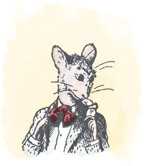
“Kings are old-fashioned,” said Harry.
“Well, all right then, let’s talk about the Chairman of the World. The world gets into a lot of trouble because it has no chairman. I would like to be Chairman of the World myself.”
“You’re too small,” said Mary Bendix.
“Oh, fish feathers!” said Stuart. “Size has nothing to do with it. It’s temperament and ability that count. The Chairman has to have ability and he must know what’s important. How many of you know what’s important?”
Up went all the hands.
“Very good,” said Stuart, cocking one leg across the other and shoving his hands in the pockets of his jacket. “Henry Rackmeyer, you tell us what is important.”
“A shaft of sunlight at the end of a dark afternoon, a note in music, and the way the back of a baby’s neck smells if its mother keeps it tidy,” answered Henry.
“Correct,” said Stuart. “Those are the important things. You forgot one thing, though. Mary Bendix, what did Henry Rackmeyer forget?”
“He forgot ice cream with chocolate sauce on it,” said Mary quickly.
“Exactly,” said Stuart. “Ice cream is important. Well now, if I’m going to be Chairman of the World this morning, we’ve got to have some rules, otherwise it will be too confusing, with everyone running every which way and helping himself to things and nobody behaving. We’ve got to have some laws if we’re going to play this game. Can anybody suggest any good laws for the world?”
Albert Fernstrom raised his hand. “Don’t eat mushrooms, they might be toadstools,” suggested Albert.
“That’s not a law,” said Stuart, “that’s merely a bit of friendly advice. Very good advice, Albert, but advice and law are not the same. Law is much more solemn than advice. Law is extremely solemn. Anybody else think of a law for the world?”
“Nix on swiping anything,” suggested John Poldowski, solemnly.
“Very good,” said Stuart. “Good law.”
“Never poison anything but rats,” said Anthony Brendisi.
“That’s no good,” said Stuart. “It’s unfair to rats. A law has to be fair to everybody.”
Anthony looked sulky. “But rats are unfair to us,” he said. “Rats are objectionable.”
“I know they are,” said Stuart. “But from a rat’s point of view, poison is objectionable. A Chairman has to see all sides to a problem.”
“Have you got a rat’s point of view?” asked Anthony. “You look a little like a rat.”
“No,” replied Stuart, “I have more the point of view of a mouse, which is very different. I see things whole. It’s obvious to me that rats are underprivileged. They’ve never been able to get out in the open.”
“Rats don’t like the open,” said Agnes Beretska.
“That’s because whenever they come out, somebody socks them. Rats might like the open if they were allowed to use it. Any other ideas for laws?”
Agnes Beretska raised her hand. “There ought to be a law against fighting.”
“Impractical,” said Stuart. “Men like to fight. But you’re getting warm, Agnes.”
“No scrapping?” asked Agnes, timidly. Stuart shook his head.
“Absolutely no being mean,” suggested Mildred Hoffenstein.
“Very fine law,” said Stuart. “When I am Chairman, anybody who is mean to anybody else is going to catch it.”
“That won’t work,” remarked Herbert Prendergast. “Some people are just naturally mean. Albert Fernstrom is always being mean to me.”
“I’m not saying it’ll work,” said Stuart. “It’s a good law and we’ll give it a try. We’ll give it a try right here and now. Somebody do something mean to somebody. Harry Jamieson, you be mean to Katharine Stableford. Wait a minute, now, what’s that you’ve got in your hand, Katharine?”
“It’s a little tiny pillow stuffed with sweet balsam.”
“Does it say ‘For you I pine, for you I balsam’ on it?”
“Yes,” said Katharine.
“Do you love it very much?” asked Stuart.
“Yes, I do,” said Katharine.
“O.K., Harry, grab it, take it away!”
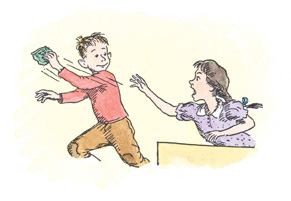
Harry ran over to where Katharine sat, grabbed the little pillow from her hand, and ran back to his seat, while Katharine screamed.
“Now then,” said Stuart in a fierce voice, “hold on, my good people, while your Chairman consults the book of rules!” He pretended to thumb through a book. “Here we are. Page 492. ‘Absolutely no being mean.’ Page 560. ‘Nix on swiping anything.’ Harry Jamieson has broken two laws—the law against being mean and the law against swiping. Let’s get Harry and set him back before he becomes so mean people will hardly recognize him any more! Come on!”
Stuart ran for the yardstick and slid down, like a fireman coming down a pole in a firehouse. He ran toward Harry, and the other children jumped up from their seats and raced up and down the aisles and crowded around Harry while Stuart demanded that he give up the little pillow. Harry looked frightened, although he knew it was just a test. He gave Katharine the pillow.
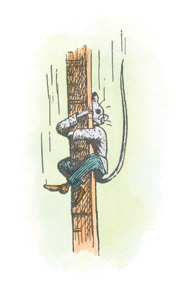
“There, it worked pretty well,” said Stuart. “No being mean is a perfectly good law.” He wiped his face with his handkerchief, for he was quite warm from the exertion of being Chairman of the World. It had taken more running and leaping and sliding than he had imagined. Katharine was very much pleased to have her pillow back.
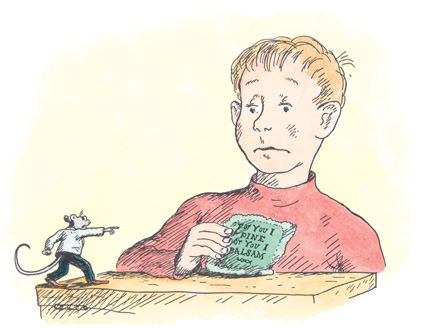
“Let’s see that little pillow a minute,” said Stuart, whose curiosity was beginning to get the better of him. Katharine showed it to him. It was about as long as Stuart was high, and Stuart suddenly thought what a fine sweet-smelling bed it would make for him. He began to want the pillow himself.
“That’s a very pretty thing,” said Stuart, trying to hide his eagerness. “You don’t want to sell it, do you?”
“Oh, no,” replied Katharine. “It was a present to me.”
“I suppose it was given you by a boy you met at Lake Hopatcong last summer, and it reminds you of him,” murmured Stuart, dreamily.
“Yes, it was,” said Katharine, blushing.
“Ah,” said Stuart, “summers are wonderful, aren’t they, Katharine?”
“Yes, and last summer was the most wonderful summer I have ever had in all my life.”
“I can imagine,” replied Stuart. “You’re sure you wouldn’t want to sell that little pillow?”
Katharine shook her head.
“Don’t know as I blame you,” replied Stuart, quietly. “Summertime is important. It’s like a shaft of sunlight.”
“Or a note in music,” said Elizabeth Acheson.
“Or the way the back of a baby’s neck smells if its mother keeps it tidy,” said Marilyn Roberts.
Stuart sighed. “Never forget your summertimes, my dears,” he said. “Well, I’ve got to be getting along. It’s been a pleasure to know you all. Class is dismissed!”
Stuart strode rapidly to the door, climbed into the car, and with a final wave of the hand drove off in a northerly direction, while the children raced alongside and screamed “Good-by, good-by, good-by!” They all wished they could have a substitute every day, instead of Miss Gunderson.