MARGALO liked it so well at the Littles’ house she decided to stay for a while instead of returning to the open country. She and Stuart became fast friends, and as the days passed it seemed to Stuart that she grew more and more beautiful. He hoped she would never go away from him.
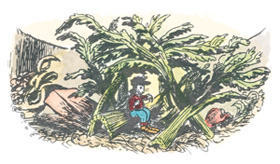
One day when Stuart had recovered from bronchitis he took his new skates and put on his ski pants and went out to look for an ice pond. He didn’t get far. The minute he stepped out into the street he saw an Irish terrier, so he had to shinny up an iron gate and jump into a garbage can, where he hid in a grove of celery.
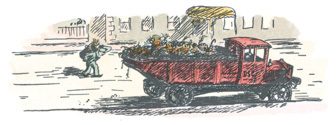
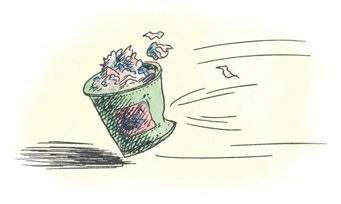
While he was there, waiting for the dog to go away, a garbage truck from the Department of Sanitation drove up to the curb and two men picked up the can. Stuart felt himself being hoisted high in the air. He peered over the side and saw that in another instant he and everything in the can would be dumped into the big truck.
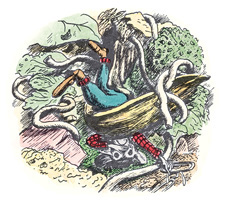
“If I jump now I’ll kill myself,” thought Stuart. So he ducked back into the can and waited. The men threw the can with a loud bump into the truck, where another man grabbed it, turned it upside down, and shook everything out. Stuart landed on his head, buried two feet deep in wet slippery garbage. All around him was garbage, smelling strong. Under him, over him, on all four sides of him—garbage. Just an enormous world of garbage and trash and smell. It was a messy spot to be in. He had egg on his trousers, butter on his cap, gravy on his shirt, orange pulp in his ear, and banana peel wrapped around his waist.
Still hanging on to his skates, Stuart tried to make his way up to the surface of the garbage, but the footing was bad. He climbed a pile of coffee grounds, but near the top the grounds gave way under him and he slid down and landed in a pool of leftover rice pudding.
“I bet I’m going to be sick at my stomach before I get out of this,” said Stuart.
He was anxious to work his way up to the top of the pile because he was afraid of being squashed by the next can-load of garbage. When at last he did succeed in getting to the surface, tired and smelly, he observed that the truck was not making any more collections but was rumbling rapidly along. Stuart glanced up at the sun. “We’re going east,” he said to himself. “I wonder what that means.”
There was no way for him to get out of the truck, the sides were too high. He just had to wait.
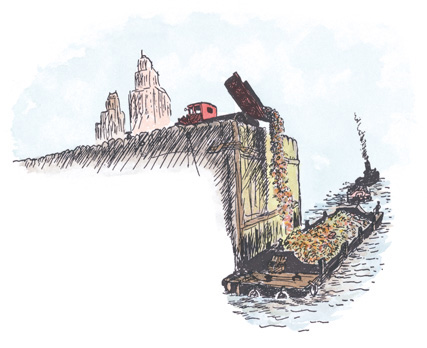
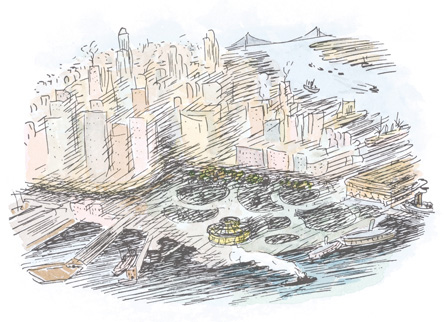
When the truck arrived at the East River, which borders New York City on the east and which is a rather dirty but useful river, the driver drove out onto the pier, backed up to a garbage scow, and dumped his load. Stuart went crashing and slithering along with everything else and hit his head so hard he fainted and lay quite still, as though dead. He lay that way for almost an hour, and when he recovered his senses he looked about him and saw nothing but water. The scow was being towed out to sea.
“Well,” thought Stuart, “this is about the worst thing that could happen to anybody. I guess this will be my last ride in this world.” For he knew that the garbage would be towed twenty miles out and dumped into the Atlantic Ocean. “I guess there’s nothing I can do about it,” he thought, hopelessly. “I’ll just have to sit here bravely and die like a man. But I wish I didn’t have to die with egg on my pants and butter on my cap and gravy on my shirt and orange pulp in my ear and banana peel wrapped around my middle.”
The thought of death made Stuart sad, and he began to think of his home and of his father and mother and brother and of Margalo and Snowbell and of how he loved them (all but Snowbell) and of what a pleasant place his home was, specially in the early morning with the light just coming in through the curtains and the household stirring and waking. The tears came into his eyes when he realized that he would never see them again. He was still sobbing when a small voice behind him whispered:
“Stuart!”
He looked around, through his tears, and there, sitting on a Brussels sprout, was Margalo.
“Margalo!” cried Stuart. “How did you get here?”
“Well,” said the bird, “I was looking out the window this morning when you left home and I happened to see you get dumped into the garbage truck, so I flew out the window and followed the truck, thinking you might need help.”
“I’ve never been so glad to see anybody in all my life,” said Stuart. “But how are you going to help me?”
“I think that if you’ll hang onto my feet,” said Margalo, “I can fly ashore with you. It’s worth trying anyway. How much do you weigh?”
“Three ounces and a half,” said Stuart.
“With your clothes on?” asked Margalo.
“Certainly,” replied Stuart, modestly.
“Then I believe I can carry you all right.”
“Suppose I get dizzy,” said Stuart.
“Don’t look down,” replied Margalo. “Then you won’t get dizzy.”
“Suppose I get sick at my stomach.”
“You’ll just have to be sick,” the bird replied. “Anything is better than death.”
“Yes, that’s true,” Stuart agreed.
“Hang on, then! We may as well get started.”
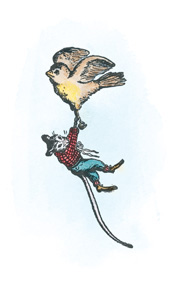
Stuart tucked his skates into his shirt, stepped gingerly onto a tuft of lettuce, and took a firm grip on Margalo’s ankles. “All ready!” he cried.
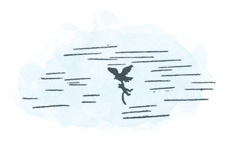
With a flutter of wings, Margalo rose into the sky, carrying Stuart along, and together they flew out over the ocean and headed toward home.
“Pew!” said Margalo, when they were high in the air, “you smell awful, Stuart.”
“I know I do,” he replied, gloomily. “I hope it isn’t making you feel bad.”
“I can hardly breathe,” she answered. “And my heart is pounding in my breast. Isn’t there something you could drop to make yourself lighter?”
“Well, I could drop these ice skates,” said Stuart.
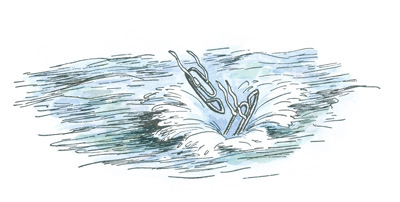
“Goodness me,” the little bird cried, “I didn’t know you had skates hidden in your shirt. Toss those heavy skates away quickly or we will both come down in the ocean and perish.” Stuart threw his skates away and watched them fall down, down, till they disappeared in the gray waves below. “That’s better,” said Margalo. “Now we’re all right. I can already see the towers and chimneys of New York.”
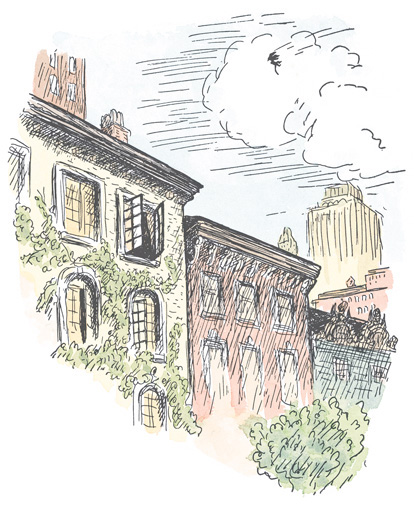
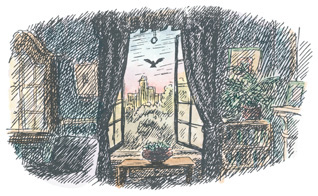
Fifteen minutes later, in they flew through the open window of the Littles’ living room and landed on the Boston fern. Mrs. Little, who had left the window up when she missed Margalo, was glad to see them back, for she was beginning to worry. When she heard what had happened and how near she had come to losing her son, she took Stuart in her hand, even though his clothes smelled nasty, and kissed him. Then she sent him upstairs to take a bath, and sent George out to take Stuart’s clothes to the cleaner.
“What was it like, out there in the Atlantic Ocean?” inquired Mr. Little, who had never been very far from home.
So Stuart and Margalo told all about the ocean, and the gray waves curling with white crests, and the gulls in the sky, and the channel buoys and the ships and the tugs and the wind making a sound in your ears. Mr. Little sighed and said some day he hoped to get away from business long enough to see all those fine things.
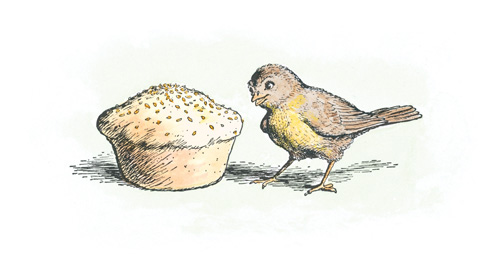
Everyone thanked Margalo for saving Stuart’s life; and at suppertime Mrs. Little presented her with a tiny cake, which had seeds sprinkled on top.
SNOWBELL, the cat, enjoyed nighttime more than daytime. Perhaps it was because his eyes liked the dark. But I think it was because there are always so many worth-while things going on in New York at night.
Snowbell had several friends in the neighborhood. Some of them were house cats, others were store cats. He knew a Maltese cat in the A & P, a white Persian in the apartment house next door, a tortoise-shell in the delicatessen, a tiger cat in the basement of the branch library, and a beautiful young Angora who had escaped from a cage in a pet shop on Third Avenue and had gone to live a free life of her own in the tool house of the small park near Stuart’s home.
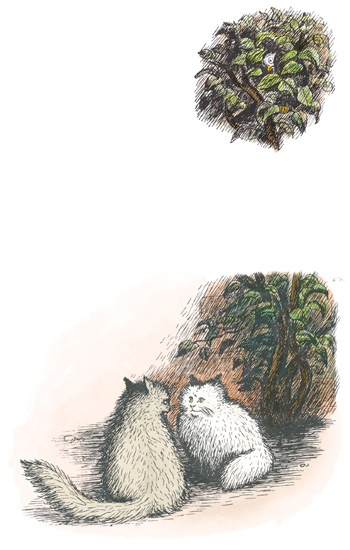
One fine spring evening Snowbell had been calling on the Angora in the park. He started home, late, and it was such a lovely night she said she would walk along with him to keep him company. When they got to Mr. Little’s house, the two cats sat down at the foot of a tall vine which ran up the side of the house past George’s bedroom. This vine was useful to Snowbell, because he could climb it at night and crawl into the house through George’s open window. Snowbell began telling his friend about Margalo and Stuart.
“Goodness,” said the Angora cat, “you mean to say you live in the same house with a bird and a mouse and don’t do anything about it?”
“That’s the situation,” replied Snowbell. “But what can I do about it? Please remember that Stuart is a member of the family, and the bird is a permanent guest, like myself.”
“Well,” said Snowbell’s friend, “all I can say is, you’ve got more self-control than I have.”
“Doubtless,” said Snowbell. “However, I sometimes think I’ve got too much self-control for my own good. I’ve been terribly nervous and upset lately, and I think it’s because I’m always holding myself in.”
The cats’ voices grew louder, and they talked so loudly that they never heard a slight rustling in the vine a few feet above their heads. It was a gray pigeon, who had been asleep there and who had awakened at the sound of cats and begun to listen. “This sounds like an interesting conversation,” said the pigeon to himself. “Maybe I’d better stay around and see if I can learn something.”
“Look here,” he heard the Angora cat say to Snowbell, “I admit that a cat has a duty toward her own people, and that under the circumstances it would be wrong for you to eat Margalo. But I’m not a member of your family and there is nothing to stop me from eating her, is there?”
“Nothing that I can think of offhand,” said Snowbell.
“Then here I go,” said the Angora, starting up the vine. The pigeon was wide awake by this time, ready to fly away; but the voices down below continued.
“Wait a minute,” said Snowbell, “don’t be in such a hurry. I don’t think you’d better go in there tonight.”
“Why not?” asked the other cat.
“Well, for one thing, you’re not supposed to enter our house. It’s unlawful entry, and you might get into trouble.”
“I won’t get into any trouble,” said the Angora.
“Please wait till tomorrow night,” said Snowbell, firmly. “Mr. and Mrs. Little will be going out tomorrow night, and you won’t be taking such a risk. It’s for your own good I’m suggesting this.”
“Oh, all right,” agreed the Angora. “I guess I can wait. But tell me where I’ll find the bird, after I do get in.”
“That’s simple,” said Snowbell. “Climb this vine, enter George’s room through the open window, then go downstairs and you’ll find the bird asleep in the Boston fern on the bookcase.”
“Easy enough,” said the Angora, licking her chops. “I’m obliged to you, sir.”
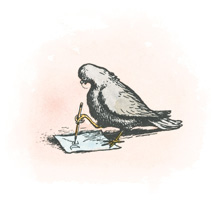
“Well, the old thing!” whispered the pigeon to himself, and he flew away quickly to find a piece of writing paper and a pencil. Snowbell said goodnight to his friend and climbed up the vine and went in to bed.
Next morning Margalo found a note on the branch of her fern when she woke. It said: BEWARE OF A STRANGE CAT WHO WILL COME BY NIGHT. It was signed A WELL WISHER. She kept the note under her wing all day long, wondering what she had better do, but she didn’t dare show it to anyone—not even to Stuart. She couldn’t eat, she was so frightened.
“What had I better do?” she kept saying to herself.
Finally, just before dark, she hopped up to an open window and without saying anything to anybody she flew away. It was springtime, and she flew north, just as fast as she could fly, because something inside her told her that north was the way for a bird to go when spring comes to the land.
FOR THREE days everybody hunted all over the house for Margalo without finding so much as a feather.
“I guess she had spring fever,” said George. “A normal bird doesn’t stay indoors this kind of weather.”
“Perhaps she has a husband somewhere and has gone to meet him,” suggested Mr. Little.
“She has not!” sobbed Stuart, bitterly. “That’s just a lot of nonsense.”
“How do you know?” asked George.
“Because I asked her one time,” cried Stuart. “She told me she was a single bird.”
Everybody questioned Snowbell closely, but the cat insisted he knew nothing about Margalo’s disappearance. “I don’t see why you have to make a pariah out of me just because that disagreeable little chippy flew the coop,” said Snowbell, irritably.
Stuart was heartbroken. He had no appetite, refused food, and lost weight. Finally he decided that he would run away from home without telling anybody, and go out into the world and look for Margalo. “While I am about it, I might as well seek my fortune, too,” he thought.
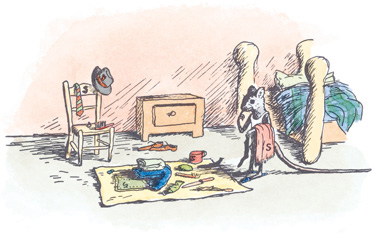
Before daybreak next morning he got out his biggest handkerchief and in it he placed his toothbrush, his money, his soap, his comb and brush, a clean suit of underwear, and his pocket compass.
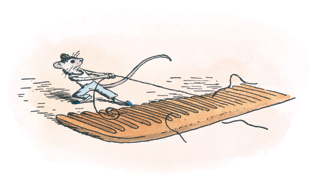
“I ought to take along something to remember my mother by,” he thought. So he crept into his mother’s bedroom where she was still asleep, climbed the lamp cord to her bureau, and pulled a strand of Mrs. Little’s hair from her comb. He rolled the hair up neatly and laid it in the handkerchief with the other things. Then he rolled everything up into a bundle and tied it onto one end of a wooden match. With his gray felt hat cocked jauntily on one side of his head and his pack slung across his shoulder, Stuart stole softly out of the house.
“Good-by, beautiful home,” he whispered. “I wonder if I will ever see you again.”
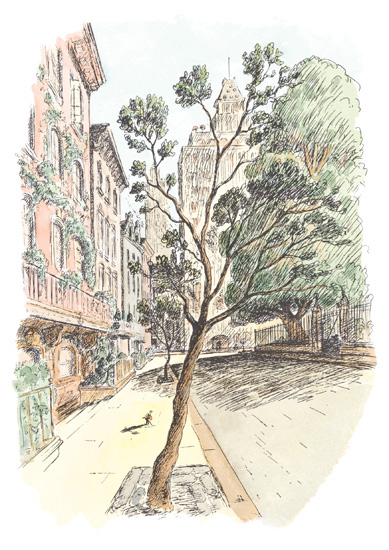
Stuart stood uncertainly for a moment in the street in front of the house. The world was a big place in which to go looking for a lost bird. North, south, east, or west—which way should he go? Stuart decided that he needed advice on such an important matter, so he started uptown to find his friend Dr. Carey, the surgeon-dentist, owner of the schooner Wasp.
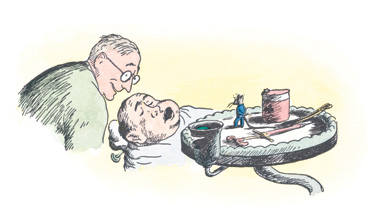
The doctor was glad to see Stuart. He took him right into his inner office where he was busy pulling a man’s tooth. The man’s name was Edward Clydesdale, and he had several wads of gauze in his cheek to hold his mouth open good and wide. The tooth was a hard one to get out, and the Doctor let Stuart sit on his instrument tray so they could talk during the operation.
“This is my friend, Stuart Little,” he said to the man with the gauze in his cheek.
“How ’oo oo, Soo’rt,” replied the man, as best he could.
“Very well, thank you,” replied Stuart.
“Well, what’s on your mind, Stuart?” asked Dr. Carey, seizing hold of the man’s tooth with a pair of pincers and giving a strong pull.
“I ran away from home this morning,” explained Stuart. “I am going out into the world to seek my fortune and to look for a lost bird. Which direction do you think I should start out in?”
Dr. Carey twisted the tooth a bit and racked it back and forth. “What color is the bird?” he asked.
“Brown,” said Stuart.
“Better go north,” said Dr. Carey. “Don’t you think so, Mr. Clydesdale?”
“’ook in ’entral ’ark,” said Mr. Clydesdale.
“What?” cried Stuart.
“I ’ay, ’ook in ’entral ’ark,” said Mr. Clydesdale.
“He says look in Central Park,” explained Dr. Carey, tucking another big wad of gauze into Mr. Clydesdale’s cheek. “And it’s a good suggestion. Oftentimes people with decayed teeth have sound ideas. Central Park is a favorite place for birds in the spring.” Mr. Clydesdale was nodding his head vigorously, and seemed about to speak again.
“If ’oo ’on’t ’ocate a ’ird in ’entral ’ark, ’ake a ’ew ’ork ’ew ’aven & ’artford ’ailway ’n ’ook in ’onnecticut.”
“What?” cried Stuart, delighted at this new kind of talk. “What say, Mr. Clydesdale?”
“If ’oo ’on’t ’ocate a ’ird in ’entral ’ark, ’ake a ’ew ’ork ’ew ’aven & ’artford ’ailway ’n ’ook in ’onnecticut.”
“He says if you can’t locate the bird in Central Park, take a New York New Haven & Hartford Railway train and look in Connecticut,” said Dr. Carey. Then he removed the rolls of gauze from Mr. Clydesdale’s mouth. “Rinse, please!” he said.
Mr. Clydesdale took a glass of mouthwash that was beside the chair and rinsed his mouth out.
“Tell me this, Stuart,” said Dr. Carey. “How are you traveling? On foot?”
“Yes, sir,” said Stuart.
“Well, I think you’d better have a car. As soon as I get this tooth out, we’ll see what can be done about it. Open, please, Mr. Clydesdale.”
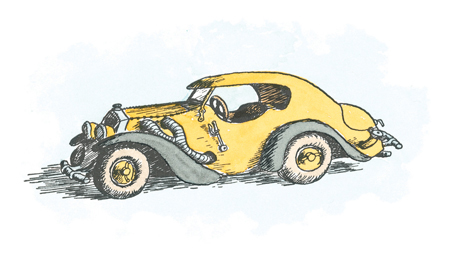
Dr. Carey grabbed the tooth with the pincers again, and this time he pulled so long and so hard and with such determination that the tooth popped out, which was a great relief to everybody, particularly to Mr. Clydesdale. The Doctor then led Stuart into another room. From a shelf he took a tiny automobile, about six inches long—the most perfect miniature automobile Stuart had ever seen. It was bright yellow with black fenders, a streamlined car of graceful design. “I made this myself,” Dr. Carey said. “I enjoy building model cars and boats and other things when I am not extracting teeth. This car has a real gasoline motor in it. It has quite a good deal of power—do you think you can handle it, Stuart?”
“Certainly,” replied Stuart, looking into the driver’s seat and blowing the horn. “But isn’t it going to attract too much attention? Won’t everybody stop and stare at such a small automobile?”
“They would if they could see you,” replied Dr. Carey, “but nobody will be able to see you, or the car.”
“Why not?” asked Stuart.
“Because this automobile is a thoroughly modern car. It’s not only noiseless, it’s invisible. Nobody can see it.”
“I can see it,” remarked Stuart.
“Push that little button!” said the Doctor, pointing to a button on the instrument panel. Stuart pushed the button. Instantly the car vanished from sight.
“Now push it again,” said the Doctor.
“How can I push it when I can’t see it?” asked Stuart.
“Feel around for it.”
So Stuart felt around until his hand came in contact with a button. It seemed like the same button, and Stuart pushed it. He heard a slight grinding noise and felt something slip out from under his hand.
“Hey, watch out!” yelled Dr. Carey. “You pushed the starter button. She’s off! There she goes! She’s away! She’s loose in the room—now we’ll never catch her.” He grabbed Stuart up and placed him on a table where he wouldn’t be hit by a runaway car.
“Oh, mercy! Oh, mercy!” Stuart cried when he realized what he had done. It was a very awkward situation. Neither Dr. Carey nor Stuart could see the little automobile, yet it was rushing all over the room under its own power, bumping into things. First there came a crashing noise over by the fireplace. The hearth broom fell down. Dr. Carey leapt for the spot and pounced on the place where the sound had come from. But though he was quick, he had hardly got his hands on the place when there was another crash over by the wastebasket. The Doctor pounced again. Pounce! Crash! Pounce! Crash! The Doctor was racing all over the room, pouncing and missing. It is almost impossible to catch a speedy invisible model automobile even when one is a skillful dentist.
“Oh, oh,” yelled Stuart, jumping up and down. “I’m sorry, Dr. Carey, I’m dreadfully sorry!”
“Get a butterfly net!” shouted the Doctor.
“I can’t,” said Stuart. “I’m not big enough to carry a butterfly net.”
“That’s true,” said Dr. Carey. “I forgot. My apologies, Stuart.”
“The car is bound to stop sometime,” said Stuart, “because it will run out of gas.”
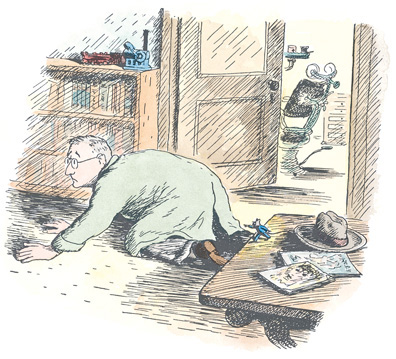
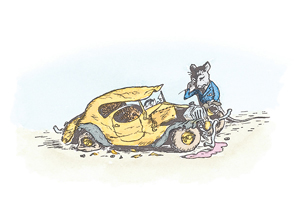
“That’s true, too,” said the Doctor. And so he and Stuart sat down and waited patiently until they no longer heard any crashing sounds in the room. Then the Doctor got down on his hands and knees and crawled cautiously all over, feeling here and there, until at last he found the car. It was in the fireplace, buried up to its hubs in wood ashes. The Doctor pressed the proper button and there it stood in plain sight again, its front fenders crumpled, its radiator leaking, its headlights broken, its windshield shattered, its right rear tire punctured, and quite a bit of yellow paint scratched off the hood.
“What a mess!” groaned the Doctor. “Stuart, I hope this will be a lesson to you: never push a button on an automobile unless you are sure of what you are doing.”
“Yes, sir,” answered Stuart, and his eyes filled with tears, each tear being smaller than a drop of dew. It had been an unhappy morning, and Stuart was already homesick. He was sure that he was never going to see Margalo again.