Chapter 18
THE LITTLE PRINCE crossed the desert and encountered only one flower. A flower with three petals – a flower of no consequence…
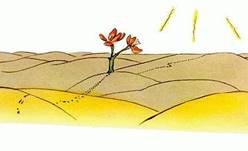
“Good morning,” said the little prince.
“Good morning,” said the flower.
“Where are the people?” the little prince inquired politely.
The flower had one day seen a caravan passing.
“People? There are six or seven of them, I believe, in existence. I caught sight of them years ago. But you never know where to find them. The wind blows them away. They have no roots, which hampers them a good deal.”
“Good-bye,” said the little prince.
“Good-bye,” said the flower.
Chapter 19
TTHE LITTLE PRINCE climbed a high mountain. The only mountains he had ever known were the three volcanoes, which came up to his knee. And he used the extinct volcano as a footstool. “From a mountain as high as this one,” he said to himself, “I’ll get a view of the whole planet and all the people on it…”
But he saw nothing but rocky peaks as sharp as needles.
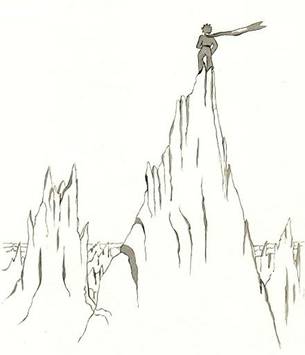
“Hello,” he said, just in case.
“Hello…” hello…” hello…” the echo answered.
“Who are you?” asked the little prince.
“Who are you… who are you… who are you…” the echo answered.
“Let’s be friends. I’m lonely,” he said.
“I’m lonely… I’m lonely… I’m lonely…” the echo answered.
“What a peculiar planet!” he thought. “It’s all dry and sharp and hard. And people here have no imagination. They repeat whatever you say to them. Where I live I had a flower: She always spoke first…”
Chapter 20
BUT IT SO HAPPENED that the little prince, having walked a long time through sand and rocks and snow, finally discovered a road. And all roads go to where there are people.
“Good morning,” he said.
It was a blossoming rose garden.
“Good morning,” said the roses.
The little prince gazed at them. All of them looked like his flower.
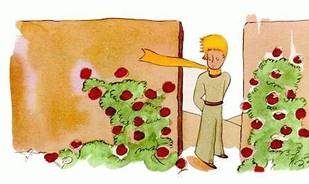
“Who are you?” he asked, astounded.
“We’re roses,” the roses said.
“Ah!” said the little prince.
And he felt very unhappy. His flower had told him she was the only one of her kind in the whole universe. And here were five thousand of them, all just alike, in just one garden!
“She would be very annoyed,” he said to himself, “if she saw this…”She would cough terribly and pretend to be dying, to avoid being laughed at. And I’d have to pretend to be nursing her; otherwise, she’d really let herself die in order to humiliate me.”
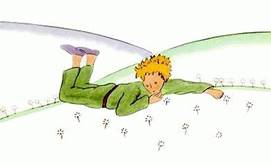
And then he said to himself, “I thought I was rich because I had just one flower, and all I own is an ordinary rose. That and my three volcanoes, which come up to my knee, one of which may be permanently extinct. It doesn’t make me much of a prince…” And he lay down in the grass and wept.
Chapter 21
IT WAS THEN that the fox appeared.
“Good morning,” said the fox.
“Good morning,” the little prince answered politely, though when he turned around he saw nothing.
“I’m here,” the voice said, “under the apple tree.”
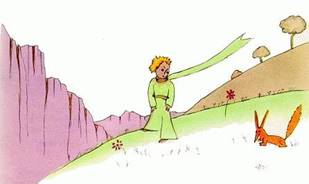
“Who are you?” the little prince asked. “You’re very pretty…”
“I’m a fox,” the fox said.
“Come and play with me,” the little prince proposed. “I’m feeling so sad.”
“I can’t play with you,” the fox said. “I’m not tamed.”
“Ah! Excuse me,” said the little prince. But upon reflection he added, “What does 'tamed' mean?”
“You’re not from around here,” the fox said. “What are you looking for?”
“I’m looking for people,” said the little prince. “What does tamed mean?”
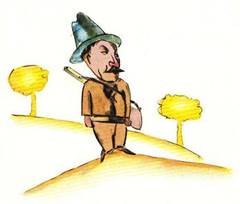
“People,” said the fox, “have guns and they hunt. It’s quite troublesome. And they also raise chickens. That’s the only interesting thing about them. Are you looking for chickens?”
“No,” said the little prince, “I’m looking for friends. What does tamed mean?”
“It’s something that’s been too often neglected. It means, 'to create ties'…”
“To create ties?”
“That’s right,” the fox said. “For me you’re only a little boy just like a hundred thousand other little boys. And I have no need of you. And you have no need of me, either. For you I’m only a fox like a hundred thousand other foxes. But if you tame me, we’ll need each other. You’ll be the only boy in the world for me. I’ll be the only fox in the world for you…”
“I’m beginning to understand,” the little prince said. “There’s a flower… I think she’s tamed me…”
“Possibly.” the fox said. “On Earth, one sees all kinds of things.”
“Oh, this isn’t on Earth,” the little prince said.
The fox seemed quite intrigued.
“On another planet?”
“Yes.”
“Are there hunters on that planet?”
“No.”
“Now that’s interesting. And chickens?”
“No.”
“Nothing’s perfect,” sighed the fox.
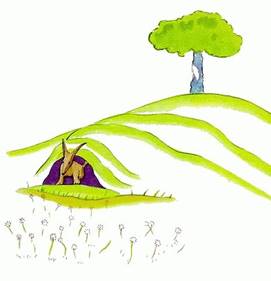
But he returned to his idea. “My life is monotonous. I hunt chickens; people hunt me. All chickens are just alike, and all men are just alike. So I’m rather bored. But if you tame me, my life will be filled with sunshine. I’ll know the sound of footsteps that will be different from all the rest. Other footsteps send me back underground. Yours will call me out of my burrow like music. And then, look! You see the wheat fields over there? I don’t eat bread. For me wheat is of no use whatever. Wheat fields say nothing to me. Which is sad. But you have hair the color of gold. So it will be wonderful, once you’ve tamed me! The wheat, which is golden, will remind me of you. And I’ll love the sound of the wind in the wheat...”
The fox fell silent and stared at the little prince for a long while. “Please… tame me!” he said.
“I’d like to,” the little prince replied, “but I haven’t much time. I have friends to find and so many things to learn.”
“The only things you learn are the things you tame,” said the fox. “People haven’t time to learn anything. They buy things ready-made in stores. But since there are no stores where you can buy friends, people no longer have friends. If you want a friend, tame me!”
“What do I have to do?” asked the little prince.
“You have to be very patient,” the fox answered. “First you’ll sit down a little ways away from me, over there, in the grass. I’ll watch you out of the corner of my eye, and you won’t say anything. Language is the source of misunderstandings. But day by day, you’ll be able to sit a little closer…”
The next day the little prince returned.
“It would have been better to return at the same time,” the fox said. “For instance, if you come at four in the afternoon, I’ll begin to be happy by three. The closer it gets to four, the happier I’ll feel. By four I’ll be all excited and worried; I’ll discover what it costs to be happy! But if you come at any old time, I’ll never know when I should prepare my heart…” There must be rites.”
“What’s a rite?” asked the little prince.
“That’s another thing that’s been too often neglected,” said the fox. “It’s the fact that one day is different from the other days, one hour from the other hours. My hunters, for example, have a rite. They dance with the village girls on Thursdays.
“So Thursday’s a wonderful day: I can take a stroll all the way to the vineyards. If the hunters danced whenever they chose, the days would all be just alike, and I’d have no holiday at all.”
That was how the little prince tamed the fox. And when the time to leave was near:
“Ah!” the fox said. “I shall weep.”
“It’s your own fault,” the little prince said. “I never wanted to do you any harm, but you insisted that I tame you…”
“Yes, of course,” the fox said.
“But you’re going to weep!” said the little prince.
“Yes, of course,” the fox said.
“Then you get nothing out of it?”
“I get something,” the fox said, “because of the color of the wheat.” Then he added, “Go look at the roses again. You’ll understand that yours is the only rose in all the world. Then come back to say good-bye, and I’ll make you the gift of a secret.”
The little prince went to look at the roses again.
“You’re not at all like my rose. You’re nothing at all yet,” he told them. “No one has tamed you and you haven’t tamed anyone. You’re the way my fox was. He was just a fox like a hundred thousand others. But I’ve made him my friend, and now he’s the only fox in all the world.”
And the roses were humbled.
“You are lovely, but you’re empty,” he went on. “One couldn’t die for you. Of course, an ordinary passerby would think my rose looked just like you. But my rose, all on her own, is more important than all of you together, since she’s the one I’ve watered. Since she’s the one I put under glass. Since she’s the one I sheltered behind a screen. Since she’s the one for whom I killed the caterpillars (except the two or three for butterflies). Since she’s the one I listened to when she complained, or when she boasted, or even sometimes when she said nothing at all. Since she’s my rose.”
And he went back to the fox.
“Good-bye,” he said.
“Good-bye,” said the fox. “Here is my secret. It’s quite simple: One sees clearly only with the heart. Anything essential is invisible to the eyes.”
“Anything essential is invisible to the eyes,” the little prince repeated, in order to remember.
“It’s the time you spent on your rose that makes your rose so important.”
“It’s the time I spent on my rose…” the little prince repeated, in order to remember.
“People have forgotten this truth,” the fox said. “But you mustn’t forget it. You become responsible forever for what you’ve tamed. You’re responsible for your rose…”
“I’m responsible for my rose…” the little prince repeated, in order to remember.
Chapter 22
GOOD MORNING,” said the little prince.
“Good morning,” said the railway switchman.
“What is it that you do here?” asked the little prince.
“I sort the travelers into bundles of a thousand,” the switchman said. “I dispatch the trains that carry them, sometimes to the right, sometimes to the left.”
And a brightly lit express train, roaring like thunder, shook the switchman’s cabin.
“What a hurry they’re in,” said the little prince. “What are they looking for?”
“Not even the engineer on the locomotive knows,” the switchman said.
And another brightly lit express train thundered by in the opposite direction.
“Are they coming back already?” asked the little prince.
“They’re not the same ones,” the switchman said. “It’s an exchange.”
“They weren’t satisfied, where they were?” asked the little prince.
“No one is ever satisfied where he is,” the switchman said.
And a third brightly lit express train thundered past.
“Are they chasing the first travelers?” asked the little prince.
“They’re not chasing anything,” the switchman said. “They’re sleeping in there, or else they’re yawning. Only the children are pressing their noses against the windowpanes.”
“Only the children know what they’re looking for,” said the little prince. “They spend their time on a rag doll and it becomes very important, and if it’s taken away from them, they cry…”
“They’re lucky,” the switchman said.
Chapter 23
“OOD MORNING,” said the little prince.
“Good morning,” said the salesclerk. This was a salesclerk who sold pills invented to quench thirst. Swallow one a week and you no longer feel any need to drink.
“Why do you sell these pills?”
“They save so much time,” the salesclerk said. “Experts have calculated that you can save fifty- three minutes a week.”
“And what do you do with those fifty-three minutes?”
“Whatever you like.”
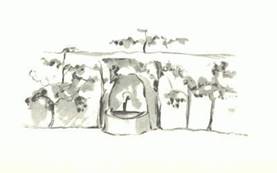
“If I had fifty-three minutes to spend as I liked,” the little prince said to himself, “I’d walk very slowly toward a water fountain…”
Chapter 24
IT WAS NOW the eighth day since my crash landing in the desert, and I’d listened to the story about the salesclerk as I was drinking the last drop of my water supply.
“Ah,” I said to the little prince, “your memories are very pleasant, but I haven’t yet repaired my plane. I have nothing left to drink, and I, too, would be glad to walk very slowly toward a water fountain!”
“My friend the fox told me -”
“Little fellow, this has nothing to do with the fox!”
“Why?”
“Because we’re going to die of thirst.”
The little prince didn’t follow my reasoning, and answered me, “It’s good to have had a friend, even if you’re going to die. Myself, I’m very glad to have had a fox for a friend.”
“He doesn’t realize the danger,” I said to myself. “He’s never hungry or thirsty. A little sunlight is enough for him…”
But the little prince looked at me and answered my thought. “I’m thirsty, too… Let’s find a well…”
I made an exasperated gesture. It is absurd looking for a well, at random, in the vastness of the desert. But even so, we started walking.
When we had walked for several hours in silence, night fell and stars began to appear. I noticed them as in a dream, being somewhat feverish on account of my thirst. The little prince’s words danced in my memory.
“So you’re thirsty, too?” I asked.
But he didn’t answer my question. He merely said to me, “Water can also be good for the heart…”
I didn’t understand his answer, but I said nothing…” I knew by this time that it was no use questioning him.
He was tired. He sat down. I sat down next to him. And after a silence, he spoke again. “The stars are beautiful because of a flower you don’t see…”
I answered, “Yes, of course,” and without speaking another word I stared at the ridges of sand in the moonlight.
“The desert is beautiful,” the little prince added.
And it was true. I’ve always loved the desert. You sit down on a sand dune. You see nothing. You hear nothing. And yet something shines, something sings in that silence…
“What makes the desert beautiful,” the little prince said, “is that it hides a well somewhere…”
I was surprised by suddenly understanding that mysterious radiance of the sands. When I was a little boy I lived in an old house, and there was a legend that a treasure was buried in it somewhere.
Of course, no one was ever able to find the treasure, perhaps no one even searched. But it cast a spell over that whole house. My house hid a secret in the depths of its heart…
“Yes,” I said to the little prince, “whether it’s a house or the stars or the desert, what makes them beautiful is invisible!”
“I’m glad,” he said, “you agree with my fox.”
As the little prince was falling asleep, I picked him up in my arms, and started walking again. I was moved.
It was as if I was carrying a fragile treasure. It actually seemed to me there was nothing more fragile on Earth.
By the light of the moon, I gazed at that pale forehead, those closed eyes, those locks of hair trembling in the wind, and I said to myself, “What I’m looking at is only a shell. What’s most important is invisible…”
As his lips parted in a half smile, I said to myself, again, “What moves me so deeply about this sleeping little prince is his loyalty to a flower – the image of a rose shining within him like the flame within a lamp, even when he’s asleep…” And I realized he was even more fragile than I had thought. Lamps must be protected: a gust of wind can blow them out…”
And walking on like that, I found the well at daybreak.