
The countess Quintet had discovered that it was a somewhat messy affair to have an elephant in one’s ballroom, and so, for matters of delicacy and cleanliness, she engaged the services of a small, extremely unobtrusive man whose job it was to stand behind the elephant, ever at the ready with a bucket and a shovel. The little man’s back was bent and twisted, and because of this, it was almost impossible for him to lift his face and look directly at anyone or anything.
He viewed everything sideways.
His name was Bartok Whynn, and before he came to stand perpetually and forever at the rear of the elephant, he had been a stonecutter who labored high atop the city’s largest and most magnificent cathedral, working at coaxing gargoyles from stone. Bartok Whynn’s gargoyles were well and truly frightening, each different from the others and each more horrifying than the one that had preceded it.
On a day in late summer, the summer before the winter the elephant arrived in Baltese, Bartok Whynn was engaged in the task of bringing to life the most gruesome gargoyle he had yet conceived when he lost his footing and fell. Because he was so high atop the cathedral, it took him quite a long time to reach the ground. The stonecutter had time to think.
What he thought was, I am going to die.
This thought was followed by another thought: But I know something. I know something. What is it I know?
It came to him then. Ah, yes, I know what I know. Life is funny. That is what I know.
And falling through the air, he actually laughed aloud. The people on the street below heard him. They exclaimed over it among themselves: “Imagine a man falling to his death and laughing all the while!”
Bartok Whynn hit the ground, and his broken, bleeding, and unconscious body was borne by his fellow stonecutters through the streets and home to his wife, who equivocated between sending for the funeral director and sending for the doctor.
She settled, finally, upon the doctor.
“His back is broken and he cannot survive,” the doctor told Bartok Whynn’s wife. “It is not possible for any man to survive such a fall. That he has lived this long is some miracle that we cannot understand and should only be grateful for. Surely it has some meaning beyond our understanding.”
Bartok Whynn, who had, up to this point, been unconscious, made a small sound and took hold of the doctor’s great coat and gestured for him to come close.
“Wait only,” said the doctor. “Attend, madam. Now he will deliver the words, the important words, the great message that he has been spared in order to speak. You may give those words to me, sir. Give them to me.” And with a flourish, the doctor flung his coat to the side and bent over Bartok’s broken body and offered him his ear.
“Heeeeeeeeeeee,” whispered Bartok Whynn into the doctor’s ear, “heee, heee.”
“What does he say?” said the wife.
The doctor stood up. His face was very pale. “Your husband says nothing,” he said.
“Nothing?” said the wife.
Bartok tugged again at the doctor’s coat. Again, the doctor bent and offered his ear, but this time with markedly less enthusiasm.
“Heeeeeeeeeeee,” laughed Bartok Whynn into the doctor’s ear, “heeeee, heee.”
The doctor stood up. He straightened his coat.
“He said nothing?” said the wife. She wrung her hands.
“Madam,” said the doctor, “he laughs. He has lost his mind. His life is to follow. I tell you he will not, he cannot, live.”
But the stonecutter’s broken back healed in its strange and crooked way, and he lived.
Before the fall, Bartok Whynn was a dour man who measured five feet nine inches and who laughed, at most, once a fortnight. After the fall, he measured four feet eleven inches, and he laughed darkly, knowingly, daily, hourly, at everything and nothing at all. The whole of existence struck him as cause for hilarity.
He went back to work high atop the cathedral. He held the chisel in his hand. He stood before the stone. But he could not stop laughing long enough to coax anything from it. He laughed and laughed, his hands shook, the stone remain untouched, the gargoyles did not appear, and Bartok Whynn was dismissed from his job.
That is how he came, in the end, to stand behind the elephant with a bucket and a shovel. His new position in life did not at all, in any way, diminish his propensity for hilarity. If anything, if possible, he laughed more. He laughed harder.
Bartok Whynn laughed.
And so when Peter, late in the day, in the perpetual, unvarying gloom of the Baltesian winter afternoon, finally stepped through the elephant door and into the brightly lit ballroom of the countess Quintet, what he heard was laughter.
The elephant, at first, was not visible to him.
There were so many people gathered around her that she was obscured entirely. But then, as Peter got closer and closer still, she was finally, and at last, revealed. She was both larger and smaller than he had expected her to be. And the sight of her, her head hung low, her eyes closed, made his heart feel tight in his chest.
“Move along — ha, ha, hee!” shouted a small man with a shovel. “Wheeeeee! You must move along so that everyone, everyone, may view the elephant.”
Peter took his hat from his head. He held it over his heart. He inched close enough to put his hand on the rough, solid flank of the elephant. She was moving, swaying from side to side. The warmth of her astonished him. Peter shoved at the people surrounding him and managed to get his face up next to hers so that he could say what he had come to say, ask what he had come to ask.
“Please,” he said, “you know where my sister is. Can you tell me?”
And then he felt terrible for saying anything at all. She seemed so tired and sad. Was she asleep?
“Move along, move along — ha, ha, hee!” shouted the little man.
“Please,” whispered Peter to the elephant, “could you — I need you to — could you — would it be possible for you to open your eyes? Could you look at me?”
The elephant stopped swaying. She held very still. And then, after a long moment, she opened her eyes and looked directly at him. She delivered to him a single, great, despairing glance.
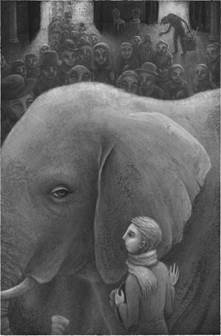
And Peter forgot about Adele and his mother and the fortuneteller and the old soldier and his father and battlefields and lies and promises and predictions. He forgot about everything except for the terrible truth of what he saw, what he understood in the elephant’s eyes.
She was heartbroken.
She must go home.
The elephant must go home or she would surely die.
As for the elephant, when she opened her eyes and saw the boy, she felt a small shock go through her.
He was looking at her as if he knew her.
He was looking at her as if he understood.
For the first time since she had come through the roof of the opera house, the elephant felt something akin to hope.
“Don’t worry,” Peter whispered to her. “I will make sure that you get home.”
She stared at him.
“I promise,” said Peter.
“Next!” shouted the little man with the shovel. “You must, you simply must, move along. Ha, ha, hee! There are others waiting to see the — ha, ha, hee! — elephant, too.”
Peter stepped away.
He turned. He walked without looking back, out of the ballroom of the countess Quintet, through the elephant door, and into the dark world.
He had made a promise to the elephant, but what kind of promise was it?
It was the worst kind of promise; it was yet another promise that he could not keep.
How could he, Peter, make sure that an elephant got home? He did not even know where the elephant’s home was. Was it Africa? India? Where were those places, and how could he get an elephant there?
He might just as well have promised the elephant that he would secure for her an enormous set of wings.
It is horrible, what I have done, thought Peter. It is terrible. I should never have promised. Nor should I have asked the fortuneteller my question. I should not have, no. I should have left things as they were. And what the magician did was a terrible thing, too. He should never have brought the elephant here. I am glad that he is in prison. They should never, ever let him out. He is a terrible man to do such a thing.
And then Peter was struck by a thought so wondrous that he stopped walking. He put his hat on his head. He took it off. He put it back on again.
The magician.
If the world held magic powerful enough to make the elephant appear, then there must exist, too, magic in equal measure, magic powerful enough to undo what had been done.
There must be magic that could send the elephant home.
“The magician,” said Peter out loud, and then he said, “Leo Matienne!”
He put his hat on his head. He began to run.

Leo Matienne opened the door of his apartment. He was barefoot. A napkin was tied around his neck, and a bit of carrot and a crumb of bread were caught in his mustache. The smell of mutton stew wafted out into the cold, dark street.
“It is Peter Augustus Duchene!” said Leo Matienne. “And he has his hat on his head. And he is here, on the ground, instead of up there, acting like a cuckoo in a clock.”
“I am very sorry to disturb you at your dinner,” said Peter, “but I must see the magician.”
“You must do what?”
“I need for you to take me to the prison so that I may see the magician. You are a policeman, an officer of the law; surely they will let you inside.”
“Who is it?” said Gloria Matienne. She came to the door and stood beside her husband.
“Good evening, Madam Matienne,” said Peter. He took off his hat and bowed to Gloria.
“And a good evening to you,” said Gloria.
“Yes, good evening,” said Peter. He put his hat back on his head. “I am sorry to disturb you at your dinner, but I need to go to the prison immediately.”
“He needs to go to the prison?” said Gloria Matienne to her husband. “Is that what he said? Have mercy! What kind of request is that for a child to make? And look at him, please. He is so skinny that you can see right through him. He is . . . what is the word?”
“Transparent?” said Leo.
“Yes,” said Gloria, “exactly that. Transparent. Does that old man not feed you? In addition to no love, is there no food in that attic room?”
“There is bread,” said Peter. “And also fish, but they are very small fish, exceedingly small.”
“You must come inside,” said Gloria. “That is the thing which you must immediately do. You must come inside.”
“But —” said Peter.
“Come inside,” said Leo. “We will talk.”
“Come inside,” said Gloria Matienne. “First we will eat, and then we will talk.”
There was, in the apartment of Leo and Gloria Matienne, a wonderful fire blazing, and the kitchen table was pulled up close to the hearth.
“Sit,” said Leo.
Peter sat. His legs were shaking and his heart was beating fast, as if he were still running. “I do not think that there is much time,” he said. “I do not think that there is enough time, truly, to dine.”
Gloria put a bowl of stew in Peter’s hands. “Eat,” she said.
Peter raised the spoon to his lips. He chewed. He swallowed.
It had been a long time since he had eaten anything besides tiny fish and old bread.
And so when Peter had his first bite of stew, it overwhelmed him. The warmth of it, the richness of it, knocked him backward; it was as if a gentle hand had pushed him when he was not expecting it. Everything he had lost came flooding back: the garden, his father, his mother, his sister, the promises that he had made and could not keep.
“What’s this?” said Gloria Matienne. “The boy is crying.”
“Shhh,” said Leo. He put his hand on Peter’s shoulder. “Shhh. Don’t worry, Peter. Everything will be good. All will be well. We will do together whatever it is that needs to be done. But for now, you must eat.”
Peter nodded. He raised his spoon. Again he chewed and swallowed, and again he was overcome. He could not help it. He could not stop the tears; they flowed down his cheeks and into the bowl. “It is very good stew, Madam Matienne,” he managed to say. “Truly, it is excellent stew.”
His hands shook; the spoon rattled against the bowl.
“Here, now,” said Gloria Matienne, “don’t spill it.”
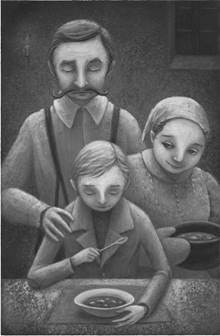
It is gone, thought Peter. All of it is gone! And there is no way to get it back.
“Eat,” said Leo Matienne again, very gently.
Peter looked the truth of what he had lost full in the face.
And then he ate.
When Peter was done, Leo Matienne sat down in the chair beside him and said, “Now you must tell us everything.”
“Everything?” said Peter.
“Yes, everything,” said Leo Matienne. He leaned back in his chair. “Begin at the beginning.”
Peter started in the garden. He began his story with his father throwing him up high in the air and catching him. He began with his mother dressed all in white, laughing, her stomach round like a balloon. “The sky was purple,” said Peter. “The lamps were lit.”
“Yes,” said Leo Matienne. “I can see it all very well. And where is your father now?”
“He was a soldier,” said Peter, “and he died on the battlefield. Vilna Lutz served with him and fought beside him. He was his friend. He came to our house to deliver the news of my father’s death.”
“Vilna Lutz,” said Gloria Matienne, and it was as if she were uttering a curse.
“When my mother heard the news, the baby started to come: my sister, Adele.” Peter stopped. He took a deep breath. “My sister was born, and my mother died. Before she died, I promised her that I would always watch out for the baby. But then I could not, because the midwife took the baby away and Vilna Lutz took me with him, to teach me how to be a soldier.”
Gloria Matienne stood. “Vilna Lutz!” she shouted. She shook a fist at the ceiling. “I will have a word with him.”
“Sit, please,” said Leo Matienne.
Gloria sat.
“And what became of your sister?” said Leo to Peter.
“Vilna Lutz told me that she died. He said that she was born dead, stillborn.”
Gloria Matienne gasped.
“He said that. But he lied. He lied. He has admitted that he lied. She is not dead.”
“Vilna Lutz!” said Gloria Matienne. Again, she leaped to her feet and shook her fist at the ceiling.
“First the fortuneteller told me that she lives, and then my own dream told me the same. And the fortuneteller told me, also, that the elephant — an elephant — would lead me to her. But today, this afternoon, I saw the elephant, Leo Matienne, and I know that she will die if she cannot go home. She must go home. The magician must return her there.”
Leo crossed his arms and tipped his chair back on two legs.
“Don’t do that,” said Gloria. She sat down again. “It is very bad for the chair.”
Leo Matienne came slowly forward until all four chair legs were again resting on the floor. He smiled. “What if?” he said.
“Oh, don’t start,” said his wife. “Please, don’t start.”
“Why not?”
From somewhere high above them, there came a muffled thump, the sound of Vilna Lutz beating his wooden foot on the floor, demanding something.
“Could it be?” said Leo.
“Yes,” said Peter. He did not look up at the ceiling. He kept his eyes on Leo Matienne. “What if?” he said to the policeman.
“Why not?” said Leo back to him. He smiled.
“Enough,” said Gloria.
“No,” said Leo Matienne, “not enough. Never enough. We must ask ourselves these questions as often as we dare. How will the world change if we do not question it?”
“The world cannot be changed,” said Gloria. “The world is what the world is and has forever been.”
“No,” said Leo Matienne softly, “I will not believe that. For here is Peter standing before us, asking us to make it something different.”
Thump, thump, thump went Vilna Lutz’s foot above them.
Gloria looked up at the ceiling. She looked over at Peter.
She shook her head. She nodded her head. And then, slowly, she nodded it again.
“Yes,” said Leo Matienne, “yes, that is what I thought, too.” He stood and took the napkin from his neck. “It is time for us to go to the prison.”
He put his arms around his wife and pulled her close. She rested her cheek against his for a moment, and then she pulled away from Leo and turned to Peter.
“You,” she said.
“Yes,” said Peter. He stood straight before her, like a soldier awaiting inspection, and so he was not prepared at all when she grabbed him and pulled him close, enveloping him in the smell of mutton stew and starch and green grass.
Oh, to be held!
He had forgotten entirely what it meant. He wrapped his arms around Gloria Matienne and began, again, to cry.
“There,” she said. She rocked him back and forth. “There, you foolish, beautiful boy who wants to change the world. There, there. And who could keep from loving you? Who could keep from loving a boy so brave and true?”