
DESPEREAUX STOOD TREMBLING on the steps. The thread was most definitely gone. He could not hear it. He could not see it. He should have tied it to himself when he had the chance. But it was too late now.
Despereaux’s dire situation suddenly became quite clear to him. He was a two-ounce mouse alone in a dark, twisting dungeon full of rats. He had nothing but a sewing needle with which to defend himself. He had to find a princess. And he had to save her once he found her.
“It’s impossible,” he said to the darkness. “I can’t do it.”
He stood very still. “I’ll go back,” he said. But he didn’t move. “I have to go back.” He took a step backward. “But I can’t go back. I don’t have a choice. I have no choice.”
He took one step forward. And then another.
“No choice,” his heart beat out to him as he went down the stairs, “no choice, no choice, no choice.”
At the bottom of the stairs, the rat Botticelli sat waiting, and when Despereaux stepped from the last stair onto the dungeon floor, Botticelli called out to him as if he were a long-lost friend. “Ah,” said Botticelli, “there you are. Exactly. I’ve been waiting for you.”
Despereaux saw the dark shape of a rat, that thing that he had feared and dreaded for so long, finally step out of the gloom and come to greet him.
“Welcome, welcome,” said Botticelli.
Despereaux put his paw on the needle.
“Ah,” said Botticelli, “you are armed. How charming.” He put his paws up in the air. “I surrender. Oh, yes, certainly, exactly, I surrender!”
“I . . .,” said Despereaux.
“Yes,” said Botticelli. “You.” He took the locket from around his neck. He began to swing it back and forth. “Please, go on.”
“I don’t want to hurt you,” said Despereaux. “I just need to get by you. I . . . I am on a quest.”
“Really?” said Botticelli. “How extraordinary. A mouse on a quest.” Back and forth, back and forth went the locket. “A quest for what?”
“A quest to save the princess.”
“The princess,” said Botticelli, “the princess, the princess. Everything seems to be about the princess these days. The king’s men were down here searching for her, you know. They didn’t find her. That goes without saying. But now a mouse has arrived. And he is on a quest to save the princess.”
“Yes,” said Despereaux. He took a step to the left of Botticelli.
“How inspiring,” said Botticelli. He lazily took a step to his right, blocking Despereaux’s way. “Why the hurry, little friend?”
“Because,” said Despereaux, “I have to —”
“Yes. Yes. You have to save the princess. Exactly. But before you save her, you must find her. Correct?”
“Yes,” said Despereaux.
“What if,” said Botticelli, “what if I told you that I know exactly where the princess is? What if I told you that I could take you right directly to her?”
“Ummm,” said Despereaux. His voice shook. His paw on the needle trembled. “Why would you do that?”
“Why would I do that? Why would I help you? Why . . . to be of service. To do my part for humanity. To aid in the saving of a princess.”
“But you are a . . .”
“A rat,” supplied Botticelli. “Yes. I am a rat. And I see by your trem-trem-trembling that the greatly exaggerated rumors of our evil nature have reached your oversize ears.”
“Yes,” said Despereaux.
“If,” said Botticelli, swinging the locket back and forth, “if you allow me to be of assistance, you will be doing me a tremendous favor. Not only can I do a good deed for you and for the princess, but my actions will help to dispel this terrible myth of evil that seems to surround rats everywhere. Will you let me assist you? Will you let me assist myself and my kind?”
Listener, was it a trick?
Of course it was!
Botticelli did not want to be of service. Far from it. You know what Botticelli wanted. He wanted others to suffer. Specifically, he wanted this small mouse to suffer. How best to do that?
Why, take him right directly to what he wanted. The princess. Let him see what his heart desired, and then, and only then, faced with what he loved, would Despereaux die. And at the end of it all, how tasty the mouse would be . . . seasoned with hope and tears and flour and oil and thwarted love!
“My name, little friend, is Botticelli Remorso. And you may trust me. You must trust me. Will you tell me your name?”
“Despereaux. Despereaux Tilling.”
“Despereaux Tilling, take your paw from your weapon. Come with me.”
Despereaux stared at him.
“Come, come,” said Botticelli, “let go of your needle. Take hold of my tail. I will lead you to your princess. I promise.”
What, listener, in your experience is the promise of a rat worth?
That’s right.
Zero. Zip. Nada. Goose eggs.
But I must ask you this question, too. What else was there for Despereaux to hold on to?
You are right again.
Nothing.
And so the mouse reached out. He took hold of the rat’s tail.

HAVE YOU EVER had hold of the tail of a rat? At best, it is an unpleasant sensation, scaly and cold, similar to holding on to a small, narrow snake. At worst, when you are dependent upon a rat for your survival, and when a part of you is certain that you are being led nowhere except to your death, it is a hideous sensation, indeed, to have nothing but a rat’s tail to cling to.
Nonetheless, Despereaux held on to Botticelli Remorso. And the rat led him deeper and deeper into the dungeon.
Despereaux’s eyes had, by this point, adjusted quite well to the darkness, though it would have been better if they had not, for the things he saw made him shiver and shake.
What did he see?
He saw that the floor of the dungeon was littered with tufts of fur, knots of red thread, and the skeletons of mice. Everywhere there were tiny white bones glowing in the darkness. And he saw, in the dungeon tunnels through which Botticelli led him, the bones of human beings, too, grinning skulls and delicate finger bones, rising up out of the darkness and pointing toward some truth best left unspoken.
Despereaux closed his eyes.
But it didn’t help. He saw as if his eyes were still open wide the bones, the tufts of hair, the knots of thread, the despair.
“Ha-ha, exactly!” Botticelli laughed as he negotiated the twists and turns. “Oh, yes, exactly.”
If what was in front of Despereaux was too horrible to contemplate, what followed behind him was, perhaps, even worse: rats, a happy, hungry, vengeful parade of rats, their noses up in the air, sniffing, sniffing.
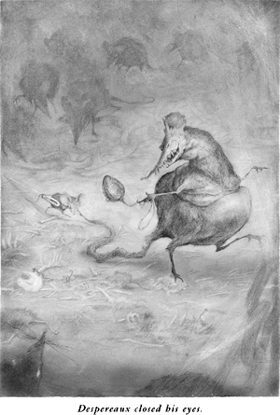
“Mouse!” sang out one rat joyfully.
“Yes, oh, yes, mouse,” agreed another. “But something else, too.”
“Soup!” called out another rat.
“Yes, soup,” the others agreed.
“Blood!” sang a rat.
“Blood,” they all agreed together.
And then they sang: “Here, mousie, mousie, mousie! Here, little mousie!”
Botticelli called out to the other rats. “Mine,” he said. “This little treasure is all mine, gentlemen and ladies. Please, I beg you. Do not infringe on my discovery.”
“Mr. Remorso,” said Despereaux. He turned and looked behind him and saw the rats, their red eyes and their smiling mouths. He closed his eyes again. He kept them closed. “Mr. Remorso!” he shouted.
“Yes?” said Botticelli.
“Mr. Remorso,” said Despereaux. And he was crying now. He couldn’t help it. “Please. The princess.”
“Tears!” shouted the rats. “We smell tears, mousie, we do.”
“Please!” shouted Despereaux.
“Little friend,” said Botticelli. “Little Despereaux Tilling. I promised you. And I will keep that promise.”
The rat stopped.
“Look ahead of you,” he said. “What do you see?”
Despereaux opened his eyes.
“Light,” he said.
“Exactly,” said Botticelli. “Light.”

AGAIN, LISTENER, we must go backward, before we go forward. We must consider, for a moment, what had occurred with the rat and the serving girl and the princess down in the dungeon before Despereaux made his way to them.
What happened was this: Roscuro led the Pea and Mig deep into the dungeon to a hidden chamber, and there he directed Mig to put the princess in chains.
“Gor,” said Mig, “she’s going to have a hard time learning her lessons if she’s all chained up-like.”
“Do as I say,” said Roscuro.
“Maybe,” said Mig, “before I lock her up, her and me could switch outfits, so we could start in already with her being me and me being a princess.”
“Oh, yes,” said Roscuro. “Certainly. A wonderful idea, Miss Miggery. Princess, take off your crown and give it to the serving girl.”
The Pea sighed and took off her crown and handed it to Mig, and Mig put it on and it slid immediately right down her small head and came to rest, quite painfully, on her poor, abused ears. “It’s a biggish thing,” she said, “and painful-like.”
“Well, well,” said Roscuro.
“How do I look?” Mig asked, smiling at him.
“Ridiculous,” he said. “Laughable.”
Mig stood, blinking back tears. “You mean I don’t look like a princess?” she said to the rat.
“I mean,” said Roscuro, “you will never look like a princess, no matter how big a crown you put on your tiny head. You look exactly like the fool you are and always will be. Now, make yourself useful and chain the princess up. Dress-up time is over.”
Mig sniffed and wiped at her eyes and then bent to look at the pile of chains and locks on the floor.
“And now, Princess,” he said, “I’m afraid that the time for your truth has arrived. I will now tell you what your future holds. As you consigned me to darkness, so I consign you, too, to a life spent in this dungeon.”
Mig looked up. “Ain’t she going upstairs to be a serving maid?”
“No,” said Roscuro.
“Ain’t I going to be a princess, then?”
“No,” said Roscuro.
“But I want to be a princess.”
“No one,” said Roscuro, “cares what you want.”
As you know, listener, Miggery Sow had heard this sentiment expressed many times in her short life. But now, in the dungeon, it hit her full force: The rat was right. No one cared what she wanted. No one had ever cared. And perhaps, worst of all, no one ever would care.
“I want!” cried Mig.
“Shhhh,” said the princess.
“Shut up,” said the rat.
“I want . . .,” sobbed Mig. “I want . . . I want . . .”
“What do you want, Mig?” the princess said softly.
“Eh?” shouted Mig.
“What do you want, Miggery Sow?!” the princess shouted.
“Don’t ask her that,” said Roscuro. “Shut up. Shut up.”
But it was too late. The words had been said; the question, at last, had been asked. The world stopped spinning and all of creation held its breath, waiting to hear what it was that Miggery Sow wanted.
“I want . . .,” said Mig.
“Yes?” shouted the Pea.
“I want my ma!” cried Mig, into the silent, waiting world. “I want my ma!”
“Oh,” said the princess. She held out her hand to Mig.
Mig took hold of it.
“I want my mother, too,” said the princess softly. And she squeezed Mig’s hand.
“Stop it!” shouted Roscuro. “Chain her up. Chain her up.”
“Gor,” said Mig, “I ain’t going to do it. You can’t make me do it. I got the knife, don’t I?” She took the knife and held it up.
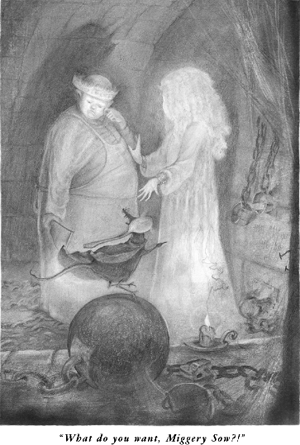
“If you have any sense at all,” said Roscuro, “and I heartily doubt that you do, you will not use that instrument on me. Without me, you will never find your way out of the dungeon, and you will starve to death here, or worse.”
“Gor,” said Mig, “then lead us out now, or I will chop you up into little rat bits.”
“No,” said Roscuro. “The princess shall stay here in the darkness. And you, Mig, will stay with her.”
“But I want to go upstairs,” said Mig.
“I’m afraid that we are stuck here, Mig,” shouted the princess, “unless the rat has a change of heart and decides to lead us out.”
“There will be no changes of heart,” said Roscuro. “None.”
“Gor,” said Mig. She lowered the knife.
And so, the rat and the princess and the serving girl sat together in the dungeon as, outside the castle, the sun rose and moved through the sky and sank to the earth again and night fell. They sat together until the candle had burned out and another one had to be lit. They sat together in the dungeon. They sat. And sat.
And, listener, truthfully, they might be sitting there still, if a mouse had not arrived.

“PRINCESS!” Despereaux shouted. “Princess, I have come to save you.”
The Princess Pea heard her name. She looked up.
“Despereaux,” she whispered.
And then she shouted it, “Despereaux!”
Listener, nothing is sweeter in this sad world than the sound of someone you love calling your name.
Nothing.
For Despereaux, the sound was worth everything: his lost tail, his trip to the dungeon, and back out of it and back into it again.
He ran toward the princess.
But Roscuro, baring his teeth, blocked the mouse’s way.
The princess cried, “Oh no, rat, please. Don’t hurt him. He is my friend.”
Mig said, “Don’t worry, Princess. I will save the meecy.”
She took the kitchen knife. She aimed to cut off the rat’s head, but she missed her mark.
“Whoopsie,” said Miggery Sow.

“OWWWWWWWW!” screamed Roscuro.
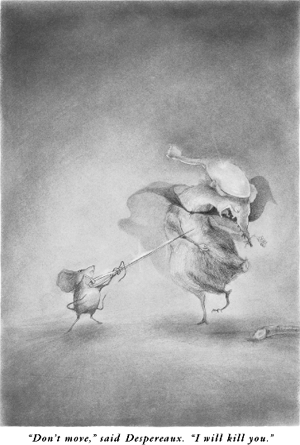
He turned to look at where his tail had been, and as he did, Despereaux drew his needle and placed the sharp tip of it right where the rat’s heart should be.
“Don’t move,” said Despereaux. “I will kill you.”
“Ha-ha-ha!” Botticelli laughed from the sidelines. “Exactly.” He slapped his tail on the floor in approval. “Absolutely delightful. A mouse is going to kill a rat. Oh, all of this is much better than I anticipated. I love it when mice come to the dungeon.”
“Let me see,” said the other rats, pushing and shoving.
“Stand back,” Botticelli told them, still laughing. “Let the mouse do his work.”
Despereaux held the trembling needle against Roscuro’s heart. The mouse knew that as a knight, it was his duty to protect the princess. But would killing the rat really make the darkness go away?
Despereaux bowed his head ever so slightly. And as he did so, his whiskers brushed against the rat’s nose.
Roscuro sniffed.
“What . . . is that smell?” he asked.
“Mousie blood!” shouted one rat.
“Blood and bones!” shouted another.
“You’re smelling tears,” said Botticelli. “Tears and thwarted love.”
“Exactly,” said Roscuro. “And yet . . . there’s something else.”
He sniffed again.
And the smell of soup crashed through his soul like a great wave, bringing with it the memory of light, the chandelier, the music, the laughter, everything, all the things that were not, would never, could never be available to him as a rat.
“Soup,” moaned Roscuro.
And he began to cry.
“Booooooo!” shouted Botticelli.
“Sssssssss,” hissed the other rats.
“Kill me,” said Roscuro. He fell down before Despereaux. “It will never work. All I wanted was some light. That is why I brought the princess here, really, just for some beauty . . . some light of my own.”
“Please,” shouted Botticelli, “do kill him! He is a miserable excuse for a rat.”
“No, Despereaux,” said the princess. “Don’t kill him.”
Despereaux lowered his needle. He turned and looked at the Pea.
“Boooo!” shouted Botticelli again. “Kill him! Kill him. All this goodness is making me sick. I’ve lost my appetite.”
“Gor!” shouted Mig, waving her knife. “I’ll kill him.”
“No, wait,” said the princess. “Roscuro,” she said to the rat.
“What?” he said. Tears were falling out of his eyes and creeping down his whiskers and dripping onto the dungeon floor.
And then the princess took a deep breath and put a hand on her heart.
I think, listener, that she was feeling the same thing that Despereaux had felt when he was faced with his father begging him for forgiveness. That is, Pea was aware suddenly of how fragile her heart was, how much darkness was inside it, fighting, always, with the light. She did not like the rat. She would never like the rat, but she knew what she must do to save her own heart.
And so, here are the words that the princess spoke to her enemy.
She said, “Roscuro, would you like some soup?”
The rat sniffed. “Don’t torment me,” he said.
“I promise you,” said the princess, “that if you lead us out of here, I will get Cook to make you some soup. And you can eat it in the banquet hall.”
“Speaking of eating,” shouted one of the rats, “give us the mousie!”
“Yeah,” shouted another, “hand over the mouse!”
“Who would want him now?” said Botticelli. “The flavor of him will be ruined. All that forgiveness and goodness. Blech. I, for one, am leaving.”
“Soup in the banquet hall?” Roscuro asked the princess.
“Yes,” said the Pea.
“Really?”
“Truly. I promise.”
“Gor!” shouted Mig. “Soup is illegal.”
“But soup is good,” said Despereaux.
“Yes,” said the Pea. “Isn’t it?”
The princess bent down before the mouse. “You are my knight,” she said to him, “with a shining needle. And I am so glad that you found me. Let’s go upstairs. Let’s eat some soup.”
And, listener, they did.

BUT THE QUESTION you want answered, I know, is did they live happily ever after?
Yes . . . and no.
What of Roscuro? Did he live happily ever after? Well . . . the Princess Pea gave him free access to the upstairs of the castle. And he was allowed to go back and forth from the darkness of the dungeon to the light of the upstairs. But, alas, he never really belonged in either place, the sad fate, I am afraid, of those whose hearts break and then mend in crooked ways. But the rat, in seeking forgiveness, did manage to shed some small light, some happiness into another life.
How?
Roscuro, listener, told the princess about the prisoner who had once owned a red tablecloth, and the princess saw to it that the prisoner was released. And Roscuro led the man up out of the dungeon and to his daughter, Miggery Sow. Mig, as you might have guessed, did not get to be a princess. But her father, to atone for what he had done, treated her like one for the rest of his days.
And what of Despereaux? Did he live happily ever after? Well, he did not marry the princess, if that is what you mean by happily ever after. Even in a world as strange as this one, a mouse and a princess cannot marry.
But, listener, they can be friends.
And they were. Together, they had many adventures. Those adventures, however, are another story, and this story, I’m afraid, must now draw to a close.
But before you leave, listener, imagine this: Imagine an adoring king and a glowing princess, a serving girl with a crown on her head and a rat with a spoon on his, all gathered around a table in a banquet hall. In the middle of the table, there is a great kettle of soup. Sitting in the place of honor, right next to the princess, is a very small mouse with big ears.
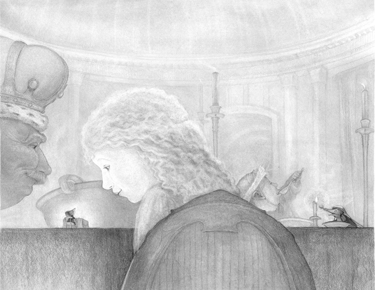
And peeking out from behind a dusty velvet curtain, looking in amazement at the scene before them, are four other mice.
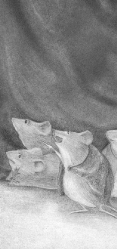
“Mon Dieu, look, look,” says Antoinette. “He lives. He lives! And he seems such the happy mouse.”
“Forgiven,” whispers Lester.
“Cripes,” says Furlough, “unbelievable.”
“Just so,” says the threadmaster Hovis, smiling, “just so.”
And, listener, it is just so.
Isn’t it?
THE END