5
FOR YEARS WE COULDN’T TALK ABOUT anything else. Our daily conduct, dominated then by so many linear habits, had suddenly begun to spin around a single common anxiety. The cocks of dawn would catch us trying to give order to the chain of many chance events that had made absurdity possible, and it was obvious that we weren’t doing it from an urge to clear up mysteries but because none of us could go on living without an exact knowledge of the place and the mission assigned to us by fate.
Many never got to know. Cristo Bedoya, who went on to become a surgeon of renown, never managed to explain to himself why he gave in to the impulse to spend two hours at his grandparents’ house until the bishop came instead of going to rest at his parents’, who had been waiting for him since dawn to warn him.
But most of those who could have done something to prevent the crime and did not consoled themselves with the pretext that affairs of honour are sacred monopolies, giving access only to those who are part of the drama. “Honour is love,” I heard my mother say. Hortensia Baute, whose only participation was having seen two bloody knives that weren’t bloody yet, felt so affected by the hallucination that she fell into a penitential crisis, and one day, unable to stand it any longer, she ran out naked into the street. Flora Miguel, Santiago Nasar’s fiancée, ran away out of spite with a lieutenant of the border patrol, who prostituted her among the rubber workers on the Vichada. Aura Villeros, the midwife who had helped bring three generations into the world, suffered a spasm of the bladder when she heard the news and to the day of her death had to use a catheter in order to urinate. Don Rogelio de la Flor, Clotilde Armenta’s good husband, who was a marvel of vitality at the age of eighty-six, got up for the last time to see how they had hewn Santiago Nasar to bits against the locked door of his own house, and he didn’t survive the shock. Plácida Linero had locked that door at the last moment, but with the passage of time she freed herself from blame. “I locked it because Divina Flor had sworn to me that she’d seen my son come in,” she told me, “and it wasn’t true.” On the other hand, she never forgave herself for having mixed up the magnificent augury of trees with the unlucky one of birds, and she succumbed to the pernicious habit of her time of chewing pepper cress seeds.
Twelve days after the crime, the investigating magistrate came upon a town that was an open wound. In the squalid wooden office in the town hall, drinking pot coffee laced with cane liquor against the mirages of the heat, he had to ask for troop reinforcements to control the crowd that was pouring in to testify without having been summoned, everyone eager to show off his own important role in the drama. The magistrate was newly graduated and still wore his black linen law school suit and the gold ring with the emblem of his degree, and he had the airs and the lyricism of a happy new parent. But I never discovered his name. Everything we know about his character has been learned from the brief, which several people helped me look for twenty years later in the Palace of Justice in Riohacha. There was no classification of files whatever, and more than a century of cases were piled up on the floor of the decrepit colonial building that had been Sir Francis Drake’s headquarters for two days. The ground floor would be flooded by high tides and the unbound volumes floated about the deserted offices. I searched many times with the water up to my ankles in that lagoon of lost causes, and after five years rummaging around only chance let me rescue some 322 pages filched from the more than 500 that the brief must have contained.
The judge’s name didn’t appear on any of them, but it was obvious that he was a man burning with the fever of literature. He had doubtless read the Spanish classics and a few Latin ones, and he was quite familiar with Nietzsche, who was the fashionable author among magistrates of his time. The marginal notes, and not just because of the colour of the ink, seemed to be written in blood. He was so perplexed by the enigma that fate had touched him with, that he kept falling into lyrical distractions that ran contrary to the rigour of his profession. Most of all, he never thought it legitimate that life should make use of so many coincidences forbidden literature, so that there should be the untrammelled fulfilment of a death so clearly foretold.
Nevertheless, what had alarmed him most at the conclusion of his excessive diligence was not having found a single clue, not even the most improbable, that Santiago Nasar had been the cause of the wrong. The friends of Angela Vicario who had been her accomplices in the deception went on saying for a long time that she had shared her secret with them before the wedding, but that she hadn’t revealed any name. In the brief, they declared: “She told us about the miracle but not the saint.” Angela Vicario, for her part, wouldn’t budge. When the investigating magistrate asked her with his oblique style if she knew who the decedent Santiago Nasar was, she answered him impassively: “He was my perpetrator.”
That’s the way she swears in the brief, but with no further precision of either how or where. During the trial, which lasted only three days, the representative of the people put his greatest effort into the weakness of that charge. Such was the perplexity of the investigating magistrate over the lack of proof against Santiago Nasar that his good work at times seemed ruined by disillusionment. On folio 416, in his own handwriting and with the druggist’s red ink, he wrote a marginal note: Give me a prejudice and I will move the world. Under that paraphrase of discouragement, in a merry sketch with the same blood ink, he drew a heart pierced by an arrow. For him, just as for Santiago Nasar’s closest friends, the victim’s very behaviour during his last hours was overwhelming proof of his innocence.
On the morning of his death, in fact, Santiago Nasar hadn’t had a moment of doubt, in spite of the fact that he knew very well what the price of the insult imputed to him was. He was aware of the prudish disposition of his world, and he must have understood that the twins’ simple nature was incapable of resisting an insult. No one knew Bayardo San Roman very well, but Santiago Nasar knew him well enough to know that underneath his worldly airs he was as subject as anyone else to his native prejudices. So the murdered man’s refusal to worry could have been suicide. Besides, when he finally learned at the last moment that the Vicario brothers were waiting for him to kill him, his reaction was not one of panic, as has so often been said, but rather the bewilderment of innocence.
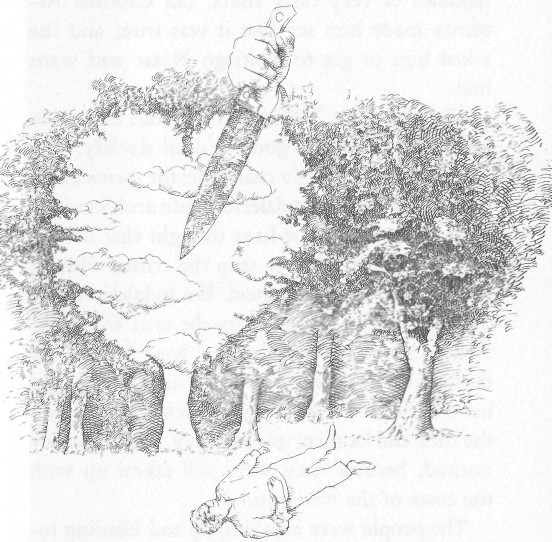
My personal impression is that he died without understanding his death. After he’d promised my sister Margot that he would come and have breakfast at our house, Cristo Bedoya took him by the arm as they strolled along the dock and both seemed so unconcerned that they gave rise to false impressions. “They were both going along so contentedly,” Merne Loiza told me, “that I gave thanks to God, because I thought the matter had been cleared up.” Not everybody loved Santiago Nasar so much, of course. Polo Carrillo, the owner of the electric plant, thought that his serenity wasn’t innocence but cynicism.
-.
“He thought that his money made him untouchable,” he told me. Fausta Lopez, his wife, commented: “Just like all Turks.” Indalecio Pardo had just passed by Clotilde Armenta’s store and the twins had told him that as soon as the bishop left, they were going to kill Santiago Nasar. Like so many others, he thought these were the usual fantasies of very early risers, but Clotilde Armenta made him see that it was true, and she asked him to get to Santiago Nasar and warn him.
“Don’t bother,” Pedro Vicario told him. “No matter what, he’s as good as dead already.”
It was too obvious a challenge: the twins knew the bonds between Indalecio Pardo and Santiago Nasar, and they must have thought that he was just the right person to stop the crime without bringing any shame on them. But Indalecio found Santiago Nasar being led by the arm by Cristo Bedoya among the groups that were leaving the docks, and he didn’t dare warn him. “I lost my nerve,” he told me. He gave each one a pat on the back and let them go their way. They scarcely noticed, because they were still taken up with the costs of the wedding.
The people were breaking up and heading toward the square the same way they were. It was a thick crowd, but Escolástica Cisneros thought she noticed that the two friends were walking in the centre of it without any difficulty, inside an empty circle, because everyone knew that Santiago Nasar was about to die and they didn’t dare touch him. Cristo Bedoya also remembered a strange attitude toward them. “They were looking at us as if we had our faces painted,” he told me. Also, Sara Noriega was opening her shoe store at the moment they passed and she was frightened at Santiago Nasar’s paleness. But he calmed her down.
“You can imagine, Missy Sara,” he told her without stopping, “with this hangover!”
Celeste Dangond was sitting in his pyjamas by the door of his house, mocking those who had gone to greet the bishop, and he invited Santiago Nasar to have some coffee. “It was in order to gain some time to think,” he told me. But Santiago Nasar answered that he was in a hurry to change clothes to have breakfast with my sister. “I got all mixed up,” Celeste Dangond told me, “because it suddenly seemed to me that they couldn’t be killing him if he was so sure of what he was going to do.” Yamil Shaium was the only one who did what he had proposed doing. As soon as he heard the rumour, he went out to the door of his dry goods store and waited for Santiago Nasar so he could warn him. He was one of the last Arabs who had come with Ibrahim Nasar, had been his partner in cards until his death, and was still the hereditary counsellor of the family. No one had as much authority as he to talk to Santiago Nasar. Nevertheless, he thought that if the rumour was baseless it would alarm him unnecessarily, and he preferred to consult first with Cristo Bedoya in case the latter was better informed. He called to him as he went by. Cristo Bedoya gave a pat on the back to Santiago Nasar, who was already at the corner of the square, and answered Yamil Shaium’s call. “See you Saturday,” he told him.
Santiago Nasar didn’t reply, but said something in Arabic to Yamil Shaium, and the latter answered him, also in Arabic, twisting with laughter. “It was a play on words we always had fun with,” Yamil Shaium told me. Without stopping, Santiago Nasar waved good-bye to both of them and turned the corner of the square. It was the last time they saw him.
Cristo Bedoya only took the time to grasp Yamil Shaium’s information before he ran out of the store to catch Santiago Nasar. He’d seen him turn the corner, but he couldn’t find him - among the groups that were beginning to break up on the square. Several people he asked gave him the same answer.
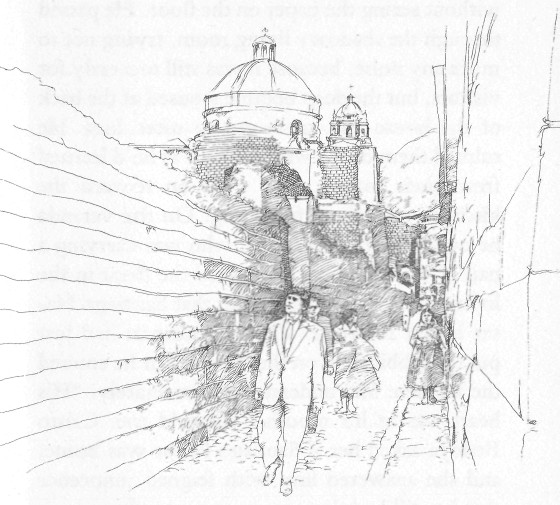
“I just saw him with you.”
It seemed impossible that he could have reached home in such a short time, but just in case, he went in to ask about him since he found the front door unbarred and ajar. He went in without seeing the paper on the floor. He passed through the shadowy living room, trying not to make any noise, because it was still too early for visitors, but the dogs became aroused at the back of the house and came out to meet him. He calmed them down with his keys as he’d learned from their master, and went on toward the kitchen, with them following. On the veranda he came upon Divina Flor, who was carrying a pail of water and a rag to clean the floor in the living room. She assured him that Santiago Nasar hadn’t returned. Victoria Guzman had just put the rabbit stew on the stove when he entered the kitchen. She understood immediately. “His heart was in his mouth,” she told me. Cristo Bedoya asked her if Santiago Nasar was home, and she answered him with feigned innocence that he still hadn’t come in to go to sleep, “It’s serious,” Cristo Bedoya told her. “They’re looking for him to kill him.”
Victoria Guzman forgot her innocence.
“Those poor boys won’t kill anybody,” she said.
“They’ve been drinking since Saturday,” Cristo Bedoya said.
“That’s just it,” she replied. “There’s no drunk in the world who’ll eat his own crap.”
Cristo Bedoya went back to the living room, where Divina Flor had just opened the windows. “Of course it wasn’t raining,” Cristo Bedoya told me. “It was just going on seven and a golden sun was already coming through the windows.” He asked Divina Flor again if she was sure that Santiago Nasar hadn’t come in through the living room door. She wasn’t as sure then as the first time. He asked her about Plácida Linero, and she answered that just a moment before she’d put her coffee on the night table, but she hadn’t awakened her. That’s the way it always was: Plácida Linero would wake up at seven, have her coffee, and come down to give instructions for lunch. Cristo Bedoya looked at the clock: it was six fifty-six. Then he climbed up to the second floor to make sure that Santiago Nasar hadn’t come in.
The bedroom was locked from the inside, because Santiago Nasar had gone out through his mother’s bedroom. Cristo Bedoya not only knew the house as well as his own, but was so much at home with the family that he pushed open the door to Plácida Linero’s bedroom and went from there into the adjoining one. A beam of dusty light was coming in through the skylight, and the beautiful woman asleep on her side in the hammock, her bride’s hand on her cheek, had an unreal look. “It was like an apparition,” Cristo Bedoya told me. He looked at her for an instant, fascinated by her beauty, and then he crossed the room in silence, passed by the bathroom, and proceeded into Santiago Nasar’s bedroom. The bed was still made, and on the chair, well-pressed, were his riding clothes, and on top of the clothes his horseman’s hat, and on the floor his boots beside their spurs. On the night table, Santiago Nasar’s wristwatch said six fifty-eight. “Suddenly I thought that he’d come back so that he could go out armed,” Cristo Bedoya told me. But he found the Magnum in the drawer of the night table. “I’d never shot a gun,” Cristo Bedoya told me, “but I decided to take the revolver and bring it to Santiago Nasar.” He stuck it in his belt, under his shirt, and only after the crime did he realise that it was unloaded. Plácida Linero appeared in the doorway with her mug of coffee just as he was closing the drawer.
“Good heavens!” she exclaimed. “You gave me a start!”
Cristo Bedoya was also startled. He saw her in the full light, wearing a dressing gown with golden larks, her hair loose, and the charm had vanished. He explained, somewhat confused, that he was looking for Santiago Nasar.
“He went to receive the bishop,” Plácida Linero said.
“The bishop went right through,” he said.
“I thought so,” she said. “He’s the son of the worst kind of mother.”
She didn’t go on because at that moment she realised that Cristo Bedoya didn’t know what to do with his body. “I hope that God has forgiven me,” Plácida Linero told me, “but he seemed so confused that it suddenly occurred to me that he’d come to rob us.” She asked him what was wrong. Cristo Bedoya was aware that he was in a suspicious situation, but he didn’t have the courage to reveal the truth.
“It’s just that I haven’t had a minute’s sleep,” he told her.
He left without any further explanations. “In any case,” he told me, “she was always imagining that she was being robbed.” In the square he ran into Father Amador, who was returning to the church with the vestments for the frustrated mass, but he didn’t think he could do anything for Santiago Nasar except save his soul. He was heading toward the docks again when he heard them calling him from the door of Clotilde Armenta’s store. Pedro Vicario was in the doorway, pale and haggard, his shirt open and his sleeves rolled up to the elbows, and with the naked knife in his hand. His manner was too insolent to be natural, and yet it wasn’t the only final or the most visible pose that he’d assumed in the last moments so they would stop him from committing the crime.
“Cristobal,” he shouted, “tell Santiago Nasar that we’re waiting for him here to kill him.”
Cristo Bedoya could have done him the favour of stopping him. “If I’d known how to shoot a revolver, Santiago Nasar would be alive today,” he told me. But the idea did impress him, after all he’d heard about the devastating power of an armour-plated bullet.
“I warn you. He’s armed with a Magnum that can go through an engine block,” he shouted.
Pedro Vicario knew it wasn’t true. “He never went armed except when he wore riding clothes,” he told me. But in any case, he’d foreseen the possibility that he might be armed when he made the decision to wipe his sister’s honour clean.
“Dead men can’t shoot,” he shouted.
Then Pablo Vicario appeared in the doorway. He was as pale as his brother and he was wearing his wedding jacket and carrying his knife wrapped in the newspaper. “If it hadn’t been for that,” Cristo Bedoya told me, “I never would have known which of the two was which.” Clotilde Armenta then appeared behind Pablo Vicario and shouted to Cristo Bedoya to hurry up, because in that faggot town only a man like him could prevent the tragedy.
Everything that happened after that is in the public domain. The people who were coming back from the docks, alerted by the shouts, began to take up positions around the square to witness the crime. Cristo Bedoya asked several people he knew if they’d seen Santiago Nasar, but no one had. At the door of the social club he ran into Colonel Lázaro Aponte and he told him what had just happened in front of Clotilde Armenta’s store.
“It can’t be,” Colonel Aponte said, “because I told them to go home to bed.”
“I just saw them with pig-killing knives,” Cristo Bedoya said.
“It can’t be, because I took them away from them before sending them home to bed,” said the mayor. “It must be that you saw them before that.”
“I saw them two minutes ago and they both had pig-killing knives,” Cristo Bedoya said.
“Oh, shit,” the mayor said. “Then they must have come back with two new ones.”
He promised to take care of it at once, but he went into the social club to check on a date for dominoes that night, and when hefiancee came out again the crime had already been committed. Cristo Bedoya then made his only mortal mistake: he thought that Santiago Nasar had decided at the last moment to have breakfast at our house before changing his clothes, and he went to look for him there. He hurried along the riverbank, asking everyone he passed if they’d seen him go by, but no one said he had. He wasn’t alarmed, because there were other ways to get to our house. Próspera Arango, the uplander, begged him to do something for her father, who was in his death throes on the stoop of his house, immune to the bishop’s fleeting blessing. “I’d seen him when I passed,” my sister Margot told me, “and he already had the face of a dead man.” Cristo Bedoya delayed four minutes to ascertain the sick man’s condition, and promised to come back later for some emergency treatment, but he lost three minutes more helping Próspera Arango carry him into the bedroom. When he came out again he heard distant shouts and it seemed to him that rockets were being fired in the direction of the square. He tried to run but was hindered by the revolver, which was clumsily stuck in his belt. As he turned the last corner he recognised my mother from the rear as she was practically dragging her youngest son along.
“Luisa Santiaga,” he shouted to her, “where’s your godson?”
My mother barely turned, her face bathed in tears.
“Oh, my son,” she answered, “they say he’s been killed!”
That’s how it was. While Cristo Bedoya had been looking for him, Santiago Nasar had gone into the house of Flora Miguel, his , just around the corner from where he’d seen him for the last time. “It didn’t occur to me that he could be there,” he told me, “because those people never got up before noon.” The version that went around was that the whole family slept until twelve o’clock on orders from Nahir Miguel, the wise man of the community. “That’s why Flora Miguel, who wasn’t that young anymore, was preserved like a rose,” Mercedes says. The truth is that they kept the house locked up until very late, like so many others, but they were early-rising and hardworking people. The parents of Santiago Nasar and Flora Miguel had agreed that they should get married. Santiago Nasar accepted the engagement in the bloom of his adolescence, and he was determined to fulfil it, perhaps because he had the same utilitarian concept of matrimony as his father. Flora Miguel, for her part, enjoyed a certain floral quality, but she lacked wit and judgment and had served as bridesmaid for her whole generation, so the agreement was a providential solution for her. They had an easy engagement, without formal visits or restless hearts. The wedding, postponed several times, was finally set for the following Christmas.
Flora Miguel awoke that Monday with the first bellows of the bishop’s boat, and shortly thereafter she found out that the Vicario twins were waiting for Santiago Nasar to kill him. She informed my sister the nun, the only one she spoke to after the misfortune, that she didn’t even remember who’d told her. “I only know that at six o’clock in the morning everybody knew it,” she told her. Nevertheless, it seemed inconceivable to her that they were going to kill Santiago Nasar, but on the other hand, it occurred to her that they would force him to marry Angela Vicario in order to give her back her honour. She went through a crisis of humiliation. While half the town was waiting for the bishop, she was in her bedroom weeping with rage, and putting in order the chestful of letters that Santiago Nasar had sent her from school.
Whenever he passed by Flora Miguel’s house, even if nobody was home, Santiago Nasar would scratch his keys across the window screens. That Monday she was waiting with the chest of letters in her lap. Santiago Nasar couldn’t see her from the street, but she, however, saw him approaching through the screen before he scratched it with his keys.
“Come in,” she told him.
No one, not even a doctor, had entered that house at six forty-five in the morning. Santiago Nasar had just left Cristo Bedoya at Yamil Shaium’s store, and there were so many people hanging on his movements in the square that it was difficult to believe that no one saw him go into his fiancee’s house. The investigating magistrate looked for a single person who’d seen him, and he did so with as much persistence as I, but it was impossible to find one. In folio 382 of the brief, he wrote another marginal pronouncement in red ink: Fatality makes us invisible. The fact is that Santiago Nasar went in through the main door, in full view of everyone, and without doing anything not to be seen. Flora Miguel was waiting for him in the parlour, green with rage, wearing one of the dresses with unfortunate ruffles that she was in the habit of putting on for memorable occasions, and she placed the chest in his hands.
“Here you are,” she told him. “And I hope they kill you!”
Santiago Nasar was so perplexed that he dropped the chest and his loveless letters poured out onto the floor. He tried to catch Flora Miguel in the bedroom, but she closed the door and threw the bolt. He knocked several times, and called her in too pressing a voice for the time of day, so the whole family came in, all alarmed. Counting relatives by blood and by marriage, adults and minors, there were more than fourteen of them. The last to come was Nahir Miguel, the father, with his red beard and the Bedouin caftan he had brought from his homeland and which he always wore at home. I saw him many times and he was immense and spare, but what most impressed me was the glow of his authority.
“Flora,” he called in his language. “Open the door.”
He went into his daughter’s bedroom while the family stared at Santiago Nasar. He was kneeling in the parlour, picking up the letters and putting them into the chest. “It looked like a penance, ” they told me. Nahir Miguel came out of the bedroom after a few minutes, made a signal with his hand, and the whole family disappeared.
He continued talking in Arabic to Santiago Nasar. “From the first moment I understood that he didn’t have the slightest idea of what I was saying,” he told me. Then he asked him outright if he knew that the Vicario brothers were looking for him to kill him. “He turned pale and lost control in such a way that it was impossible to think that he was pretending,” he told me. He agreed that his manner reflected not so much fear as confusion.
“Only you can know if they’re right or not,” he told him. “But in any case, you’ve only got two paths to follow now: either you hide here, in this house which is yours, or you go out with my rifle.”
“I don’t understand a God-damned thing,” Santiago Nasar said.
It was the only thing he managed to say, and he said it in Spanish. “He looked like a little wet bird,” Nahir Miguel told me. He had to take the chest from his hands because he didn’t know where to put it in order to open the door.
“It’ll be two against one,” he told him.
Santiago Nasar left. The people had stationed themselves on the square the way they did on parade days. They all saw him come out, and they all understood that now he knew they were going to kill him, and that he was so confused he couldn’t find his way home. They say that someone shouted from a balcony: “Not that way, Turk; by the old dock.” Santiago Nasar sought out the voice. Yamil Shaium shouted for him to get into his store and went to get his hunting gun, but he couldn’t remember where he’d put the cartridges. They began to shout at him from every side, and Santiago Nasar went backward and forward several times, baffled by hearing so many voices at the same time. It was obvious that he was heading toward his house as if to enter through the kitchen door, but suddenly he must have realised that the main door was open.
“There he comes,” said Pedro Vicario.
They’d both seen him at the same time. Pablo Vicario took off his jacket, put it on the bench, and unwrapped his knife, holding it like a scimitar. Before leaving the store, without any agreement, they both crossed themselves. Then Clotilde Armenta grabbed Pedro Vicario by the shirt and shouted to Santiago Nasar to run because they were going to kill him. It was such an urgent shout that it drowned out all the others. “At first he was startled,” Clotilde Armenta told me, “because he didn’t know who was shouting at him or from where.” But when he saw her, he also saw Pedro Vicario, who threw her to the ground and caught up with his brother. Santiago Nasar was less than fifty yards from his house and he ran to the main door.
Five minutes before, in the kitchen, Victoria Guzman had told Plácida Linero what everybody already knew. Plácida Linero was a woman of steady nerves, so she didn’t let any sign of alarm show through. She asked Victoria Guzman if she’d said anything to her son, and she lied honestly, since she answered that she still hadn’t known anything when he came down for coffee. In the living room, where she was still scrubbing the floor, Divina Flor at the same time saw Santiago Nasar come in through the door on the square and go up the open stairs to the bedrooms. “It was a very clear vision,” Divina Flor told me. “He was wearing his white suit and carrying something that I couldn’t make out well in his hand, but it looked like a bouquet of roses.” So when Plácida Linero asked about him, Divina Flor calmed her down.
“He went up to his room a minute ago,” she told her.
Plácida Linero then saw the paper on the floor, but she didn’t think to pick it up, and she only found out what it said when someone showed it to her later on during the confusion of the tragedy. Through the door she saw the Vicario brothers running toward the house with their knives out. From the place where she was standing she could see them but she couldn’t see her son, who was running toward the door from a different angle. “I thought they wanted to get in to kill him inside the house,” she told me. Then she ran to the door and slammed it shut. She was putting up the bar when she heard Santiago Nasar’s shouts, and she heard the terrified pounding on the door, but she thought he was upstairs, insulting the Vicario brothers from the balcony in his room. She went up to help him.
Santiago Nasar only needed a few seconds to get in when the door closed. He managed to pound with his fists several times, and he turned at once to face his enemies with his bare hands. “I was scared when I saw him face on,” Pablo Vicario told me, “because he looked twice as big as he was.” Santiago Nasar raised his hand to stop the first strike from Pedro Vicario, who attacked him on the right side with his knife pointed straight in.
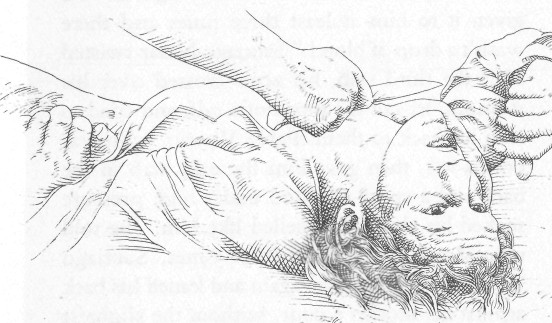
“Sons of bitches!” he shouted.
The knife went through the palm of his right hand and then sank into his side up to the hilt. Everybody heard his cry of pain.
“Oh, mother of mine!”
Pedro Vicario pulled out his knife with his slaughterer’s iron wrist and dealt him a second thrust almost in the same place. “The strange thing is that the knife kept coming out clean,” Pedro Vicario declared to the investigator. “I’d given it to him at least three times and there wasn’t a drop of blood.” Santiago Nasar twisted after the third stab, his arms crossed over his stomach, let out the moan of a calf, and tried to turn his back to them. Pablo Vicario, who was on his left, then gave him the only stab in the back and a spurt of blood under high pressure soaked his shirt. “It smelled like him,” he told me. Mortally wounded three times, Santiago Nasar turned frontward again and leaned his back against his mother’s door, without the slightest resistance, as if he only wanted to help them finish killing him by his own contribution. “He didn’t cry out again,” Pedro Vicario told the investigator. “Just the opposite: it looked to me as if he was laughing.” Then they both kept on knifing him against the door with alternate and easy stabs, floating in the dazzling backwater they had found on the other side of fear. They didn’t hear the shouts of the whole town, frightened by its own crime. “I felt the way you do when you’re galloping on horseback,” Pablo Vicario declared. But they both suddenly woke up to reality, because they were exhausted, and yet they thought that Santiago Nasar would never fall. “Shit, cousin,” Pablo Vicario told me, “you can’t imagine how hard it is to kill a man!” Trying to finish it once and for all, Pedro Vicario sought his heart, but he looked for it almost in the armpit, where pigs have it. Actually, Santiago Nasar wasn’t falling because they themselves were holding him up with stabs against the door. Desperate, Pablo Vicario gave him a horizontal slash on the stomach, and all his intestines exploded out. Pedro Vicario was about to do the same, but his wrist twisted with horror and he gave him a wild cut on the thigh. Santiago Nasar was still for an instant, leaning against the door, until he saw his own viscera in the sunlight, clean and blue, and he fell on his knees.
After looking and shouting for him in the bedroom, hearing other shouts that weren’t hers and not knowing where they were coming from, Plácida Linero went to the window facing the square and saw the Vicario twins running toward the church. Hot in pursuit was Yamil Shaium with his jaguar gun and some other unarmed Arabs, and Plácida Linero thought the danger had passed. Then she went out onto the bedroom balcony and saw Santiago Nasar in front of the door, face down in the dust, trying to rise up out of his own blood. He stood up, leaning to one side, and started to walk in a state of hallucination, holding his hanging intestines in his hands.
He walked more than a hundred yards, completely around the house, and went in through the kitchen door. He still had enough lucidity not to go along the street, it was the longest way, but by way of the house next door. Poncho Lanao, his wife, and their five children hadn’t known what had just happened twenty paces from their door. “We heard the shouting,” the wife told me, “but we thought it was part of the bishop’s festival.” They were sitting down to breakfast when they saw Santiago Nasar enter, soaked in blood and carrying the roots of his entrails in his hands. Poncho Lanao told me: “What I’ll never forget was the terrible smell of shit.” But Argénida Lanao, the oldest daughter, said that Santiago Nasar walked with his usual good bearing, measuring his steps well, and that his Saracen face with its dashing ringlets was handsomer than ever. As he passed by the table he smiled at them and continued through the bedrooms to the rear door of the house. “We were paralysed with fright,” Argénida Lanao told me. My aunt, Wenefrida Márquez, was scaling a shad in her yard on the other side of the river when she saw him go down the steps of the old dock, looking for his way home with a firm step.
“Santiago, my son,” she shouted to him, “what has happened to you?”
“They’ve killed me, Wene child,” he said.
He stumbled on the last step, but he got up at once. “He even took care to brush off the dirt that was stuck to his guts,” my Aunt Wene told me. Then he went into his house through the back door that had been open since six and fell on his face in the kitchen.