3
THE LAWYER STOOD BY THE THESIS OF homicide in legitimate defence of honour, which was upheld by the court in good faith, and the twins declared at the end of the trial that they would have done it again a thousand times over for the same reason. It was they who gave a hint of the direction the defence would take as soon as they surrendered to their church a few minutes after the crime. They burst panting into the parish house, closely pursued by a group of roused-up Arabs, and they laid the knives, with clean blades, on Father Amador’s desk. Both were exhausted from the barbarous work of death, and their clothes and arms were soaked and their faces smeared with sweat and still living blood, but the priest recalled the surrender as an act of great dignity.
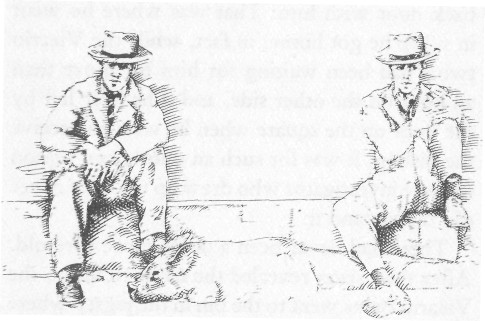
“We killed him openly,” Pedro Vicario said, “but we’re innocent.”
“Perhaps before God,” said Father Amador.
“Before God and before men,” Pablo Vicario said. “It was a matter of honour.”
Furthermore, with the reconstruction of the facts, they had feigned a much more unforgiving bloodthirstiness than really was true, to such an extreme that it was necessary to use public funds to repair the main door of Placida Linero’s house, which was all chipped with knife thrusts. In the panopticon of Riohacha, where they spent three years awaiting trial because they couldn’t afford bail, the older prisoners remembered them for their good character and sociability, but they never noticed any indication of remorse in them. Still, in reality it seemed that the Vicario brothers had done nothing right with a view to killing Santiago Nasar immediately and without any public spectacle, but had done much more than could be imagined to have someone to stop them from killing him, and they had failed.
According to what they told me years later, they had begun by looking for him at Maria Alejandrina Cervantes’s place, where they had been with him until two o’clock. That fact, like many others, was not reported in the brief. Actually, Santiago Nasar was no longer there at the time the twins said they went looking for him, because we’d left on a round of serenades, but in any case, it wasn’t certain that they’d gone. “They never would have left here,” Maria Alejandrina Cervantes told me, and knowing her so well, I never doubted it. On the other hand, they did go to wait for him at Clotilde Armenta’s place, where they knew that almost everybody would turn up except Santiago Nasar. “It was the only place open,” they declared to the investigator. “Sooner or later he would have to come out,” they told me, after they had been absolved. Still, everybody knew that the main door of Plácida Linero’s house was always barred on the inside, even during the daytime, and that Santiago Nasar always carried the keys to the back door with him. That was where he went in when he got home, in fact, while the Vicario twins had been waiting for him for more than an hour on the other side, and if he later left by the door on the square when he went to receive the bishop, it was for such an unforeseen reason that the investigator who drew up the brief never did understand it.
There had never been a death more foretold. After their sister revealed the name to them, the Vicario twins went to the bin in the pigsty where they kept their sacrificial tools and picked out the two best knives: one for quartering, ten inches long by two and a half inches wide, and the other for trimming, seven inches long by one and a half inches wide. They wrapped them in a rag and went to sharpen them at the meat market, where only a few stalls had begun to open. There weren’t very many customers that early, but twenty-two people declared they had heard everything said, and they all coincided in the impression that the only reason the brothers had said it was so that someone would come over to hear them. Faustino Santos, a butcher friend, saw them enter at three-twenty, when he had just opened up his innards table, and he couldn’t understand why they were coming on a Monday and so early, and still in their dark wedding suits. He was accustomed to seeing them on Fridays, but a little later, and wearing the leather aprons they put on for slaughtering. “I thought they were so drunk,” Faustino Santos told me, “that not only had they forgotten what time it was, but what day it was too.” He reminded them that it was Monday.
“Everybody knows that, you dope,” Pablo Vicario answered him good-naturedly. “We just came to sharpen our knives.”
They sharpened them on the grindstone, and the way they always did: Pedro holding the knives and turning them over on the stone, and Pablo working the crank. At the same time, they talked with the other butchers about the splendour of the wedding. Some of them complained about not having gotten their share of cake, in spite of their being working companions, and they promised them to have some sent over later. Finally, they made the knives sing on the stone, and Pablo laid his beside the lamp so that the steel sparkled.
“We’re going to kill Santiago Nasar,” he said.
Their reputation as good people was so well-founded that no one paid any attention to them. “We thought it was drunkards’ baloney,” several butchers declared, just as Victoria Guzman and so many others did who saw them later. I was to ask the butchers sometime later whether or not the trade of slaughterer didn’t reveal a soul predisposed to killing a human being. They protested: “When you sacrifice a steer you don’t dare look into its eyes.” One of them told me that he couldn’t eat the flesh of an animal he had butchered. Another said that he wouldn’t be capable of sacrificing a cow if he’d known it before, much less if he’d drunk its milk. I reminded them that the Vicario brothers sacrificed the same hogs they raised, which were so familiar to them that they called them by their names. “That’s true,” one of them replied, “but remember that they didn’t give them people’s names but the names of flowers.” Faustino Santos was the only one who perceived a glimmer of truth in Pablo Vicario’s threat, and he asked him jokingly why they had to kill Santiago Nasar since there were so many other rich people who deserved dying first.
“Santiago Nasar knows why,” Pedro Vicario answered him.
Faustino Santos told me that he’d still been doubtful, and that he reported it to a policeman who came by a little later to buy a pound of liver for the mayor’s breakfast. The policeman, according to the brief, was named Leandro Pornoy, and he died the following year, gored in the jugular vein by a bull during the national holidays, so I was never able to talk to him. But Clotilde Armenta confirmed for me that he was the first person in her store when the Vicario twins were sitting and waiting there.
Clotilde Armenta had just replaced her husband behind the counter. It was their usual system. The shop sold milk at dawn and provisions during the day and became a bar after six o’clock in the evening. Clotilde Armenta would open at three-thirty in the morning. Her husband, the good Don Rogelio de la Flor, would take charge of the bar until closing time. But that night there had been so many stray customers from the wedding that he went to bed after three o’clock without closing, and Clotilde Armenta was already up earlier than usual because she wanted to finish before the bishop arrived.
The Vicario brothers came in at four-ten. At that time only things to eat were sold, but Clotilde Armenta sold them a bottle of cane liquor, not only because of the high regard she had for them but also because she was very grateful for the piece of wedding cake they had sent her. They drank down the whole bottle in two long swigs, but they remained stolid. “They were stunned,” Clotilde Armenta told me, “and they couldn’t have got their blood pressure up even with lamp oil.” Then they took off their cloth jackets, hung them carefully on the chair backs, and asked her for another bottle. Their shirts were dirty with dried sweat and a one-day beard gave them a backwoods look. They drank the second bottle more slowly, sitting down, looking insistently toward Plácida Linero’s house on the sidewalk across the way, where the windows were dark. The largest one, on the balcony, belonged to Santiago Nasar’s bedroom. Pedro Vicario asked Clotilde Armenta if she had seen any light in that window, and she answered him no, but it seemed like a strange thing to be interested in.
“Did something happen to him?” she asked.
“No,” Pedro Vicario replied. “Just that we’re looking for him to kill him.”
It was such a spontaneous answer that she couldn’t believe she’d heard right. But she noticed that the twins were carrying two butcher knives wrapped in kitchen rags.
“And might a person know why you want to kill him so early in the morning? she asked.
“He knows why,” Pedro Vicario answered.
Clotilde Armenta examined them seriously: she knew them so well that she could tell them apart, especially ever since Pedro Vicario had come back from the army. “They looked like two children,” she told me. And that thought frightened her, because she’d always felt that only children are capable of everything. So she finished getting the jug of milk ready and went to wake her husband to tell him what was going on in the shop. Don Rogelio de la Flor listened to her half-awake.
“Don’t be silly,” he said to her. “Those two aren’t about to kill anybody, much less someone rich.”
When Clotilde Armenta returned to the store, the twins were chatting with Officer Leandro Pornoy, who was coming for the mayor’s milk. She didn’t hear what they were talking about, but she supposed that they had told him something about their plans from the way he looked at the knives when he left.
Colonel Lázaro Aponte had just got up a little before four. He’d finished shaving when Officer Leandro Pornoy revealed the Vicario brothers’ intentions to him. He’d settled so many fights between friends the night before that he was in no hurry for another one. He got dressed calmly, tied his bow tie several times until he had it perfect, and around his neck he hung the scapular of the Congregation of Mary, to receive the bishop. While he breakfasted on fried liver smothered with onion rings, his wife told him with great excitement that Bayardo San Roman had brought Angela Vicario back home, but he didn’t take it dramatically.
“Good Lord!” he mocked. “What will the bishop think!”
Nevertheless, before finishing breakfast he remembered what the orderly had just told him, put the two bits of news together, and discovered immediately that they fit like pieces of a puzzle. Then he went to the square, going along the street to the new dock, where the houses were beginning to liven up for the bishop’s arrival. “I can remember with certainty that it was almost five o’clock and it was beginning to rain,” Colonel Lázaro Aponte told me. Along the way three people stopped him to inform him in secret that the Vicario brothers were waiting for Santiago Nasar to kill him, but only one person could tell him where.
He found them in Clotilde Armenta s store. “When I saw them I thought they were nothing but a pair of big bluffers,” he told me with his personal logic, “because they weren’t as drunk as I thought.” Nor did he interrogate them concerning their intentions, but took away their knives and sent them off to sleep. He treated them with the same self-assurance with which he had passed off his wife’s alarm.
“Just imagine!” he told them. “What will the bishop say if he finds you in that state!”
They left. Clotilde Armenta suffered another disappointment with the mayor’s casual attitude, because she thought he should have detained the twins until the truth came out. Colonel Aponte showed her the knives as a final argument.
“Now they haven’t got anything to kill anybody with,” he said.
“That’s not why,” said Clotilde Armenta. “It’s to spare those poor boys from the horrible duty that’s fallen on them.”
Because she’d sensed it. She was certain that the Vicario brothers were not as eager to carry out the sentence as to find someone who would do them the favour of stopping them. But Colonel Aponte was at peace with his soul.
“No one is arrested just on suspicion,” he said. “Now it’s a matter of warning Santiago Nasar, and happy new year.”
Clotilde Armenta would always remember that Colonel Aponte’s chubby appearance evoked a certain pity in her, but on the other hand I remembered him as a happy man, although a little bit off due to the solitary spiritualist practises he had learned through the mails. His behaviour that Monday was the final proof of his silliness. The truth is that he didn’t think of Santiago Nasar again until he saw him on the docks, and then he congratulated himself for having made the right decision.
The Vicario brothers had told their plans to more than a dozen people who had gone to buy milk, and these had spread the news everywhere before six o’clock. It seemed impossible to Clotilde Armenta that they didn’t know in the house across the way. She didn’t think that Santiago Nasar was there, since she hadn’t seen the bedroom light go on, and she asked all the people she could to warn him when they saw him. She even sent word to Father Amador through the novice on duty, who came to buy milk for the nuns. After four o’clock, when she saw the lights in the kitchen of Plácida Linero’s house, she sent the last urgent message to Victoria Guzman by the beggar woman who came every day to ask for a little milk in the name of charity. When the bishop’s boat bellowed, almost everybody was up to receive him and there were very few of us who didn’t know that the Vicario twins were waiting for Santiago Nasar to kill him, and, in addition, the reasons were understood down to the smallest detail.
Clotilde Armenta hadn’t finished dispensing her milk when the Vicario brothers returned with two other knives wrapped up in newspapers. One was for quartering, with a strong, rusty blade twelve inches long and three inches wide, which had been put together by Pedro Vicario with the metal from a marquetry saw at a time when German knives were no longer available because of the war. The other one was shorter, but broad and curved. The investigator had made sketches of them in the brief, perhaps because he had trouble describing them, and all he ventured to say was that this one looked like a miniature scimitar. It was with these knives that the crime was committed, and both were rudimentary and had seen a lot of use.
Faustino Santos couldn’t understand what had happened. “They came to sharpen their knives a second time,” he told me, “and once more they shouted for people to hear that they were going to cut Santiago Nasar’s guts out, so I believed they were kidding around, especially since I didn’t pay any attention to the knives and thought they were the same ones.” This time, however, Clotilde Armenta noticed from the moment she saw them enter that they didn’t have the same determination as before.
Actually, they’d had their first disagreement. Not only were they much more different inside than they looked on the outside, but in difficult emergencies they showed opposite characters. We, their friends, had spotted it ever since grammar school. Pablo Vicario was six minutes older than his brother, and he was the more imaginative and resolute until adolescence. Pedro Vicario always seemed more sentimental to me, and by the same token more authoritarian. They presented themselves together for military service at the age of twenty, and Pablo Vicario was excused in order to stay home and take care of the family. Pedro Vicario served for eleven months on police patrol. The army routine, aggravated by the fear of death, had matured his tendency to command and the habit of deciding for his brother. He also came back with a case of sergeant’s blennorrhea that resisted the most brutal methods of military medicine as well as the arsenic injections and permanganate purges of Dr. Dionisio Iguarán. Only in jail did they manage to cure it. We, his friends, agreed that Pablo Vicario had suddenly developed the strange dependence of a younger brother when Pedro Vicario returned with a barrack-room soul and with the novel trick of lifting his shirt for anyone who wanted to see a bullet wound with seton on his left side. He even began to develop a kind of fervour over the great man’s blennorrhea that his brother wore like a war medal.
Pedro Vicario, according to his own declaration, was the one who made the decision to kill Santiago Nasar, and at first his brother only followed along. But he was also the one who considered his duty fulfilled when the mayor disarmed them, and then it was Pablo Vicario who assumed command. Neither of the two mentioned that disagreement in their separate statements to the investigator, but Pablo Vicario confirmed several times to me that it hadn’t been easy for him to convince his brother of their final resolve. Maybe it was really nothing but a wave of panic, but the fact is that Pablo Vicario went into the pigsty alone to get the other two knives, while his brother agonised, drop by drop, trying to urinate under the tamarind trees. “My brother never knew what it was like,” Pedro Vicario told me in our only interview. “It was like pissing ground glass.” Pablo Vicario found him hugging the tree when he came back with the knives. “He was in a cold sweat from the pain,” he said to me, “and he tried to tell me to go on by myself because he was in no condition to kill anybody.” He sat down on one of the carpenters’ benches they’d set up under the trees for the wedding lunch, and he dropped his pants down to his knees. “He spent about half an hour changing the gauze he had his prick wrapped in,” Pablo Vicario told me. Actually, he hadn’t delayed more than ten minutes, but this was something so difficult and so puzzling for Pablo Vicario that he interpreted it as some new trick on his brother’s part to waste time until dawn. So he put the knife in his hand and dragged him off almost by force in search of their sister’s lost honour.
“There’s no way out of this,” he told him. “It’s as if it had already happened.”
They left by way of the pigpen gate with the knives unwrapped, trailed by the uproar of the dogs in the yards. It was beginning to get light. “It wasn’t raining,” Pablo Vicario remembered.
“Just the opposite,” Pedro recalled. “There was a sea wind and you could still count the stars with your finger.” The news had been so well spread by then that Hortensia Baute opened her door precisely as they were passing her house, and she was the first to weep for Santiago Nasar. “I thought they’d already killed him,” she told me, “because I saw the knives in the light from the street lamp and it looked to me like they were dripping blood.” One of the few houses open on that misbegotten street was that of Prudencia Cotes, Pablo Vicario’s fiancée. Whenever the twins passed by there at that time, and especially on Fridays when they were going to the market, they would drop in to have their first cup of coffee. They pushed open the door to the courtyard, surrounded by the dogs, who recognised them in the half light of dawn, and they greeted Prudencia Cotes’s mother in the kitchen. Coffee wasn’t ready yet.
“We’ll leave it for later,” Pablo Vicario said. “We’re in a hurry now.”
“I can imagine, my sons,” she said. “Honour doesn’t wait.”
But in any case, they waited, and this time it was Pedro Vicario who thought his brother was wasting time on purpose. While they were drinking their coffee, Prudencia Cotes came into the kitchen in all her adolescent bloom, carrying a roll of old newspapers to revive the fire in the stove. “I knew what they were up to,” she told me, “and I didn’t only agree, I never would have married him if he hadn’t done what a man should do.” Before leaving the kitchen, Pablo Vicario took two sections of newspaper from her and gave them to his brother to wrap the knives in.
Prudencia Cotes stood waiting in the kitchen until she saw them leave by the courtyard door, and she went on waiting for three years without a moment of discouragement until Pablo Vicario got out of jail and became her husband for life.
“Take good care of yourselves,” she told them.
So Clotilde Armenta had good reason when it seemed to her that the twins weren’t as resolute as before, and she served them a bottle of rotgut rum with the hope of getting them dead drunk.
“That day,” she told me, “I realised just how alone we women are in the world!” Pedro Vicario asked to borrow her husband’s shaving implements, and she brought him the brush, the soap, the hanging mirror, and the safety razor with a new blade, but he shaved with his butcher knife. Clotilde Armenia thought that was the height of machismo. “He looked like a killer in the movies,” she told me. But as he explained to me later, and it was true, in the army he’d learned to shave with a straight razor and couldn’t do it any other way ever since. His brother, for his part, shaved in a more humble way, with Don Rogelio de la Flor’s borrowed safety razor. Finally, they drank the bottle in silence, very slowly, gazing with the boobish look of early risers at the dark window in the house across the way, while fake customers buying milk they didn’t need and asking for food items that didn’t exist went in and out with the purpose of seeing whether it was true that they were waiting for Santiago Nasar to kill him.
The Vicario brothers would not see that window light up. Santiago Nasar went into the house at four-twenty, but he didn’t have to turn on any light to reach his bedroom because the bulb on the stairway stayed lit through the night. He threw himself onto his bed in the darkness and with his clothes on, since he had only an hour in which to sleep, and that was how Victoria Guzman found him when she came up to wake him so he could receive the bishop. We’d been together at Maria Alejandrina Cervantes’s until after three, when she herself sent the musicians away and turned out the lights in the dancing courtyard so that her pleasurable mulatto girls could go to bed by themselves and get some rest. They’d been working without cease for three days, first taking care of the guests of honour in secret, and then turned loose, the doors wide open for those of us still unsated by the wedding bash. Maria Alejandrina Cervantes, about whom we used to say that she would go to sleep only once and that would be to die, was the most elegant and the most tender woman I have ever known, and the most serviceable in bed, but she was also the strictest. She’d been born and reared here, and here she lived, in a house with open doors, with several rooms for rent and an enormous courtyard for dancing lit by lantern gourds bought in the Chinese bazaars of Paramaribo. It was she who did away with my generation’s virginity. She taught us much more than we should have learned, but she taught us above all that there’s no place in life sadder than an empty bed. Santiago Nasar lost his senses the first time he saw her. I warned him: “‘A falcon who chases a warlike crane can only hope for a life of pain. But he didn’t listen to me, dazzled by Maria Alejandrina Cervantes’s illusory calls. She was his mad passion, his mistress of tears at the age of fifteen, until Ibrahim Nasar drove him out of the bed with a whip and shut him up for more than a year on The Divine Face. Ever since then they were still linked by a serious affection, but without the disorder of love, and she had so much respect for him that she never again went to bed with anyone if he was present. During those last vacations she would send us off early with the pretext that she was tired, but she left the door unbarred and with a lamp lighted in the hall so that I could come in secretly.
Santiago Nasar had an almost magical talent for disguises, and his favourite sport was to confuse the identities of the mulatto girls. He would rifle the wardrobe of some to disguise the others, so that they all ended up feeling different from themselves and like the ones they weren’t. On a certain occasion, one of them found herself repeated in another with such exactness that she had an attack of tears. “I felt like I’d stepped out of the mirror,” she said. But that night Maria Alejandrina Cervantes wouldn’t let Santiago Nasar indulge himself for the last time in his tricks as a transformer, and she prevented it with such flimsy pretexts that the bad taste left by that memory changed his life. So we took the musicians with us for a round of serenades, and we continued the party on our own, while the Vicario twins were waiting for Santiago Nasar to kill him. It was he who got the idea, at almost four o’clock, to go up the widower Xius’s hill and sing for the newly weds.
Not only did we sing under the windows, but we set off rockets and fireworks in the gardens, yet we didn’t perceive any sign of life inside the farmhouse. It didn’t occur to us that there was no one there, especially because the new car was by the door with its top still folded down and with the satin ribbons and bouquets of wax orange blossoms they had hung on it during the festivities. My brother Luis Enrique, who played the guitar like a professional at that time, improvised a song with matrimonial double meanings in honour of the newlyweds. Until then it hadn’t rained; on the contrary, the moon was high in the sky and the air was clear, and at the bottom of the precipice you could see the trickle of light from the Saint Elmo’s fire in the cemetery. On the other side you could make out the groves of blue banana trees in the moonlight, the sad swamps, and the phosphorescent line of the Caribbean on the horizon. Santiago Nasar pointed to an intermittent light at sea and told us that it was the soul in torment of a slave ship that had sunk with a cargo of blacks from Senegal across from the main harbour mouth at Cartagena de Indias. It wasn’t possible to think that his conscience was bothering him, although at that time he didn’t know that the ephemeral married life of Angela Vicario had come to an end two hours before. Bayardo San Roman had taken her to her parents’ house on foot so that the noise of the motor wouldn’t betray his misfortune in advance, and he was back there alone and with the lights out in the widower Xius’s happy farmhouse.
When we went down the hill my brother invited us to have some breakfast of fried fish at one of the lunch stands in the market, but Santiago Nasar was against it because he wanted to get an hour’s sleep before the bishop arrived. He went along the riverbank with Cristo Bedoya, passing the poor people’s eating places that were beginning to light up by the old harbour, and before turning the corner he waved good-bye. It was the last time we saw him.
Cristo Bedoya, whom he had agreed to meet later on at the docks, took leave of him at the back door of his house. The dogs barked at him as usual when they heard him come in, but he calmed them down in the half light with the tinkling of his keys. Victoria Guzman was keeping watch over the coffeepot on the stove when he passed by the kitchen on his way into the house.
“White man,” she called to him, “coffee will be ready soon.”
Santiago Nasar told her that he’d have some later, and he asked her to tell Divina Flor to wake him up at five-thirty and bring him a clean change of clothes, just like the ones he had on. An instant after he’d gone to bed, Victoria Guzman got the message from Clotilde Armenta sent via the milk beggar. At five-thirty she followed his orders to wake him, but she didn’t send Divina Flor and went up to the bedroom herself with the suit of pure linen, because she never missed a chance to keep her daughter away from the claws of the seigneur.
Maria Alejandrina Cervantes had left the door of her house unbarred. I took leave of my brother, crossed the veranda where the mulatto girls’ cats were sleeping curled up among the tulips, and opened the bedroom door without knocking. The lights were out, but as soon as I went in I caught the smell of a warm woman and I saw the eyes of an insomniac leopard in the darkness, and then I didn’t know anything else about myself until the bells began to ring.
On his way to our house, my brother went in to buy some cigarettes at Clotilde Armenia’s store. He’d drunk so much that his memories of that encounter were always quite confused, but he never forgot the fatal drink that Pedro Vicario offered him. “It was liquid fire,” he told me. Pablo Vicario, who had fallen asleep, awoke with a start when he heard him come in, and he showed him the knife.
“We’re going to kill Santiago Nasar,” he told him.
My brother doesn’t remember it. “But even if I did remember, I wouldn’t have believed it,” he told me many times. “Who the fuck would ever think that the twins would kill anyone, much less with a pig knife!” Then they asked him where Santiago Nasar was, because they’d seen the two of them together, and my brother didn’t remember his own answer either. But Clotilde Armenta and the Vicario brothers were so startled when they heard it that it was left established in the brief in separate declarations. According to them, my brother said: “Santiago Nasar is dead.” Then he delivered an episcopal blessing, stumbled over the threshold, and staggered out. In the middle of the square he crossed paths with Father Amador, who was going to the dock in his vestments, followed by an acolyte ringing the bell and several helpers carrying the altar for the bishop’s field mass. The Vicario brothers crossed themselves when they saw them pass.
Clotilde Armenta told me that they’d lost their last hopes when the priest passed by her place. “I thought he hadn’t got my message,” she said. Nonetheless, Father Amador confessed to me many years later, retired from the world in the gloomy Calafell Rest Home, that he had in fact received Clotilde Armenta’s message and others more peremptory while he was getting ready to go the docks. “The truth is I didn’t know what to do,” he told me. “My first thought was that it wasn’t any business of mine but something for the civil authorities, but then I made up my mind to say something in passing to Plácida Linero.” Yet when he crossed the square, he’d forgotten completely. “You have to understand,” he told me, “that the bishop was coming on that unfortunate day.” At the moment of the crime he felt such despair and was so disgusted with himself that the only thing he could think of was to ring the fire alarm.
My brother Luis Enrique entered the house through the kitchen door, which my mother left unlocked so my father wouldn’t hear us come in. He went to the bathroom before going to bed, but he fell asleep sitting on the toilet, and when my brother Jaime got up to go to school he found him stretched out face down on the tile floor and singing in his sleep. My sister the nun, who wasn’t going to wait for the bishop because she had an eighty-proof hangover, couldn’t get him to wake up. “It was striking five when I went to the bathroom,” she told me. Later, when my sister Margot went in to bathe before going to the docks, she managed with great effort to drag him to his bedroom. From the other side of sleep he heard the first bellows of the bishop’s boat without awakening. Then he fell into a deep sleep, worn out by his carousing, until my sister the nun rushed into the bedroom, trying to put her habit on as she ran, and woke him up with her mad cry: “They’ve killed Santiago Nasar!”