2
BAYARDO SAN ROMAN, THE MAN WHO had given back his bride, had turned up for the first time in August of the year before: six months before the wedding. He arrived on the weekly boat with some saddlebags decorated with silver that matched the buckle of his belt and the rings on his boots. He was around thirty years old, but they were well-concealed, because he had the waist of P a novice bullfighter, golden eyes, and a skin slowly roasted by saltpetre. He arrived wearing a short jacket and very tight trousers, both of natural calfskin, and kid gloves of the same colour. Magdalena Oliver had been with him on the boat and couldn’t take her eyes off him during the whole trip. “He looked like a fairy,” she told me. “And it was a pity, because I could have buttered him and eaten him alive.” She wasn’t the only one who thought so, nor was she the last to realise that Bayardo San Roman was not a man to be known at first sight.
My mother wrote to me at school toward the end of August and said in a casual postscript: “A very strange man has come.” In the following letter she told me: “The strange man is called Bayardo San Roman, and everybody says he’s enchanting, but I haven’t seen him.” Nobody knew what he’d come for. Someone who couldn’t resist the temptation of asking him, a little before the wedding, received the answer: “I’ve been going from town to town looking for someone to marry.” It might have been true, but he would have answered anything else in the same way, because he had a way of speaking that served to conceal rather than to reveal.
The night he arrived he gave them to understand at the movies that he was a track engineer, and spoke of the urgency for building a railroad into the interior so that we could keep ahead of the river’s fickle ways. On the following day he had to send a telegram and he transmitted it on the key himself, and in addition, he taught the telegrapher a formula of his so that he could keep on using the worn-out batteries. With the same assurance he talked about frontier illnesses with a military doctor who had come through during those months of conscription. He liked noisy and long-lasting festivities, but he was a good drinker, a mediator of fights, and an enemy of cardsharps. One Sunday after mass he challenged the most skillful swimmers, who were many, and left the best behind by twenty strokes in crossing the river and back. My mother told me about it in a letter, and at the end she made a comment that was very much like her: “It also seems that he’s swimming in gold.” That was in reply to the premature legend that Bayardo San Roman not only was capable of doing everything, and doing it quite well, but also had access to endless resources.
My mother gave him the final blessing in a letter in October: “People like him a lot,” she told me, “because he’s honest and has a good heart, and last Sunday he received communion on his knees and helped with the mass in Latin.” In those days it wasn’t permitted to receive communion standing and everything was in Latin, but my mother is accustomed to noting that kind of superfluous detail when she wants to get to the heart of the matter. Nevertheless, after that consecrated verdict she wrote me two letters in which she didn’t say anything about Bayardo San Roman, not even when it was known very well that he wanted to marry Angela Vicario. Only a long time after the unfortunate wedding did she confess to me that she actually knew him when it was already too late to correct the October letter, and that his golden eyes had caused the shudder of a fear in her.
“He reminded me of the devil,” she told me, “but you yourself had told me that things like that shouldn’t be put into writing.”
I met him a short while after she did, when I came home for Christmas vacation, and I found him just as strange as they had said. He seemed attractive, certainly, but far from Magdalena Oliver’s idyllic vision. He seemed more serious to me than his antics would have led one to believe, and with a hidden tension that was barely concealed by his excessive good manners. But above all, he seemed to me like a very sad man. At that time he had already formalised his contract of love with Angela Vicario.
It had never been too well established how they had met. The landlady of the bachelors’ boarding house where Bayardo San Roman lived told of how he’d been napping in a rocking chair in the parlour toward the end of September, when Angela Vicario and her mother crossed the square carrying two baskets of artificial flowers. Bayardo San Roman half-awoke, saw the two women dressed in the unforgiving black worn by the only living creatures in the morass of two o’clock in the afternoon, and asked who the young one was. The landlady answered him that she was the youngest daughter of the woman with her and that her name was Angela Vicario. Bayardo San Roman followed them with his look to the other side of the square.
“She’s well-named,” he said.
Then he rested his head on the back of the rocker and closed his eyes again.
“When I wake up,” he said, “remind me that I’m going to marry her.”
Angela Vicario told me that the landlady of the boardinghouse had spoken to her about that occurrence before Bayardo San Roman began courting her. “I was quite startled,” she told me. Three people who had been in the boardinghouse confirmed that it had taken place, but four others weren’t sure. On the other hand, all the versions agreed that Angela Vicario and Bayardo San Roman had seen each other for the first time on the national holiday in October during a charity bazaar at which she was in charge of singing out the raffle numbers. Bayardo San Roman came to the bazaar and went straight to the booth run by the languid raffler, who was in mourning, and he asked her the price of the music box inlaid with mother-of-pearl that must have been the major attraction of the fair. She answered him that it was not for sale but was to be raffled off.
“So much the better,” he said. “That makes it easier and cheaper besides.”
She confessed to me that he’d managed to impress her, but for reasons opposite those of love. “I detested conceited men, and I’d never seen one so stuck-up,” she told me, recalling that day. “Besides, I thought he was a Jew.” Her annoyance was greater when she sang out the raffle number for the music box, to the anxiety of all, and indeed, it had been won by Bayardo San Roman. She couldn’t imagine that he, just to impress her, had bought all the tickets in the raffle.
That night, when she returned home, Angela Vicario found the music box there, gift-wrapped and tied with an organdy bow. “I never did find out how he knew that it was my birthday,” she told me. It was hard for her to convince her parents that she hadn’t given Bayardo San Roman any reason to send her a gift like that, and even worse, in such a visible way that it hadn’t gone unnoticed by anyone. So her older brothers, Pedro and Pablo, took the music box to the hotel to give back to its owner, and they did it with such a rush that there was no one to witness them come and then not leave. Since the only thing the family hadn’t counted upon was Bayardo San Roman’s irresistible charm, the twins didn’t reappear until dawn of the next day, foggy with drink, bearing once more the music box, and bringing along, besides, Bayardo San Roman to continue the revels at home.
Angela Vicario was the youngest daughter of a family of scant resources. Her father, Poncio Vicario, was a poor man’s goldsmith, and he’d lost his sight from doing so much fine work in gold in order to maintain the honour of the house. Purísima del Carmen, her mother, had been a schoolteacher until she married forever. Her meek and somewhat afflicted look hid the strength of her character quite well. “She looked like a nun,” my wife Mercedes recalls. She devoted herself with such spirit of sacrifice to the care of her husband and the rearing of her children that at times one forgot she still existed. The two oldest daughters had married very late. In addition to the twins, there was a middle daughter who had died of nighttime fevers, and two years later they were still observing a mourning that was relaxed inside the house but rigorous on the street. The brothers were brought up to be men. The girls had been reared to get married. They knew how to do screen embroidery, sew by machine, weave bone lace, wash and iron, make artificial flowers and fancy candy, and write engagement announcements. Unlike other girls of the time, who had neglected the cult of death, the four were past mistresses in the ancient science of sitting up with the ill, comforting the dying, and enshrouding the dead. The only thing that my mother reproached them for was the custom of combing their hair before sleeping. “Girls,” she would tell them, “don’t comb your hair at night; you’ll slow down seafarers.” Except for that, she thought there were no better-reared daughters. “They’re perfect,” she was frequently heard to say. “Any man will be happy with them because they’ve been raised to suffer.” Yet it was difficult for the men who married the two eldest to break the circle, because they always went together everywhere, and they organised dances for women only and were predisposed to find hidden intentions in the designs of men.
Angela Vicario was the prettiest of the four, and my mother said that she had been born like the great queens of history, with the umbilical cord wrapped around her neck. But she had a helpless air and a poverty of spirit that augured an uncertain future for her. I would see her again year after year during my Christmas vacations, and every time she seemed more destitute in the window of her house, where she would sit in the afternoon making cloth flowers and singing songs about single women with her neighbours. “She’s all set to be hooked,” Santiago Nasar would tell me, “your cousin the ninny is.” Suddenly, a little before the mourning for her sister, I passed her on the street for the first time dressed as a grown woman and with her hair curled, and I could scarcely believe it was the same person. But it was a momentary vision: her penury of spirit had been aggravated with the years. So much so that when it was discovered that Bayardo San Roman wanted to marry her, many people thought it was an outsider’s scheming.
The family took it not only seriously but with great excitement. Except Pura Vicario, who laid down the condition that Bayardo San Roman should identify himself properly. Up till then nobody knew who he was. His past didn’t go beyond that afternoon when he disembarked in his actor’s getup, and he was so reserved about his origins that even the most demented invention could have been true. It came to be said that he had wiped out villages and sown terror in Casanare as troop commander, that he had escaped from Devil’s Island, that he’d been seen in Pernambuco trying to make a living with a pair of trained bears, and that he’d salvaged the remains of a Spanish galleon loaded with gold in the Windward Passage. Bayardo San Roman put an end to all those conjectures by a simple recourse: he produced his entire family.
There were four of them: the father, the mother, and two provocative sisters. They arrived in a Model T Ford with official plates, whose duck-quack horn aroused the streets at eleven o’clock in the morning. His mother, Alberta Simonds, a big mulatto woman from Curacao, who spoke Spanish with a mixture of Papiamento, in her youth had been proclaimed the most beautiful of the two hundred most beautiful women in the Antilles. The sisters, newly come into bloom, were like two restless fillies. But the main attraction was the father: General Petronio San Roman, hero of the civil wars of the past century, and one of the major glories of the Conservative regime for having put Colonel Aureliano Buendía to flight in the disaster of Tucurinca. My mother was the only one who wouldn’t go to greet him when she found out who he was. “It seems all right to me that they should get married,” she told me. “But that’s one thing and it’s something altogether different to shake hands with the man who gave the orders for Gerineldo Márquez to be shot in the back.” As soon as he appeared in the window of the automobile waving his white hat, everybody recognised him because of the fame of his pictures. He was wearing a wheat-coloured linen suit, high-laced cordovan shoes, and gold-rimmed glasses held by a clasp on the bridge of his nose and connected by a chain to a buttonhole in his vest. He wore the Medal of Valour on his lapel and carried a cane with the national shield carved on the pommel. He was the first to get out of the automobile, completely covered with the burning dust of our bad roads, and all he had to do was appear on the running board for everyone to realise that Bayardo San Roman was going to marry whomever he chose.
It was Angela Vicario who didn’t want to marry him. “He seemed too much of a man for me,” she told me. Besides, Bayardo San Roman hadn’t even tried to court her, but had bewitched the family with his charm. Angela Vicario never forgot the horror of the night on which her parents and her older sisters with their husbands, gathered together in the parlour, imposed on her the obligation to marry a man whom she had barely seen. The twins stayed out of it. “It looked to us like woman problems,” Pablo Vicario told me. The parents’ decisive argument was that a family dignified by modest means had no right to disdain that prize of destiny. Angela Vicario only dared hint at the inconvenience of a lack of love, but her mother demolished it with a single phrase: “Love can be learned too.”
Unlike engagements of the time, which were long and supervised, theirs lasted only four months due to Bayardo San Roman’s urgings. It wasn’t any shorter because Pura Vicario demanded that they wait until the family mourning was over. But the time passed without anxiety because of the irresistible way in which Bayardo San Roman arranged things. “One night he asked me what house I liked best,” Angela Vicario told me. “And I answered, without knowing why, that the prettiest house in town was the farmhouse belonging to the widower Xius.” I would have said the same. It was on a windswept hill, and from the terrace you could see the limitless paradise of the marshes covered with purple anemones, and on clear summer days you could make out the neat horizon of the Caribbean and the tourist ships from Cartagena de Indias. That very night Bayardo San Roman went to the social club and sat down at the widower Xius’s table to play a game of dominoes.
“Widower,” he told him, “I’ll buy your house.”
“It’s not for sale,” the widower said.
“I’ll buy it along with everything inside.”
The widower Xius explained to him with the good breeding of olden days that the objects in the house had been bought by his wife over a whole lifetime of sacrifice and that for him they were still a part of her. “He was speaking with his heart in his hand,” I was told by Dr. Dionisio Iguarán, who was playing with them. “I was sure he would have died before he’d sell a house where he’d been happy for over thirty years.” Bayardo San Roman also understood his reasons.
“Agreed,” he said. “So sell me the house empty.”
But the widower defended himself until the end of the game. Three nights later, better prepared, Bayardo San Roman returned to the domino table.
“Widower,” he began again, “what’s the price of the house?”
“It hasn’t got a price.”
“Name any one you want.”
“I’m sorry, Bayardo,” the widower said, “but you young people don’t understand the motives of the heart.”
Bayardo San Roman didn’t pause to think.
“Let’s say five thousand pesos,” he said.
“You don’t beat around the bush,” the widower answered him, his dignity aroused. “The house isn’t worth all that.”
“Ten thousand,” said Bayardo San Roman. “Right now and with one bill on top of another.”
The widower looked at him, his eyes full of tears. “He was weeping with rage,” I was told by Dr. Dionisio Iguarán, who, in addition to being a physician, was a man of letters. “Just imagine: an amount like that within reach and having to say no from a simple weakness of the spirit.” The widower Xius’s voice didn’t come out, but without hesitation he said no with his head.
“Then do me one last favour,” said Baynardo San Roman. Wait for me here for five minutes.
Five minutes later, indeed, he returned to the social club with his silver-trimmed saddlebags, and on the table he laid ten bundles of thousand-peso notes with the printed bands of the State Bank still on them. The widower Xius died two months later. “He died because of that,” Dr. Dionisio Iguarán said. “He was healthier than the rest of us, but when you listened with the stethoscope you could hear the tears bubbling inside his heart.” But not only had he sold the house with everything in it; he asked Bayard San Roman to pay him little by little because he didn’t even have an old trunk where he could keep so much consolation money.
No one would have thought, nor did anyone say, that Angela Vicario wasn’t a virgin. She hadn’t known any previous fiancée and she’d grown up along with her sisters under the rigour of a mother of iron. Even when it was less than two months before she would be married, Pura Vicario wouldn’t let her go out alone with Bayardo San Roman to see the house where they were going to live, but she and the blind father accompanied her to watch over her honour. “The only thing I prayed to God for was to give me the courage to kill myself,” Angela Vicario told me. “But he didn’t give it to me.” She was so distressed that she had resolved to tell her mother the truth so as to free herself from that martyrdom, when her only two confidantes, who worked with her making cloth flowers, dissuaded her from her good intentions. “I obeyed them blindly,” she told me, “because they made me believe that they were experts in men’s tricks.” They assured her that almost all women lost their virginity in childhood accidents. They insisted that even the most difficult of husbands resigned themselves to anything as long as nobody knew about it. They convinced her, finally, that most men came to their wedding night so frightened that they were incapable of doing anything without the woman’s help, and at the moment of truth they couldn’t answer for their own acts. “The only thing they believe is what they see on the sheet,” they told her. And they taught her old wives’ tricks to feign her lost possession, so that on her first morning as a newlywed she could display open under the sun in the courtyard of her house the linen sheet with the stain of honour.
She got married with that illusion. Bayardo San Roman, for his part, must have got married with the illusion of buying happiness with the huge weight of his power and fortune, for the more the plans for the festival grew, the more delirious ideas occurred to him to make it even larger. He tried to hold off the wedding for a day when the bishop’s visit was announced so that he could marry them, but Angela Vicario was against it. “Actually,” she told me, “the fact is I didn’t want to be blessed by a man who cut off only the combs for soup and threw the rest of the rooster into the garbage.” Yet, even without the bishop’s blessing, the festival took on a force of its own so difficult to control that it got out of the hands of Bayardo San Roman and ended up being a public event.
General Petronio San Roman and his family arrived that time on the National Congress’s ceremonial boat, which remained moored to the dock until the end of the festivities, and with them came many illustrious people who, even so, passed unnoticed in the tumult of new faces. So many gifts were brought that it was necessary to restore the forgotten site of the first electrical power plant in order to display the most valuable among them, and the rest were immediately taken to the former home of the widower Xius, which had already been prepared to receive the newlyweds. The groom received a convertible with his name engraved in Gothic letters under the manufacturer’s seal. The bride was given a chest with table settings in pure gold for twenty-four guests. They also brought in a ballet company and two waltz orchestras that played out of tune with the local bands and all the groups of brass and accordion players who came, animated by the uproar of the revelry.
The Vicario family lived in a modest house with brick walls and a palm roof, topped by two attics where in January swallows got in to breed. In front it had a terrace almost completely covered with flowerpots, and a large yard with hens running loose and with fruit trees. In the rear of the yard the twins had a pigsty, with its sacrificial stone and its disembowelling table, which had been a good source of domestic income ever since Poncio Vicario had lost his sight. Pedro Vicario had started the business, but when he went into military service, his twin brother also learned the slaughterer’s trade.
The inside of the house barely had enough room in -which to live, and so the older sisters tried to borrow a house when they realised the size of the festival. “Just imagine,” Angela Vicario told me, “they’d thought about Plácida Linero’s house, but luckily my parents stubbornly held to the old song that our daughters would be married in our pigpen or they wouldn’t be married at all.” So they painted the house its original yellow colour, fixed up the doors, repaired the floors, and left it as worthy as was possible for such a clamorous wedding. The twins took the pigs off elsewhere and sanitised the pigsty with quicklime, but even so it was obvious that there wasn’t enough room. Finally, through the efforts of Bayardo San Roman, they knocked down the fences in the yard, borrowed the neighbouring house for dancing, and set up carpenters’ benches to sit and eat on under the leaves of the tamarind trees.
The only unforeseen surprise was caused by the groom on the morning of the wedding, for he was two hours late in coming for Angela Vicario and she had refused to get dressed as a bride until she saw him in the house. “Just imagine,” she told me. “I would have been happy even if he hadn’t come, but never if he abandoned me dressed up.” Her caution seemed natural, because there was no public misfortune more shameful than for a woman to be jilted in her bridal gown. On the other hand, the fact that Angela Vicario dared put on the veil and the orange blossoms without being a virgin would be interpreted afterwards as a profanation of the symbols of purity. My mother was the only one who appreciated as an act of courage the fact that she had played out her marked cards to the final consequences. “In those days,” she explained to me, “God understood such things.” But no one yet knew what cards Bayardo San Roman was playing. From the moment he finally appeared in frock coat and top hat until he fled the dance with the creature of his torment, he was the perfect image of a happy bridegroom.
Nor was it known what cards Santiago Nasar was playing. I was with him all the time, in the church and at the festival, along with Cristo Bedoya and my brother Luis Enrique, and none of us caught a glimpse of any change in his manner. I’ve had to repeat this many times, because the four of us had grown up together in school and later on in the same gang at vacation time, and nobody could have believed that one of us could have a secret without its being shared, particularly such a big secret.
Santiago Nasar was a man for parties, and he had his best time on the eve of his death calculating the expense of the wedding. He estimated that they’d set up floral decorations in the church equal in cost to those for fourteen first-class funerals. That precision would haunt me for many years, because Santiago Nasar had often told me that the smell of closed-in flowers had an immediate relation to death for him, and that day he repeated it to me as we went into the church. “I don’t want any flowers at my funeral,” he told me, hardly thinking that I would see to it that there weren’t any the next day. En route from the church to the Vicarios’ house he drew up the figures for the coloured wreaths that decorated the streets, calculated the cost of the music and the rockets, and even the hail of raw rice with which they received us at the party. In the drowsiness of noon, the newlyweds made their rounds in the yard. Bayardo San Roman had become our very good friend, a friend of a few drinks, as they said in those days, and he seemed very much at ease at our table. Angela Vicario, without her veil and bridal bouquet and in her sweat-stained satin dress, had suddenly taken on the face of a married woman. Santiago Nasar calculated, and told Bayardo San Roman, that up to then the wedding was costing some nine thousand pesos. It was obvious that Angela took this as an impertinence. “My mother taught me never to talk about money in front of other people, ” she told me. Bayardo San Roman, on the other hand, took it very graciously and even with a certain pride.
“Almost,” he said, “but we’re only beginning. When it’s all over it will be twice that, more or less.”
Santiago Nasar proposed proving it down to the last penny, and his life lasted just long enough. In fact, with the final figures that Cristo Bedoya gave him the next day on the docks, forty-five minutes before he died, he ascertained that Bayardo San Roman’s prediction had been exact.
I had a very confused memory of the festival before I decided to rescue it piece by piece from the memory of others. For years they went on talking in my house about the fact that my father had gone back to playing his boyhood violin in honour of the newlyweds, that my sister the nun had danced a merengue in her doorkeeper’s habit, and that Dr. Dionisio Iguarán, who was my mother’s cousin, had arranged for them to take him off on the official boat so he wouldn’t be here the next day when the bishop arrived. In the course of the investigations for this chronicle I recovered numerous marginal experiences, among them the free recollections of Bayardo San Roman’s sisters, whose velvet dresses with great butterfly wings pinned to their backs with gold brooches drew more attention than the plumed hat and row of war medals worn by their father. Many knew that in the confusion of the bash I had proposed marriage to Mercedes Barcha as soon as she finished primary school, just as she herself would remind me fourteen years later when we got married. Really, the most intense image that I have always held of that unwelcome Sunday was that of old Poncio Vicario sitting alone on a stool in the centre of the yard. They had placed him there thinking perhaps that it was the seat of honour, and the guests stumbled over him, confused him with someone else, moved him so he wouldn’t be in the way, and he nodded his snow-white head in all directions with the erratic expression of someone too recently blind, answering questions that weren’t directed at him and responding to fleeting waves of the hand that no one was making to him, happy in his circle of oblivion, his shirt cardboard-stiff with starch and holding the lignum vitae cane they had bought him for the party.
The formal activities ended at six in the afternoon, when the guests of honour took their leave. The boat departed with all its lights burning, and with a wake of waltzes from the player piano, and for an instant we were cast adrift over an abyss of uncertainty, until we recognised each other again and plunged into the confusion of the bash. The newlyweds appeared a short time later in the open car, making their way with difficulty through the tumult.
Bayardo San Roman shot off rockets, drank cane liquor from the bottles the crowd held out to him, and got out of the car with Angela Vicario to join the whirl of the cumbiamba dance. Finally, he ordered us to keep on dancing at his expense for as long as our lives would reach, and he carried his terrified wife off to his dream house, where the widower Xius had been happy.
The public spree broke up into fragments at around midnight, and all that remained was Clotilde Armenta’s establishment on one side of the square. Santiago Nasar and I, with my brother Luis Enrique and Cristo Bedoya, went to Maria Alejandrina Cervantes’s house of mercies. Among so many others, the Vicario brothers were there and they were drinking with us and singing with Santiago Nasar five hours before killing him. A few scattered embers from the original party must still have remained, because from all sides waves of music and distant fights reached us, sadder and sadder, until a short while before the bishop’s boat bellowed.
Pura Vicario told my mother that she had gone to bed at eleven o’clock at night after her older daughters had helped her clean up a bit from the devastation of the wedding. Around ten o’clock, when there were still a few drunkards singing in the square, Angela Vicario had sent for a little suitcase of personal things that were in the dresser in her bedroom, and she asked them also to send a suitcase with everyday clothes; the messenger was in a hurry. Pura Vicario had fallen into a deep sleep, when there was knocking on the door. “They were three very slow knocks,” she told my mother, “but they had that strange touch of bad news about them.” She told her that she’d opened the door without turning on the light so as not to awaken anybody and saw Bayardo San Roman in the glow of the street light, his silk shirt unbuttoned and his fancy pants held up by elastic suspenders. “He had that green colour of dreams,” Pura Vicario told my mother. Angela Vicario was in the shadows, so she saw only her when Bayardo San Roman grabbed her by the arm and brought her into the light. Her satin dress was in shreds and she was wrapped in a towel up to the waist. Pura Vicario thought they’d gone off the road in the car and were lying dead at the bottom of the ravine.
“Holy Mother of God,” she said in terror. “Answer me if you’re still of this world.”
Bayardo San Roman didn’t enter, but softly pushed his wife into the house without speaking a word. Then he kissed Pura Vicario on the cheek and spoke to her in a very deep, dejected voice, but with great tenderness. “Thank you for everything, Mother,” he told her. “You’re a saint.
Only Pura Vicario knew what she did during the next two hours, and she went to her grave with her secret. “The only thing I can remember is that she was holding me by the hair with one hand and beating me with the other with such rage that I thought she was going to kill me,” Angela Vicario told me. But even that she did with such stealth that her husband and her older daughters, asleep in the other rooms, didn’t find out about anything until dawn, when the disaster had already been consummated.
The twins returned home a short time before three, urgently summoned by their mother. They found Angela Vicario lying face down on the dining room couch, her face all bruised, but she’d stopped crying. “I was no longer frightened,” she told me. “On the contrary: I felt as if the drowsiness of death had finally been lifted from me, and the only thing I wanted was for it all to be over quickly so I could flop down and go to sleep.” Pedro Vicario, the more forceful of the brothers, picked her up by the waist and sat her on the dining room table.
“All right, girl,” he said to her, trembling with rage, “tell us who it was.”
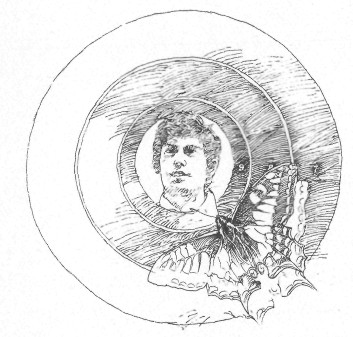
She only took the time necessary to say the name. She looked for it in the shadows, she found it at first sight among the many, many easily confused names from this world and the other, and she nailed it to the wall with her well-aimed dart, like a butterfly with no will whose sentence has always been written.
“Santiago Nasar,” she said.