The news of the burglary was all round the New Cut before breakfast. Ordinary burglaries were one thing, but this was a bigger job altogether than pinching a sack of potatoes from the greengrocer’s or a tin alarm clock from the pawnbroker’s window. The Worshipful Company of Gas-Fitters was an important body of men, and Gas-Fitters’ Hall was the most noble edifice in the whole of Lambeth, apart from the Archbishop’s Palace and the Lunatic Asylum, anyway.
As soon as the kids heard about it they ran there at once, and found a crowd gathered outside, staring at four policemen who were pretending to look for clues.
“I hear as they drugged the night watchman,” said Dippy Hitchcock, the hot-chestnut-and-baked-potato man. “They slipped him an unknown Chinese poison in a cup of tea, and he fell asleep and never heard nothing.”
Benny and the others listened, enthralled.
“I don’t know about that,” said Mr. Myhill solemnly, “but I’m given to understand that that silver’s worth over ten thousand pounds.”
Mr. Myhill was a bank clerk, and understood the value of money.
“Daft, if you ask me,” said Mrs. Fanny Blodgett of the Excelsior Tea and Coffee Rooms. “What do a lot of blooming gas-fitters want with ten thousand quid’s worth of silver plate?”
The men turned to her, shocked.
“Mrs. Blodgett!” said Mr. Tate, the pawnbroker. “The Worshipful Company of Gas-Fitters is a most ancient and honorable charitable association, fit to rank with the Dyers, the Tanners, the Vintners, the Merchant Taylors—all the most noble City Livery companies. Of course they need silver plate. I’m surprised at you for thinking otherwise. I thought you was a woman of sense.”
Urgently, Benny led the others away, down a little alley at the side of the building.
“This is the crime we been waiting for!” he said. “I bet we can solve it. I bet the police can’t. I bet Scotland Yard’s baffled. I reckon it’s an international gang, that’s what I reckon.”
“Or pirates!” said Angela. “Off a boat on the river. Bound to be.”
“I just hope we can solve it before Sexton Blake gets to hear about it,” said Thunderbolt.
“Well, come on!” said Benny. “What we waiting for?”
“Look at this,” said Thunderbolt. “Here’s a clue straight off.”
He pointed down at the ground. Because of the dry weather, there wasn’t much mud about just then, but a leaking overflow pipe somewhere above had dripped onto the dust in the alley and created a churned-up patch of wet yellowish earth.
“If we find someone with that color mud on their boots,” Thunderbolt said, “they’re as good as guilty. Sexton Blake knows all the different colors of London mud. He’s always checking boots and that. We oughter do the same.”
“And footprints,” said Angela. “We could look for footprints in it.”
“Yeah!” said Thunderbolt. “That’s a good idea.”
“That’s what I mean,” said Angela. “And we could’ve, and all, till you put your great plates all over it.”
Thunderbolt looked down. She was right; he’d trodden everything into a swamp. If there’d been any burglarious footprints a moment ago, there were certainly none now.
“Hmm,” he said. “Oh well.”
Benny was peering closely at a little window four feet above the ground.
“Here’s a clue,” he said.
The others gathered round. Benny was pointing at a dent in the woodwork near the window catch which looked as if it had been made by a jimmy.
“That’s where they forced their way in!” said Benny. “Betcher!”
“Yeah, could be!” said Zerlina.
Thunderbolt was peering at it closely. His glasses didn’t always work when he hadn’t cleaned them for a while, and it was hard to clean them anyway, given the usual state of his handkerchief, so he couldn’t see the little dent as well as the others could. He felt along the windowsill and found something else, though.
“Here’s a drop of wax—look.”
The others demanded to feel it too. It was almost invisible, but their fingers could make it out, all right.
“A little blob of wax,” said Benny. “That’s definitely a clue! He musta spilled it from a candle. And look—here’s a Lucifer!”
He had spotted a match lying at the foot of the wall, and stooped to pick it up. This was the real thing, and no error. A genuine criminal match combined with a genuine criminal blob of candle wax right next to a genuine criminal jimmy dent—it was too good to be true.
“OI!”
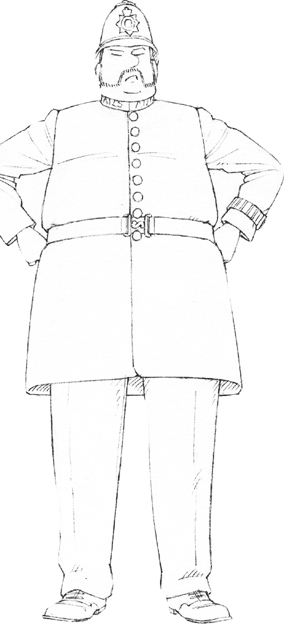
The roar resounded down the alley, and all the kids looked up, startled. Police Constable Jellicoe, the stoutest bobby in the whole of Lambeth, was standing in the entrance.
“Get out of it! Go on! Move along there!”
Benny darted up to him, holding the match.
“Mr. Jellicoe! Look what we found! It’s a clue!”
“Oh, it’s you lot,” said P.C. Jellicoe, recognizing him. “Go on, hop it. This is a serious police investigation. What are you doing here, anyway? You oughter be in school. Or prison. I know where I’d send yer.”
“But, Mr. Jellicoe—”
“Did you hear what I said? Clear off!”
“But we got a—”
P.C. Jellicoe’s mighty hand, raised high, showed them clearly what they’d get if they didn’t do as he said. They dodged past him out of the alley and stopped in the street to look back.
“No good telling old Jelly-Belly,” said Benny. “It’s the Inspector we ought to tell. He’ll know about clues and that.”
But the inspector was inside the building, and the constable on guard at the door was even less patient than P.C. Jellicoe. Benny had to move fast to dodge the automatic clout.
“Right,” he said hotly to the policeman. “That’s it. You done it now. When the New Cut Gang catches the burglar as done this job, you’re going to look pretty silly. I wouldn’t like to be in your boots. I wouldn’t like to be a policeman then. I’d rather be a pantomime horse than a policeman when we catch the Gas-Fitters’ Hall burglar.”
The policeman sneered, and Benny and the others left in disdain.
“You better not lose that match,” said Angela. “Give us it here, I’ll look after it.”
“Not blooming likely,” said Benny. “Remember when you looked after Sharky Bob for the afternoon?”
Sharky Bob was the youngest member of the New Cut Gang, a cheerful, benevolent six-year-old who would eat anything, and often did. The twins had once borrowed him for an afternoon in order to match him against the Brixton Gobbler, an infant of similar talents, in a contest involving hard-boiled eggs. Sharky had beaten the Gobbler hands down, and the twins, who had bet a total of nine shillings on him, had run off at once to claim their winnings from Snake-Eyes Melmott. In doing so, they’d forgotten Sharky Bob altogether. He was later found happily eating his way up the Lambeth Walk from chophouse to pub to baked-potato stall, followed by an admiring crowd, but the damage had been done: the twins had earned a reputation. They won bets, but they lost things.
They gave Benny a dark look, but he was intent on fumbling in his pocket for something to put the match in.
“Here it is,” he said. “I’ll keep it in me matchbox.”
He brought out a Bryant and May’s matchbox and carefully slid it open. He had to be careful in case the unusual worm he kept in there had come alive again, but it was either dead or asleep. The worm was unknown to science, Thunderbolt said, but then, after three weeks in Benny’s pocket, probably not even its mother would have known it.
Benny prodded the worm carefully aside and put the match in the box. Or tried to.
“Here,” he said, “it won’t go.”
The match was too long for the box.
“I thought all matches was the same?” said Zerlina.
“Give us a look,” said Thunderbolt.
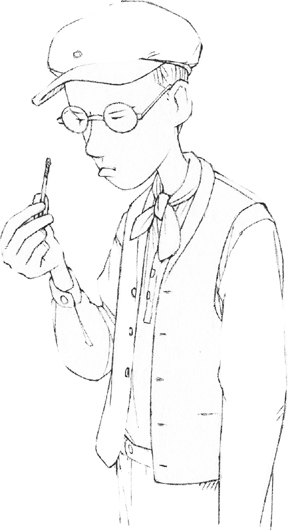
He held it close to his eyes. It looked like every other match he’d ever seen, except that it was, now he looked at it, a bit longer than most.
“This is an even better clue!” he said. “A highly unusual match!”
“Yeah!” Benny said, excited. “That’s right! Let’s go and ask Mr. MacPhail about it. He’ll know all right.”
MacPhail’s was the tobacconist’s at the corner of the New Cut. Mr. MacPhail sold snuff and walking sticks and Smoker’s Companions as well as tobacco and cigars and cigarettes and things, so he was bound to know about matches.
“Aye,” he said, examining it through his pince-nez. “Swedish, this is. Not a British Lucifer. Swedish.”
“How d’you know that, Mr. MacPhail?” said Benny. “I mean, apart from it being long, and that.”
“Because o’ these little marks at the end.”
They all crowded round to look. He was pointing at the unburnt end. Thunderbolt, blinking and widening his eyes, could just see two little grooves pressed into the wood on opposite sides of the square stick, a fraction of an inch from the end.
“When they make ’em,” Mr. MacPhail explained, “there’s a machine that holds the stick by one end and dips it into a tank o’ thick inflammable stuff. Then they pull it out again with a wee blob on, and that’s the head, ye see, and they march the sticks around till the head’s dry and then pack ’em in the boxes. A British Lucifer’s made the same way, only British Lucifers is held by a different kind o’ machine that makes a different kind o’ mark. Look.”
He took a Bryant and May’s matchbox from the shelf behind him and showed them a match. He was right: on this one, each of the four edges where the sides of the match met had been nipped in a little about an eighth of an inch from the end. It was quite different from the Swedish one.
“D’you sell Swedish matches, Mr. MacPhail?” said Thunderbolt.
“No, son. Only British ones.”
“So who d’you reckon might be using Swedish Lucifers round here?” said Benny.
“A sailor,” said Mr. MacPhail. “Someone in the timber trade, mebbe. Anyone who’s been to the Baltic recently.”
“Or any real Swedes,” said Thunderbolt. “Like S—”
Benny kicked his ankle to shut him up. “Right. Thanks, Mr. MacPhail,” he said, and they left.
Outside, in the street, Thunderbolt rubbed his ankle and said, “What was that for?”
“ ’Cause you might warn him, you clot!”
“Warn who? Mr. MacPhail’s not the burglar, is he?”
“Warn Sid the Swede, of course! That’s who you were going to say, wasn’t it?”
“Well, yeah,” Thunderbolt admitted.
Sid the Swede was a local villain. He was a furtive and ratlike little man who always seemed to know where you could find a bit of mislaid fruit and veg, or someone who could change the markings on a horse to make it look as it if wasn’t the one that was pinched from the stables last week.
“Betcher it ain’t Sid the Swede,” said Angela.
“Yeah, me too,” said Zerlina. “I betcher lots.”
“Give you ten to one,” said Angela.
You didn’t bet against the twins, even at odds like that.
“Why not?” said Benny.
“ ’Cause he’s in jail,” said Zerlina, “that’s why. He got caught last week nicking washing off old Mrs. Pearson’s line.”
“He got jugged for a month,” said Angela.
“Hmm,” said Benny. “Well, that puts a different confection on things. Seems to me we’ll have to go inspecting every blooming box of matches in Lambeth. Every time someone lights a cigar, we’ll have to pick up the match afterwards and see if it’s Swedish.”
“And if they’ve got yellow mud on their boots,” said Thunderbolt, “they’re done for.”
So the gang split up to go looking for Swedish matches, yellow mud, and ten thousand pounds’ worth of silver.
That evening, Dick was going to take Daisy to the Music Hall. The twins wanted to go along too, in order to supervise him, but their mother wouldn’t hear of it. She looked up from the table where she was rolling out some pasta, and her dark eyes flashed.
“What do you tink you do with that poor boy?” she said. “You leave him alone! He’s a-nervous, he’s a-shy, he don’t want silly faces talking to him to a-do this and a-say that and all so on. You a-pester him, I cut your troats.”
She reached for the knife with a beefy flour-covered arm, and they fled. Mrs. Peretti had been threatening to cut her daughters’ throats ever since they could remember. It was just a sign of how fond she was of them, and they always liked to hear it, because it reassured them that everything was all right; but it meant that they’d have to give Dick some careful instructions if he was to face Daisy alone.
They guessed he’d be a little early, so they waylaid him outside the Music Hall three-quarters of an hour before the show began. He was walking up and down the pavement in the sunny evening, chewing his nails and muttering to himself.
“What can I do, kids?” he said miserably. “Look at me! I’m a shadow of a man! I wish Daisy was a heavyweight boxer and I was going to go three rounds with her. I wouldn’t be half so blooming nervous. If only I could think of what to say …”
“That’s what we’ve come for, you great goopus,” said Zerlina. “Just listen and we’ll tell you what to do.”
“Now, what ladies like,” said Angela knowledgeably, “is flattery. You gotta tell her that her eyes is like stars.”
“And her lips is like cherries,” added Zerlina.
“Cherries? You sure?” said Dick.
“That’s right. And altogether she looks like a fashion plate.”
“What’s a fashion plate?”
The twins weren’t sure themselves, but they had an answer; they had an answer for everything.
“It’s a special ladies’ thing,” said Angela. “That’ll please her; you watch. Then, during intermission, you buy her an orange.”
“And in the second half you whisper, ‘Daisy, will you do me the honor of being my guest at the Gas-Fitters’ Ball?’ ”
“And she’ll say, ‘Oh, blimey, Dick, not half.’ ”
“And you say, ‘Cor, Daisy, I love yer,’ and—”
“Here she is!”
The twins fled before Daisy could see them. They were like little demons, thought Dick nervously: one second they were here, whispering mischief; the next they’d vanished. And here was Daisy, looking prettier than ever.
“Hello, Dick,” she said sweetly.
He gulped so hard he nearly swallowed his own head.
“Hello, Daisy,” he croaked.
Should he start flattering her straightaway? Or should they get inside first? Luckily, the queue was moving forward and he didn’t have time to say anything until he’d bought the tickets and they were sitting in the middle of the stalls. He helped her in and sat down beside her. The band was tuning up in the orchestra pit; the stage curtain was glowing crimson in the limelight; the gilt on the plasterwork was glittering; the boxes and the balcony were all full of jolly-looking people, laughing and chattering. Dick looked around desperately, but there was nothing for it; he’d have to talk to her.
What on earth had the twins told him to say? It had gone right out of his head.
“Yes, Dick?”
“Er—you look like a bowl,” he said.
“What?”
“I mean a plate.”
“A plate?”
“Yeah. Or a dish. I mean—”
What Daisy might have said in reply he never knew, because the band struck up with “Down at the Old Bull and Bush” and she turned away bewildered, to look at the stage as the curtain rose.
During the first half of the bill, they watched Mr. Hosmer Simpkins, the Lyrical Tenor; Madame Taroczy’s Hungarian Spiral Bicycle Ascensionists; Mr. Paddy O’Flynne, the Jolly Wee Man from the Emerald Isle; and the Louisiana Banjo Playboys. In between each act, Dick turned to Daisy and began to speak, but the emcee always spoke louder, and the audience roared with laughter at his jokes, and Dick had to open and shut his mouth like a fish.
At last there came the intermission.
“I liked the Spiral Hungarians, Dick,” she said. “Didn’t you?”
“Yeah, I did, yeah,” he agreed. “Cor. Here, Daisy …”
“Yes, Dick?”
“Um—” he began. He was trying to remember the other things the twins had told him to say. Wasn’t there something to do with the night and the sky? “Your face,” he said nervously.
“Is there something on it?”
“It’s like the—the moon.”
“The moon?”
“No, no—that wasn’t it. Um—”
People in the row behind were listening, and enjoying it all immensely. Dick mopped his forehead with a redspotted handkerchief. Perhaps he should have gone back to saying she was like a bowl, only that hadn’t come out right either. But the word “bowl” made him think of cherries, and then he remembered.
“Um—your eyes is like cherries, Daisy.”
“What d’you mean, Dick? Are they bloodshot or something?”
“No,” he said. “No. Not at all. No. What I mean is, your lips. That’s what I meant. Like—um—” This was awful, he thought. He’d forgotten it altogether, but he had to go on now he’d started. Fruit, some kind of fruit; come on … Oranges, was it? No, couldn’t have been. “Bananas,” he said desperately.
“Why?” she demanded.
He hadn’t the faintest idea.
“Er—same shape,” he mumbled doubtfully.
“What do you mean?” she said. “Honestly, Dick, if I didn’t know you better, I’d say you was trying to upset me.”
“Oh, Lor—no—I’m not, honest—”
The people behind were laughing and nudging each other and telling the people in the next row back. More and more of the audience were trying to listen, craning over from the balcony above, peering at them through opera glasses.
Someone up in the seats behind yelled, “Go it, Dick! I got five bob on yer!”
Dick looked round, puzzled, because he hadn’t the faintest idea what the man meant, of course. Someone else took up the cry, and soon the whole audience was cheering like a racehorse crowd. As for Daisy, she was mortified, poor girl.
“I can’t sit here and be laughed at, Dick, I really can’t!” she said. “It’s awful! It’s just too embarrassing for words! Everybody’s listening, and I’m sure you mean well, but—”
And she stood up and struggled to get out along the crowded row of seats. A big groan of disappointment went up. Dick struggled after her, but he was too late; and then the band struck up for the second half of the bill, and the lights went down, and she was gone.
Meanwhile, the twins were pestering their big brother Alfredo to look out for Swedish matches, as the gang were doing. Alf was a hokey-pokey man, an ice-cream vendor, and naturally, spending his time in commerce, he was bound to meet a lot of men who smoked and dropped the matches in the street. So the twins said, anyway.
“D’you mean every time I see some bloke light up a gasper, I got to get down on me hands and knees and pick up his dead Lucifer? Get out of it!”
He was combing his thick black mustache and smoothing down his glossy black hair in the kitchen mirror, and he was dressed up to the nines.
“Where you going, Alf?” said Zerlina.
“I’m off to see my mate Orlando down the Music Hall. I got a special pass to go in the stage door.”
“Orlando the Strong Man?” said Angela.
“Yeah. He bought five pound of ice cream off me the other day and swallered it just like that. He’s a real gentleman. He’s the strongest man in the world, I shouldn’t wonder.”
“Can we come with yer?”
“Don’t see why not, as long as you come straight back.”
So the twins set off with Alf, hoping they might be able to find out how Dick was getting on. They liked going about with their big brother; he was smart and handsome and all the young ladies liked his flashing eyes and his jet-black whiskers, and he was usually good for a lump of hokey-pokey on a hot day, especially if he’d won a bet. He once bet Stan Garside, the fishmonger, a whole guinea at a hundred to eight that the Archbishop of Canterbury would come and judge the Elephant and Castle Cat Show. Naturally, Stan thought he was on a winner, but sure enough, His Grace the Lord Archbishop did turn up, and he was as nice as pie. It was the twins who’d done it. They’d just gone to Lambeth Palace, knocked on the door, and asked. When they wanted to be, they were irresistible—or supernatural, one or the other. Anyway, they got a lot of hokey-pokey that day.
They reached the stage door and Alf waved his pass at the old porter, who didn’t even look up from his copy of Wild West Yarns, and then they were inside the theatre itself.
It was a dark, busy place, smelling of glue and greasepaint, with music and bursts of loud laughter coming from somewhere else in the building. Performers in costumes were waiting in the corridors or coming out of the dressing rooms, a group of stage carpenters were sitting around a packing case, playing cards, and they all greeted Alf like an old friend.
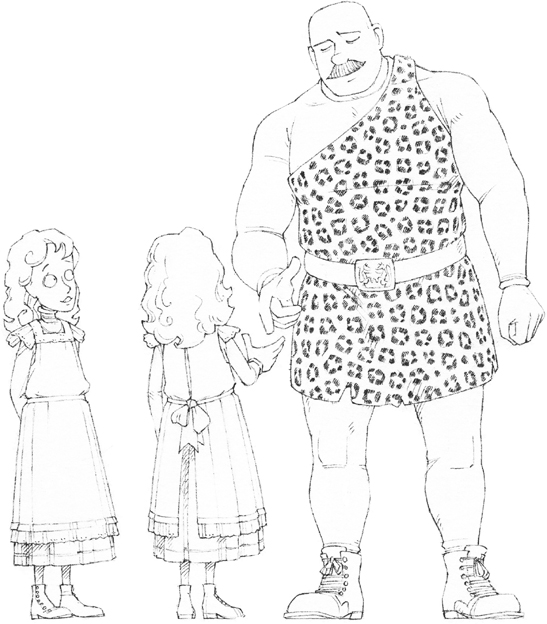
In one corner of the wings, Orlando the Strong Man was warming up. He was wearing a leopard-skin costume that showed off his mighty muscles, and he had a gleaming bald head and a huge black mustache even bigger than Alf’s.
“Wotcher, Alf,” he said, “and who’s these young ladies?”
“Me sisters,” said Alf. “They come to say hello.”
While Alf went to talk to some of the chorus girls nearby, Orlando bent down and very politely offered his forefinger to the twins to shake. His hands were too big to shake all at once. As Alf had said, he was a real gentleman.
“Are you the strongest man in the world, Mr. Orlando?” said Angela.
“Probably,” he said. “You seen the act, have yer?”
“Yeah!” said Zerlina. “We liked the cannonball bit best.”
“Ah,” he said. “That takes practice. You have to—”
But he couldn’t say any more because, to everyone’s surprise, the curtain nearby swirled open and suddenly there was Daisy. She looked as if she’d been crying.
“Daisy!” said Zerlina.
“What’s the matter?” said Angela.
“I—I got lost,” Daisy sniffed. “I was trying to find me way out and—and—”
“Excuse me, miss,” said Orlando, “but you seem to be distressed. Can I help in any way?”
“That’s very kind of you, Mr.…”
“This is Orlando,” said Angela. “He’s showing us his muscles.”
“He’s got ever such a lot,” said Zerlina.
“Cor,” said Orlando, “you ain’t wrong. Here—look at this.” He struck a pose and flexed his mighty arms. “You see that muscle there?” he went on, frowning at a spot behind his shoulder.
“Which one?” said Daisy. “There’s hundreds.”
“That one going in and out.”
“There it is!” said Zerlina, pointing.
“Oh yes! I see it now,” said Daisy.
“Well,” said Orlando, “most people ain’t got one of them.”
“Oh,” said Daisy, impressed. “What does it do?”
“Well, it goes in and out,” said Orlando. “Here! Did you know I can lift a full-grown ox in my teeth?”
“No! Really?”
“Yeah. The trick is to get it right between the shoulder blades. You probably wouldn’t be able to do it at first. I should practice on a dog if I was you, and work up to a calf. You seen the act?”
Daisy shook her head and dabbed her eyes with a little handkerchief.
“I was going to,” she said, “but I had to leave.”
“The best bit is where they bounce fifteen cannonballs off me head, one after the other. The trick is to get ’em right there,” he added, pointing at the middle of his gleaming forehead, “else it could be dangerous. Anyway, miss,” he said politely, “I got to go now, ’cause I’m on in a minute. I’m very glad to have made your acquaintance.”
He held out his hand, but as she was about to shake it, he took it back.
“No,” he said, “I better not shake your hand. Shall I tell you why?”
Daisy nodded, surprised.
“ ’Cause this hand can crush rocks,” he said. “I got to be careful what I do with it. Goodbye, miss, and cheer up, eh?”
Then there was a roll of drums, and he sprang onto the stage to a great round of applause. The twins would have liked to watch, but there was Daisy to look after; things didn’t seem to be going very well for the great bet. They took her out and tried to find out what had happened.
Oddly enough, Benny and Thunderbolt were doing the same thing at that very moment, with Dick. He had tried to follow Daisy out of the Music Hall, but had taken a different turning and run into the boys outside the foyer. They were hanging about, watching every smoker with grim suspicion. Every time a match fell to the ground they pounced, but so far they hadn’t had any luck.
“You seen Daisy?” Dick said.
“I thought she was with you,” said Benny. “Here! Thunderbolt! Geezer in the straw hat …”
Thunderbolt darted across the road and practically snatched the match out of the hands of a stout man who’d just lit a cigar. He looked at the match closely and shook his head in disappointment. Benny sighed.
“Woss going on?” said Dick.
“We’re looking for Swedish matches,” said Benny.
“Oh,” said Dick. Probably collecting them, he thought, like stamps or something. He sighed even more deeply than Benny.
That reminded Benny of the bet, and with an effort he pulled his mind back to it.
“Here,” he said, “I thought you was going to ask Daisy to the Ball?”
“I was,” said Dick in tones of the deepest gloom. “But it seems to me that every time I open my mouth, I say the wrong thing. I told her her face was like a bowl of bananas. At least that’s what I think I said. I can’t remember. It’s all gone dark in me mind.”
“Hmm,” said Benny. He didn’t know much about the language of love, but he didn’t think that sounded like a compliment.
Thunderbolt darted back across the street.
“No good,” he said. “It was a Bryant and May’s. What’s the matter with Dick?”
Benny told him. Thunderbolt whistled. “A bowl of bananas?” he said, impressed. “Cor. She ought to be pleased, anyway. Anybody’d be flattered by that.”
“You think so?” said Dick, cheering up a little. Maybe it hadn’t been such a mistake after all. “Here, them Swedish matches you’re looking for …”
“Yeah?” said Benny eagerly.
“Well, I know who’d probably have some. I mean, being as he went to the European Congress of Gas and Coke Industries in Stockholm last month to make a speech.”
“Who?”
“Mr. Whittle,” said Dick. “I dunno what’s bin up with him lately, neither. He’s bin acting most peculiar. Almost as if he had summing on his mind. Still, I can’t hang about here. I better go and look for Daisy.”
He kicked at a gloomy bit of straw on the pavement and wandered away, sighing. The boys looked at each other with bright speculation in their eyes.
“Mr. Whittle …,” said Benny. “I wonder.”
“And—and Miss Honoria Whittle was unhappy when I went for me trigonometry lesson,” Thunderbolt said. “She kept sighing and gazing out the window. I thought she was sad about me not giving her that shilling I bet Snake-Eyes Melmott, but maybe she was worried about her pa. Same as I was about my pa over the snide coins business. So maybe he is up to summing. Cor!”
“Well,” said Benny, “there’s only one way to find out. We’ll have to detect him good and proper. Come on! Let’s get going!”
When the twins heard what Dick had said to Daisy, they thought it would be a good idea to keep out of his way for a day or so, in case he thought it was their fault. They knew that other people sometimes found it hard to believe in their good intentions.
“We oughter wrote it down for the great clot to read,” said Angela.
“That’d look good, wouldn’t it?” said Zerlina. “Fishing out a bit of paper and reading to her. I dunno what we can do.”
“You can’t help some people,” said Angela.
Shaking their heads over the futility of human endeavor, they went home. They were so preoccupied that they didn’t see Daisy, at her front door, being stopped by a handsome young man with fair curly hair, who lifted his hat very politely and told her how pretty she was looking. The young man was Mr. Horspath, the Deputy Gasworks Manager, Daisy’s other admirer. It was lucky for him the twins weren’t watching, or they’d have been there in a second, to get him away from Daisy at all costs. Snake-Eyes Melmott was taking a lot of money in bets on him, and Daisy’s mother strongly approved of Mr. Horspath, because he had nice soft hands, she said, like a proper gentleman, not great rough oily shovels like Dick’s. There was no doubt about it, Mr. Horspath was a serious threat.