Some members of the IRA had ‘wanted Jean’s body dumped in the middle of Albert Street’. But, Price maintained, Gerry Adams ‘argued against that’, saying that doing so would be bad for the image of the Provos.
These charges were devastating in their specificity, and dovetailed quite precisely with the account by Brendan Hughes. But there was something peculiar about the article in Sunday Life. To begin with, the author, Ciarán Barnes, did not appear to have spoken to Dolours Price himself. Instead he cited a ‘tape recorded confession’ by Price, ‘which Sunday Life has heard’. But what was this confession? Elsewhere in the article, Barnes wrote that Price ‘has made taped confessions of her role in the abductions to academics at Boston University’. Apart from the erroneous name – Boston University and Boston College are separate institutions – the implication was unmistakable: it appeared that Ciarán Barnes, a Belfast tabloid journalist, had somehow listened to the Boston College tapes of Dolours Price.
When Ed Moloney learned about the Sunday Life story, he reacted with alarm. The article clearly intimated that Barnes had accessed the archive at Boston College. But Moloney knew that this could not be true. The recordings had been held under lock and key, in the Treasure Room at the Burns Library. What’s more, Moloney could point to another reason why Barnes could not have had access to the tapes: in her recorded interviews with Mackers, Dolours Price had never mentioned Jean McConville – because Mackers had warned her against doing so. ‘Dolours Price did not once mention the name “Jean McConville”,’ Moloney wrote in a subsequent affidavit.
If Barnes hadn’t heard the Boston tapes, then which confession was he referring to? As they tried to fathom what had happened, Moloney and Mackers arrived at a theory. Allison Morris and Ciarán Barnes were friends and former colleagues who had worked together in the past, at the Andersonstown News. Moloney and Mackers knew about the abortive Irish News interview that had been halted by Marian Price. They concluded that, after publishing her own defanged version of the Price story, Morris must have shared the tape of her interview with her friend Barnes. In the article, Barnes wrote about hearing a ‘taped confession’ and also said that Dolours Price had made a ‘taped confession’ for the Belfast Project. The article implied that there was only one taped confession. But in fact there were two.
Allison Morris denied sharing her interview with Barnes; Barnes would say only that he ‘would be remiss’ to talk about his sources. Gerry Adams, meanwhile, angrily contested Price’s claims, noting that she was ‘a long-standing opponent of Sinn Féin and the peace process’. Price was suffering from ‘trauma’, Adams pointed out, adding, ‘There obviously are issues she has to find closure on for herself.’ It was the same criticism Adams had levelled at Hughes, who he characterised as having ‘his issues and his difficulties’.
If Adams had indeed been the commanding officer of both Price and Hughes, this talking point could be interpreted as surpassingly callous: both were indignant because Adams had ordered them to take brutal actions, then disowned them, claiming that they alone bore moral responsibility, because he was never in the IRA. When each finally spoke up, Adams maintained that they were lying – and, in order to discredit them, pointed to the genuine trauma they were experiencing. Adams himself seemed conspicuously undaunted by the past. So many others were tortured by what they had experienced in the Troubles. But he never looked as though he had lost a night’s sleep. ‘Brendan said what Brendan said,’ he told one interviewer. ‘And Brendan’s dead. So let it go.’
26
The Mystery Radio
For the McConville family, the nearly simultaneous revelations of Ed Moloney’s book about Brendan Hughes and the newspaper stories about Dolours Price were painful. Both Hughes and Price had insisted that Jean was an informant, and Hughes had described in detail how she was discovered in possession of a radio. This new information appeared to reopen a matter that the McConvilles had felt was conclusively settled. In 2006, the police ombudsman for Northern Ireland, Nuala O’Loan, released a report on the death of Jean McConville. O’Loan found that the authorities had never conducted any sort of proper investigation into the abduction. But she located intelligence files from the time that recorded rumours suggesting that ‘McConville had been abducted by the Provos because she is an informer’. When she searched old military and police files, however, O’Loan was unable to locate any records that mentioned McConville prior to her disappearance – or any suggestion that she might have been working as an agent in Divis Flats. In her report, O’Loan pointed out that the United Kingdom has a policy to neither confirm nor deny whether any particular individual has served as a clandestine agent of the state. Nevertheless, she wrote, this situation was unique. ‘That family has suffered extensively because of the allegation that their mother was an informant,’ she noted, and because Jean was long since dead, no harm could come to her now. ‘She is not recorded as having been an agent at any time,’ O’Loan wrote, before concluding, more forcefully, ‘She was an innocent woman who was abducted and murdered.’
This emphatic declaration felt like a vindication to Jean’s children, who for decades had asserted that their mother was unfairly maligned because she came to the assistance of a wounded British soldier. ‘I am glad my mother’s name was cleared,’ Michael McConville said after the report was released. ‘We knew throughout all the years, it was lies.’
Not everyone was ready to accept O’Loan’s report as the final word, however. Even after her findings were announced, the Provos stuck to their original position, saying, in a new statement, that the IRA had conducted a ‘thorough investigation’ of its own into the circumstances surrounding McConville’s murder and had confirmed that she was ‘working as an informer for the British Army’. The statement singled out Michael McConville by name and acknowledged that he might dispute the Provos’ account, before adding, acerbically, ‘The IRA accepts he rejects this conclusion.’
Ed Moloney and Anthony McIntyre also continued to believe that McConville had been an informant. Their confidence in the oral history of Brendan Hughes was unshakeable. To Moloney, it seemed that Nuala O’Loan, influenced by her obvious sympathy for the McConville children, simply chose to arrive at the categorical conclusion that would be most comforting for them. As a hard-nosed reporter, Moloney had an outlook that was more clinical and unsparing. In his view, the fact that O’Loan could not retrieve any records indicating that McConville was a spy hardly settled the matter. Which of the many secret archives of British military records had O’Loan consulted? She refused to specify. Perhaps there were records that she had not discovered. Had she really left no stone unturned? Mackers believed that the army or the police might have deliberately covered up Jean’s involvement. If she had been a tout, and she was warned by the IRA to stop, it would look pretty terrible for the authorities to give her another radio and send her back to work, when such a move was so likely to get her killed.
There was also a mystery relating to the detail of the radio itself. Some former police officers, like Trevor Campbell, maintained that neither the army nor the police were using hand-held radios to communicate in those days, much less to communicate with informants. But Ed Moloney, working with a researcher who had served in the British Army, dug through old British files and found evidence of a small radio that was used by the army in Belfast in 1972. They even managed to track down a photograph of a British soldier, squatting against a wall in full battle flak, holding this type of radio – in Divis Flats.
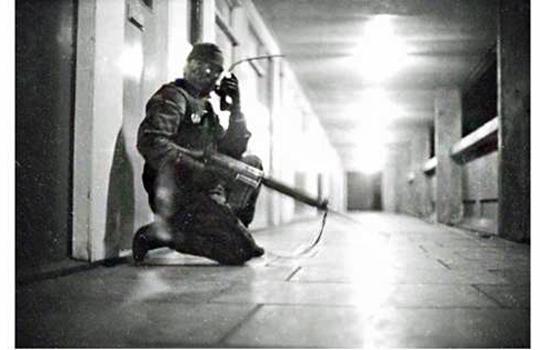
Soldier with a hand-held radio in Divis Flats (© Soldiers of Gloucestershire Museum)
Even if such a radio did exist, however, it would be folly to give the device to a low-level informant who lived with a bunch of children in an intensely republican area. And what about those thin walls in Divis Flats? You couldn’t have a casual conversation over a cup of tea without the neighbours in the next flat overhearing. So making covert transmissions on a clandestine radio would pose serious risks. When Michael McConville studied the recollections of Brendan Hughes, he was struck by the fact that Hughes never said that he had personally seen the radio in question. Perhaps this was just a rumour that got passed around Belfast for long enough that over the years it became accepted as fact. Perhaps it was a story that the people who murdered Jean McConville told one another (or told themselves) in order to feel less awful about what they’d done. Michael also wrote off as ludicrous and insulting the suggestion, by Hughes, that the McConville siblings might somehow have assisted their mother in any conspiracy to spy on their neighbours.
But there was another mystery that was compounded by the publication of the Brendan Hughes account. It involved the timeline of Jean McConville’s disappearance. In her investigation, Nuala O’Loan was not able to recover any official documents giving a precise date for the night Jean McConville disappeared. The children had always maintained that one evening in early December, Jean had gone to play bingo and had then been seized, questioned and beaten before she was discovered wandering in a daze by the army and brought home to Divis Flats. It was the following evening that she was taken away, according to the children’s memory: she was still nursing the bruises from her beating. While the children could not be absolutely certain about the date, they believed that Jean was abducted on 7 December 1972.
This timeline would seem to contradict the story told by Brendan Hughes, who recalled McConville being questioned and having the radio seized, then returning to work as an informant and, some time later, being caught with a second radio. The story that Hughes told, which Dolours Price endorsed and the IRA officially maintained in its statements, was that Jean McConville was not just an informant but a recidivist: that she was warned to stop helping the British, and then murdered only after she defied the warning. But if McConville was questioned and warned on the night of 6 December and then abducted from her flat the following night, the timeline Hughes asserted would make no sense. Even in a scenario in which McConville’s ostensible British handlers were callous enough to put her back to work after the warning, it seems unlikely that they would do so – and even supply her with a new radio – within twenty-four hours.
The McConville children embraced O’Loan’s report as a complete exoneration of their mother, a decades-overdue affirmation of everything they had been saying for years. But in a few significant particulars, the report was actually at odds with the family’s version of events. In her review of historical documentation, Nuala O’Loan discovered an official record that seemed to describe the night Jean was taken from the bingo hall by the IRA for questioning. According to an old police log, a woman was found wandering the streets in West Belfast one night at 11 p.m. She had been beaten. The log noted that her name was Mary McConville, but clearly this was Jean – her address was listed as St Jude’s Walk, in Divis Flats. The log stated that the woman had been ‘accosted by a number of men and warned to stop giving information to the military’.
Setting aside the question of whether the IRA was correct or mistaken in believing Jean to be a tout, this document appeared to corroborate the claim that a warning had been issued to her. But the police log was a significant clue for another reason as well: according to the log, McConville was found wandering the streets after the beating and the warning not on the night of 6 December, as the children’s account suggested, but seven nights earlier, on 29 November.
Michael McConville and his siblings were just kids in 1972. They lived in a war zone, their mother had been taken, and they were forced to steal and scavenge for food. In the midst of tumult and tragedy, nobody is consulting the calendar. And memory is a strange thing. Helen remembers that on the day after Jean was taken from the bingo hall, the younger children went to school; Michael remembers that they stayed home. It could be that the McConville siblings simply got the dates mixed up in retrospect and that Jean was actually questioned on 29 November and taken away on 30 November. But from the very first press interviews and accounts to social services that they gave beginning in January 1973, the children were emphatic that their mother was taken in early December, not late November. If the date of the abduction is accurate, and the police log that O’Loan discovered is reliable, then it would seem that more than a single night may have elapsed between the initial interrogation and warning and the moment Jean McConville was taken away. If that were the true chronology, then it would look a lot more like the timeline proposed by Brendan Hughes.
There was one final confounding detail in O’Loan’s report. For decades, the McConville kids had talked about the night their mother came to the aid of the wounded British soldier in Divis Flats. More than one of the children could recall vivid details from that evening: the family huddled in the darkness of the flat; the staccato pop of gunfire in the concrete corridors; the soldier’s anguished moan outside the door. But when O’Loan consulted army records from the period, she could find no evidence of a British soldier being wounded in the vicinity of Divis Flats. Perhaps the records were incomplete? Or perhaps there was some mistake regarding the nature of the soldier’s injuries, or the period in the lives of the McConvilles when the episode took place. But it was tempting to wonder whether the children of Jean McConville, like the people who abducted her, had not constructed a legend around the vanished woman that they could live with.
Brendan Hughes may have been dead by the time it was revealed that he had direct knowledge of the McConville disappearance. But Dolours Price was still alive. When the Sunday Life article was published, in 2010, the McConvilles were shocked that Price would speak so freely about her involvement in an operation that had been a closely guarded secret for so many years. Ravenous for more information, Michael sent a message, through intermediaries, that he would like a meeting with Price. But he never heard back from her. Helen greeted the story with an angry challenge to the authorities. ‘Arrest the pair of them, Adams and Price,’ she said. ‘It’s disgusting that the people involved in my mother’s murder are still walking the streets.’ The Sinn Féin president and his outspoken antagonist might not have ‘pulled the trigger’, Helen allowed. But they were ‘as guilty as the people who did’.
One bright, chilly morning the following spring, Ed Moloney was at home in the Riverdale section of the Bronx when he received a phone call that filled him with alarm. Boston College had just received a subpoena. The US Department of Justice, acting under a mutual legal assistance treaty with the United Kingdom, was passing on an official request from the Police Service of Northern Ireland. The request was made, the subpoena stated, in order to assist the authorities ‘regarding an alleged violation of the laws of the United Kingdom, namely, murder’. Specifically, the subpoena demanded ‘the original tape recordings of any and all interviews of Brendan Hughes and Dolours Price’.
27
The Boston Tapes
‘I always, probably to the point of being boring, asked about the legal status and confidentiality,’ Mackers fumed. ‘Total confidentiality and total protection. This was the whole reason for putting them in a US university!’ An emergency conference call had been convened among the chief architects of the Belfast Project to discuss what to do about the subpoena. Along with Mackers and his wife, Carrie, outside Dublin, the call was joined by Ed Moloney (in New York), Wilson McArthur, who had conducted the loyalist interviews (in Belfast), and Tom Hachey and Bob O’Neill, at Boston College. Hachey announced that he had spoken with the president of the college, William Leahy, and that Leahy had assured him, ‘We are not going to allow our interviewers or interviews to be compromised.’
Mackers and Moloney were in a state of panic. During the years when they were compiling the oral history archive, they had never believed that British authorities might seriously endeavour to access the recordings. The very idea seemed ludicrous: just a few months earlier, the British government, along with the government of Ireland, had entrusted a raft of sensitive documentation associated with the post-Troubles disarmament process to Boston College, on the understanding that the records would be sealed for up to thirty years. Could officials from the same government really be seeking, now, to violate a similar embargo at the very same university?
Administrators at Boston College had been consulting with lawyers, and it was not yet clear how the university would respond. On the call, Hachey and O’Neill were unflustered, and reassuring. But Mackers expressed a fear that BC might ultimately comply with the request and turn over the tapes – that the interviewers and the ex-paramilitaries who shared their secret histories might simply be ‘hung out to dry’.
Moloney shared this fear, and, as a form of insurance against any quiet, dead-of-night handover, he had already gone public. He contacted the New York Times, which ran a front-page story, ‘Secret Archive of Ulster Troubles Faces Subpoena’. He also spoke to the Boston Globe, suggesting in an interview that Boston College might be left with no choice but to ‘destroy’ the tapes rather than turn them over to the authorities. To Moloney and Mackers, it seemed that nothing less than the principles of free speech and academic freedom hung in the balance, and the more publicity the case received, the more likely Boston College would be to do the right thing. But Hachey scolded Moloney for going straight to the press without consulting university administrators first, and he complained that the threat about destroying the archive had been ‘over the top’.
Nobody in the group knew what was driving this sudden request for the interviews, but Moloney had a suspicion. The Police Service of Northern Ireland might be striving, on paper, to become a new kind of department, but while the police had changed the name of the constabulary, they were still, in many instances, the same police. For decades, the men of the RUC had perceived Gerry Adams to be their chief antagonist, the figurehead of a paramilitary outfit that murdered nearly three hundred police officers over the course of the Troubles. Many old hands in the PSNI had lost loved ones – fellow cops, childhood friends, fathers – at the hands of the IRA. Now they had become aware that, across an ocean at Boston College, there existed an archive featuring testimony by former subordinates of Gerry Adams, and that these secret interviews might furnish the kind of proof that had eluded British authorities for decades: evidence that could put Adams away not just for IRA membership, but for murder.
‘This is a vendetta that is being waged,’ Tom Hachey said on the conference call, agreeing with Moloney. ‘They’re out to try to find something that they can nail a person like Gerry on.’ He added, ‘I’ll be goddamned if they’re going to use our archives to indict him, because that’s not what we undertook this enterprise for.’ Hachey certainly sounded adamant. But as he and Bob O’Neill questioned the others about the particulars of the project, Moloney thought that he detected, in the line of questioning, a hint that Boston College might not be feeling quite so resolute as Hachey was making it sound. They were very curious about the precise guarantees that McIntyre and Wilson McArthur had made at the time they conducted the interviews. What exactly had the interview subjects been promised in the way of confidentiality? Before he interviewed his loyalist subjects, McArthur said, he had assured them that there was an ‘ironclad’ guarantee of confidentiality. Their testimony would be released to no one, nor would it even be acknowledged that they had participated in the project at all, until after their death. McArthur reminded Hachey and O’Neill that they themselves had used that word – ironclad – when they first discussed the archive, a decade earlier. When he encountered skittish participants, McArthur would tell them that ‘Boston College’s legal counsel’ had vetted the whole arrangement.
As it turned out, this was not actually true. When Ed Moloney was preparing the contracts that the participants would sign, in early 2001, he emailed some proposed language to Bob O’Neill, writing, ‘You may want to refer this to your legal people before we use it.’ The following day, O’Neill wrote back to say that he was working on the wording of the contract and would run it by the university’s lawyers. But in the end, it appears, he never did. A lawyer would probably have advised him that the contracts should specify that any guarantee of confidentiality they might contain would not necessarily be able to protect the archive from a court order. The contract that each participant signed did not contain any such qualification, and no lawyer at Boston College ever reviewed those agreements.
Hachey ended the conference call on an upbeat note, like a team captain breaking up a huddle, as though the men would brace themselves and march into this battle as a team. But while they would exchange a few further emails, that was the last time that Hachey or O’Neill would speak to any of their partners in the Belfast Project. Before the end of May, Boston College turned over the Brendan Hughes interviews, on the grounds that Hughes was now dead and much of the content of his oral history had already been published in Moloney’s book. But whereas Voices from the Grave had been carefully edited to shield certain identities for legal and security reasons, the Hughes transcripts and recordings were unredacted. Moloney was irate to learn that the PSNI had come into possession of this material. ‘The authorities now have information upon which to act,’ he emailed Hachey. ‘I would bet the mortgage that at this moment there are teams of lawyers working in the bowels of the British government trying to discover ways to force BC to surrender the names of other possible interviewees.’
Moloney proposed that, in order to avert a ‘huge disaster’, Hachey and O’Neill should immediately pack the entire archive into FedEx envelopes and send it overnight to Mackers in Ireland. Boston College might not have the stomach for a protracted legal fight, but Mackers did. Before he would ever turn the tapes and transcripts over, Moloney said, Mackers would ‘happily go to jail’. For the academics to send the material out of the country at that point might have constituted obstruction of justice. But Mackers agreed with Moloney that Boston College had a moral obligation to honour its commitment to confidentiality, and this pre-empted any niceties of law. People had risked their lives to entrust their stories to the Belfast Project; the least Boston College could do was engage in a little civil disobedience to protect them. Now that the authorities had the Brendan Hughes material, Moloney predicted, there was a ‘strong possibility’ that they would return with a second subpoena, seeking other interviews, based on what they had gathered from Hughes.
In a terse email, Hachey said that under ‘no circumstances’ would the university transfer the documents out of the country. In a line that would come to seem ironic in retrospect, he pointed out that promises had been made to the participants and argued that the safest place for their recollections was Boston College. The university agreed to fight the Price subpoena, arguing, in a motion to federal court, that releasing the material would violate the agreements made with the participants, undermine academic freedom, jeopardise the peace process in Northern Ireland, and throw into danger the lives of people associated with the project. ‘The IRA imposes a code of silence akin to the concept of “omerta” in the Mafia,’ the brief noted. As such, people like Dolours Price were willing to participate in the oral history only with the assurance ‘that the interviews would be kept locked away’. In an affidavit, Moloney noted that ‘it is an offence punishable by death’ for IRA members to reveal details of their paramilitary careers to outsiders.
But the US government hit back aggressively with its own arguments for why the Price interview should be handed over, suggesting that Moloney, McIntyre and Boston College had ‘made promises they could not keep – that they would conceal evidence of murder and other crimes until the perpetrators were in their graves’. The Belfast Project was not a work of journalism, and, as a legal matter, there was no ‘academic privilege’ that would shield the interviews from a court order. As for Moloney’s arguments about the dangers of revealing the archive, the government argued, Moloney himself had widely publicised the project. He published a book about it! Nobody had assassinated Mackers when it was revealed that he had interviewed Brendan Hughes and others for the project. So how dangerous could it really be?
The government also suggested, erroneously, that the Price interview had already been unsealed and shared with the reporter Ciarán Barnes for his article in Sunday Life. Lawyers for Boston College pointed out, in a filing to the court, that this was false – that US officials had clearly been duped by the ruse with which Barnes implied that he had heard the Boston tapes, without ever saying explicitly that he had. But by August, Moloney’s dire prediction had come true, and a second subpoena arrived at BC, demanding any and all tapes related to ‘the abduction and death of Mrs Jean McConville’. In December, a federal judge ruled against the university and ordered BC to hand over the tapes and transcripts to the court for review. The university chose not to appeal this ruling – a capitulation that Moloney and Mackers greeted with ire, if not surprise. So the two Irishmen hired their own lawyers and appealed the decision.
Unfortunately for the Irishmen, the legal case was cut and dried: there were few legal or constitutional protections that the men could invoke. But in parallel with their efforts in the courts, Moloney and Mackers, along with Carrie Twomey, pursued a political strategy, appealing to anyone they could for support. John Kerry, then a senator from Massachusetts, had close ties to Boston College (where he’d received his law degree) as well as to Ireland. Kerry wrote to the secretary of state, Hillary Clinton, urging her to work with British authorities on the issue, because the subpoenas might jeopardise the peace process. The Massachusetts branch of the American Civil Liberties Union filed a friend-of-the-court brief opposing the subpoenas.
In making their case that this controversy represented a crisis for academic freedom, Moloney and Mackers, and the university itself, might have turned to BC’s staff for support. But by the time the subpoenas arrived, most staff members had soured on the Belfast Project. Because of the secrecy surrounding the archive, almost nobody on campus had known about it before the publication of Moloney’s book. When it was originally conceived, the project was supposed to have a board of overseers from the university who could monitor its academic rigour, but, like the close reading of the contracts by lawyers, that idea never came to fruition. When the details of the project did come to light, some members of BC’s faculty took issue with what they learned: Anthony McIntyre might have had a PhD, but he was hardly a seasoned practitioner of oral history. Nor was Wilson McArthur. Both men appeared to be ideological fellow travellers – and, in some cases, close friends – with their interview subjects. Hardly a model of academic objectivity. Then there was the fact that Mackers had served nearly two decades in prison for murder.
Tom Hachey was regarded with suspicion by the faculty. He was an old friend of President Leahy’s, and he seemed to enjoy a sinecure with few actual departmental responsibilities. The same might be said of Bob O’Neill, who presided over the Burns Library. Neither man had a strong scholarly constituency on campus to which he could turn for backup. In an email to Moloney, Hachey remarked that there was ‘no visible support emerging from outraged academics’. Moloney may not have done the project any favours in this regard by endeavouring to bar access by graduate students to the archive. When the Boston College history department finally released a statement about the Belfast Project, in 2014, it did so not to come to the defence of academic freedom, but to make clear that the undertaking ‘is not and never was’ in any way associated with the department. ‘Nobody trusted the integrity of the project,’ one faculty member explained. Professors in the department believed in academic freedom. ‘But this was such a bad case to hang that principle on.’