Adams defended the Brighton bombing as not merely justifiable but necessary. The fatalities, he said, ‘are sad symptoms of the British presence in this country’. The bombing was not a blow against democracy, as some had charged. It was actually ‘a blow for democracy’. Thatcher may have survived the attack, but she was shaken. Privately, she became convinced that the Provos would eventually succeed. ‘They’ll probably get me in the end,’ she would say. ‘But I don’t like to hand myself to them on a plate.’
Adams shared with his nemesis a conviction that the conflict might kill him. After an arrest in 1983, when the RUC tried to stop a Sinn Féin motorcade from displaying tricolour flags, Adams was put on trial in Belfast in the spring of 1984. The MP for West Belfast faced charges of disorderly behaviour and obstruction of the police. One day, during a lunch break from the proceedings, he left the Magistrates Court and climbed into a car with some associates for the short ride back to West Belfast. After years on the run, Adams tended to deliberately make his movements difficult to predict. But his trial was a major news story, and it was widely known that he would be at court in the centre of Belfast that day. He had grown so fearful about his own safety that he had applied for a licence to carry a firearm for self-defence. But the request had been rejected, to nobody’s surprise, by the RUC. Adams had taken to predicting his own death, saying, ‘I think there is a 90 per cent chance I may be assassinated.’
Not long after the car left the court, it slowed in traffic on Howard Street, and a brown vehicle appeared, pulling alongside it. Two gunmen fired a dozen shots at Adams and his associates. Adams was hit three times, in the neck, shoulder and arm, but not killed. (Three others in the car were also wounded, but none of them died.) ‘Christ said that those that take the sword shall perish by the sword,’ the Reverend Ian Paisley declared upon hearing of the shooting. ‘I have followed too many coffins over which Gerry Adams has rejoiced to feel any pain and sorrow over what has taken place today.’
The gunmen were quickly apprehended, and identified as members of the Ulster Freedom Fighters. But from his bed at Royal Victoria Hospital, Adams claimed that the authorities had known about the attack in advance and had hoped it would succeed. It was indicative of Adams’s continued status as a political outcast that none of his fellow members of the British Parliament issued any expressions of sympathy or condemnation following this assassination attempt. They greeted the news of the shooting with glacial silence.
19
Blue Ribbons
When Brendan Hughes was finally released from Long Kesh in 1986, after nearly thirteen years, he went to live, initially, with Gerry Adams and his family in West Belfast. Hughes’s marriage had foundered while he was inside. He learned from a fellow prisoner that Lily had become involved with another man. ‘I called her to the jail and told her there was no problem,’ he later recalled. ‘She was young and deserved a bit of happiness. She always said the war was my number one priority and she was right. I was selfish. I neglected my family.’ When he got out of prison, Hughes went to Lily’s house and shook her new partner’s hand.
After so many years behind bars, he was puzzled by the city he had returned to. Everything seemed different. Sometimes Hughes would go for a walk only to discover, as if in a dream, that the old streets he remembered were gone, and new, different streets had taken their place. Once, he got lost in his own neighbourhood and a stranger had to guide him home. Prison life had a comforting, if monotonous, predictability. By contrast, Belfast seemed noisy, jarring, unsafe. Hughes found that he was uncomfortable in large crowds. He would venture out to the pub only in the afternoon, when it was quiet.
Hughes could sense that Adams was manoeuvring politically, though he had no inkling of the nascent peace process. He still thought of himself as a soldier, and Adams, who had always been political, was now an actual politician. There were places in Belfast where hard men congregated, and Hughes could go and sit and be accepted among such men, but Adams could not, because even before his rote denials of IRA membership, he had never been perceived as much of a soldier. Even so, Hughes and Adams had always been a team, and Hughes maintained a deep sense of loyalty to his comrade. If Adams’s lack of combat bona fides amounted to a liability, then Hughes hoped that his own reputation would buttress his friend’s, and he could serve Adams as ‘his physical force arm within the movement’. If Adams was the draughtsman, then Hughes would be his instrument. He may not have fully appreciated just how useful it was to Adams for the two of them to be seen together as he accompanied Adams around the country, helping to secure the electoral base for Sinn Féin. This way, Adams could keep repeating that he was not a member of the IRA, but to anyone with eyes in their head, the value of such a bromide would be subtly counteracted by the presence, at his elbow, of the ferocious, moustachioed Brendan Hughes.
Hughes was keenly aware of the ways in which his role as a republican icon – Darkie Hughes, Hunger Striker – might be put to use as a political commodity. After his release, he agreed to make a trip to America, in an effort to raise morale and financial support for the armed campaign. There were vastly more Irish Americans than there were people in Ireland itself. This demographic anomaly was a testament to centuries of migration caused by poverty, famine and discrimination, and there was strong support for the cause of Irish independence among the Irish in America. Indeed, it could occasionally seem that support for the armed struggle was more fervent in Boston or Chicago than it was in Belfast or Derry. The romantic idyll of a revolutionary movement is easier to sustain when there is no danger that one’s own family members might get blown to pieces on a trip to the grocer’s shop. Some people in Ireland looked askance at the ‘plastic Paddies’ who urged bloody war in Ulster from the safe distance of America. But the IRA had long counted on the United States as a source of support. Indeed, it was from America that Brendan Hughes had first procured the Armalite rifle years earlier.
Hughes travelled to New York and met representatives from the Irish Northern Aid Committee, or ‘Noraid’, a fund-raising group. At one meeting, an opinionated Irish American benefactor informed Hughes that the Provos were going about the war all wrong. What you should really be doing, the man told him, is widening your range of targets. Start shooting anyone who is in any way associated with the British regime – anyone who wears the crown on his uniform.
‘Postmen?’ Hughes interjected. ‘Shoot postmen?’
Of course you should be shooting postmen, the man replied.
‘Right,’ Hughes said. ‘I’m going back to Belfast in a couple of weeks … We’ll get another ticket and you come back with me and you shoot the fucking postmen.’
The man presented Hughes with a suitcase full of money for the cause. But the more they conversed, the more objectionable Hughes found his politics. Hughes still regarded himself as a revolutionary socialist, but he was discovering that among the conservative Irish Americans who supported the IRA during the 1980s, socialism was not exactly in vogue. Finally, in a fit of pique, Hughes blurted, ‘I don’t want your fucking money!’ So the man left and took his suitcase with him.
After his release from prison, Hughes had returned directly to active service with the IRA. He travelled around on both sides of the border, planning operations. But as he interacted, on these missions, with frontline volunteers, he was struck by a feeling of unease in some quarters, a lurking sense that the IRA might have become too political. At times, Hughes wondered whether, as a pure soldier, he had been overtaken by history and grown outmoded. On a visit to Dublin, he went to Sinn Féin headquarters on Parnell Square. The place was abuzz with above-board political activity. But as Hughes glanced around, he could not escape the sensation that he had no role to play in this new tableau – that he was not really a part of it. He paid a visit to Seamus Twomey, the former chief of staff of the IRA, who had been sprung from Mountjoy Prison in a helicopter back in 1973. Twomey was three decades older than Hughes. He had been sidelined, squeezed out of the IRA’s Army Council by Gerry Adams and the people around him, and Hughes found him living alone in a small Dublin flat. The place, Hughes noted, was quite run down. This was a man who had spent his whole adult life in the IRA. It occurred to Hughes, when he beheld the meagre circumstances in which Twomey would spend his final years, that there wasn’t much of a pension plan for the movement. When Twomey died, a few years later, Hughes drove his coffin from Dublin back to Belfast. Apart from Twomey’s wife, there was nobody to greet the coffin when it got there.
A few days after New Year in 1989, Dolours Price and Stephen Rea had a baby, a little boy named Fintan Daniel Sugar (‘to be known as “Danny’,’’ the birth announcement said). Just over a year later, they had a second son, Oscar, who was named after Oscar Wilde. ‘The poor fella looks like me (I think) but he may grow out of that,’ Price noted in a letter to a friend, adding, ‘Know any babysitters?’ She was besotted with her children, ‘cracked about them’, Rea said. Seamus Heaney composed an original poem for the boys. He wrote it on a Japanese fan, which the couple hung on the wall in their home. (It has never been published.) In prison, Price had feared that she might never have a child, but now here she was, getting a chance at something like a normal life. The family lived in London but continued to keep a home in Belfast. ‘I want them to have an Irish childhood, to grow up with Irish accents,’ Stephen Rea said of his sons. ‘I’d find it kind of phony to bring up two English kids.’
Price was still working on her autobiography and talking, periodically, with various publishers. But, as Rea explained in one interview, ‘It’s never the right time to publish.’ Price had retreated from politics. Yet her husband maintained an unusual connection to her old commanding officer, Gerry Adams. When he emerged as a presence on the international scene, Adams had become a hate figure in England. With his unnerving calm and his baritone erudition, he was a deeply polarising and palpably dangerous figure: a righteous, charismatic, eloquent apologist for terrorism. Fearful, perhaps, of his powers of ideological seduction, the Thatcher government imposed a peculiar restriction, ‘banning’ the IRA and Sinn Féin from the airwaves. What this meant in practice was that when Adams appeared on television, British broadcasters were prevented, by law, from transmitting the sound of his voice. His image could be shown, and the content of his speech could be conveyed, but his voice could not be heard. So broadcasters devised a work-around that was practical, if also slightly ridiculous: when Adams appeared on television, an actor would dub his voice. The face was recognisably Adams, and the words were his words, but the voice saying them would belong to somebody else.
A handful of Irish actors provided voice-overs for the Sinn Féin president; Adams was in the press with sufficient frequency that there was plenty of work to go round. One of the actors was Stephen Rea. ‘There was nothing to stop us employing the best actor we could find,’ one news producer said in 1990 when asked about Rea, adding, ‘We’re not interested in who he’s married to. Anyway, I think he’s Protestant.’ For his part, Rea explained the decision to serve as a surrogate for Adams not as an expression of any particular ideological affinity, but as a reaction against censorship. Whatever people thought of Adams, they should at least hear what the man had to say, Rea argued: ‘The problems will never be solved unless we are allowed to know what all the elements are.’
As Rea’s acting career continued to flourish, he still balked at questions about Price or her past. But he did not shy away, in his work, from the subject of the Troubles. In 1992, Rea achieved a new level of international renown when he starred in the film The Crying Game, directed by a close collaborator of his, Neil Jordan. Rea’s character in the film is an IRA gunman, Fergus, who is given the task of guarding a doomed prisoner – a British soldier, played by Forest Whitaker. Over several days, the guard and his captive develop a relationship, to the point that, when the time comes for Fergus to pull the trigger, he finds himself unable to do so. The scenario eerily evoked the dirty work that Dolours Price had done for the Unknowns two decades earlier: crying behind the wheel as she chaperoned her friend Joe Lynskey to his death; taking Kevin McKee to the house in County Monaghan, where his captors grew so fond of him that they refused to shoot him and another team of gunmen had to be summoned from Belfast to do it.
One of the characters in the film, played by Miranda Richardson, is a redheaded IRA woman. ‘I spent a few days in Belfast soaking up the atmosphere,’ Richardson said, years later, when she was asked about the part. ‘Stephen introduced me to his wife, Dolours Price, who had been a member of the Provisional IRA and a hunger striker, and who was a real heroine there. We went out to a pub, which was an extraordinary experience. She was treated like a film star.’
Rea insisted that the part of Fergus was not in any way based on his spouse. But he did allow that Price might have influenced his interpretation. ‘The only thing I can say is that I wouldn’t regard anyone involved in that conflict as essentially evil, which is what we’re told to believe,’ he said. ‘There may have been some empathy with Dolours’s situation, but … it never consciously crossed my mind.’ Discussing the themes of the film, Rea added, in a line that could be the Price family credo, ‘Redemption through suffering. That’s my fave.’
On the subject of his own ideology, Rea was elusive. ‘You mustn’t assume that my politics are the same as my wife’s, and you mustn’t assume that her politics are the same as they were twenty years ago,’ he told The Times in 1993. This was a canned answer, rehearsed for the publicity tour, and for the most part Rea stuck to it. But occasionally he would slip. After repeating the same evasive sentiment in an interview with Entertainment Weekly, he added, ‘I don’t feel ashamed of my wife’s political background, and I don’t think she should either. I feel that the people who administered the North of Ireland for the last twenty years should be ashamed.’ Realising that he had strayed off script, he added, tartly, ‘There you are. That’s a political statement.’
In December 1992, Rea and Price travelled with the children to New York, to stay for a couple of months while Rea performed in a play on Broadway. The city agreed with Price. In another life, she might have just been a theatre person. With her quick tongue, flaming red hair and peacock personality, she might have fitted in as another eccentric bohemian. ‘She would have been ideally suited to be someone’s crazy aunt who moved to New York and was in the theatre and flounced around with scarves,’ one of her friends remarked. ‘That’s who she would’ve been had it not been for the Troubles.’
In The Crying Game, Fergus ends up walking away from the armed struggle. To Rea, it was a story about someone ‘remaking’ himself, ‘going through some appalling experience yet coming out better, enriched’. There were ordinary, decent people who became involved in the republican movement only to see the conflict spiral into something that they could no longer control. For some of these people, Rea pointed out, a moment arrived when they found themselves saying, ‘I’ve had enough.’
In August 1994, the IRA declared a ceasefire. It appeared that the secret negotiations brokered by Father Alec Reid had borne fruit. Dolours Price and other republicans were summoned to a social club in West Belfast to be told about the decision. Three representatives sat behind a table and summarised the plan. The ceasefire was presented as a positive move – not a victory, certainly, but not a defeat, either. Some people struggled to understand why the IRA would lay down its weapons without any sort of promise from the British that they would withdraw from Ireland in exchange. There was talk about the enormous numbers of people who had died. Price raised her hand and asked, ‘Are we being told that with hindsight we should never have undertaken an armed struggle?’
There had always been a certain absolutism about the hard edge of Irish republicanism. ‘Whatever soul searchings there may be among Irish political parties now or hereafter, we go in the calm certitude of having done the clear, clean, sheer thing,’ Patrick Pearse, the doomed hero of the Easter Rising, once declared. ‘We have the strength and the peace of mind of those who never compromise.’ But the nature of a ceasefire and a peace process is precisely negotiation, soul searching and compromise. Much blood had been spilled over a quarter of a century in the name of a stark and absolute ambition: Brits out. Yet that ambition had not been realised. This left some members of the movement feeling confused. The leadership assured past and current foot soldiers that they had not given up their weapons, that the ceasefire was a tactical move, that it could be undone at any time. But this felt like a sop, a line concocted to placate the troops, in order to avoid another split in the ranks like the one that had divided the Provisionals from the Officials back in 1969. The one major concession that the IRA received in the ceasefire negotiations was a greater acceptance, by the British, of Sinn Féin. As one former IRA volunteer remarked, ‘In return for ending the armed insurrection, Sinn Féin was given an opportunity to present itself as a conventional political party and, perhaps more important, as a party that could help deliver an end to the long years of conflict in Northern Ireland.’
One day the following summer, a press conference was held in central Belfast at the Linen Hall Library, which occupies a handsome old building on Donegall Square. A new organisation had been formed to address the fate of the ‘disappeared’ – people who had been abducted and murdered during the Troubles and whose bodies had never been found. Participants mingled, wearing sky-blue ribbons on their lapels. Jean McConville’s daughter Helen was one of the speakers. ‘Four women and eight men came into our home in 1972 and took my mother away,’ she said. ‘We never saw her again, and I now say, to those women in particular, how can they look at their own children and not feel guilt about what they did to my mother?’
Helen was thirty-seven – nearly the same age Jean had been when she disappeared. She had a stable marriage to Seamus McKendry, and children of her own. But the McConvilles had never managed to function as a normal family after their mother’s abduction. At one point, an opportunity had emerged for Helen to relocate with Seamus and the children to Australia. But she felt that she could not go, because, as Seamus explained, ‘she always had this wee thing that her mother might come back’.
If childhood had been difficult for the McConville children, adulthood had not been much easier. Some had struggled to find work. Several grappled with drug and alcohol addiction. Jim McConville, who, along with his twin brother, Billy, was the youngest of the siblings, had been detained in a young offenders’ centre in the 1980s and had served a prison sentence in England for armed robbery. Michael was, in many respects, one of the most stable of the children. After leaving Lisnevin, the high-security group home, at sixteen, he had lived with Archie for a while, and then with Helen. But Michael and Helen had clashed, and for a time Michael ended up living on the street. He would stay with friends – a night here, a night there. But eventually he found work. At a dance one evening when he was seventeen, he met a girl named Angela. They became a couple, and eventually married. Michael held various jobs. For a time, he worked at the DeLorean plant in Belfast, where an assembly line produced futuristic cars with gull-wing doors.
In 1992, Jean McConville’s oldest child, Anne, who had been ill all her life, died at the age of thirty-nine. Helen peered into the coffin at her older sister and was struck by how much she resembled Jean. She pledged to do what she could to find out what had happened to her mother. Seamus started to ask around Belfast. Once he ventured into a bar on the Falls Road that was known as an IRA hangout. But when he mentioned the name of his mother-in-law, the place went quiet. An old fellow slipped McKendry a bookie’s docket and asked him to go next door to make a bet. On the docket, the man had written: Get away.
There were other families in the area with loved ones who had disappeared. One was a formidable woman named Margaret McKinney, whose son Brian had been abducted in 1978. ‘I’m away Mammy,’ he had told her, before climbing into his sister’s car and driving off. He was twenty-two. She never saw him again. Over the years, there were rumours that Brian had emigrated to England or to Mexico. McKinney was left with a nagging uncertainty, a dull, ever-present pain that she likened to a toothache. Eventually she rallied a group of families who were haunted by their own disappearances. After years of frightened silence, there was relief, if not catharsis, in being able to speak openly with others about the enduring trauma of this kind of loss. The families had mostly given up any hope of their relatives returning alive, but they still wanted to recover their bodies. ‘I could accept now that Brian was dead,’ McKinney said. ‘I could not accept not having a grave to go to.’ For years, she had refused to change the linen on her son’s childhood bed. ‘I used to just get into his bed and wrap his clothes around me to see if I could just dream. Sleep and dream that I could see him,’ she recalled. But she would wake each time to find that he was still gone.
When the families of the disappeared found one another, they discovered that they had been plagued by the same set of persistent, chilling questions: When had their loved one been killed? Had he suffered before he died? Was she tortured? Was he dead before they put him in the hole? Occasionally, people came forward with information. Father Alec Reid would hear things sometimes and pass along the odd tip. At one point, a rumour went around that some of the bodies had been buried on the Black Mountain, overlooking the city. But a search turned up nothing. After the ceasefire, the families felt secure enough, finally, to go public. In the hope of raising awareness, they wore the blue ribbons, as a symbol of remembrance for the disappeared, and sent ribbons to prominent figures like Bill Clinton and Nelson Mandela.
When the McConvilles and other families finally aired these revelations, the press responded with shock that a tactic more familiar from grisly civil conflicts in places like Chile or Argentina might have been employed against British citizens. This was a parallel that the families were only too happy to highlight: the group that they established was inspired by the mothers of the disappeared, who gathered at the Plaza de Mayo, in Buenos Aires. Fewer than twenty people disappeared during the Troubles. Because the country is so small, however, the impact of each disappearance reverberated throughout the society. There was Columba McVeigh, a teenager who was abducted by the IRA in 1975 and never seen again. There was Robert Nairac, a dashing British Army officer who was working undercover when he disappeared in South Armagh in 1977. There was Seamus Ruddy, a thirty-two-year-old Newry man who was working as a teacher in Paris when he vanished in 1985.
That this push by the families for answers would coincide with the peace process and the IRA ceasefire could only have been embarrassing for Gerry Adams. Just as he was positioning himself as a visionary who could see beyond the horizon of the conflict, the families of the disappeared were directing a series of loud and increasingly indignant queries at him by name. ‘We have a simple message for Gerry Adams and the IRA: our families have suffered far too much. Please bring this nightmare to an end,’ Seamus McKendry said in 1995. He continued, pointedly, ‘We feel it is hypocritical for Sinn Féin to expect the status of a full democratic party while this issue remains unresolved.’
McKendry had visited the Sinn Féin leadership and asked them to conduct some kind of internal investigation to determine what had happened to Jean. One day, he bumped into Adams at the supermarket and confronted him, blurting, ‘Gerry, are you trying to make an idiot of my wife?’ At the end of the summer in 1995, Adams issued a carefully worded statement, pledging to help locate the bodies. ‘I call upon anyone who has any information about the whereabouts of these missing people to contact the families,’ he said.
BOOK | THREE
A RECKONING
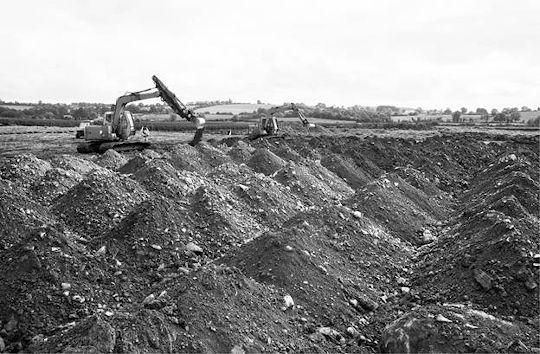
An excavation in the search for the disappeared (Sean and Yvette)
20
A Secret Archive
One cold November day in 1995, US President Bill Clinton went to Derry to deliver a speech. Since assuming office three years earlier, he had taken an interest in the peace process in Northern Ireland. He had granted a visa to Gerry Adams to visit the United States, a crucial step in ending the isolation of Sinn Féin and legitimating Adams as an acceptable interlocutor. He had also met John Hume in Washington on several occasions. In Derry, it was Hume who introduced Clinton, describing how the American president had a dream, ‘that we will have a land in the next century where for the first time in our history there will be no killing in our streets, and no emigration of our young people to other lands’.
Clinton took to the podium outside the Guildhall, beneath a display of winking Christmas lights. Bundled in a dark overcoat, he looked young, robust and optimistic. People were everywhere, clotting the narrow streets of Derry, teeming beneath the arches of the ancient city walls. ‘This city is a very different place from what a visitor like me would have seen just a year and a half ago, before the ceasefire,’ Clinton said. ‘The soldiers are off the streets. The city walls are open to civilians.’ He spoke of ‘the handshake of reconciliation’ and quoted a passage from a poem by Heaney:
History says, Don’t hope
On this side of the grave
But then, once in a lifetime
The longed-for tidal wave
Of justice can rise up
And hope and history rhyme.
The chilly air was charged with a buoyant sense of possibility. The ceasefire would eventually end, in 1996, when the IRA detonated a bomb in London’s Docklands, injuring more than one hundred people. The group issued a statement blaming the British government’s refusal to negotiate with Sinn Féin until the IRA had decommissioned its weapons. There was some speculation in the press that Gerry Adams might not have known about the bombing in advance – that in his dedication to the peace process, he may have grown alienated from the IRA’s armed wing. But a second ceasefire was initiated in 1997, and this one held. For a week in April 1998, negotiators holed up at Hillsborough Castle, a Georgian mansion outside Belfast, and thrashed out the details of a peace agreement. The new British prime minister, Tony Blair, personally attended the negotiations, subsisting on sandwiches and Mars bars and leaving the building only once in three days. The chief negotiator was an American, former Maine senator George Mitchell. He was a quiet man, with great patience. But he likened his own commitment to forging a peace agreement to the uncompromising orthodoxy of a terrorist; he had what one observer described as ‘the tenacity of a fanatic’.
The various representatives bluffed and quarrelled over dry bureaucratic questions regarding the structure of a new national assembly in Northern Ireland, the decommissioning of paramilitary weapons, the status of prisoners, and future relations between the six counties in the North and the governments of Ireland and Britain. Outside, as flurries of sleet battered the castle, Protestant and Catholic schoolchildren gathered at the gates, singing songs and asking for peace.