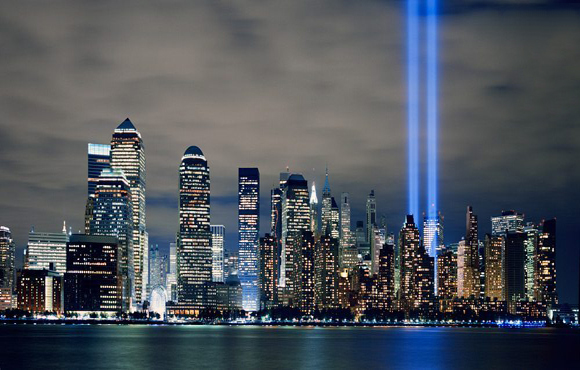
Dan Potter, firefighter, Ladder 10, FDNY: We moved out of Battery Park in December of 2001, because you could hear the equipment working and the recovery process going on. It was very debilitating for Jean. She was very, very upset. It was heart-wrenching to see broken buildings. People with devastated lives. People that lived around us had perished. You see the steel down the street. It was a very hard time.
Det. David Brink, Emergency Service Unit, Truck 3, NYPD: There was one evening—it was a cold December evening, probably around 6:30 at night—and nobody had gotten down there yet. They were getting their assignments. We were standing there, and my partner for the day had to go and use the facilities. I was standing down there, and I felt like I was the only living soul in the entire Trade Center site, out of all the acreage there. There wasn’t a sound at all. All the equipment had come to a stop. There was nobody talking. It seemed like there was nobody down there except myself, but I was there with all these people’s souls. There were almost 3,000 people waiting to be found, saying, “Please, come and find me.”
Vanessa Lawrence, artist, North Tower, 91st floor: Afterwards I went through mixed feelings. I got to the point that I had to leave New York. I couldn’t actually handle it anymore. There were too many things freaking me out—sounds, smells, anything.
Pasquale Buzzelli, engineer, Port Authority, North Tower, 64th floor: I was almost in this trance—watching, hearing the news, waiting by the phone to hear if they found someone. I would lay there on the couch, eating and watching TV. I started to grow a little bit angry, thinking every day, Wow, there are people out there that basically tried to kill me and they succeeded in killing my friends.
My daughter was born on November 18th, and that was a relief at the time. It was a break. But time went on, and I started to distance myself somehow. I remember not being able to sleep at night, getting nightmares. You would fight this battle inside of you and you say: “Hey, asshole, you’re alive, you should be happy.” Then you are happy for a second and you say to yourself: “Hey, asshole, you’re happy and someone else is dead—you’re happy you’re alive, what does that say about you?” Then you don’t feel happy.
Louise Buzzelli, wife of Pasquale Buzzelli, Port Authority, North Tower, 64th floor: There was no escaping it. You’d say, “My God! He’s so lucky. Look what he survived.” But he didn’t feel like he was lucky. He felt guilty. He felt like: “I don’t want people to look at me and think: You’re so lucky, you’re the luckiest man in the world, what are you going to do now? God has a plan for you.” For years, he couldn’t figure out what that plan was. He said, “I don’t know what the plan is, but I’m going to be the best husband, father, dad, son that I can be. That’s how I’m going to live my life.”
Frank Razzano, guest, Marriott Hotel: In the weeks afterwards, I tried to find out who the fireman was who had gotten me out of the building. About nine months later, my nephew called me up and said, “Uncle Frank, I was on my way into work, reading the New York Post, and there is a story in there about a fireman who won the Liberty Medal for saving the lives of three middle-aged men. It sounds like your story.” It identified the fireman as Jeff Johnson. I wrote Jeff a letter asking, “Are you the fireman who got me out?” Three days later, his wife, Roe, called my wife, Stephanie, and gave her the telephone number at the ladder company. I called and made contact with Jeff.
The first words out of his mouth were, “I’m very sorry for that article that appeared in the Post.” I said, “What are you sorry about?” He said, “It made me sound like I was James Bond.” I said, “Jeff, you have to understand something: to me, you’re a hero. You got me out of that building. I would still be on the third-floor landing, scratching my head, figuring out what to do, how to get out.”
YEARS
The trauma, drama, and tragedy of 9/11 forever affected those it touched, altering the course of the country, launching the United States into two wars that continue to this day. The children of those who first invaded Afghanistan in October 2001 are now eligible to serve and be deployed to continue fighting the same war more than 17 years later.
The significance of the date of September 11th, 9/11, was seared into the nation’s collective memory, altering the way those affected looked at the calendar and even clocks. Even those for whom the date was meant to bear happy memories—like Susannah Herrada, whose son was born in Arlington amid the injured from the Pentagon—found themselves haunted. Choosing what and how to remember the day remains a complicated challenge, as does charting a life forward day to day, especially for those who suffered from ongoing health challenges related to either the attacks themselves or the cleanup work after. The death toll of 9/11 has continued to steadily rise.
Rosemary Dillard, Washington, D.C., base manager, American Airlines, and wife of Flight 77 passenger Eddie Dillard: I grieved while other people became afraid. I still think that we all walk on eggshells. I don’t think that the young people who will be [reading] this will know the same freedom I knew growing up.
Susannah Herrada, resident, Arlington, Virginia, whose son was born on 9/11: The only other thing that we did for his first birthday is that we had all the neighbors over, and we said we want to celebrate the heroes of the day. We had a moment of silence during the party, and we said let’s remember everybody. Every year on his birthday we take some time.
Jeh Johnson, U.S. secretary of homeland security, 2013–17: My birthday is 9/11. I haven’t celebrated on that day since 2001. The memory from 2001 overwhelms the birthday.
Mary Matalin, aide to Vice President Dick Cheney: One of the strange things that didn’t occur to me until the first anniversary was how much I didn’t know was going on. I did not have the perspective seeing what the American public was seeing. When I watched the coverage on the first anniversary, I couldn’t stop crying. I was shocked. We weren’t watching TV. We weren’t watching people jumping out of buildings. We didn’t see all the chaos that the American people were seeing. It frightens me to the core to think what America must have been feeling watching that. We weren’t exposed to it.
James Schwartz, assistant chief for operations, Arlington County Fire Department: I actually assumed the position of president of the PTA the following year, when the one-year anniversary was about to take place. There were a lot of parents in the school that wanted to let the anniversary go by. They didn’t want to acknowledge it—“It was so horrifying, it will only traumatize the children, they don’t need to see these images or be reminded of this.” I said, “This is a learning opportunity. There is no escaping this.” We did what I thought was a very meaningful event that honored the losses, reflected on the impact to the nation, and hopefully taught the kids something about what it means to be an American and what it means to serve others.
Ultimately, the toll of 9/11 has manifested itself in ways far beyond the initial casualty list. In New York, 9/11-related ailments bedevil the first responders who spent days, weeks, and months cleaning up the wreckage at Ground Zero. All told, more than 7,000 firefighters and EMTs in New York were treated for 9/11-related injuries. New York estimates that 20 percent of those first responders also suffer from PTSD.
The toll was great at the Pentagon as well: nearly 10 percent of the Arlington County Fire Department resigned due to post-traumatic stress. First responders, including FBI agents, also struggled with physical illnesses linked to 9/11.
Philip Smith, branch chief, U.S. Army, Pentagon: We were all required to take classes at the Pentagon health clinic that were called “Get Your Life Back.” To this day, when people go through trauma, I recommend that they get mental health care. You may not think that you need care, but what you’ll learn is that if you don’t deal with the stress, the mental stress, professionally, within five years it will manifest itself in a physical ailment.
Capt. Mike Smith, Arlington County Fire Department: 9/11 tore through the department like a bowling ball.
Dr. David Prezant, chief medical officer, FDNY: Due to the physical nature of their jobs, these illnesses have had a tremendous impact on our membership and their families. Since 9/11/01, over 2,100 FDNY responders have been awarded service-connected disability due to WTC-related illnesses—mostly respiratory or cancer. The death toll continues to grow. In the years that followed, 203 of the first responders we have been monitoring died, and over half of them have had their deaths attributed to WTC-related illnesses.
Bill Spade, firefighter, Rescue 5, FDNY: My lungs aren’t too good. My wife took me to the hospital in January 2003. I was in the hospital again for three days. Basically the doctor said I have World Trade Center lungs. Then I realized it was time—March of 2003, I retired. Everything since 9/11, I count it as one more day on Earth than I ever thought I would have.
Lt. Mickey Kross, Engine 16, FDNY: I just got together with the survivors; the other night we had our annual dinner—we called it the “Survivors of Stairway B Annual Dinner.”
Philip Smith: I truly believe it was a miracle of 9/11 that I survived. So I stayed on active duty in the army as long as I could. Statutorily, my limit was 30 years. I was able to do almost an extra year as a retiree recall. Today, I work in the same workspace in the Pentagon as a civilian, because every day that I serve, I support my soldiers that were killed, and the terrorists don’t win. That means an awful lot to me.
Sharon Miller, officer, PAPD: I could never understand why I got out. How come I got out and all these guys who had kids and kids on the way didn’t? I remember they had a benefit—I think it was a hockey game or a basketball game afterwards—I had my uniform on, I had “Police Academy” on the collar, and this guy said to me, “Did you know my dad?” I said, “Well, who’s your dad?” He said, “Steve Huczko.” I said, “Oh, yes—I did.” I said, “I was with your dad on 9/11. The last time I saw him, he was helping a lady who was having trouble breathing. He was really good. He was doing his job.” “Oh, wow. That’s good!” Maybe that’s why I got out, so I could tell these kids what their dads were doing, where they were, and how they were helping everybody.
Capt. Robert Gray, Technical Rescue, Station 4, Arlington County Fire Department: We still have some people who are really, really hung up on the fact that the Pentagon is in Arlington, yet every time it’s referred to, they say “Washington, D.C.” It’s important to make sure people know that the Pentagon sits in Arlington, it’s important to make sure that everybody knows about how Arlington as a community responded, how the region responded. I made a decision in 2002 that I wasn’t going to let the whole fact that the memorial board at the Pentagon says “Pentagon” and “Washington, D.C.” under it bother me. Because I find myself even today, when relatives come in, you know what I ask them? “When are you coming to Washington?” And they’re staying at my house.
Mahlon Fuller, Pittsburgh Watch supervisor, FAA: I go back to the Shanksville site on 9/11 every year. In 2003, I was sitting on one of the benches—there was a woman beside me. I could tell from the ribbon she was wearing she had lost somebody in the crash. I said, “Did you lose someone?” She said, “Yes.” All I could say was “I’m so sorry.” She said, “Did you?” I told her that I was a supervisor in the Pittsburgh control tower, and I still can’t get over this. She said, “How are you?” She asked me that. How am I? What an amazing thing.
Theresa Flynn, librarian, H-B Woodlawn School, Arlington, Virginia: Years after, I talk to friends and relatives, and it always comes up. It always comes up. These are people who have been places with tornadoes and with hurricanes. I’ll talk to my Florida relatives and we don’t talk about Hurricane Wilma, but we talk about 9/11. I remember talking to one out-of-town person and I said, “I think the people in the D.C. area had a hard time getting over this. It’s almost as if the entire city went into a kind of post-traumatic stress.” She said, “Well, you’re never going to get over it.”
Vaughn Allex, ticket agent, Washington Dulles International Airport, Virginia: I had this wild thing in my mind that everything that happened on September 11th was my fault, personally. That I could have changed it. I felt there was no place for me in the world. There were all these support groups, and I didn’t belong there because how do I sit in a room with people that are mourning and crying and they’re like, “What’s your role in this whole thing?” “Well, I checked in a couple of the hijackers and made sure they got on the flight.” I might go weeks or months and everything would go along fine, then there would be something that would trigger it—like checking in somebody who said, “My husband got killed on September 11th.” What I heard was, “You killed my husband on September 11th.” You don’t really move past it.
Capt. Jay Jonas, Ladder 6, FDNY: I got a phone call in about 2006 from somebody from headquarters. He said, “Is this Chief Jonas?” I said, “Yes.” He said, “Are you working tonight? We have something we have to give to you.” I said, “Can’t you send it through the internal messengers?” He said, “No, this is something that has to be hand-delivered.” A captain came to the firehouse, and he has this bag and it was sealed and everything, and it was my face piece, the plastic face piece from my helmet. When you’re issued a face piece, they etch your name into it. It was pulled off the debris field and put in this bag. It wasn’t cleaned or anything. When I opened up the bag and it had the smell of the World Trade Center. It was like, Oh, that’s it! And closed it back up again.
Robert Small, office manager, Morgan Stanley, South Tower, 72nd floor: For the first six anniversaries after 9/11, I was still employed with Morgan Stanley. Basically, the world would stop, and we would get together in the conference rooms and watch the ceremonies. I knew a New York fireman who had found a shard of glass from the site, and he gave it to me. I knew a construction worker who was helping clean up—he was a mechanic for the bulldozers—and he had a piece of rock that had got wedged in one of the rotation devices, so he kept it and said, “Here, you have it.” I used to bring in my two little pieces on 9/11 and say, “This is part of it.” We would watch it as a group together. Over the years, fewer people would come to watch.
Then one year I wanted to be home, and I watched it all on television. I found out that MSNBC does a rebroadcast of the Today Show from that morning as it happened. I finally got to watch what everybody else got to watch, hearing what people thought was going on, what had hit the first tower, and then hearing them describe the jumpers, and hearing them describe the aftermath. I was like, “Wow!” I could see how hard it was for people on the outside.
* * *
In January 2011, the firefighters of Ladder 6 served as the pallbearers at the funeral of Josephine Harris, who had died at 69, nearly 10 years after all of them had been trapped together in Stairwell B. The survivors called Harris their guardian angel, believing that had they not stopped to rescue her, they would have been killed in the collapse. The interior of her coffin was custom-embroidered with the image of a firefighter walking hand in hand with an angel.
Sal Cassano, now commissioner, FDNY: On a day that will always be recalled for its inconceivable devastation and unimaginable loss, the story of Josephine and the firefighters of Ladder 6 was nothing short of miraculous.
Jay Jonas, now a deputy chief, FDNY: You cannot say that something that happened to you is a miracle, but if she was not there for us to save, we probably would not have made it.
Peter DeLuca, owner, Greenwich Village Funeral Home: The six firefighters made the request that they be the ones who carried her in and out of church.
Jay Jonas: It was an honor to do this for her. We feel very happy that she is in God’s hands.
Even as Harris was being laid to rest, the U.S. intelligence community was zeroing in on the man who launched the 9/11 plot. For nearly a decade, the CIA and U.S. government had continued to hunt for Osama bin Laden. Finally, they located a compound in Pakistan occupied by a mysterious, tall figure who never ventured outside the high walls that surrounded the building.
Senior Chief Petty Officer Rob O’Neill, SEAL Team Six, U.S. Navy: We had a few weeks to prepare for the mission targeting Osama bin Laden. I was certain he was there, in Abbottabad, because of how the CIA analysts had explained how they found him. I was convinced and the other guys were convinced that he was there too.
We also were pretty sure that we weren’t going to come back from the mission—we had this new stealth technology, but no one really knew if it worked. We didn’t know how good the air defenses for Pakistan were. We knew that we were invading, and that they could shoot us down and be justified. We also thought we might simply run out of gas in the helicopters and end up on foot in a really, really bad part of the world. We thought if anyone’s going to blow himself up and his entire family and martyr everybody, it’s going to be bin Laden. He wasn’t going to let us get him.
We went in there thinking this was a one-way mission. We had our last meals with our families and our kids—I know I did—and then hand-wrote letters to our families. We had to find people and say, “Hey, here’s an envelope. If you don’t see me tomorrow, you’ll know what this is, and there are directions inside, but if you do see me tomorrow, give these back to me.”
People were saying to each other on the mission, “If we know we’re going to die, why are we going to go?” Then we talked about the people who jumped out of the Towers on a Tuesday morning. They didn’t want to, they didn’t know what was happening—all they knew was that it was 2500 degrees Fahrenheit and the better alternative than whatever hell was going on inside, in Windows on the World or at Cantor Fitzgerald, was to jump. They were not supposed to be in the fight. We all joined to be in the fight, and that’s why we were going. We had that conversation about how the first ones to fight al-Qaeda were the passengers on Flight 93 that crashed in Shanksville, Pennsylvania. God knows how many lives they saved, but they killed themselves for the Western world. We had these conversations every night. That was why we went.
The terrorist leader behind the 9/11 plot was killed on May 2, 2011, as U.S. Navy SEALs raided the compound where he’d been hiding in Abbottabad, Pakistan. So that his gravesite would never become a shrine, the navy buried his body at sea.
Barack Obama, president of the United States, May 2, 2011: Good evening. Tonight, I can report to the American people and to the world, the United States has conducted an operation that killed Osama bin Laden, the leader of al-Qaeda, and a terrorist who’s responsible for the murder of thousands of innocent men, women, and children.
It was nearly 10 years ago that a bright September day was darkened by the worst attack on the American people in our history. The images of 9/11 are seared into our national memory—hijacked planes cutting through a cloudless September sky; the Twin Towers collapsing to the ground; black smoke billowing up from the Pentagon; the wreckage of Flight 93 in Shanksville, Pennsylvania, where the actions of heroic citizens saved even more heartbreak and destruction.
And yet we know that the worst images are those that were unseen to the world. The empty seat at the dinner table. Children who were forced to grow up without their mother or their father. Parents who would never know the feeling of their child’s embrace. Nearly 3,000 citizens taken from us, leaving a gaping hole in our hearts. . . .
Today, at my direction, the United States launched a targeted operation against that compound in Abbottabad, Pakistan. A small team of Americans carried out the operation with extraordinary courage and capability. No Americans were harmed. They took care to avoid civilian casualties. After a firefight, they killed Osama bin Laden and took custody of his body. . . .
The American people did not choose this fight. It came to our shores, and started with the senseless slaughter of our citizens. After nearly 10 years of service, struggle, and sacrifice, we know well the costs of war. . . .
Yet as a country, we will never tolerate our security being threatened, nor stand idly by when our people have been killed. We will be relentless in defense of our citizens and our friends and allies. We will be true to the values that make us who we are. And on nights like this one, we can say to those families who have lost loved ones to al-Qaeda’s terror: Justice has been done.
Mike Morell, deputy director, CIA: In 2011, the very first telephone call that President Obama made after we were sure we’d killed Osama bin Laden was to President Bush. President Obama knew that I’d been with him on 9/11, and so he asked me to fly down to Dallas after the raid to brief President Bush personally. I went down about two weeks later and walked President Bush through every aspect of the raid. I thought I could see in his face some sense of closure.
* * *
Sharon Miller, officer, PAPD: I look at the clock, and every time I look at the clock, it seems to be 9:11. I’m like, “Oh, 9:11, again.” It just happens, something so simple like that.
Linda Krouner, senior vice president, Fiduciary Trust, South Tower: The sky in September can be particularly beautiful. When you look at a sky like it was on 9/11, you see it’s that same clear, blue sky. The light is very different than the light in the summer. I said, “It’s such a 9/11 sky.”
Bruno Dellinger, principal, Quint Amasis North America, North Tower: If there is a beautiful day, I compare it to the morning of 9/11.
Philip Smith, branch chief, U.S. Army, Pentagon: I actually kept my uniform. I’ve kept it in this bag since 9/11. You can see the stains on my shirt. That’s the jet fuel from where the tank exploded and the debris in it. Army uniforms are surprisingly resilient because I was literally on fire from my head to my toe. This walked through the fires of the Pentagon and made its way out. I put it away and put it on the shelf. The army goes rolling along, and you keep moving.
Andrew Kirtzman, reporter, NY1: Life went on. The World Trade Center attacks were a horrendous catastrophe, but it’s the nature of life that the next day people get up to go to work, government officials do their jobs, controversies erupt, and life goes on. Life went on after Pearl Harbor. It’s the nature of life.
Rosemary Dillard, Washington, D.C., base manager, American Airlines, and wife of Flight 77 passenger Eddie Dillard: I never called it an anniversary, because when I think of an anniversary, I think of a happy time. I think of an observance, a time mark.
Richard Eichen, consultant, Pass Consulting Group, North Tower, 90th floor: I go down to the ceremony each year, and I go down to the ceremony for the guy who died between my legs. It sounds odd, but if it was just me and what happened to me that day, I don’t know if I’d come down. I survived. My story is ongoing.
Sheila Denise Moody, accountant, Resource Services Office, Pentagon: I don’t think there’s a day that goes by that I haven’t thought about the events of September 11th.
Dan Nigro, chief of operations, FDNY: We survive, we do our daily things, but you’re always a part of 9/11.