“I spent the evening just crying”
The Evening of 9/11
Families across the country struggled to understand what the attacks meant for their loved ones, while those directly affected continued to scatter and make their way home—sometimes without knowing how their own families had been affected.
Charles Christophe, attorney, Broadway: I tried to reach Penn Station and from Penn Station eventually to get the train to go to Maplewood [New Jersey]. Everything was closed. We had to wait hours. I think late afternoon, finally, they let the first train go. I was not able to catch the first one, but I did get the second one. People were looking at me, because I was totally covered with dust in my hair, my suit—everything.
Bruno Dellinger, principal, Quint Amasis North America, North Tower: When I arrived home, on my apartment door there was a Post-It from one of my interns who left a funny note: “If you’re alive, I’m still alive.”
Rosemary Dillard, Washington, D.C., base manager, American Airlines, and wife of Flight 77 passenger Eddie Dillard: I had to drive by the Pentagon. I wanted to stop, they wouldn’t let you. I got home, went in the house, and I smoked four cigarettes. I figured if I smoked in the house, it would bring my husband back because he didn’t smoke in the house. Then I had to call his brothers. I had to call my friends, the rest of his family, and my sister. My neighbors started coming over right away, because the flight attendants lived in the area. They came and brought me dinner. After that, it’s kind of a blur. Life changed.
Linda Krouner, senior vice president, Fiduciary Trust, South Tower: I didn’t really know what happened yet. I certainly knew we lost people. When I was at my sister’s house in New York City, there was a fellow, he got my number. He knew I was in the building that morning and he said, “I’m so-and-so. Did you see my son? Did you pass him on the staircase?” This young fellow died; it was terrible. It was really one of these calls that you want to say, “I wish I saw him. I wish I could tell you something.” I couldn’t tell him anything.
Adrian Pierce, Wachovia Bank, North Tower: Cathleen—she sat behind me—we don’t know where she was. Carlos, we don’t know where he was in the building. Toyena, she got killed also. Jeffrey got killed. Antoinette was holding a guy—his name was Tom—she was holding his hand as we were coming out the building, and he let her hand go, and the building came down on her. We lost five people from Wachovia. I also lost 150 friends from Euro Brokers on the 88th floor. One friend in particular, Adam, he came out, he called his parents, and he said, “I’m okay.” But he went back in the building, and he never came back out.
Charles Christophe: I was worrying about my wife, Kirsten [a vice president of risk services for Aon Corporation on the 104th floor of the South Tower]. I was worrying about our daughter, Gretchen, because we didn’t have close relatives to pick her up from the daycare. I was hoping maybe, maybe Kirsten was able to get on the first train or on this train and I will meet her there or meet her at home.
Robert Small, office manager, Morgan Stanley, South Tower: I was home before I normally would have been home. I still thought we were supposed to have our Pop Warner football team pictures taken that night. I still thought we were going to do that. I got a phone call from the league guy: “We’re not taking pictures tonight.” I said, “Okay,” because it still hadn’t hit me how dramatic and big the day was. It was still “my day,” as opposed to what it meant to everybody else. Within the next day or two, you started realizing how many people it affected.
Deena Burnett, wife of United Flight 93 passenger Tom Burnett: I spent the evening just crying and being with friends, having neighbors come in and out, and having family call me on my cell phone to offer their condolences.
Rosemary Dillard: I was still calling his cell phone, and he had a pager—I was still paging it every so often.
Charles Christophe: I got to Maplewood—we usually parked our car by the train station, but I didn’t have a key—so I had to walk to the daycare. I took my daughter from the daycare, and I asked about my wife. Only my daughter was there. All other kids were taken by their parents, and one or two people from the staff. She was a baby—11 months old—and she didn’t understand. She recognized my face, and obviously was happy to see me. One of the employees of the daycare drove me to my home. I didn’t have a key. I had to break the window on the back door in the kitchen to enter. I immediately took care of my daughter—I had to feed her and change her and put her in the bath, because it was already six, seven o’clock. And then I was just sitting by the phone waiting for a call.
Jillian Volk, preschool teacher, Lower Manhattan: We spent the whole night going from hospital to hospital, checking the admittance lists. Then at seven o’clock that night, we got a phone call from Bellevue Hospital, saying [my fiancé] Kevin was admitted there. His dad got there before we did, and he found out it wasn’t the right Kevin Williams. It was somebody else. We had been on this whole high, screaming. I searched the city for three days.
John Napolitano, father of FDNY firefighter John P. Napolitano: It was late, and the kids wouldn’t go to sleep because my son, whenever he worked nights, he would always call and talk to them, and tell them a story over the phone. Then he would end with “Hugs and kisses,” and they’d go to bed. They weren’t going to bed because their father didn’t call.
Charles Christophe: I was waiting for Kirsten’s call. But nobody called.
Fernando Ferrer, candidate for New York City mayor: I organized a prayer vigil on the Grand Concourse at Love Gospel Assembly. What else could you do? That place was packed. We then made the rounds of firehouses. We saw guys come back covered in white dust. People had already set up—oh, I get emotional just talking about it—had set up shrines and brought flowers and stuff and lit candles. It was really something.
Perry Weden, Los Angeles: I had been dating someone for six months and was unsure where the relationship was heading. This normally very calm and collected man was anxious and shaken, distraught over the lives already lost and fearful that L.A. was in the crosshairs. We went to the Santa Monica Pier, a relative ghost town for a warm September day, an attempt to be defiant in the face of fear. He made a comment I would never forget, something about how if the world was going to end today, he was glad to have spent it with me.
Richard Kolko, special agent, FBI: I started the day in the Atlanta FBI field office assigned to the Joint Terrorism Task Force. By midday, I was driving to Washington, D.C. A New York agent who was stuck in Atlanta jumped in the car with me. The roads were deserted. It was nighttime, and we were somewhere in North Carolina heading north on I-95, well above the speed limit. Suddenly, the rearview mirror lit up with a North Carolina trooper right behind me. I pulled over. The trooper approached my window cautiously. He got to the window and clearly, carefully, and professionally checked us out. He asked if we knew how fast we were going and what was the rush. I identified myself as an FBI agent and said we were headed to D.C. He took one step back from the window, pointed north on I-95, and said, “Go get ’em.”
* * *
Lt. Joseph Torrillo, director of fire education safety, FDNY: Eight hours later, I woke up and I didn’t know where I was. I realized I was on the eighth floor of the hospital, in a room, but I didn’t immediately know because I couldn’t see. I’m like, I don’t know if I’m dead or alive. That night, they found my car behind the firehouse. I was declared dead that night.
Lt. Mickey Kross, Engine 16, FDNY: The day had passed. I don’t even know what I did. I know I walked around. I talked to some people. We did a little search. In fact, we found a police officer on West Street. He was dead. He was buried. We helped out where we could and the day passed.
I hitched a ride with one of the fire engines that was going north. I think there was about 40 of us hanging off this fire engine. They dropped me off on Third Avenue and 29th Street and I walked down the block. I walked into the firehouse and I remember my girlfriend, Christine, was there. A number of the wives were there and some of the firemen were there. That’s when I found out that Ladder 7 was missing—that’s our company that’s quartered with us: 16 and 7. Everybody from 7 was missing. They all died.
Chris Mullin, firefighter, Ladder 1, FDNY: It was a depressed, dismal, miserable mood. Hundreds of firefighters, thousands of civilians are gone as quickly as you blow out a match. Gone.
Capt. Jay Jonas, Ladder 6, FDNY: I ended up walking from the World Trade Center to the firehouse on Canal Street. It was pretty quiet. I’m walking with all my gear on. I must have looked like Pig Pen from the Charlie Brown cartoon with this big cloud of dust following me. A bunch of Chinese people from the community start following me, and somebody broke off and came and talked to me. He says, “Are you okay?” I said, “Yeah. If I keep walking I’m okay.” I says, “If I stop, I’m not going to want to start up again.” Then they followed me to make sure I got to the firehouse.
Tracy Donahoo, transit officer, NYPD: When I went home that night, I went home to my mother and sat in the backyard—it was another beautiful day. I was sitting in the backyard, saying to my mother, “I don’t know if I can do this. I don’t know if I wanna stay on this job.” I got up the next day and went to work. I went back the day after that, and the day after that, and I said, “I’ll take it day after day and see how I feel.” Over time, I was okay.
Pasquale Buzzelli, engineer, Port Authority, North Tower, 64th floor: I was basically in a stretcher at Saint Vincent’s and they were moving me from room to room, taking X-rays and things. My friend Phil showed up. They gave me some clothes to wear, because they had to rip the clothes off of me that I had on. It was Disney or Mickey Mouse, something that didn’t fit. I put that on.
There was a police officer there with a van and he said, “Where do you want to go?” We gave him the address, our other friend’s house. When I got to my friend’s apartment, it was the first time I was actually able to watch it on television. I couldn’t believe that I actually survived.
Got in the car. We headed north and went across the Tappan Zee Bridge and I was home at eight o’clock that night. I pulled up at home with all my family and friends there. It was nice. It was nice to be home—to see my mother and father, my wife, Louise.
Louise Buzzelli, wife of Pasquale Buzzelli, Port Authority, North Tower: I remember the first thing when we finally got him inside the house, my mother-in-law—she’s from Italy—her first thing was, “You must be hungry!” She said, “Sit down! I want to make you a nice sandwich.”
* * *
As the evacuation of people from Lower Manhattan slowed, the boats that had been busy all day shuttling people out of New York reversed their journey for a new mission: shuttling relief supplies and rescuers to Lower Manhattan.
Lt. Michael Day, U.S. Coast Guard: We started getting calls that supplies were coming into Jersey and all the bridges were shut down into Manhattan. They said, “Hey, can we get someone to pick up some supplies?” I asked if anyone would mind going over to New Jersey and picking up some supplies, and I was inundated. “Sure, I’ll do it.” “I’ll do it.” “I’ll do it.”
Firefighters would come up and say, “We’re going to need water. We don’t have any water.” We’d call over to someone from New Jersey. We established a dialogue with the Office of Emergency Management over there. People were going to store shelves and buying water. It was coming over. There was a lot of stuff coming over—a lot of ice, a lot of restaurants were sending meals. It was very disorganized as far as what was coming. As we started meeting those needs, we started getting more and more requests. “We need acetylene for steel. We need oxygen. We need wrenches.” We started making requests and things started coming. It was busy throughout that night.
At Ground Zero, firefighters and rescue personnel continued to swarm over the wreckage, looking for survivors. These efforts remained haphazard, filled by an army of volunteers, many of whom had no official rescue duties. Indeed, it was two U.S. Marines, Jason Thomas and Dave Karnes, who had traveled to the site on their own volition, who made the evening’s sole incredible discovery.
Scott Strauss, officer, Emergency Service Unit, Truck 1, NYPD: We’re all itching to get back in there and find civilians, find our friends, find somebody. Sgt. Timothy Adrat grabbed a bunch of us and we started searching—because they wouldn’t allow us back onto the pile yet—we started searching the south side, the buildings on the south side of Liberty that were damaged by the collapses, but not completely collapsed. The pile of debris was massive.
Det. Steven Stefanakos, Emergency Service Unit, Truck 10, NYPD: We went to work trying to get to any voids that we could, trying to, from that moment, start any type of rescue and recovery that we could. It was pretty well established as nightfall started.
William Jimeno, officer, PAPD: It was around 8:00 that night when I heard two voices in the distance. I heard, “United States Marine Corps, can anybody hear us?” I couldn’t believe it that I heard voices again. I started yelling as loud as I could. “PAPD officers down! PAPD officers down!” They kept saying, “Keep yelling, we hear you!” They made their way over, and I could hear three individuals. They said, “Who’s down there?” I said, “Port Authority Police, Officer Jimeno, my sergeant’s down. We have men down here. We have men who have died,” and they said, “Hold on, buddy.”
Scott Strauss: A firefighter comes over to us. He says, “Hey, I got a couple of guys that are hurt on the other side.” So we started running over in that direction. We’re climbing over this twisted steel—some were very, very hot—jumping from one to the other. We’re slipping on the dust. It was a very treacherous trek. Through the dust and through the smoke, I saw a guy waving a flashlight, I went over to him. I said, “What do you got?” He goes, “You got two guys, two cops down in this hole.” So I look, and there’s this hole a little bit bigger than the size of a manhole. I dropped down into it, about six to eight feet. It was like a very, very tiny closet. Paddy McGee, an Emergency Service police officer with me, also jumped in the hole, as did this civilian, Chuck Sereika, a former paramedic.
William Jimeno: Truck 1 came up. They hooked up with another civilian named Chuck Sereika, a paramedic.
Paddy McGee, officer, Emergency Service Unit, Truck 1, NYPD: The race was on.
Scott Strauss: We came down on an angle about 20 to 30 feet, crawling headfirst around I-beams, through these tiny crevices, pulling ourselves through. We got down to this little open area, and we turned left and we came upon Dominick [Pezzulo]. About 10 feet back was Will Jimeno. The only thing we could see of Will was his head, his right arm, and part of his right side. The rest of it—it looks like he was poured out of a dump truck.
William Jimeno: He said, “What’s your name?” and I said “Jimeno.” He goes, “Scott Strauss NYPD ESU Truck 1.” I said, “Jimeno, Bus Terminal. Port Authority Police,” and he said, “Listen, you got to hold on—you can’t give up now.”
Scott Strauss: I crawled in, and I had to crawl in on my side, and with my hands above my head. I was crawling in, pulling myself in, and I was literally using my hands to scratch away at the rubble. As I free up some debris I’m pushing it down along my chest to get it back out to Paddy and Chuck, and they took it and were throwing it down the elevator shaft, digging their way out.
William Jimeno: They could barely move in there. All I could see was their bald heads.
Scott Strauss: We were dry heaving. We were choking on the smoke. The firemen were yelling from up above us, “Get out of there.” Will says, “You’re not leaving me, are you?” I go, “No. We’re not leaving you, Will.” Did I want to go? You better believe I wanted to get out of there, but I couldn’t. It had nothing to do with any macho stuff. It had to do with self-preservation. I don’t think I could have left him, gone home to my kids, and known I left him there to die. So the three of us—Chuck, Paddy, and I—stayed.
William Jimeno: For the next three hours they worked on me, and it was very, very painful. They were able to free my right leg, and then it took a long time for them to try to get me from under this wall.
Scott Strauss: Chuck, Paddy, and I, we were exhausted. We were incredibly tired. We were in a bad way, in a bad environment.
William Jimeno: I remember saying, “I have a partner, he’s here,” and they thought it was Dominick. Sergeant McLoughlin kept quiet back there. I think what happened was that when they first started on me, I yelled once really hard—when they touched my leg, it was really painful. I saw that Scott backed away. I remember thinking to myself, You need to shut up and eat the pain, and that’s what I did. I think Sergeant McLoughlin heard that as not to disrupt these guys—the best thing to do is to try to get us out of here faster.
Scott Strauss: All the time Will is talking about his partner. We don’t know—the only person that’s talking to us in this hole is Will. Dominick Pezzulo’s dead. Will’s talking about his partner: “You’ve got to get to my partner first. You got to get him out.” I’m like, He doesn’t know he’s dead, thinking “he” is Dominick.
William Jimeno: It was a nightmare that night.
Scott Strauss: He’s like, “Hurry up! Hurry! You’ve got to get to him. He’s going to die if you don’t get to him.” I said, “Will, we got to do our job. We got to get you out, and then we’ll get him out.” We’re scratching away, scratching away, and then we hear Sergeant McLoughlin’s voice, and he goes, “Hey, how are you guys doing?” I’m like, “Who’s that?” Will’s like, “That’s my partner,” like, You idiots. What do you think I’ve been talking about? So we’re like, “We thought he was your partner.” He said, “No, that’s Dominick. He’s dead.” I’m like, Oh, my God! Now we have another rescue that we have to do.
Det. Steven Stefanakos, Emergency Service Unit, Truck 10, NYPD: The two rescue sites started for the two Port Authority police officers that were trapped. Truck 1 guys, from their team, were working on that extrication. The rest of us walked around to any particular area where you might find a void that you could crawl into. Every single building in a perfect square around the Trade Center was completely demolished or damaged. The buildings were on fire still. You looked up and you said, “At any given time any one of these buildings could fall.”
Scott Strauss: Will’s screaming in pain and Sergeant McLoughlin is fading in and out this whole time. We’re talking to McLoughlin and Paddy McGee—can’t get any more Irish than him, he was born on St. Patrick’s Day, he’s in the police department pipe band—and John McLoughlin, another Irishman, and Paddy’s like, “Hey, Irish eyes, are you still with us?” Sometimes he would answer, sometimes he wouldn’t. When he didn’t answer, Will would get worked up. “John, Sarge, come on, Sarge, hold on, Sarge!” Then you’d hear him in a groggy voice say, “I’m here. I’m here.”
William Jimeno: They were able to put me on a gurney, and I remember telling the Sarge, “Hold on, Sarge.”
Scott Strauss: We get him onto the Stokes basket and we send him out—up topside.
William Jimeno: As they started pulling me out on the gurney, up this hole, I remember looking around, and I said, “Where is everything?” Because I could see the moon, and I could see smoke, but I couldn’t see the buildings. That’s when a firefighter said, “It’s all gone, kid.” That’s the first time I cried that evening.
Omar Olayan, officer, NYPD: We heard people, some excitement—coming up the line was a basket with a body in it, one of the Port Authority officers they rescued. We pulled him out. It was exciting—a great moment. All day you’ve been there and there was nothing.
Scott Strauss: I crawl back down this hole. I’m physically shot. It’s now like 11:00 at night, 11:30 at night. “John, I can’t do any more. They’re sending a fresh team in. You’ll be fine. These guys are going to get you out.” He’s like, “Thanks, Scott. I appreciate it. I’ll see you up top.” I said, “Absolutely.” Another emergency cop, Steve Clifford, comes in the hole—and I don’t know why I said this to him—but I stopped him and I go, “Steve, personal friend. Make sure you get him out.”
William Jimeno: My sergeant came out the next day, at 7:00 a.m.
Scott Strauss: The rescue workers, cops, firemen from all over the place—all of Nassau County, Connecticut, New Jersey, everywhere—Con Ed workers, construction workers are lining this path and they’re helping me get down, helping the three of us get down.
William Jimeno: I remember as we got to the hospital, I’m thinking there’s going to be thousands of people in there. That’s the second time I cried. As they pulled me off the ambulance, I see these doctors standing around and nurses. I said, “Where is everybody?” They’re like, “You’re it.” They’re telling me there’s nobody else.
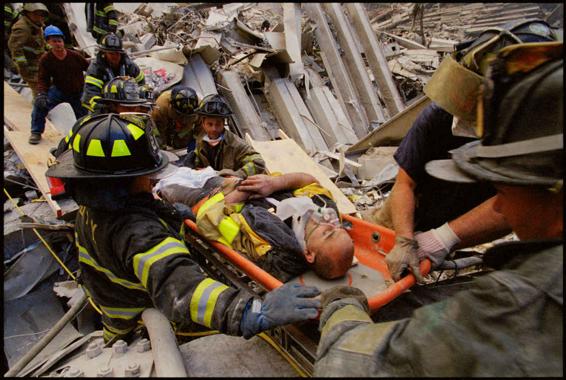 PAPD Sgt. John McLoughlin is rescued from Ground Zero.
“I wondered, ‘Did they get out?’ ”
The Day Ends
As night descended on a country transformed and the calendar flipped from 9/11 to 9/12, lawmakers, first responders, government officials, and stricken families tried to make sense of the day they’d just experienced. Fear and uncertainty permeated everything, and across the country many faced a sleepless night. In Washington, the fires at the Pentagon illuminated the night sky, an ominous sign of a nation newly at war.
Jackie Maguire, special agent, FBI Joint Terrorism Task Force, New York: That night we started to relocate and put our command center up in an automobile and maintenance garage. It was well organized. It was amazing—they emptied all the cars out and the technical people set up the phone lines. Within the next day or two, we had a full-blown, fully operational command post. We identified the hijackers pretty quickly. Then they made the case squad. They made what was known as the PENTTBOM team. The FBI’s code name for terrorism cases usually end with -bom; b-o-m. The first Trade Center was TRADEBOM, the East Africa Embassy cases were KENBOM for Kenya, and TANBOM for Tanzania, so they formed the PENTTBOM team.
Keith Custer, firefighter, Shanksville Volunteer Fire Company: Later on that night in Shanksville, we got called back for numerous brush fires. You couldn’t put the fire out because the ground was so saturated with jet fuel. You’d put out as much as you could, and then it would burn underground for a while, and then it would spring up somewhere else.
Laurence Kesterson, staff photographer, Philadelphia Inquirer: I felt so removed from everything else. They kept talking on the news about something happening in Shanksville or western Pennsylvania. No one was getting the name right the first day. Clearly everybody was focused on New York. In the evening, I stayed at a Holiday Inn in Johnstown. I watched the TV—they were all reporting from New York. We were so fearful as to what was going to happen. I really wanted to get home to my family.
Peter M. “Mike” Drewecki, photographer, WPXI-TV, Pittsburgh: I think I slept an hour. I turned on CNN, and I remember there was a doctor who was outside the Trade Centers when they went down. CNN was running the videos of people actually jumping out of the windows, and after what I saw, I couldn’t sleep. Who could? It was to the point where you were so agitated, you were so strung out on what you went through that sleep wasn’t an option.
Bruno Dellinger, principal, Quint Amasis North America, North Tower: When I got home, the first thing I did was take my suit off, and—don’t ask me why, I think it may be unconsciously because I thought there might be some human remains in those ashes—I collected them, put them into a small box. I was never able to ever wear that suit again, or the tie, or the shoes. For some reason I was inspired to collect that dust and keep it, and I still have it in a small box with the only thing that’s left of my office: a set of keys.
Brian Pearl, resident, Greenpoint, Brooklyn: That night, a bunch of our friends got together at Enid’s, a popular bar in the neighborhood. It felt good to be amongst friends if for no other reason than to remind me that I wasn’t the only person who had no idea what to think, feel, or do.
Richard Grasso, chairman and CEO, New York Stock Exchange: I was having dinner on the Upper East Side at the only restaurant that was open. What sticks in my mind was on Second Avenue and 75th Street were these enormous dump trucks that were heading south. You knew where they were going. I got back in my truck about 10:30, and I’ll never forget it—the city was so empty.
Rick Schoenlank, president, United New Jersey Sandy Hook Pilots Benevolent Association: Probably around 11:00 or 12:00, myself and seven or eight other pilots decided to go and see it for ourselves. We got off the boat, and we walked through the dust—like six inches of dust—that was covering everything. There were bulldozers slapping chains on the wrecks of firetrucks, police cars, ambulances, just dragging them down the street. You couldn’t even tell what they were anymore.
There were searchlights centered on the pile. There were hundreds of people crawling all over it. Looking around on the perimeter of the whole site, it looked like a giant animal had taken a giant claw and taken swipes out of all the buildings. There were chunks of the buildings missing. All the windows were broken. Drapes and papers were flying around in the air. Fire and flame was coming out of some of the windows. It was a scene of total destruction.
Lt. Michael Day, U.S. Coast Guard: I walked into Ground Zero and I could remember there were body parts everywhere. I remember thinking, This is a war. I looked down and saw a foot in a shoe. I was fixating on it for a few minutes. It was like a siege, looking around and seeing National Guard guys with M-16s going through the streets of Manhattan. All the power was out around the area, and a lot of other buildings were on fire, and there was this eerie gray-like snow everywhere.
Rick Schoenlank: I was standing there, and I noticed after a while there was a very tall guy standing right next to me and with a full particle mask on. I looked at him once, and I looked at him twice, and I said, “Governor, is that you?” It was Governor Pataki—just happened to be standing right there.
Chuck Cake, firefighter and EMT, Arlington County Fire Department: Around 1:00 a.m., the fire was still burning on the Pentagon roof—you could see it glowing—it was decided to suspend operations until morning, and then try again.
Sgt. Anthony Lisi, Emergency Service Unit, Truck 6, NYPD: By the end of the night we were exhausted. It was about two, three o’clock in the morning, and our vehicle that we had driven had been destroyed. NYPD boats picked us up to take us back to Truck 6, which is in Bay Ridge. As we were driving up with the boat, there was cars waiting for us with their lights on, a guy standing by each vehicle. It was amazing. They knew what we went through, and they were waiting for us to take us back to the truck, take us home.
Jared Kotz, Risk Waters Group: In the middle of the night, or maybe three or four o’clock in the morning, I was awakened by a loud clap of thunder followed by a brief rainstorm. At that moment I realized it wasn’t a dream, that I certainly had lived through an incredible day. First thing, my thoughts turned to my colleagues and I wondered, Did they get out? I didn’t know.
Sunny Mindel, communications director for the mayor of the City of New York, Rudy Giuliani: I came home at three in the morning, four in the morning, to shower. I got into my apartment and stood at the threshold and thought, What do I do with my clothes? I don’t know what’s on my clothes. I got a plastic bag to put my clothes in.
I had to go back to work obviously very shortly after—all I wanted to do was shower, lay down for a few minutes. I fell asleep, and as I did I felt like the buildings were in my nose—there was all this cement—and I woke up screaming having a nightmare, hearing the sounds in this dream.
Tom Brokaw, anchor, NBC News: I got home at 2:00 a.m., sat down, and was staring out the window. I had a big stiff drink of scotch. I was curiously contained and controlled. I was doing this out-of-body examination and asking myself, Why am I not melting down? I had a second drink. I went to sleep. I slept for four hours. I felt rested. Then a phone call came—a very close friend of mine died of congestive heart failure the night before. It released something in me. For half an hour, all the emotion I’d bottled up came out. I sobbed.
Mike Walter, senior correspondent, USA Today Live: The last interview I did on 9/11 was with a colleague of mine—Lance, the photographer who was shooting for me that day. He said, “Let me turn the camera on you as a friend, talk to you about what we saw.” We did the interview and he said, “Is there anything else you want to say?” My response was, “I’m so thankful this day is over.” Lance started laughing. He’s like, “Mike, this isn’t over, this will never be over for you. There will always be the six-month anniversary, the one-year anniversary, the five-year anniversary, the 10-year anniversary. You’ll be talking about this for the rest of your life.”
Beverly Eckert, wife of Sean Rooney, VP of risk management, Aon Corporation, South Tower, 98th floor: We met when we were only 16, at a high school dance. When he died, we were 50. I remember how I didn’t want that day to end, terrible as it was. I didn’t want to go to sleep because as long as I was awake, it was still a day that I shared with Sean. He kissed me goodbye before leaving for work. I could still say that was just a little while ago. That was only this morning.