“I’d never heard of al-Qaeda before”
Airborne, En Route to Andrews Air Force Base
Air Force One left Offutt Air Force Base at 4:36 p.m. ET, en route to Andrews Air Force Base, outside Washington, D.C. The president, finally, was coming home.
Col. Mark Tillman, presidential pilot, Air Force One: I’m doing .94 Mach. We went as fast as we could across the United States. F-16s were coming out of D.C. to meet us, everyone was joining up with us. We had F-15s with us too.
Mike Morell, presidential briefer, Central Intelligence Agency: On the flight to Andrews, I finally got this packet full of all the intelligence the CIA had. It included the talking points that George Tenet had used to brief the president, but there was still a lot he hadn’t been able to say. I shared all those details with the president. The second half of the packet was a set of intelligence passed to us by a European ally explaining that it had detected signs that al-Qaeda was planning a second wave. When I was showing that to the president, I could tell from his reaction, it struck him: Gosh, this could happen again. This isn’t over.
Eric Draper, presidential photographer: I asked Andy Card at one point, “Who did this?” “Al-Qaeda.” I’d never heard of al-Qaeda before.
Andy Card, chief of staff, White House: By the time we’re coming from STRATCOM, it was a skeleton crew aboard. The closer we got to Washington, the more the president wandered.
Brian Montgomery, director of advance, White House: I found the president at the front of the staff cabin at one point. I said, “We’re going to hit ’em hard, right, when this is all over?” He said, “Yes, yes, we are.” I knew that look in his eyes. He was mad.
Ellen Eckert, stenographer, White House: The president came back to the press cabin. I asked him if he was doing okay, and he said yes. I asked, “Have you spoken to Mrs. Bush?” He said, “Yes, she’s fine.” He patted me on the back, twice. Then Doug Mills, the AP photographer, said, “Keep your spirits up.” The president said, “We won’t let a thug bring this country down.”
Sonya Ross, reporter, AP: I was typing away in the press cabin, working on my notes, when the president came in, and I don’t think he saw me at first. I started typing that quote down, and he heard me typing and turned to me: “Hey, off the record!” He didn’t say anything else.
Ellen Eckert: He gave Sonya the stink eye.
Gordon Johndroe, assistant press secretary, White House: He was trying to be a very calm and comforting presence to everyone.
Eric Draper: Everyone was trying to take it all in. I took this picture of Cindy Wright, a White House nurse, rubbing the president’s back. At another moment, the president had his arm around Harriet Miers as they walked down the plane.
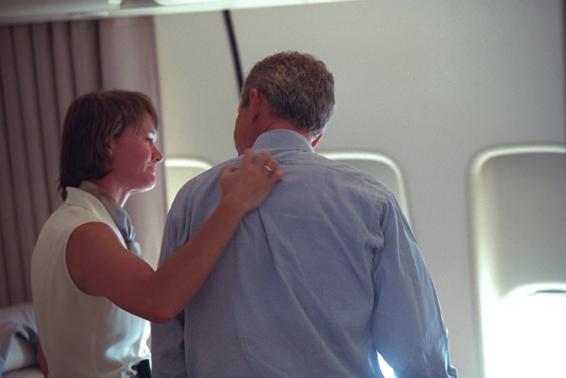
Capt. Cindy Wright, nurse, White House Medical Unit: What’s funny about that picture is I don’t really remember being compassionate or ministering to him—I do remember that he came in to check on me and the team. It was amazing to me that he was walking through the plane checking on us. It was still fairly new in the administration, so we knew each other from talking and being at the ranch, but that was the first time we hugged—I’m a big hugger, and he is too.
Ann Compton, reporter, ABC News: We were finally able to say on the record—I called my bureau and told them—that the president was heading back to Washington and would address the nation from the Oval Office.
Col. Dr. Richard Tubb, presidential physician: The thing at that moment I was most worried about was a biologic attack. In the unlikely but high-risk scenario, I thought there was little harm to be prophylaxing the staff with antibiotics. I gave everyone on the plane a week of Cipro. I hoped by the time they ran out, we’d have figured out the fog of war and know whether we needed to continue measures.
Brian Montgomery: I noticed that Dr. Tubb was walking and talking to each person. He’d lean over and whisper to each person, pat them on the shoulder, and he’d hand over a little envelope, like what the military uses to put pills in. He got to me and said, “Monty”—that was my nickname—“how do you feel?” I said, “Other than the obvious, physically, I feel fine.” “You don’t feel disoriented?” “Nope.” Then he said, “Have you ever heard of Cipro? We don’t know what might’ve been in that school, so we’re being careful.” I asked him, “What’s it used for?” He told me, “In case it’s anthrax.”
Mike Morell: It was about an hour from touching down, pretty late in the day—a lot of people were asleep, and the lights on Air Force One were turned down—the president came back into the staff compartment. I was the only one awake. One of the things that struck me: he transformed right before my eyes from a president who was struggling a bit with the direction of his administration on September 10th to a wartime president, just in a matter of hours. I could already see this new confidence and power in him.
Gordon Johndroe: I don’t really remember eating, but the stewards put out some sandwiches and chips. The air force bills you for your meals aboard Air Force One, through the White House Military Office. I remember a couple days later getting a bill for $9.18. The bill said for meals on September 11th between Sarasota–Barksdale, Barksdale–Offutt, Offutt–Washington.
Mike Morell: The president’s mil aide, Tom Gould, was looking out the window on the left side of the plane. He motioned me over: “Look.” There was a fighter jet on the wingtip. In the distance, you could see the still-burning Pentagon. Throughout the day, all this is happening and you don’t really have the chance to feel the emotion. But that got me. Tears filled my eyes for the first time that day.
Andy Card: We kneeled on the benches to look outside, you could see the fighter jets coming up pretty close to Air Force One. You just don’t see that on Air Force One.
Karl Rove, senior adviser, White House: I realized this was no ceremonial escort—this was the last line of defense in case there was a MANPAD [surface-to-air missile] on the approach to Washington. They were going to put themselves between Air Force One and whatever the threat was.
Col. Dr. Richard Tubb: As we were coming in on final approach, Dan Bartlett came into my office and said, “Thanks, I took all those pills. Anything else I need?” I said, “What?! Absolutely not! That was supposed to be a week’s worth!” I’m flipping through the Physician’s Desk Reference, that huge book, trying to figure out what the toxic level of Cipro is.
Brian Montgomery: Dan was real worried for a moment. After all that happened that day, Dan was going to die from Cipro poisoning.
Col. Dr. Richard Tubb: I looked into it and told him, “Listen, you’re going to be fine. You might want to take an antacid.”
Col. Mark Tillman: As we’re landing, I was thinking, All I’ve got to do is get him on the ground, then I can hand him off to the Marines. I was watching the fighters scream by underneath, doing suppression, trying to figure out if there was anything waiting for us. The landing itself, after everything, was entirely normal.
Maj. Scott “Hooter” Crogg, F-16 pilot, 111th Fighter Squadron, Houston: We had landed right behind Air Force One, and so we saluted as [the president’s helicopter] Marine One took off. We knew the president was heading to the White House.
Ari Fleischer, press secretary, White House: There are several different routes that Marine One can take back—we took the most scenic, directly over the Capitol, down the Mall, at the Washington Monument, you bank right.
Andy Card: We only flew at tree-top level, zigzagging, to make it harder for a missile to hit us. We were really low to the water on the Potomac.
Ari Fleischer: Out of the front left of the chopper, the president had a clear view of the Pentagon. The president said to nobody and everybody, “The mightiest building in the world is on fire. This is the face of war in the 21st century.”
“A spontaneous song”
Evening in Washington
With the president en route to Washington, scheduled to arrive around 6:00 p.m. ET, the congressional leadership hidden at Mount Weather began to make their way back as well. In the early-fall darkness, about 150 representatives and senators gathered at the Capitol around 7:45 p.m.
John Feehery, press secretary to Speaker Dennis Hastert (R-Illinois): We took a helicopter ride back from the secure location. Beautiful Virginia sunset, beautiful day, and seeing the flames still leaping up from the Pentagon. It was really quite a sight and quite emotional.
Sen. Tom Daschle (D–South Dakota), Senate Majority Leader: Yet with that soft September light was chaos all around. Smoke still billowing from the Pentagon. Fire trucks below, jets above, tanks and all kinds of security—just an amazing transformation of what started as one of the most tranquil and beautiful days of the year that morning.
Brian Gunderson, chief of staff for House Majority Leader Richard Armey (R-Texas): You knew something was very wrong with the world that day. We passed over some office buildings in northern Virginia that had dump trucks parked at the entrance to their parking lots to prevent possible car bomb attacks.
Steve Elmendorf, chief of staff for House Minority Leader Richard Gephardt (D-Missouri): It was very surreal to fly in in helicopters, see the smoke coming out of the Pentagon, land on the Capitol grounds with a heightened level of security. At that time, it was very rare to see the Capitol Police with a machine gun or a shotgun or anything remotely like that. We landed and there were all sorts of people with automatic weapons and SWAT gear surrounding us, surrounding the helicopters.
John Feehery: It had really become a fortress.
Rep. Martin Frost (D-Texas), chair, House Democratic Caucus: At some point, there was a report on television that members were going to come back and meet at a certain time, so I did along with everybody else.
Rep. Dennis Hastert (R-Illinois), House Speaker: We walked across the East Front of the Capitol and there were probably 200—maybe 175 or 225—members of Congress on the front stairs of the Capitol. Wow, it’s pretty amazing. Members of the House, members of the Senate, Democrats, Republicans.
Sen. Tom Daschle: I don’t recall seeing a smile the entire evening. It was facial expressions that were somber—very, very grave.
Eve Butler-Gee, chief journal clerk, U.S. House of Representatives: By then, of course, we had learned about Flight 93. It was very bittersweet because our sense was that that plane was headed for the Capitol building. Had it not been for those people, it could have been much, much worse. They gave their lives to save ours.
Rep. Dennis Hastert: Daschle came up and spoke for a couple 20 seconds or so. I got up and basically said, “Look this country will be okay, we’re going to stand up, we’ll be back to work tomorrow, we’ll do the people’s work and get this country going again. And we’ll find out who did this and protect our country.”
Sen. Tom Daschle: After the two speeches, there was a moment of silence that wasn’t scheduled. Nobody really wanted to leave. People started holding hands. Somebody started to sing.
Rep. Dennis Hastert: As I turned back to go back to the place I was standing, somebody broke out in the crowd of members of Congress in “God Bless America.”
John Feehery: I think it was [Rep.] Jennifer Blackburn Dunn who started breaking out in “God Bless America.”
Sen. Tom Daschle: It didn’t take long before everybody began singing along. It was probably the most beautiful part of the entire experience, totally unplanned, totally spontaneous. But probably more powerful than whatever the Speaker and I said.
Rep. Dennis Hastert: I remember the chills going down my spine. I remember thinking, This country will be okay. We’ll stand shoulder to shoulder.
Eve Butler-Gee: I cried. That was the moment when I really lost it, watching that happen. The feeling was, no matter what happens, nobody’s going to defeat us, either psychologically or in actual fact.
Celine Haga, staff, U.S. House of Representatives: In the hours and days and weeks later, when it was replayed on TV, it felt trite and corny, but in that moment, that night, it felt like we were clinging to something, like a lifeline.
Rep. Martin Frost: Then we dispersed.
* * *
Marine One arrived at the White House shortly after 7:00 p.m., landing on the South Lawn.
Alberto Gonzales, White House counsel: The rest of the afternoon, I just ran between the underground bunker, the Situation Room, and my office on the second floor of the West Wing, making sure that all of the legal issues were being evaluated as policymakers were making decisions. Finally at about 7:30, I stood outside the Oval Office with Karen Hughes, the communications director, and we watched as Marine One landed on the South Lawn. We greeted the president as he returned home. We followed him into the Oval Office and then back into his private dining room. There, with Ari Fleischer, the press secretary, Andy Card, the chief of staff, Condi Rice, the national security adviser, Karen and I and the president, we talked about what happened that morning. We talked about what were we going do in response to the attacks, and we talked about what the president was going to say in his address to the nation that night.
Nic Calio, director of legislative affairs, White House: I stuck my head in at one point and said, “How are you doing, sir?” The president said, “I’m ready, and you need to be ready too.” He was calm, the look in his eye was intense, and then when he talked to the senior staff, he said, “We all have to be ready. We are at war. We have to let the American people know that we’re going to protect them. In a month from now, we’re all going to want to go back to baseball and football and not think about this, but it’s going to be our job to make sure that we’re always thinking about it.”
Condoleezza Rice, national security adviser, White House: By that night, the president was in the mood to start handing out assignments. He really was determined that Don Rumsfeld was going to be doing his work to make sure the military was ready.
Commander Anthony Barnes, deputy director, Presidential Contingency Programs, White House: Karen Hughes banged out that statement on her knees because there weren’t any other chairs in there next to a computer. She kneeled down beside a computer and banged out that statement in about 20 minutes. When the president got back, he edited it for a couple of minutes, and then it was to the Oval Office for the television cameras.
Josh Bolten, deputy chief of staff, White House: I was nervous for the president because I knew how important this was to the feeling in America that day.
“We go forward to defend freedom”
In the Oval Office
8:30 P.M.
Good evening.
Today, our fellow citizens, our way of life, our very freedom came under attack in a series of deliberate and deadly terrorist acts.
The victims were in airplanes or in their offices—secretaries, businessmen and women, military and federal workers. Moms and dads. Friends and neighbors.
Thousands of lives were suddenly ended by evil, despicable acts of terror.
The pictures of airplanes flying into buildings, fires burning, huge structures collapsing, have filled us with disbelief, terrible sadness, and a quiet, unyielding anger.
These acts of mass murder were intended to frighten our nation into chaos and retreat. But they have failed. Our country is strong. A great people has been moved to defend a great nation.
Terrorist attacks can shake the foundations of our biggest buildings, but they cannot touch the foundation of America. These acts shatter steel, but they cannot dent the steel of American resolve.
America was targeted for attack because we’re the brightest beacon for freedom and opportunity in the world. And no one will keep that light from shining.
Today, our nation saw evil, the very worst of human nature, and we responded with the best of America, with the daring of our rescue workers, with the caring for strangers and neighbors who came to give blood and help in any way they could.
Immediately following the first attack, I implemented our government’s emergency response plans. Our military is powerful, and it’s prepared. Our emergency teams are working in New York City and Washington, D.C., to help with local rescue efforts.
Our first priority is to get help to those who have been injured and to take every precaution to protect our citizens at home and around the world from further attacks.
The functions of our government continue without interruption. Federal agencies in Washington which had to be evacuated today are reopening for essential personnel tonight and will be open for business tomorrow.
Our financial institutions remain strong, and the American economy will be open for business as well.
The search is under way for those who are behind these evil acts. I’ve directed the full resources for our intelligence and law enforcement communities to find those responsible and bring them to justice. We will make no distinction between the terrorists who committed these acts and those who harbor them.
I appreciate so very much the members of Congress who have joined me in strongly condemning these attacks. And on behalf of the American people, I thank the many world leaders who have called to offer their condolences and assistance.
America and our friends and allies join with all those who want peace and security in the world and we stand together to win the war against terrorism.
Tonight I ask for your prayers for all those who grieve, for the children whose worlds have been shattered, for all whose sense of safety and security has been threatened. And I pray they will be comforted by a power greater than any of us, spoken through the ages in Psalm 23: “Even though I walk through the valley of the shadow of death, I fear no evil, for You are with me.”
This is a day when all Americans from every walk of life unite in our resolve for justice and peace. America has stood down enemies before, and we will do so this time.
None of us will ever forget this day, yet we go forward to defend freedom and all that is good and just in our world.
Thank you. Good night, and God bless America.
* * *
After the president’s Oval Office address, Vice President Cheney boarded a helicopter to fly to an undisclosed location for the night—a site that later would be revealed as Camp David. Cheney slept that night in the president’s own cabin, known as Aspen, a violation of normal protocol made necessary because Aspen connected directly to the presidential retreat’s own escape bunker.
Dick Cheney, vice president: As we lifted off and headed up the Potomac, you could look out and see the Pentagon, see that black hole where it’d been hit. A lot of lights on the building, smoke rising from the Pentagon. It helped bring home the impact of what had happened, that we had in fact been attacked.
Lewis “Scooter” Libby, chief of staff to Vice President Dick Cheney: I recall watching the vice president, who was staring out the window at the Pentagon, and wondering what he may be thinking about, the responsibilities he would have in the future. A pretty sobering moment.
David Addington, counsel to the vice president: The headquarters of the U.S. military was still smoking, and we were flying over on our way to hide the vice president. My God, we’re evacuating the vice president from Washington, D.C., because we’ve been attacked.
Dick Cheney: I remember sitting in the living room there [in the Aspen cabin], turning on the television, watching the reruns. I suppose that was the moment—as much as any—that it really hit home what the country had been through that day.