“Have you heard from my dad?”
Midday in New York City
Families and friends across the country tried to find out if their loved ones were among the day’s victims; tens of thousands in New York were imagined missing, maybe presumed dead. Amid the morning’s tragedy, three sisters tried to discover whether their dad, who worked at Windows on the World, was among those lost.
Joann Gomez, eighth grade, Junior High School 56: We were in class, and we heard this big explosion—our whole school shook.
Melissa Gomez, fourth grade, New York City: My principal had mentioned in the announcements the Twin Towers, that a plane hit.
Joann Gomez: My father, Jose Bienvenido Gomez, and my uncle, Enrique Gomez, were born in the Dominican Republic, Santiago. They came to the U.S. in the early 1980s and started working in the World Trade Center in 2000.
Joanna Gomez: Our dad was very excited to work at the World Trade Center. I remember when he told us—from our apartment, you were able to see the Twin Towers, so he would show us from our window, like, “Look! That’s where I’m going to work!” He was a prep cook, so he was the one in charge of cutting the vegetables and the shrimps and so on. It was actually four brothers who worked there. Two of my other uncles also worked there—one was injured on 9/11 and the other one was in the Dominican Republic, so he wasn’t there that day.
Joanna Gomez: I was only 13, so I only thought of the World Trade Center as the Twin Towers—not the World Trade Center. I asked my classmate if the World Trade Center is where the Twin Towers are. He was like, “Yeah, that’s where it is.” I started crying. Then they asked everyone to go to their homeroom class, and I met with my sister in the hallway.
Melissa Gomez: Then parents started coming.
Joanna Gomez: We were sent to the office, and we called our house, and they said that my cousin was going to pick us up from school. From school, we see the [South Tower] fall. I remember my cousin told me, “Don’t worry. The tower where your father works is the one that has the big antennae and it’s still up. There’s still a chance. They’ll get him through a helicopter or something.”
Melissa Gomez: I was nine or 10 years old. I got home and I see everybody’s crying, but I was confused. I don’t know what’s happened, because I don’t know my father [worked in the Twin Towers]—I knew he used to work somewhere, but I didn’t know it was there, specifically. I was still innocent.
Joanna Gomez: We were making calls and we were making pictures with signs, the age, the name. My mom didn’t speak any English, so me and my sister had to go to the hospitals, talk to FBI agents. We had to do everything.
* * *
In Lower Manhattan, some of those caught in the collapse made their way out of the destruction, emerging from the clouds as dust-covered ghosts, fleeing across the Brooklyn Bridge on foot or making their way uptown into a New York City reeling from the disaster. Everyone was in a state of shock, desperate to tell their waiting families that they were alive. Strangers stepped up to aid the refugees as best they could.
David Kravette, bond broker, Cantor Fitzgerald, North Tower, 105th floor: I was walking, and I said, “I need to borrow a phone.” I used this guy’s phone. I talked to my wife a couple of seconds, and I lost the connection. The guy saw I was upset. He gives me a hug—a stranger. It’s funny. This stranger gives me a hug and goes, “You’ll be okay,” and walks on. That was it.
Richard Eichen, consultant, Pass Consulting Group, North Tower, 90th floor: I walked out of the hospital. I met this woman, Pansy, who was walking out as well. We shared a Snapple. There was a guy at the hospital entrance, a security guard, saying, “Don’t go out.” I said, “No, I want to leave.” He said, “All right, if you’re going then—here,” and he gave me a surgical mask. We walked across the Brooklyn Bridge, Pansy and I—she lived in Brooklyn, and my parents live in Queens. As I was walking across the bridge, I could feel the sun on my face. I remember taking the mask off, and it felt good to have the sun on my face. It’s like, All right, it’s over.
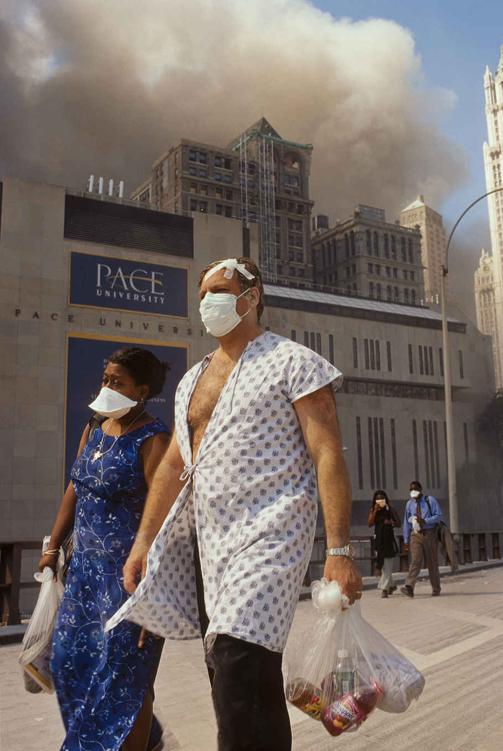
Somi Roy, resident, Lower Manhattan: It was like the scene from The Ten Commandants, with Charlton Heston leading people across the Sinai Desert. There was a stream of people walking across the Brooklyn Bridge. Endless. Downstairs was another stream of people, all covered in dust, all with briefcases half-open, women with no shoes. They had to shut the FDR Drive, so it was eerily empty. The sound was different. Usually we have this constant roar in the background, of traffic.
Howard Lutnick, CEO, Cantor Fitzgerald, North Tower: We kept walking and wiping our faces and cleaning our mouths and our eyes. In the middle of the street. There were no cars. It was so strange, like the end of the world.
Betsy Gotbaum, candidate for New York City public advocate: People in our building were in shock, total shock. People didn’t know what to do. We invited the elevator men in to come and watch because they didn’t have a television.
David Kravette: I walked uptown to Howard Lutnick’s apartment and we started meeting there, the few survivors. Howard Lutnick came up. He was covered in soot because he was down there when it collapsed. We started calling some of the spouses, and none of them had heard from their husbands or wives.
Jillian Volk, preschool teacher, Lower Manhattan: I thought my fiancé, Kevin, was out of the Trade Center. I truly thought he was going to walk into the school and get me. I waited at the school until maybe 10:30 or so. Most of the kids had gone by then, so I started walking north. I didn’t know where to go.
Richard Eichen: This guy, Gary, was picking up his niece from Brooklyn Law School. He said, “Do you want a ride to your parents? Where do they live?” I said, “The Rockaways.” I said, “I’m filthy.” He goes, “Don’t worry about it.” He gave me a ride. We stopped off at his house to give me a drink of water, and they asked me, “Do you want to take a shower?” I said, “No, I really want to go to my parents’ house.” Then he drove me to Rockaway. My father had put out a flag in front of the house. I went inside and my sister said, “You want to take a shower?” I said, “Yeah.”
Betsy Gotbaum: At one point, I went outside. It was a beautiful day, and I was terribly upset. We live right next to the park. It was completely silent. You couldn’t hear anything. It was so eerie. I’ve never experienced anything like that in New York City in my entire life. The silence.
* * *
Even as people fled Lower Manhattan, thousands more firefighters, police, EMTs, paramedics, and first responders flooded in to what would become known as Ground Zero, both in hopes of rescuing survivors and also to take stock of the massive losses their own departments and colleagues had suffered in the collapses. Given the tight-knit, multigeneration traditions of the NYPD and FDNY, many of those responding had brothers, sisters, sons, daughters, fathers, mothers, or other relatives who had perished. They all confronted an apocalyptic landscape, full of fire, debris, and death.
Joe Finley, firefighter, Ladder 7, FDNY: I got in the car and drove in. The police had every entrance and exit closed. The only way you could get on the expressway was with your badge and your ID. There were hundreds of cars filled with cops and firemen streaming into the city.
Capt. Joe Downey, Squad Company 18, FDNY: I couldn’t believe that the tower had fallen. I thought they were making a mistake. Until I got to the scene, I still couldn’t understand that they all came down. I went to my dad’s firehouse, Special Operations, on Roosevelt Island. We started regrouping there, and when a bunch of us got together, we came into Manhattan.
Paul McFadden, firefighter, Rescue 2, FDNY: They were saying tens of thousands of people were dead. It sounded like the whole New York City Fire Department had been killed.
Capt. Joe Downey: When I got to the firehouse, obviously, my first question was “Have you heard from my dad?” That was the first bad feeling I got—nobody had talked to him.
Joe Finley: At a rally point in Cunningham Park, Queens, hundreds of firemen waited for city buses to come in and pick them up. Nobody was saying anything to each other. We all looked out the window at the skyline of New York City, and the huge plume of smoke going miles up in the air.
Paul McFadden: There were cops on every corner, and you had to show your badge and then they waved you through. When I was in Rescue 2 earlier, Ray Downey had been the captain and now, on 9/11, he was the chief of all special operations, so I knew he’d be at the Towers. On our way there that day, I was saying, “Listen, when we get there we’ll go right to the command post; we’ll check in with Ray. He’s going to be happy to see us and give us a job or an area or what have you to search.”
Lt. Chuck Downey, FDNY: It was white all over the place. Dust almost looked like some type of snowstorm.
Jeff Johnson, firefighter, Engine 74, FDNY: The streets were six inches to a foot thick of this white-gray talcum powder–type of dust, and any time a fire truck or anything went by, it became impossible to breathe.
Joe Finley: We couldn’t even hear our own footsteps. Nobody was talking. There was no sound, no cars. Downtown Manhattan in the middle of the day, and it was absolutely silent.
Capt. Joe Downey: I walked down West Street and the first gentleman I ran into was Chief Frank Carruthers. He was my dad’s boss. I asked him, “Have you seen my father?” He put his head down and walked away. That’s when I knew that he probably was gone.
Paul McFadden: When we got down to the World Trade Center site, the first two people I saw were Ray’s two sons, Joe and Chuck. I went right up to them—because I thought this was a real good thing—and I said, “Joey, Chuckie, where’s the command post? Where’s your dad?” Joey looked at me and he said, “We’re on our way home to my mother. My father’s under the rubble.” That was like getting kicked in the head by a horse. It was the last thing I expected to hear—that Ray was dead. That set the stage for the night.
Jeff Johnson: At the time, Building Seven was fully involved with fire. There was nobody trying to put that fire out. We were busy doing other things, obviously. It was pretty surreal to see that building on fire.
James Luongo, inspector, NYPD: At one point, there had to be 200 construction workers walking down West Street. I said, “Who’s in charge?” They said, “Nobody’s in charge. We’re here to help.” I’ll never forget those men—big burly guys, coming down. So much of that day, so much of that day was just New Yorkers. People who can help people. A lot of credit goes to the fire department. A lot of credit goes to the police department and emergency response people. But that’s what we get paid for. The amount of New Yorkers—just everyday New Yorkers—who stepped up to the plate that day was incredible.
* * *
Both Dan and Jean Potter emerged safely from the collapse of the World Trade Center, but with no sense of how to reunite with each other. Jean didn’t know her firefighter husband was searching frantically for her.
Dan Potter, firefighter, Ladder 10, FDNY: There was fire in all the buildings around the Trade Center. All the paper that had come out of the Towers had carpeted nearby fire escapes. That paper and the fire escapes were all in flames, all the way down Greenwich. Fire all around us, cars on fire on the street—it’s like a movie set. I said, “I’ve got to go find my wife.”
Jean Potter, Bank of America, North Tower: This lovely gentleman asked me if I needed help. I said, “Do you have water and a phone?” I was in such a state. He invited me into his house—they had a brownstone in Chinatown—and I was in this fearful state. I said, “No, can I stay outside, please?” He brought a chair out and gave me a phone.
Dan Potter: I don’t recall seeing any civilians. I do remember all the ambulances turned over, Ladder 113 burning. I walked past them quickly. I was focused on trying to find her, but there was nobody.
Jean Potter: All the while I was thinking Dan was studying in school, studying for the lieutenant’s test. I was thinking, He’s in Staten Island. He’s not home. He’s not working. He’s away, thank God.
Dan Potter: My first plan is, “Okay, she’ll be home. Then we’ll worry about the next step.” You try to put off the inevitable thought. I walked home, and I remember getting a bottle of water out of one of the juice places. The door was open, and no one was in there. I still owe the guy a dollar.
Jean Potter: In an emergency, Dan had always told me, go to a firehouse. I said, “I need to get to a firehouse.” The guy helping me took me to the Chinatown firehouse.
Dan Potter: I walked to the apartment on Rector Place. The doorman, Arturo, was there. He said, “Can I help you, sir?” I said, “It’s me—Dan.” He didn’t even recognize me at first. He said, “Are we safe here, fireman?” I said, “It’s me, Dan—I live here. I’m looking for Jean. Did Jean come home?” He goes, “No, I haven’t seen her.” I said, “Okay.” There were people in the lobby of our building. They thought I was a fireman coming to help them. Then they realized who I was. They were used to seeing me in slacks and penny loafers, never in gear covered in gray matter.
Jean Potter: This couple passed by the firehouse. She said, “My phone will work.” I managed to call my mom. My mom heard my voice, and she started to cry. I said “I’m OK.” I said, “Dan’s at school, so Dan’s OK, so call June”—my mother-in-law—“and tell her that he’s OK.” I told her that because in my head, I still think he’s in Staten Island taking the practice test.
Dan Potter: I went across the street, and that’s when I sat on the bench. I had to collect my thoughts. What am I going to do now? I was sitting on the bench, getting a little upset. The guy clicked the picture. I told him, “It’s not the time.”
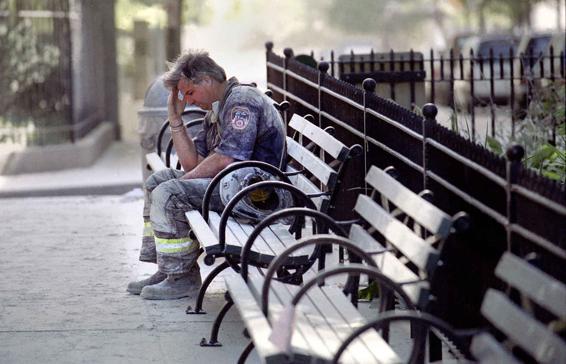
Matt Moyer, photographer: As I neared the marina I saw a solitary firefighter sitting on a bench. It was a quiet scene amid a very chaotic situation. His body language spoke of deep loss. When he finally heard the click of my shutter he lifted his head, looked toward me, raised his hand and slowly shook his head indicating, no more photos. I took my camera from my eye and before I could speak he said, “I just lost my wife.” His voice was full of heartache. All I could muster was “I’m so so sorry.” He lowered his head and continued sitting on the bench.
Jean Potter: I felt I had to make myself useful, so I started answering the phone. Can you imagine? This woman covered in dust—I was in a state of shock. I said, “Give me the phone. I’ll answer.” Calls were starting to come in: “I’m so-and-so’s dad, I’m so-and-so’s wife.” Then a few guys came in and told me, “OK, let’s go in the back. We need to go back and relax.”
Dan Potter: I went back inside the lobby. I said, “All my stuff is back in Ladder 10’s compartments. I don’t have keys to my apartment.” I started to force my door to get inside the apartment. The door finally opened up, and the phone was ringing. The first call was one of Jean’s aunts. I said, “Listen, I can’t talk. I’ve got to go look for Jean.” I hung up, and the next call was my dad. He’s crying. He’s very upset. I said, “Dad, I’m okay, but I can’t find Jean.” He goes, “I know where she is.” I’m like, “Where is she?” He answered, “She’s at the Chinatown firehouse.” I said, “Oh my God. Thank you.” I hang up the phone. I don’t remember hitting any of the steps going down nine floors. I went back to the street and down and out. My truck is all covered in gray dust. I drove up through South Street and up to the Chinatown firehouse on Canal Street.
Jean Potter: I was sitting in the house, watching it on television.
Dan Potter: I walked into the firehouse and said, “You got a redhead in here somewhere?” Another firefighter, a real kid in the company, said, “Yeah, she’s in the back room.” I walked in, and that’s when she saw me.
Jean Potter: He was in this bunker gear and coat. His eyes were blood red from the debris and the dust. I never thought he was down there. I expected him to pick me up in street clothes. Here he is, picking me up totally, totally covered, with blood-red eyes.
Dan Potter: We hugged. She’s all covered in gray dust. We hugged and kissed. I said, “Okay, let’s get you out of here. Where do you want to go?” She was very upset, shaking, and she said, “Let’s go to my mom’s house.” It’s an hour ride into Pennsylvania.
Jean Potter: Our life was like scrambled eggs. We were so grateful our lives were spared, but everything we knew that day changed. We were spared, but everything changed.
* * *
Herb Ouida, World Trade Centers Association, North Tower, and father of Todd Ouida, Cantor Fitzgerald, North Tower, 105th floor: I remember being on the street on Broadway, and people saying there’s no more World Trade Center. I said, “What does that mean?” They said, “The buildings are gone.” I absolutely could not believe it. When I got to my daughter’s apartment I saw on the TV that the buildings had in fact collapsed like pancakes. I kept thinking: Todd was on the 105th. What stays with me and what will be with me until I die is the question: What was it like for Todd? Did he know it was the end? Was he awake?
Adrian Pierce, Wachovia Bank, North Tower: I went in the ladies’ room of a nearby building. Everything was stuck to me. I rinsed my hair off, I rinsed my blouse off, and as I was coming out of the bathroom, there were two plastic bags. I wrapped one around my foot and I wrapped one around my head. Outside, two white guys were sitting on a bench, they had a traveling case, and I asked them: “Do you have a shirt I can put on?” One gave me the shirt off his back. I took my shirt off and I put his shirt on, and I wrapped my shirt around my foot. I was walking, and I was crying. I found myself walking over the bridge.
Ian Oldaker, staff, Ellis Island: It was time to walk home. We started walking with this mass of humanity up the ramp to the Brooklyn Bridge. The scariest moment for me was seeing people screaming randomly. It would be quiet, quiet, quiet. Then someone would scream because they’d realize that they had lost their friend. One guy was standing next to me, walking, and he asked me where he was. I was like, “We’re on the Brooklyn Bridge, man.” He’s in a suit. He asked me what happened. I said, “The World Trade Center collapsed.”
We got across the Brooklyn Bridge into Cadman Plaza. We saw this line of buses. The bus driver was hollering at us, “I’m going south down Flatbush.” We got on that bus and it was so quiet. Everyone was so entranced.
Adrian Pierce: When we got over the bridge, I sat on the curb. I said, “I can’t go no more. I can’t go no more.” An ambulance stopped to pick me up and the driver said, “Miss, you need to come with me.” I was crying. I said, “I don’t want to go with you. I want to go home. I want to let my mother and my husband and my son know I’m okay.”
Joe Massian, technology consultant, Port Authority, North Tower: I kept walking. It was shocking. Everybody was stopped on the sidewalks. People would look at me, put their hand to their mouth, and stand there crying. After a while I’m like, Okay. What’s going on? What don’t I know about myself? I passed a building that had a reflective glass, and I realized I was covered in material.
Jared Kotz, Risk Waters Group: Finally at about 11:00 a.m., I guess, maybe 11:30 or so—I’m not sure what time it was—I realized I hadn’t eaten, and I realized my decision to forgo breakfast and run back to the office was another reason I had survived. If I had stayed there for breakfast, I wouldn’t be alive. I was hungry, so I headed down to the street in search of a muffin or something to eat. I walked to the corner on Avenue A and people were evacuating southern Manhattan, coming from the World Trade Center area. Right at Tompkins Square Park, I saw a young man. He looked like he was in a state of shock. He was covered in dust from head to toe. The back of his knapsack, I remember, was the weirdest thing I could imagine. There must have been two or three inches of dust on top of his knapsack—this thick layer of dust—and he was also covered head to foot in a gray dust. I can’t understand why I didn’t stop to try to help the guy. I was in a daze of my own.
Robert Snyder, professor, Rutgers University, and collapse survivor: As I got further up into the East 50s, it was a strange scene. There were throngs of people headed north in the streets like me who looked like refugees out of movies about wars and catastrophes. Yet there was a lunchtime crowd watching us too. I saw this restaurant, and all the people who worked in the restaurant are sitting in the window looking at us walk by.
Constance Labetti, accountant, Aon Corporation, South Tower: We walked and walked and walked. We walked through pretty bad neighborhoods in Brooklyn, and people were out there with their hoses: “Do you want a sip of water from our hose?”
Vanessa Lawrence, artist, North Tower: It was strange walking past shops where people gathered around where there was TV screens or radios and I’d be like, “No! No! I can’t!” I was looking forward, going straight ahead.
Bruno Dellinger, principal, Quint Amasis North America, North Tower: I kept walking on Broadway. There were groups of people, cars stopped, people watching. I kept redialing, redialing, redialing. It went through to my parents. When I spoke to my mom, I collapsed. It was too much. I couldn’t articulate a word. I was crying—a big guy like me.
Joe Massian: I ended up getting to a stoplight where there was a box truck and a bunch of people sitting in the back. They were giving rides to people who wanted to head up north. The guy said, “Jump in and jump out when you want.” I jumped in right around 14th Street, jumped out around 53rd, and headed over to Cushman & Wakefield, where my fiancée worked. When I got off the elevator and opened up the door—I remember the entire organization stood up in their cubicles and they started crying. I grabbed my fiancée. I said, “How did you know that I was okay?” She’s like, “Your picture was on the internet. It was on MSNBC.com.” It was also on the cover of Yahoo. It was on Reuters. It was on a bunch of different websites. I’ve learned a lot of people knew that I was out of the building.
Vanessa Lawrence: I managed to get ahold of my friend Amelia and she was like, “Come here, now!” I think she was near 28th Street. Amelia said when she saw me that I looked like a sculpture walking toward her. She said it was a really strange thing. I was completely covered. I showered and then I kept getting really itchy and sore. It took me three showers to really stop the prickly feeling I had on me and in my hair and everything.
* * *
John Napolitano, father of FDNY firefighter John Napolitano: I was in a car heading downtown with my brother-in-law. His cell phone rang, and he got very excited on the phone. He said, “Yes, yes, yes, yes, all right, all right.” He said, “Turn around and go home.” I looked at him and saw he had a lot of concern on his face. I said, “What’s the matter?” He said, “Turn around and go home. You have to go home. Something happened. You have to go home.” I did a quick U-turn.
Terri Langone, wife of FDNY firefighter Peter Langone: I went to get the girls at school. I definitely knew he was there. When I saw the building come down, I knew in my heart he was gone. I knew without a doubt. He was in the second tower to fall, Tower One. I found out about Peter’s brother, Thomas Langone, later on that afternoon. He was a police officer with ESU Truck 10. He was in the other tower.
Michael McAvoy, associate director, Bear Stearns, Brooklyn: I decided to go to my brother’s firehouse on 13th Street. From a few blocks away, I saw a ton of firemen, plus a ton of fire trucks. I had a little hope. The firemen were from firehouses all over the city. It was total pandemonium. I saw a fireman I know. He was covered in soot. I look him in the eye, I say, “Was my brother down there?” He says, “Yes.” I say, “Any chance for survivors? You can tell me.” He says, “Mike, I wish I had better news, but no. The place is the worst any of us have ever seen.”
John Napolitano: I got to my house. I went upstairs and my wife was on the floor, kneeling, being held by her sister. She was saying, “My baby! My baby!” Over and over and over, “My baby! My baby!” I looked at my sister-in-law. She says, “We got a call. John’s missing.”
Paul McFadden, firefighter, Rescue 2, FDNY: I remember speaking to one fireman—it was probably by O’Hara’s on Cedar Street—and he was telling me how his daughter worked on the 109th floor, and he was saying, “You don’t think she made it, do you, Paul?” What do you say to a guy like that? I said, “We don’t know. Let’s keep our hopes up.”
John Cartier, brother of James Cartier, electrician, who was working in the South Tower: We pulled up to my parents’ house, and we were completely covered in the silky soot from head to toe, both of us. My parents came out and they were hugging my sister. Then I remember my mother asking about James. I looked at my father and said, “I couldn’t get to him. I couldn’t do it.”
* * *
New York City’s leadership found themselves refugees in their own city, unable to communicate, and tried to find a space to regroup and coordinate the rescue and response efforts.
Andrew Kirtzman, reporter, NY1: We kept walking, and Giuliani kept turning to me to say, “You’ve got to tell the public to stay out of here so our emergency vehicles can get through.” He’s like, “Please. Everyone south has got to get out of here. Go north. No one should come south.” I said, “Well”—I’ve got my little StarTAC flip phone—“would you go on live with New York 1 and tell the city yourself?” I called New York 1 like 10 times, finally got through, and the control room was crazy busy. I said, “I’ve got Giuliani on the phone!” They were overwhelmed. I waited and waited. I don’t know whether it was 30 seconds or three minutes. Suddenly the phone went dead. I was never able to get through to them. We were on our own.
Rudy Giuliani, mayor, New York City: A few police officers ran ahead and picked a hotel we could use as a command post.
Andrew Kirtzman: We were walking up Church Street. Giuliani’s team decided at first to try the Tribeca Grand Hotel. The news had not hit them yet, and there were all these tourists. Tribeca Grand was this ridiculously trendy SoHo hotel, and there was this dissonance between this nomadic tribe covered with dust walking in, and all these trendy people wearing black, going about their day.
Rudy Giuliani: As we walked in, I looked at the fire commissioner and the police commissioner. They looked at me, and we walked right straight through and out. It was a totally glass building. We figured a glass building is not a good place to be.
Andrew Kirtzman: We kept walking up Church Street. There were crowds on the streets, on the sidewalks, and as they saw Giuliani they started cheering. One person was like, “Go, Giuliani!” We went a little further, and there was this young policewoman—she was trying to control this pandemonium as thousands of people were walking back and forth—and she made eye contact with us and Giuliani. She was scared to death. Giuliani rubbed her cheek as he walked by. It was fatherly. He tried to calm her down.
Now we’re at the south end of Greenwich Village, and they decide to locate into a firehouse. There’s a firehouse on the west side of Sixth Avenue. It was deserted because all firemen were at the Trade Center, and it was locked. The leadership of the city was gathered outside this firehouse door that we couldn’t get into.
Bernie Kerik, commissioner, NYPD: We had to break in.
Rudy Giuliani: NYPD Det. John Huvaine had to knock open the door of the firehouse. He used a fire extinguisher to do it and we got in. That was the first time I was able to get on a hard line. The first thing I did was call Governor Pataki, because he had been trying to reach me. The governor said, “How are you? We were very worried about you. There were reports that you were missing.” Then he said, “I’ve alerted the National Guard. Do you want them?”
In part I had not wanted the National Guard because I think the police department is so big and has expertise in an urban environment that the National Guard doesn’t have. I always resisted the National Guard. Immediately, I said, “Yes, I want the National Guard.” I knew from the moment I saw the man jump that we were in over our heads. This was beyond the resources of the largest city in America. I needed all the help I could get. I said, “George, I need them.”
Andrew Kirtzman: Giuliani, once he walked into that fire command office, he called New York 1 and gave them his message. New York 1 is a sister station of CNN, so they gave that to CNN and broadcast it to the world. I have to say, Giuliani was a flawed man, but he was the calmest one in the bunch. He never exhibited panic or fear. Someone once said that Giuliani was most hysterical when things were calm, and most calm when things were hysterical. This was the perfect example. The city, the world, was desperate for leadership. Bush was out of communication for hours. All they had was Giuliani, and he rose to the occasion.
Sunny Mindel, communications director for the mayor of the City of New York, Rudy Giuliani: I saw my colleague Beth Petrone. Her husband, Terry Hatten, was captain of Rescue 1. I asked her where Terry was, and she looked at me and said, “He’s dead.” I looked at her. I got angry with her, and I said, “No, Beth, you don’t know that.” Beth is possibly the most even-keeled person I know. She got agitated with me, and she said, “He’s dead. I know he’s dead. I know he was in there, and he’s dead.”
Andrew Kirtzman: It started then to sink in. I ran out of the firehouse. I was completely dehydrated, and I went into a deli across the street and got all the Gatorade I could. I asked that man whether I could use his phone. I called my parents. Suddenly it all hit me—it struck me how many people were losing their lives.
Det. Hector Santiago, NYPD: The boss [NYPD Commissioner Bernard Kerik] makes a command decision. “Okay, we’re going to establish a command center. We’re not going to let anybody know. I don’t want it over the radio. We don’t know what’s happening.” We confiscated a bunch of cars and motorcaded all the way up to the police academy, where we regrouped.
George Pataki, governor of New York: That afternoon, my team and Mayor Giuliani and the city’s team sat down together to discuss what had happened and what we were going to do. There was enormous uncertainty as to whether there would be additional attacks. I made the decision that we could only have one response center—we couldn’t have a city command center, a state command center, a FEMA national command center. We had to all be together.
Sunny Mindel: There was a facility at the police academy we converted into a press filing area, and we had to do a formal press conference that would be carried live. It suddenly occurred to me while we were in this facility, the city was still at risk. If we used the stage of the auditorium, our exact location would be very apparent to anybody watching TV. I looked at this room and said, “Everybody turn around. Sorry, we’re gonna do this backwards.”
George Pataki: I’ll never forget one obviously homeless gentleman coming up and giving me a hug, and me telling him, “We’ll get through this,” and him saying, “Thank you, I’m sure we will.”