“Tower Two is gone”
After the Collapse
Those who survived the collapse of the South Tower emerged into an unrecognizable landscape. Lost and traumatized, some fled, while others searched the wreckage for signs of hope.
Gregory Fried, executive chief surgeon, NYPD: I can’t tell you how long I was down, but then it stopped. I wasn’t dead, but I was really hurting a lot. I squirmed to my feet, and I guess the rubble was about shoulder-high in certain areas. My head was fairly well out of it, but I felt my right buttock, my right cheek. That was where all the pain really was. It was swelling, so I knew I was bleeding. I took my belt, wrapped it around, and started heading to the Hudson.
William Jimeno, officer, PAPD, buried under the rubble of the South Tower: Sergeant McLoughlin said, “What’s everybody’s condition?” Dominick said, “I’m trapped, I think I can shimmy out of here.” I told Sarge, “I’m in a lot of pain, my whole left side, I’ve got concrete on me, and I’m being crushed.” At this point, Sergeant McLoughlin was more stuck. He was in a fetal position, about 15 feet back. I could hear him, but I couldn’t see him. This hallway somehow collapsed and had separated us. He was very calm.
After about seven, eight minutes, Dominick shimmied himself up. We were in a very tight compartment, and I was lying on my back at a 45-degree angle. Sarge said, “Are you free?” Dominick said, “Sarge, I can go out this hole.” The hole was about 30 feet up—it looked dangerous. Sergeant McLoughlin said, “No, if you leave, you’ll never find us. You need to get Jimeno out, and you and Jimeno get me out.” It went on for a couple minutes. We’re human beings—and here you’re presented with a situation where you can go out for help, go for freedom and come back, or you stay in—literally—a hellhole, with your team. Sergeant McLoughlin, myself, Dominick Pezzulo, Antonio Rodrigues, and Christopher were all fathers—we all had kids. There’s no superheroes here—we’re regular human beings. Dominick had a real tough decision.
In the end, he said, “I’m going to get Will out.” He worked on me for about 15 minutes. At that point, he stopped. He said, “I can’t get you out.” This was about 20, 30 minutes after the initial collapse.
Chief Joseph Pfeifer, Battalion 1, FDNY: I remember walking north on West Street, walking through the blackness of downtown. I realized my brother was gone, and hundreds of firefighters were gone. All I could think of was how much we really used to love working downtown, and all the times we used to talk on the phone, or at the house, or at parties about the job. I realized all that was gone.
Al Kim, vice president of operations, TransCare Ambulance: I looked around and there were firefighters’ jackets everywhere. They were everywhere. I remember climbing over debris, and someone yelled, “There’s someone alive here.” Ran over. There was a guy who looked pretty messed up. We had no equipment. There was an ambulance burning, and all those vehicles I lined up, they were all on fire. Every last one of them. I went in one of those, grabbed some stuff. I grabbed the longboard, and whatever we did, we did. I don’t remember doing any of it, but we did it.
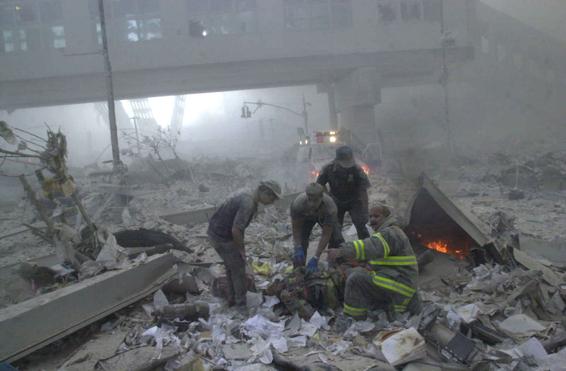 Al Kim, center, helps a firefighter amid the rubble.
Jean Potter, Bank of America, North Tower: I started walking in the gray dust. I was soaked because in the Concourse water had been pouring from the ceiling. People were yelling at me to cover my mouth, but I said, “Which way are the Towers? Are they behind me?” I didn’t want to be walking toward them. I made my way to Chinatown and tried to use the phone. I wanted to get as far away from the Towers as possible.
Steven Bienkowski, Aviation Unit, NYPD: All of Lower Manhattan was covered in a giant white dust cloud. As we came around in our helicopter to the North Tower again, you could still see people falling and jumping, except it didn’t look so violent anymore because you weren’t watching them hit the ground. It almost looked peaceful because they were falling into a white cloud.
Andrew Kirtzman, reporter, NY1: My taxi headed toward Chambers Street near City Hall and the taxi driver slammed on the brakes. He said, “I’m not going any further. Get out of here.” I fumbled for my money and this woman outside opened up the cab and climbed in next to me. She yelled, “Get me out of here!” I said, “Give me a second. I’m leaving.” “You’re leaving?” I said, “I’m a reporter. I’ve got to go cover the story.” She looked incredulous. He dumped me out on the street, and I was alone on Chambers Street, which on a daytime on a weekday is normally packed. The street was covered with white soot. It was eerily quiet and it was incredibly disorienting.
Lila Speciner, paralegal, Port Authority, North Tower, 88th floor: It looked almost like a snow globe, only it was flying papers and dust from the falling building. We still didn’t realize what had happened. We are soaking wet and I had debris in my hair, my ripped stockings, whatever. There were emergency people wandering around. “Are you hurt? Go here. If you’re not hurt, walk north. Go away from this building. We don’t know what’s going to happen next. Walk away.”
Frederick Terna, Holocaust survivor and Brooklyn resident: As ashes were falling, I was back in Auschwitz, with ashes coming down. In Auschwitz, I knew what the ashes were. Here, I assumed I knew what the ashes were—it was a building and human remains.
Det. Sgt. Joe Blozis, crime scene investigator, NYPD: Maybe I’m exaggerating, but it looked like maybe 18 inches of paper were covering the streets. Just tons and tons of paper from all those office buildings. The paper was catching on fire, which caused our emergency vehicles to catch on fire. We needed equipment before it was burnt up, so we were emptying out the trucks, taking the oxygen out, tools, ropes, and everything.
Dan Potter, firefighter, Ladder 10, FDNY: I started to see people coming out of wherever they took shelter. I rearranged myself, get myself focused again. I said, “That was the South Tower. I’m pretty sure it was the South Tower.” Now I said, “I got to get to my wife.”
Lila Speciner: As we got further and further away, there were some office buildings. People called us in and said, “Do you want to wash up? Our phones are working. Do you need to call family?” We got T-shirts from some company that had a picnic and had extra T-shirts. Everything we were wearing was soaking wet and dirty.
Lt. Joseph Torrillo, director of fire education safety, FDNY: All the screams around me were turning to cries, and the cries turned into whimpers, and the whimpers turned to silence. I didn’t hear anybody else anymore.
Across New York Harbor, in New Jersey, a junior Coast Guard officer, Lt. Michael Day, put in motion a massive boatlift to help evacuate people from the tip of Lower Manhattan.
Lt. Michael Day, U.S. Coast Guard: We were all in the Command Center, riveted, because we had these large-screen TVs and CNN reports, and when the first tower collapsed we lost one of the means of communication with the small boats; our 41-foot utility boats were on their way over there. We lost the radar image after the first tower collapsed because of all of the debris. We got reports there were people congregating on the lower tip of Manhattan. That’s when it really kicked in, when the first tower collapsed—the havoc.
Rick Schoenlank, president, United New Jersey Sandy Hook Pilots Benevolent Association: There was a call that was put out by the Coast Guard for all boats to render assistance to Lower Manhattan. Our boat—the 184-foot New York—got underway and went steaming full ahead up to the Battery. We sent a number of launches that we had to go up and assist as well.
Lt. Michael Day: The marina was filled with firefighters, police officers, rescue workers, and they were jumping onto the boats that were there, all on the sides, and they were getting overloaded again. Firefighters were throwing off their gear and leaping onto the tugs as they were leaving. We probably had 25 to 30 firefighters in the water floundering because this building had come down.
Edward Aswad Jr., officer, NYPD: We came across the marina. We got on a boat, or we were trying to get on a boat. [My NYPD colleague] Sean keeps saying he needs water, and I’m rummaging through this boat—there was this silver cabinet, like a cooler, and I opened it and there was water and beer. We start getting bottles of water and we’re pouring it all over our faces, our heads, taking our jackets off.
* * *
A few blocks from the World Trade Center, the city’s leaders, who had been forced into makeshift command posts because New York’s emergency management center in Seven World Trade Center had been damaged, found themselves on the run again following the collapse of the South Tower.
Rudy Giuliani, mayor, New York City: We walked out into the lobby of 100 Church Street, and within seconds, I had the feeling we had gone from bad to worse. What I saw outside on Church Street was a big cloud going through the street.
Sunny Mindel, communications director for the mayor of the City of New York, Rudy Giuliani: Everything was gray—a color world went monochromatic from all the soot and the ash. In this monochromatic world, the first bit of color came in the form of a guy named Tibor Kerekes, who was on the mayor’s security detail. He came into the building and was completely gray except for the blood.
Rudy Giuliani: Tibor Kerekes was all beaten up, blood coming down his face, and looking like he was somewhat in shock. Now, he was a black belt karate, in the military—you don’t get tougher than Tibor. To see him shook up, from pain, heightened just how bad this was.
Andrew Kirtzman, reporter, NY1: A police officer came up to me and said, “Get off this street.” I said, “I’m sorry. I’m a journalist,” as though this press pass were like a magic device. I said, “I’ve got to find Giuliani.” He said, “Oh, Giuliani is right over there.” Sure enough, about 10 feet away from me was Giuliani, surrounded with all of his aides: Bernie Kerik, the police commissioner, Tommy Von Essen, the fire commissioner, Tony Carbonetti, and a whole bunch of his aides. They emerged, and that’s when I ran into them.
Rudy Giuliani: I said, “Okay, we’re going out. We’ll go up Church and we’ll look for a new command center and we’ll make the decision as we’re walking along, but let’s get out of this building.” I grabbed Kirtzman’s arm and said, “Come on, Andrew, you’re coming with me.”
Andrew Kirtzman: Relations between Giuliani and me had not been particularly warm. In the year preceding that moment I’d written a book about him called Rudy Giuliani, Emperor of the City. Giuliani vowed never to read it. When he waved me over, suddenly everything changed. He said, “We’re going to walk north. We’ve got to get out of here.” Because the Office of Emergency Management had been destroyed, City Hall was evacuated, One Police Plaza had lost contact with the world, there was no place for him to take command.
Rudy Giuliani: We started walking north. People started following us, and we kept encouraging people to come with us.
Sunny Mindel: As we travel up Broadway, like a bunch of pied pipers, people are gathering with us.
Rudy Giuliani: As we were walking we were conferring, like, Where should we put the command post?
Andrew Kirtzman: It was pretty weird that here was the mayor and the entire leadership of the city, and they were as helpless as anyone walking down the street. As a citizen, it was pretty frightening that no one was in charge—or the person who is supposed to be in charge had no way of operating.
Sunny Mindel: I remember coming upon one older woman, who was seated in a park. She was drinking a Starbucks, she wasn’t moving—she was sitting there drinking her coffee. I didn’t want to frighten her, but I thought, She needs to get outta here. I went up to her, and I said, “Ma’am, you need to go north,” and she says, “No, I’m fine here.” I said, “You really have to get outta here.” But she wasn’t frightened. I think she maybe had that same reaction I had when I looked at the TV and went, “This is not my life, this is something I’m watching.”
* * *
Having just survived the collapse of the South Tower, siblings John and Michele Cartier formulated a plan to escape the devastation of Lower Manhattan, even as they worried about their brother James, not knowing whether he too had escaped.
John Cartier, brother of James Cartier, electrician, who was working in the South Tower: We made it not that far and went into a deli. The deli owner was like, “Take everything. Take water. Take whatever you want.”
Michele Cartier, Lehman Brothers, North Tower: At that point John had his water, I grabbed mine, and I remember grabbing one for my brother James, and throwing it into the briefcase I had. We started talking about John’s motorcycle, and where it was, and how far away.
John Cartier: I walked back toward my bike. It was on the sidewalk, completely covered in soot. I was like, “I hope this damn thing starts. Please God, start.” It fired right up. I pulled up, Michele got on the bike, and we slowly left. People were taking pictures of us, covered in this soot, leaving.
Michele Cartier: I’m in this blue skirt and on my brother’s motorcycle. I was completely disoriented. I had no idea which way we were going.
John Cartier: We only had one goal: Make it home. She kept on asking me about James. I said, “He probably got out on the west side.” That’s what I thought.
Michele Cartier: Then he said, “Just pray. Just pray.”
“You were hoping you would find something”
The Rescue at Shanksville
Just like their colleagues in New York and Washington, the first responders and officials around Shanksville were forced to improvise a response to a worst-case scenario.
James Clark, first assistant chief, Somerset Volunteer Fire Department: It was ten o’clock or so when our pagers tripped for a large aircraft down.
Alan Baumgardner, Somerset County 911 coordinator: It seemed like immediately every phone line in the center was lit up. Everybody grabbed for a phone and they were all the same call: A plane has gone down out near Lambertsville.
Rick King, assistant chief, Shanksville Volunteer Fire Company: I got into the station. I remember the dispatcher saying, “A plane down. Lambertsville Road, Lambertsville area.” I asked who was dispatched with us, and they said, “Your station, Friedens and Stoystown.” I knew County 911 thought it was a small plane, so I said, “County, I heard this plane crash. I’m convinced it was a commercial airliner.” I said, “I want additional departments.” I called for Central City, Somerset, Listie, Berlin, and I called for Somerset’s Hazmat Unit. They started to dispatch those.
Sgt. Patrick Madigan, commander, Somerset Station, Pennsylvania State Police: We all packed up and headed to Shanksville.
Rick King: Keith Custer was sitting beside me in the officer’s seat. Keith said, “I can’t swallow. My mouth is dry.” Mine was too. It sucked everything out of me. We’ve been in situations where we’ve been on terrible car accidents and things like that. This was different. I knew that somehow this was related to what was going on.
Keith Custer, firefighter, Shanksville Volunteer Fire Company: It was total silence in that truck the whole way out there. I don’t think we said but five words to each other.
Rick King: We had a cell phone in the engine at the time, and I got on the cell phone, being afraid for what was happening to our country, and I called my wife and I said, “Go get our kids out of school. I don’t know what’s happening.” I was thinking planes were now somehow going to be indiscriminately falling out of the sky. I said, “While you’re there, you might want to tell the school to close early.”
Kevin Huzsek, paramedic, Somerset Area Ambulance Association: We got a short ways down from our station on Route 30, looked over to the horizon, and saw a big large cloud of black smoke. We advised our dispatch center to dispatch every ambulance that had two or more ambulances in their station in Somerset and Cambria County.
* * *
The first to reach the crash scene in Shanksville were local neighbors who witnessed the crash, workers from a nearby salvage yard, and two coal truck drivers. Not long after, volunteer firefighters began to arrive. Then, within hours, state and federal officials—and scores of reporters—would descend on the former mine site en masse, setting up a temporary town that would exist for months as investigators sifted and searched through the wreckage. The crash site of Flight 93 perplexed many of those responding, as the soft earth of the former mine swallowed up the wreckage and buried much of the plane in the ground.
Douglas Miller, coal truck driver, James F. Barron Trucking: We turned in and then immediately made a right, which took us to the crash scene, within 30 yards. There was nobody else there at the time.
Robert “Bobby” Blair, truck driver, James F. Barron Trucking: The trees were on fire.
Douglas Miller: The heat—I assumed it was from the jet fuel—was so intense I had to remark to Bob, “Hey, we better back up,” because I thought it would blister the paint on my hood. You could feel the heat through the windows.
Robert “Bobby” Blair: We had taken our fire extinguishers, and we knocked the fire out that was blowing across the field pretty quick. There was a large tire laying there right at the hole; it was still burning. We both tried to knock it out, but then as soon as you quit spraying, it started back up again.
Eric Peterson, resident, Stonycreek Township: When I got up there, there was actually still pieces of mail and stuff like that falling from the sky.
Douglas Miller: There wasn’t anything to tell you that it was a plane when you first looked—it looked like maybe a truck delivering mail or maybe something carrying a lot of paperwork might have wrecked. There was paperwork—letters and envelopes—scattered everywhere.
Kevin Huzsek, paramedic, Somerset Area Ambulance Association: Shanksville Fire Department’s engine was actually arriving at the same time that we were. We went back first, their engine followed, and I believe a unit from Stoystown Fire Department was right behind them.
Merle Flick, firefighter, Shanksville Volunteer Fire Company: It wasn’t too much to see.
James Broderick, trooper, Pennsylvania State Police: I remember opening the car door and going to step out. I happened to look down and there was a piece of a human body—a bone or a joint. I knew no one could have survived that crash, seeing that small of a piece. I got back in the car. I knew that I had pulled too close. I backed up.
Ralph Blanset, fire chief, Stoystown Volunteer Fire Company: Trooper Broderick and I were standing next to the crater, and one of my firemen came up and said, “Are you in charge here?,” which is protocol for fire companies. Rick King of the Shanksville Fire Department said, “I’m in charge.” Before he got that out of his mouth, Trooper Broderick says, “I’m in charge. This is a crime scene.” That settled everything real quick.
James Broderick: I knew that we had to secure the scene, keep people out, because people were starting to pick things up.
Rick King: People are coming to me and saying, “What do we do? What do you want us to do?” There wasn’t anything to do.
Norbert Rosenbaum, firefighter, Stoystown Volunteer Fire Company: They said, “Go on to a search and rescue.” When I saw the parts and everything, I said, “I don’t think you’re going to be rescuing nobody. It’s too big a hole.” I did see a lot of stuff that I’d seen before; I was in Vietnam. There was just parts of human pieces. That’s all it was—pieces.
James Broderick: I remember the smell. Once you smell diesel fuel mixed with the human body, you’ll never forget that smell.
Lt. Robert Weaver, Pennsylvania State Police: That was the first thing that hit me—the smell.
Michael Rosenbaum, firefighter, Stoystown Volunteer Fire Company: Something was smelling really sweet. I didn’t know what it was, and I thought it was a flower or something that was in the woods. It had a sweet smell to it. I had asked my dad several times and he wouldn’t tell me. Later that day, one of the other firemen told me what it was.
Sgt. Denise Miller, Indian Lake Police Department: I thought, This is what hell must look like. The ground was smoking and smoldering.
Keith Custer, firefighter, Shanksville Volunteer Fire Company: We did a little sweep around, and it was probably 10, 15 minutes before we realized there would be no survivors.
Cynthia Daniels, EMT, Somerset Area Ambulance Association: Kevin [Huzsek] radioed the Somerset manager, Jill Miller, and Jill told him that we might as well go back to the ambulance hall and regroup. There was really nothing we could do. There was nothing—no one to take care of.
Kevin Huzsek, paramedic, Somerset Area Ambulance Association: The conversation was very bleak.
Tim Lensbouer, crane operator, Rollock Incorporated: We hollered all the way down through the woods and there was nothing there, just the pine trees burning. We searched and searched. We ran and ran. There was nothing other than paper. One of us found a book bag, a little kid’s book bag.
Cpl. Louis Veitz, collision reconstruction specialist, Pennsylvania State Police: We actually found money that was still intact. I can remember finding pocketbooks with family pictures in it, clothing, someone’s shoe.
Sgt. Craig Bowman, Crime Investigation Unit, Pennsylvania State Police: An open Bible was laying there. Considering the condition of all the other debris, it was relatively unscathed.
T. Michael Lauffer, trooper, Pennsylvania State Police: I actually found a flight book from one of the flight attendants laying down there, down in the hemlocks. That’s when I knew it was a United flight, because it had “United Airlines” printed on it. “Bradshaw” was the name in it.
James Broderick: I remember it was Flight Attendant Sandra Bradshaw. It had a picture of her and her family. I had taken that with me, because we started to take things back and place them on the back of a fire truck. Things were starting to blow away or burn. We wanted to protect everything that we could that could be possible evidence or things that could possibly be returned to the family members.
Clyde Ware, assistant chief, Stoystown Volunteer Fire Company: You kept looking and hoping for the impossible that day.
Lt. Robert Weaver: We were talking and I said, “I can’t believe this is a commercial plane.” Within minutes, [FBI agent] Wells [Morrison] got a phone call and confirmed it was Flight 93. He said, “Yes, it’s confirmed—this is Flight 93.”
Keith Custer, firefighter, Shanksville Volunteer Fire Company: Then we put it all together: “Hey, this is the fourth plane.”
Paula Pluta, resident, Stonycreek Township: I started thinking, What in the world do they want with Shanksville, Pennsylvania? There’s nothing here!
Sgt. Denise Miller, Indian Lake Police Department: When I first got out there to the site, I was actually a little nervous. I wondered what the importance of the field was and what possibly the government had hidden under the ground there that they wanted. I couldn’t figure out why the plane had come down here.
Wells Morrison, supervisory special agent, FBI: What became the priority now was to preserve the crash site and attempt to obtain anything of evidentiary value.
Not long after Flight 93 crashed, the first media arrived at the scene and began to confirm for the world that another attack had occurred, ending in a field near Shanksville.
Laurence Kesterson, staff photographer, Philadelphia Inquirer: All we had was “There’s a plane that crashed in western Pennsylvania. Go!” My boss said, “Just go. Just get on the turnpike and go west. We’ll call as we know more.”
Peter M. “Mike” Drewecki, photographer, WPXI-TV, Pittsburgh: We were trying to pinpoint exactly where Shanksville was because I had never heard of it before.
David Mattingly, national correspondent, CNN: This was in the days before everyone had a GPS in their car, so I still had to get there the old-fashioned way: I had to stop and buy a map.
Cpl. Jeffrey Braid, Aviation Patrol Unit, Pennsylvania State Police: It was eerily quiet on the radios for the airplanes. The whole ride out to Shanksville, there was really no communication between airplanes and ground.
Tony James, investigator, FAA: I drove to the FAA’s Hangar 6 in Washington, which is located at Ronald Reagan Airport, and I put my stuff on the airplane. It was myself, two NTSB [National Transportation Safety Board] people, and the two pilots. We were the only airplane in the air. We were talking to air traffic control and they said, “You’re cleared direct. Go as fast and as high as you want to go.”
Cpl. Jeffrey Braid: We were five miles out, and we still didn’t see anything, so we started contacting the ground units and said, “Are these the right coordinates?” We still didn’t see any smoke or debris. We got almost right on top of it, and then we started seeing the cars and stuff.
Tony James: We get up here and we could see the woods burning and we made a couple of low fly-bys, which got a lot of people’s attention.
Braden Shober, firefighter, Shanksville Volunteer Fire Company: Keith Custer pointed up in the sky and said, “That’s not supposed to be there.” We looked and there was a large plane flying toward us. At this point we all know that there aren’t supposed to be any planes in the sky because the FAA’s put everybody on the ground. It was a little eerie. You started looking around. Where are we going to hide?
Keith Custer: What do you do to get away from a plane that’s coming at you? Do you try to outrun it? It’s coming at you so fast.
Capt. Frank Monaco, Pennsylvania State Police: There was a giant jet liner right over our heads. It was like a Twilight Zone episode—everybody was frozen in their tracks. Nobody was moving. Nobody was talking. Everybody was stunned. “Is it another one?”
Keith Custer: When it went by us, everybody kind of did a “Wow.”
Peter M. “Mike” Drewecki, photographer, WPXI-TV, Pittsburgh: There was a gathering of workers standing in front of Highland Tank Company. Some were smoking cigarettes; some were standing around, scratching their heads. They knew why we were there, and they just pointed their thumbs over their shoulders and said, “Whatever it is you’re looking for, it’s up that way.”
Jon Meyer, reporter, WNEP-TV (Scranton, Pennsylvania): The next thing I knew, I was right where the crater was. It was an overwhelming experience. The only way I knew it was a plane was the size—it was a big crater.
Peter M. “Mike” Drewecki: I was met by a photographer from the Greensburg [Pennsylvania] Tribune-Review by the name of Sean Stipp. It’s strange—you’re not looking at each other, but you’re looking at the things you have to shoot. I remember saying, “Sean, this is the beginning of World War III.”
David Mattingly, national correspondent, CNN: The first live report I did was over the telephone. I was explaining where I was—this bucolic setting, this pasture on the right, this cornfield on the left, these rolling hills around me, this blue sky above me. It seemed a highly, highly improbable location to be doing a story about what appeared to be some terrorist attack.
As word spread of the fourth crash, the families of victims aboard Flight 93 learned that their greatest fears had been realized.
Alice Ann Hoagland, mother of United Flight 93 passenger Mark Bingham: We heard the news that Flight 93 had crashed in Pennsylvania. They had the footage on television so fast, and it showed rescue workers already on the site with a big, gaping, smoldering hole. That’s the way I found out Mark had been killed.
Deena Burnett, wife of United Flight 93 passenger Tom Burnett: I realized I had been running around the house all morning in my pajamas. I needed to get dressed. I went upstairs. I had the telephone with me. I put it on the ledge by the shower so that in the event I didn’t hear it, I could see it ring. I never took my eyes off the telephone while I was showering. I got dressed and went downstairs. The policeman was standing at the bottom of the stairs, and I could tell by the look on his face that something was wrong. He said, “I think I have bad news for you.” I remember turning toward the television and seeing that there had been another plane crash. I ran over to the TV and I asked, “Is that Tom’s plane?” He said, “Yes, it’s Flight 93.” I felt my knees buckle.
Lyzbeth Glick, wife of United Flight 93 passenger Jeremy Glick: They told me that Jeremy’s plane had gone down. The police were at my house, and somebody said there had been some survivors on the plane. I thought, Okay, if there are survivors, he’s going to be one of them because he’s a survivor. My minister came over and we sat there and prayed. I knew since there was no call, it wasn’t good news. United probably called three hours after the plane went down. I said, “You don’t even need to tell me, I know.”
“That very slow, quiet panic”
At School in Arlington, Virginia
Since the attacks happened in the morning, teachers all around the East Coast were faced with a decision they had not been trained to make: how to talk to their students about the tragedies happening in New York and Washington, D.C. One of the schools that faced this dilemma most profoundly was in the Pentagon’s hometown, just a few miles from the crash site. H-B Woodlawn School officials tried to calm their 600 students—many of whom had family members working at the Pentagon, the Capitol, the White House, or other government offices—as panicked parents began to arrive to take them home.
Ray Anderson, principal, H-B Woodlawn School, Arlington: At about nine o’clock, kids started coming into the office who had gotten off the bus. They were wearing Walkmans and listening to the radio, and they’re talking about terrible things happening in New York City.
Frank Haltiwanger, assistant principal, H-B Woodlawn School: Sometime during the first period, the second tower was hit.
Ray Anderson: We had to adjust to this unbelievable thing. You had no frame of reference for it and quickly realized that this was going to be a real problem for students being in school. I got on the PA and I told everyone, told the teachers to turn off all the TVs. People didn’t need to sit around all morning and watch these horrible events.
Theresa Flynn, librarian, H-B Woodlawn School: My phone rang, and it was my mother—she had heard an explosion at the Pentagon and ran out her front door. She said, “We’re in trouble. You need to get home.”
Frank Haltiwanger: When the Pentagon was hit, that changed everything—because we had a number of kids who have parents who work there.
Ray Anderson: The phone system quickly became inoperative, and cell phones became inoperative. Everybody was trying to use the phones at the same time.
Theresa Flynn: People stopped teaching. They didn’t know what to do. About a third of our staff and students had family members who were at the Pentagon, who were working downtown. The news was not helpful. They started saying: “Car bomb at the State Department.” “There’s another plane in the air.” “We don’t know how many planes are in the air.” “They’re all heading toward D.C.” Everybody was panicking, but it was that very slow, quiet panic.
Frank Haltiwanger: We were able to maintain reasonable order downstairs by keeping the kids in the classrooms. There were two or three students who either had parents at the Pentagon or parents who were in the air to New York who became hysterical and were running down the hall. I had some come into my office. I found another teacher who was a good counselor and had that teacher sit with them.
Ray Anderson: Parents started showing up at school, wanting their children.
Frank Haltiwanger: I’d say 50 or 70 parents came. Most of them came, checked on their child, and left.
Ray Anderson: I got on the PA, now it’s probably about 10:15—10:30 at the latest—and said, without being any more specific, “We may need to do our tornado drill today.” I reminded people the tornado drill is not the fire drill—where we all go outside and get away from the building—the tornado drill is when we all go down to the basement and first-floor hallways.
Mary McBride, assistant principal, H-B Woodlawn School: Mercifully, those parents working at the Pentagon were all right. That was the most important piece of almost the whole day for us—because that didn’t happen for one of our principals.
Ray Anderson: The husband of the principal at Hoffman Boston Elementary in Arlington was on the plane that hit the Pentagon—it flew right over her building. She had some notion that that might be the case, but she stayed at her post as principal of the school, doing what I was doing at my school until the day was over. Then, at the end of the day, she found out her notion was correct.
Theresa Flynn: We had in the library 100, 150 people standing there—we had a television at either end of the library. There’s not a sound other than the news. The news anchors were beginning to spout theories about Osama bin Laden. A young boy—he was in ninth grade at the time—he turned to me and said, “Why did they do this to us?,” which was a big question from the kids. I said, “Well, they don’t like us very much.” He said, “Why not?”