“We’re in a little trouble here”
The Military Responds
With the order from Vice President Cheney, the military scrambled to find planes it could bring into the fight—even if that meant launching them unarmed, launching them on a kamikaze mission to crash their own fighters into hijacked airliners. It was an unbelievable and unprecedented mission, the weight of which was not lost on the pilots gathered to take it on. What was not yet widely known was that the United 93 passengers were planning, at the same time, to take the plane over themselves.
Col. Matthew Klimow, executive assistant to the vice chair of the Joint Chiefs of Staff, Gen. Richard Myers, Pentagon: It was a very painful discussion for all of us. We didn’t want the burden of shooting down the airliner to be on the shoulders of a single fighter pilot, but we also didn’t want to have that pilot go all the way up the chain of command to get permission to shoot. It was decided the pilots should do their best to try to wave the airplane off, and if it’s clear the airplane is headed into a heavily populated area, the authority to shoot can be given to a regional commander.
Lt. Heather “Lucky” Penney, F-16 pilot, D.C. Air National Guard: This sounds counterintuitive, but when the magnitude of the situation hit me, I really lost all emotion. I was really much more focused on What are the things I need to do to enable us to protect our capital? What are the things I need to do to facilitate us getting airborne?
Brig. Gen. David Wherley, commander, D.C. Air National Guard: My translation of the rules to Sass [Lt. Col. Marc Sasseville, F-16 pilot] was, “You have weapons-free flight-lead control.” I said, “Do you understand what I’m asking you to do?” They both [Sasseville and Lt. Heather “Lucky” Penney] said yes. I told them to be careful.
Lt. Col. Marc Sasseville, F-16 pilot, U.S. Air Force: As we’re going out to the jets, Lucky and I had a quick conversation about what it is that we were going to do and how we were basically going to do the unthinkable if we had to.
Lt. Heather “Lucky” Penney: We would be ramming the aircraft. We didn’t have weapons on board to shoot the airplane down. Both Sass and I had 105 bullets, lead-nosed. As we were putting on our flight gear in the life support shop, Sass looked at me and said, “I’ll ram the cockpit.” I made the decision I would take the tail off the aircraft.
Lt. Col. Marc Sasseville: We didn’t have a whole lot of options.
Lt. Heather “Lucky” Penney: I had never been trained to scramble the aircraft. It would typically take about 20 minutes to start the jets, get the avionics systems going, go through all the preflight checks to make sure the systems were operating properly, program the computers in the aircraft. That’s not even including the time to look at the forms, do the walk-around of the airplane, and whatnot. We usually planned about half an hour to 40 minutes from the time you walked out the door to the time that you actually took off.
Col. George Degnon, vice commander, 113th Wing, Andrews Air Force Base, Prince George’s County, Maryland: We did everything humanly possible to get the aircraft in the air.
Lt. Heather “Lucky” Penney: I just got my radios up and I was yelling at my crew chief, “Pull the chocks!” He pulled the chocks and I push my throttle. The crew chief was still running under the tail so that my gear would come up—there are safety pins that are all in the airplane—and so they were pulling all those safety pins as I was taxiing to go do an immediate takeoff. I didn’t even have an inertia navigation unit. I didn’t have any of that set up. It was lucky it was a clear, blue day because we didn’t have all the avionics. They were not yet awake when we took off.
Lt. Col. Marc Sasseville: I was thinking, Wow, we’re in a little trouble here.
Lt. Heather “Lucky” Penney: Sass and I fully expected to intercept Flight 93 and take it down.
Lt. Col. Marc Sasseville: I was going into this moral or ethical justification of the needs of the many versus the needs of the few.
Lt. Heather “Lucky” Penney: I genuinely believed that was going to be the last time I took off. If we did it right, this would be it.
Maj. Gen. Larry Arnold, commander of the 1st Air Force, NORAD, Tyndall Air Force Base, Florida: Bob Marr quotes me as saying that I told him that we would “take lives in the air to save lives on the ground.”
Lt. Heather “Lucky” Penney: Seeing the Pentagon was surreal. It was totally surreal to see this billowing black smoke. We didn’t get high. We were at about 3,000 feet. We never got above 3,000 feet, at least on that first sweep out.
Lt. Col. Marc Sasseville: There was all this smoke in my cockpit. It made me nauseous to be honest with you—not from an Ugh, this stinks, it was more from an Oh my God, we’ve been hit on our own soil and we’ve been hit big. I couldn’t believe they had gotten through and they managed to pull off this attack.
Lt. Heather “Lucky” Penney: The real heroes are the passengers on Flight 93 who were willing to sacrifice themselves.
Lt. Col. Marc Sasseville: They made the decision we didn’t have to make.
Lt. Heather “Lucky” Penney: I don’t remember how many miles we got away from D.C., but we flew quite a bit down the Potomac. We said we need to go back over and fly over D.C. because we’ve clearly sanitized the area. When we returned to D.C., that was when things began to settle down.
“Let’s get them”
The Fourth Crash
A few minutes before 10:00 a.m., United Flight 93 passenger Edward Felt, a 41-year-old married father of two who was traveling as part of his job as a computer engineer for BEA Systems, called 911 from the plane and reached emergency dispatcher John Shaw in Westmoreland County, Pennsylvania. It was the first tip to Pennsylvania authorities that there was trouble in the skies overhead. This is an abridged transcript of their call.
Ed Felt: Hijacking in pro—
John Shaw: Excuse me? Hey somebody’s reporting a—
Felt: Hijacking in progress.
Shaw: Sir, I’m losing you, where are you?
Felt: United Flight 93.
Shaw: Wait a minute, wait, United flight. United Flight 93.
Felt: Hijacking in progress!
Shaw: Okay, where are you? Where are you?
Felt: I’m in the bathroom, United Flight 93.
Shaw: Okay, where are you?
Felt: I don’t know.
Shaw: Where are you?
Felt: I don’t know where the plane is.
Shaw: Where did you take off?
Felt: Newark to San Francisco.
Shaw: I got it, okay, stay on the phone with me sir.
Felt: I’m trying to . . . [unintelligible] at the bathroom. I don’t know what’s going on.
Shaw: Hey somebody get the FAA, Newark to San Francisco and they got a hijacking in progress. Okay, yeah. Get somebody from the airport on the line. This is a hijacking in progress. Are you still there, sir?
Felt: Yes I am.
Shaw: What’s your name, sir?
Felt: Edward Felt.
Shaw: How big of a plane, sir?
Felt: It’s like a 757.
Shaw: This is a 757. Hey we need—It’s a 757. Sir, sir?
Felt: Yes.
Shaw: Okay, how many people on the plane?
Felt: It was—it was pretty empty, maybe [unintelligible].
Shaw: Can you still hear me, sir, sir, sir can you still hear me? It’s over [unintelligible]. There’s a plane . . . said the plane’s going down. It’s over Mt. Pleasant Township somewhere. Sir? It’s going down. You better make an announcement on [unintelligible]. It’s over Mt. Pleasant somewhere. Hello?
* * *
Alice Ann Hoagland, mother of United Flight 93 passenger Mark Bingham: The uniqueness of Flight 93 is that it was in the air longer than the other flights. People on board were able to find out about the fate of the other three flights and mount an effort to thwart the hijackers, even if they weren’t able to save their own lives.
Deena Burnett, wife of United Flight 93 passenger Tom Burnett: It was silent, and I could feel my heart racing. Tom said, “We’re waiting until we’re over a rural area. We’re going to take back the airplane.” I became very frightened and I begged, “No, no, Tom. Just sit down, be still, be quiet, and don’t draw attention to yourself.” He said, “No, Deena. If they’re going to crash this plane, we’re going to have to do something.”
I asked, “What about the authorities?” He said, “We can’t wait for the authorities. I don’t know what they can do anyway. It’s up to us.” He said, “I think we can do it.” Neither of us said anything for a few seconds. Then I said, “What do you want me to do? What can I do?” “Pray, Deena, just pray.” “I am praying. I love you.” Tom said, “Don’t worry. We’re going to do something,” then he hung up. He never called back.
Lisa Jefferson, Verizon Airfone supervisor: As that plane took a dive, I could hear the commotion in the background. I heard the flight attendant screaming. People hollering out, “Oh, my God! Jesus, help us!” [Todd Beamer] asked me, if he didn’t make it, would I please call his wife? I told him I would, but I asked him if he would like me to connect him to her right then. He said, no, he didn’t want to upset her. She was expecting their third child in January, and he knew she was home alone. He gave me his home phone number.
Lyzbeth Glick, wife of United Flight 93 passenger Jeremy Glick: Jeremy said there were three other guys as big as him, and they were going to jump on the hijacker with the bomb and try to take back the plane. He asked if I thought that was a good idea. We debated a little bit. He said that they were going to take a vote, and asked what did I think he should do. I said, “You need to do it.” He’s a very strong man, and large—six feet, 220. He was a national judo champion, so he was really well equipped with self-defense. He was joking, “I have my butter knife from breakfast.” Despite everything, he was able to be a little bit humorous. Then he said, “Okay, I’m going to put the phone down. I’ll be right back. I love you.”
Philip Bradshaw, husband of Sandra Bradshaw, flight attendant, United Flight 93: We talked about how much we loved each other and our children. Then she said: “Everyone is running to first class, I’ve got to go. Bye.” Those were the last words I heard from her.
Lisa Jefferson: Todd turned to someone else and he said, “Are you ready?” I could hear them; they responded. He said, “Okay. Let’s roll.” That was the last thing I heard.
* * *
Transcript from the United Airlines Flight 93 cockpit voice recorder:
9:57 A.M.
Voice in Arabic: Is there something?
Voice in Arabic: A fight?
Voice in Arabic: Yeah?
Voice in Arabic: Let’s go guys. Allah is greatest. Allah is greatest. Oh, guys. Allah is greatest.
Voice in Arabic: O Allah. O Allah. Oh the most Gracious.
[Sounds of a struggle, grunting]
Voice in English: Stay back.
Voice in English: In the cockpit! In the cockpit!
Voice in Arabic: They want to get in there. Hold, hold from the inside. Hold from the inside. Hold.
Voice in English: Hold the door.
Voice in English: Stop him.
Voice in English: Sit down. Sit down. Sit down.
Voice in Arabic: There are some guys. All those guys.
Voice in English: Let’s get them.
Voice in English: Sit down.
Voice in Arabic: Trust in Allah and in him.
10:00 A.M.
Voice in Arabic: There is nothing.
Voice in Arabic: Is that it? Shall we finish it off?
Voice in Arabic: No. Not yet.
Voice in Arabic: When they all come, we finish it off.
Voice in Arabic: There is nothing.
Voice in English: I’m injured.
Voice in Arabic: O Allah. O Allah. O Gracious.
Voice in English: In the cockpit. If we don’t, we’ll die.
Voice in Arabic: Up, down. Up, down, in the cockpit. Up, down. Saeed, up, down.
Voice in English: Roll it.
Voice in Arabic: Allah is the greatest. Allah is the greatest.
Voice in Arabic: Is that it? I mean, shall we pull it down?
Voice in Arabic: Yes, put it in it, and pull it down.
Voice in Arabic: Cut off the oxygen. Cut off the oxygen. Cut off the oxygen. Cut off the oxygen.
Voice in Arabic: Up, down. Up, down.
Voice in Arabic: What?
Voice in Arabic: Up, down.
Voice in English: Shut them off. Shut them off.
Voice in English: Go, go, move, move.
Voice in English: Turn it up.
Voice in Arabic: Down, down.
Voice in Arabic: Pull it down. Pull it down.
Voice in English: Down. Push, push, push, push, push.
Voice in Arabic: Hey. Hey. Give it to me. Give it to me.
Voice in Arabic: Give it to me. Give it to me. Give it to me.
Voice in Arabic: Give it to me. Give it to me. Give it to me.
10:03 A.M.
Voice in Arabic: Allah is the greatest.
Voice in Arabic: Allah is the greatest.
Voice in Arabic: Allah is the greatest.
Voice in Arabic: Allah is the greatest.
Voice in Arabic: Allah is the greatest.
Voice in English: No!
Voice in Arabic: Allah is the greatest. Allah is the greatest.
Voice in Arabic: Allah is the greatest. Allah is the greatest.
* * *
Lyzbeth Glick, wife of United Flight 93 passenger Jeremy Glick: I didn’t want to listen to what happened, so I gave the phone to my dad. It wasn’t until a couple of days later that I found out what had transpired. My father told me later that he had heard a series of screams. Then there was a series of more screams, and then it sounded like a roller coaster. Then there was nothing.
* * *
As the passengers and crew aboard Flight 93 tried to wrest control of the plane from the hijackers, their decisions in the air would alter the lives of those who lived in the small towns in Somerset County, near Shanksville, Pennsylvania, who suddenly found themselves in the midst of the nation’s still-unfolding tragedy. The crash sowed even further confusion among the military and air traffic controllers who were mustering the government to respond to an attack they still didn’t understand.
Sgt. Patrick Madigan, commander, Somerset Station, Pennsylvania State Police: While we were watching, I said, “At least there’s no terrorist targets in Somerset County.” Shortly thereafter, we received a call [from Ed Felt] that a plane was over Somerset, and my first thought and reaction to that was, What am I going to be able to do about it?
Rick King, assistant chief, Shanksville Volunteer Fire Company: I called my sister, Jody [King Walsh]. Jody lives in Lambertsville, which is not very far. As I was talking to her, she said, “Rick, I hear a plane.” She said, “Rick, it’s loud. It sounds like a jet.” I said, “Oh, my God!” I walked out onto my front porch, and I could hear the plane. I could hear the engine screaming.
Anita McBride Miller, resident, Stonycreek Township, Pennsylvania: Out of nowhere, this absolutely unbearable, horrific noise was going on outside. It was deafening. It shook the windows and rattled the rafters.
Douglas Miller, coal truck driver, James F. Barron Trucking: I happened to look up in the sky and there was this giant aircraft, coming straight down.
Tim Lensbouer, crane operator, Rollock Incorporated: I can’t describe what it sounded like, almost like a missile type—and it came over us real fast and then it hit the ground. All of a sudden, all the lights went out. It went black and the whole building shook.
Douglas Miller: I remember getting on the CB [radio] and asking my buddy, “Did I see that?” He said, “Yeah.” He said, “It didn’t look good.”
John Werth, air traffic controller, Cleveland Air Route Traffic Control Center: We never lost them from the radar until they took the steep descent into the crash. We observed the target all the way to the southeast of Pittsburgh, until 10:03 a.m.
Stacey Taylor Parham, air traffic control specialist, Cleveland Air Route Traffic Control Center: I vectored another nearby plane toward the incident site and asked if he would look for smoke.
Terry Yeazell, pilot, Falcon 20 corporate jet, airborne over Pennsylvania: Stacey asked if there was any activity off the right side of the airplane, like smoke or something like that. There were a lot of small white clouds around. After looking for a while, I saw a puff of black smoke, a black cloud floating. As we got closer, we could see basically a forest fire burning next to a tree line in a field of grass.
Yates Gladwell, pilot, Falcon 20 corporate jet, airborne over Pennsylvania: It was a big black hole and it was smoking.
Ben Sliney, national operations manager, FAA Command Center, Herndon, Virginia: The other plane reported the smoke plume. That drew a close to the day in reality, but we didn’t know that yet—in our minds, the attacks were not over, and we continued to track the remaining eight or 10 or maybe even a dozen planes, monitor their progress, report on what they were doing. Until they were resolved, until their radios came back on, they landed, they did whatever they had to do.
Maj. Gen. Larry Arnold, commander of the 1st Air Force, NORAD, Tyndall Air Force Base, Florida: We did not know that was the last plane. The war was still on as far as we are concerned.
* * *
Lisa Jefferson, Verizon Airfone supervisor: I kept calling out Todd Beamer’s name, hoping and praying either him or anyone would pick up that phone. Someone touched my shoulder and said, “Lisa, that was their plane”—the plane had just crashed in Pennsylvania—“you can release the line now.” I kept calling and calling. I held that phone an additional 15 minutes, praying someone would pick up.
Lyzbeth Glick, wife of United Flight 93 passenger Jeremy Glick: My dad stayed on the line for over two hours, hoping beyond hope.
Deena Burnett, wife of United Flight 93 passenger Tom Burnett: I kept waiting. I held on to the telephone for almost three hours, waiting for him to call back to tell me he had landed the plane and everything was fine and he would be home later. I started thinking about what I could cook for dinner. I was thinking about sending the kids to school and who could come pick them up, because I didn’t want to miss his phone call. So I just sat there.
“There was no place for us to run”
Fear at the Pentagon
The first hour of rescue efforts at the Pentagon proved to be a frustrating stop-and-start, as fire responders noticed that the outer rings of the building—which bore the brunt of the plane’s impact—were in danger of collapsing, and officials feared reports that more hijacked aircraft were inbound.
James Schwartz, assistant chief for operations, Arlington County Fire Department: There was this sense of the battlefield—of war, if you will. We were very clear that there may be more waves of the attack coming. At one point early on, [FBI Special Agent] Chris Combs said to me, “There are still eight more aircraft that are unaccounted for.” We were waiting. Is there going to be another airplane, like there was in New York, at the Pentagon? This is an attack the likes of which we’ve never seen before.
Chris Combs, special agent, FBI, Pentagon: The FBI command center was relaying to me all of the other stories that were out there about other attacks happening. There were stories that the White House had been hit, that the State Department had been hit. One thing I remember hearing was “Hey, Cleveland has been hit as well.” I remember thinking, What’s in Cleveland? Why are they hitting Cleveland?
Thomas O’Connor, special agent, FBI, Pentagon: We were standing with a guy from the Metropolitan Washington Area Airports Authority, who had a radio, and he said, “Hey, you’ve got a plane that’s off radar.” He said, “It’s a good distance out.” I was like, “Okay.” But he said, “They’re calculating back”—at the speed it was going or should be going, and the direction—“how long it would take to get to Washington, D.C.” It was more of an urgent matter than I had first thought it was.
Chris Combs: It was on track to D.C., and it was 20 minutes’ flight time out. They said we had 20 minutes.
James Schwartz, assistant chief for operations, Arlington County Fire Department: I made a decision to evacuate the incident scene at the Pentagon.
John Jester, chief, Defense Protective Service, Pentagon: We were outside and heard the fire trucks blowing their horns. They said it was for recall, to come down off the building because of a report of a second plane inbound. They pulled the firemen off the building for a while.
Chris Combs: We looked around and decided the safest places were under the overpasses on the highways. We sent everyone there.
Capt. Charles Gibbs, Arlington County Fire Department: I refer to it as “Everybody out of the pool.” On the heliport side, we went back to the other side of Washington Boulevard, which in reality probably wasn’t far enough, but that’s where we went.
James Schwartz: We picked up all the victims, we got everybody as much as we could off of the incident scene. We stood there getting radio transmissions from the Washington Field Office of the FBI counting down.
Chris Combs: It was pretty eerie—the Pentagon is absolutely in flames, and there are thousands of first responders and people from the Pentagon huddled underneath all of these overpasses, waiting.
Thomas O’Connor: The hard part of being under the bridge was that you knew the firefighters weren’t in there fighting the fire—and every minute they weren’t fighting the fire, it was getting further out of hand. They were really frustrated.
Capt. Charles Gibbs: That was probably 10, 15 minutes, just sitting there.
Thomas O’Connor: They were actually counting down the time.
James Schwartz: We were standing there looking out at the sky, looking to see if an airplane is going to pierce the clouds.
Chris Combs: We got to about five minutes past the deadline. People were getting a little antsy. Members of the command team were asking me, “Hey what’s going on? Where’s this plane?”
James Schwartz: We were waiting for a word from somebody.
Chris Combs: It was about 10 minutes after that they said it was a confirmed crash at Camp David, and we were good to go.I
James Schwartz: At that time I ordered everybody back to the incident scene.
Capt. Robert Gray, Technical Rescue, Station 4, Arlington County Fire Department: We walked up to the front of the building, and it was unbelievable. My thought was, This feels so evil, that somebody has done this, and they did it with a loaded plane. It was overwhelming. We basically started on the first floor and worked our way in. It was obvious on the first floor once we got all the way to where the plane had hit that there weren’t any survivors.
I. This report—of a crash near Camp David—was the garbled initial news of the crash of Flight 93, whose Pennsylvania crash location was initially misplaced as being close to the presidential retreat in Thurmont, Maryland, along the Pennsylvania border.
“Oh my god, it’s Father Mike”
The First Casualty
One of the most memorable figures at the Trade Center was Father Mychal Judge, one of the FDNY’s six chaplains, a gregarious, gay, recovering alcoholic Irishman, known throughout the city for ministering to firefighters, the homeless, and AIDS victims. He’d been an FDNY chaplain since 1992 and had responded to numerous emergencies, including the 1996 crash of TWA Flight 800, which exploded over Suffolk County, New York. On 9/11, he was one of the first to arrive at the World Trade Center and is believed to be the only priest who entered the Twin Towers that day.
Mychal Judge, chaplain, FDNY: It’s fantastic how I can sometimes begin a day and go through a day, but not realize that everything that happens—every single thing that happens—is somehow within the divine plan.
Friar Michael Duffy: Priests and firemen both enter people’s lives at a point of crisis. They have similar outlooks on life—it’s the need to help, to rescue. So you have Mike Judge wanting to do that in a spiritual way, and the firemen wanting to do it in a physical way. It was a natural match.
Malachy McCourt, actor: There’s a very old postcard of a giant Jesus looking in the window of the Empire State Building in those long, long robes. That was Mike Judge in New York. He was everywhere over the city.
Friar Michael Duffy: On 9/11, one of our friars, Brian Carroll, was walking down Sixth Avenue and actually saw the airplane go overhead at a low altitude. Then he saw smoke coming from the Trade Towers. He ran into Mychal Judge’s room and said, “Mychal, I think they’re going to need you. I think the World Trade Tower is on fire.” He jumped up, took off his habit, got his FDNY uniform on, and—I have to say this, in case you think he’s perfect—he did take time to comb and spray his hair. He ran down the stairs and got in his car with some firemen and went to the World Trade Towers. One of the first people he met was the mayor, Mayor Giuliani.
Rudy Giuliani, mayor, New York City: Father Judge was walking in the other direction. I was walking south, he was walking north. “Father Judge,” I said, “please pray for us.” He put a smile on his face and said, “I always do.” I said, “Thanks.” We didn’t quite have a chance to do the whole joke—I used to say to him, “Pray for me.” He would say, “I will.” I’d say, “It’s more effective if you pray ’cause you’re in a lot better shape than I am with God.” He would say, “Yeah, but it’s better if you do it ’cause it’s more unusual, and it will be more of a surprise to God.”
For the better part of an hour, Father Judge was a constant, reassuring presence to emergency workers—praying aloud in the North Tower lobby and dashing outside at one point to administer last rites to a firefighter, Danny Suhr, hit and killed by a person falling from the burning tower.
Gregory Fried, executive chief surgeon, NYPD: I saw Mychal Judge, the fire chaplain, and I said, “Father, be careful.” He said, “God bless,” because he always said “God bless.” Then he headed right and I went left.
Bill Spade, firefighter, Rescue 5, FDNY: I’d known him from other incidents, other things and weddings and all. I’d say, “Hey Father, how you doing, you remember me?” He’d say, “Sure I remember you, you got that 20 I lent you?” He was there in the building, in the North Tower. He had his rosary at his side, in his right hand, and he was saying the rosary. He was white. Everything that he was seeing was really bothering him.
Christian Waugh, firefighter, Ladder 5, FDNY: You could see it in his face. He usually joked around. He was always saying hello to somebody. This time he was stone-faced.
Chief Joseph Pfeifer, Battalion 1, FDNY: He was in the lobby with us and I could tell he was praying.
Lt. Bill Cosgrove, NYPD: That’s when the whole building shook. The lights went out. There was this giant vacuum sound. We thought it was our building [South Tower] that was collapsing. It wasn’t. The pressure was sucking the windows out of Tower One. It was totally dark.
Wesley Wong, assistant special agent in charge, FBI: I took a couple of steps, and I tripped over what I thought is a piece of debris. I could barely make out the outline of a fireman’s bunker coat. I say to some other firemen, “Hey, I think one of your guys is down.” Two other firemen go to look in the darkness.
Lt. Bill Cosgrove: One of the firefighters put the light on him—and I remember him saying, “Oh my god, it’s Father Mike.”
Wesley Wong: We picked up Father Judge and we headed out.
Lt. Bill Cosgrove: I took an arm. Someone else took an arm. Two other guys took his ankles.
Wesley Wong: We brought Father Judge back in the orange chair that you see in the famous picture of him. That orange chair was sitting by its lonesome in the mezzanine level. Some of the firemen started working on him, trying to help his breathing. He was in real bad shape at that point.
John Maguire, finance associate, Goldman Sachs: I saw the firemen carrying a man I later discovered was Father Mychal Judge in a chair. I offered them a hand. It took five men because the ground was shifting on top of the debris, which made it difficult to walk.
Shannon Stapleton, photographer, Reuters: I noticed some rescue workers carrying this man in a chair. I knew it was a pretty intense image. They weren’t too happy.
Lt. Bill Cosgrove: I remember looking up because one of the firemen was yelling at a photographer. He was telling him in no uncertain terms, “Get out of the way.”
Christian Waugh: At the time, I thought photographing Father Judge that way was in very bad taste. I went after Shannon Stapleton, the photographer. I started screaming at him. I knew that thing was gonna be out on the internet in a half hour.
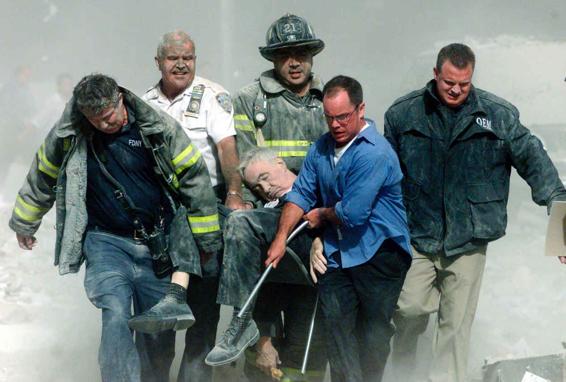
John Maguire: We carried him to a street corner and laid his body on the sidewalk. I pushed on his chest with a thought of starting CPR. No response. We folded his hands and covered his face with a jacket.
Jose Rodriguez, officer, NYPD: We knelt down. I grabbed Father Judge’s hand. He was already dead. Lieutenant Cosgrove put his hand on Father Judge’s head and we said an Our Father.
Friar Michael Duffy: The firemen took his body. Because they respected and loved him so much, they didn’t want to leave it in the street. They quickly carried it into St. Peter’s Church. They went up the center aisle, and they put the body in front of the altar. They covered it with a sheet. On the sheet, they placed his stole and his fire badge.
Monsignor John Delendick, chaplain, FDNY: They told me Mychal Judge’s body was in St. Peter’s Church. I went up there—I had to walk around a bit to do that—and they had him lying in state, almost, in front of the altar. I prayed a little bit.
Friar Michael Duffy: Mychal Judge’s body was the first one released from Ground Zero. His death certificate has the number “1” on the top.
James Hanlon, former firefighter, FDNY: The first official casualty of the attack.
Craig Monahan, firefighter, Ladder 5, FDNY: I think he wouldn’t have had it any other way. It was as if he took the lead—all those angels, right through heaven’s gates. That’s what it seemed like to us. If any of those guys were confused on the way up, he was there to ease the transition from this life to the next.
“Nobody is coming to get us”
Around the Towers
Inside the North Tower the remaining rescuers and building occupants realized they, too, faced immediate peril as they learned that the South Tower had collapsed.
Capt. Jay Jonas, Ladder 6, FDNY: The emergency power came up and the lights came on. I looked at [fellow firefighter] Billy Burke and I said, “What was that?” I said, “Billy, you go check the south windows, and I’ll go check the north windows and we’ll meet back here.” I couldn’t see anything when I went to my window. All I could see was white dust pressed against the glass. We met back at the stairway and I expected Billy to tell me that something happened with our building. With a straight face, he looked at me and says, “The South Tower’s collapsed.”
John Abruzzo, staff accountant, Port Authority, North Tower, 69th floor: When we got to the 20th [floor], I remember hearing a rumble. We knew it didn’t sound good. We knew we had to get out of there and not stop for anything.
David Norman, officer, Emergency Service Unit, Truck 1, NYPD: Our colleague at the command post, Kenny Winkler, came over the radio and told us that the South Tower had collapsed. Now I know this sounds a little silly, but if you didn’t see that footage on TV, and you were locked in a room that doesn’t have any windows, when somebody tells you a 110-story building is gone, you want to say to them, “Are you sure?” We communicated some message like that to Kenny, like, “Are you sure?” I think I may have even said, “Calm down,” to him, “relay that message again.” He came back very boldly: “There’s nothing left of the building! You need to get out of there! Your building is in imminent danger of collapse!”
Capt. Jay Jonas: My mind was exploding. I knew from all my studies that a high-rise building had never collapsed before. Now the sister one to the one I was in had collapsed. You start doing the math.
Sharon Miller, officer, PAPD: I said to the chief, “Hey, Chief. This building is coming down next.” He goes, “We’re going up a couple more and then we’re getting outta here.”
Capt. Jay Jonas: I had this terrible feeling that, Man, we’re not going to make it out of here. We’re on the 27th floor. We’re in no-man’s-land. It’s going to be hard to get out of here. In addition to that, I had this feeling, Jeez, I wonder how many firemen died? That was the linchpin that said, All right. This is no longer a doable mission for us. It’s time to get out of here. I looked at my guys and said, “If that one can go, this one can go. It’s time for us to get out of here.” They were a little—not standoffish—but they were like, “You mean we’ve got to go downstairs now? We climbed all this way for nothing?” I says, “Come on. Let’s go. It’s time to get out of here.” I told them to keep their tools with them, because the first thought might be, “Well, let’s jettison everything and go.” I says, “No, you keep everything.” As it turns out, it was good that we did.
Det. David Brink, Emergency Service Unit, Truck 3, NYPD: I wanted to go. I had just survived the first collapse, and I was like, All right. I really don’t want to go through that again. The South Tower was on fire, obviously, and in ruins on the ground. We saw a lot of civilians. I thought to myself: Well, these are the people that we’re here to help. We can’t abandon them now.
David Norman: We felt that we were no longer part of the solution. We were now part of the problem.
Lt. Gregg Hansson, Engine 24, FDNY: I remember turning to the lieutenant in Ladder 5, Mike Warchola, and telling him, “Just heard a Mayday to get out of the building. We’re all leaving.” None of us were really in a hurried state at that point because on the 35th floor everything was as calm as could be.
Sharon Miller: I had a bunch of firemen behind me. You could hear their radios crackling. “Holy this!” and “Holy that!” And “Two just came down—One’s comin’ down next. Mayday, Mayday!” When PAPD Chief [James] Romito heard “Mayday!” that’s when he said, “All right, let’s go. We gotta get outta here.” We were at the 31st floor, 32nd floor, and we all turned around and started coming down.
John Abruzzo: We made it out to the West Street entrance. There was glass all over the place. They had to lift the chair physically off the ground to carry me out into the street. They put me down to rest. It took an hour and a half to get from the 69th floor down to street level. If it weren’t for the evacuation chair and the 10 people who brought me down, I would not have made it.
* * *
Pasquale Buzzelli, engineer, Port Authority, North Tower, 64th floor: We were the only people on the 64th floor of the North Tower. It wasn’t until we felt the building shake and vibrate that we started questioning, “Okay. Now this is getting more serious.”
Louise Buzzelli, Riverdale, New Jersey, wife of Pasquale Buzzelli, Port Authority, North Tower, 64th floor: The second building to get hit started to crumble and come down. I kept thinking: That building is just like his building.
Pasquale Buzzelli: Steve and I looked at each other and he said, “What the fuck are we still doing here? Let’s get the fuck out.” We gathered up rags that we wet, flashlights, whatever we could find, not knowing what we’d encounter on the way down. We formed a line and got ready to leave. We took a head count: 16. I was in the front, not because I was leading or anything. It happened to be where I was standing. Then Pat said, “All right. Let’s go.”
Genelle Guzman, office assistant, Port Authority, North Tower, 64th floor: Finally we decided to go down the staircase. My friend Pasquale was leading the way. I held on to [my coworker] Rosa’s hand. She was holding on to me. She was crying. I didn’t cry for some reason. I was trying to comfort her.
Pasquale Buzzelli: We encountered some firemen sitting on the stairs. They were tired and sweaty with their gear. They said, “Keep going straight down. Keep moving.” I don’t think their radios were working. If they had known themselves that Tower Two had collapsed, they would have been going down the stairs with us too. Instead they were going up.
Louise Buzzelli: I’m praying that I hear the phone ring and it’s him, and he’s going to tell me that he’s out and he’s somewhere on his way across the river or somewhere away.
Genelle Guzman: Pasquale kept making a couple of stops to ask, “Are you guys OK?” We kept saying, “Yes, we’re doing fine.” We kept walking and walking and kept counting the staircases because they had the number written on the columns. I was trying to tell Rosa, “We’re almost there.” I was wearing high-heeled shoes, so she was telling me, “Do you want to take your shoes off?” I’m like, “No, I’ll be all right. I’m doing OK.” My feet were killing me going down the stairs, and I wanted to stop but didn’t want to lose a minute.