“Something wasn’t right”
The First Collapse
At 9:59 a.m. less than an hour after it was the second building hit, the South Tower, weakened by fires fueled by thousands of gallons of jet fuel, collapsed.
Dan Potter, firefighter, Ladder 10, FDNY: I ran into the Engine 10 firehouse, at the base of the World Trade Center, and Captain Mallory grabbed me and said, “Sign into the book, because it’s total recall, they’re calling all firefighters back here.” I remember signing the book and putting on my gear. Other firefighters were also starting to run in now. One of them was Pete Bielfeld—I figured he and I would team up. As we go toward the front of the firehouse, I said, “Pete, let me go grab a tool first. Stand here. Let me go grab a rescue tool.” I turned around, ran back for that. He didn’t wait for me. As I was going out the front [of the firehouse], there was a firefighter standing in the door. I don’t know who he was. I remember him standing there, looking up, and he saw the top of the tower twist. As I was going by, he clotheslined me—he sticks his arm out and it catches me. He goes, “Holy shit, here it comes.”
Dan Nigro, chief of operations, FDNY: No one has heard a high-rise building collapse before, but as soon as I heard it, I knew what it was.
Donna Jensen, resident, Battery Park City: It was this rat-tat-tat-tat-tat-tat-tat-tat, this snapping sound in perfect rhythm, this loud, cracking, snapping sound.
John Cartier, brother of James Cartier, electrician, who was working in the South Tower: At first, it was a faint sound, and then it came closer and closer.
Capt. Sean Crowley, NYPD: We’re talking to [NYPD officer] Glen Pettit at the intersection of Liberty and West when we hear a rumble.
Edward “Eddie” Aswad Jr., officer, NYPD: I’m looking at the building, and Sean’s facing me. The next thing you hear is, “It’s going!” I look up and see this black cloud of smoke.
Capt. Sean Crowley: I was looking away from the building, toward Eddie. I saw his face, and he goes, “Fucking run,” or something like that. He turned around and ran toward where our cars were parked, which was right in front of Three World Financial Center, underneath the walkway. I never saw Glen again.
William Jimeno, officer, PAPD, inside the lobby of the South Tower: Everything started shaking. I looked back toward the lobby, and I saw a fireball the size of my house coming. Sergeant [John] McLoughlin yelled, “Run!” I said to myself, What did I get myself into? As I was running, I could see a light in front of me. I remember thinking, in a split second, Wow, I should run toward the light, maybe it will take me outside. Then I remembered we promised we would not leave each other. I saw Dominick run, he turned to the left, so I started to follow him. At that point, all I felt was my body go up in the air and get slammed.
John Cartier: The sound was so deafening.
Michele Cartier, Lehman Brothers, North Tower, 40th floor: This high-pitched sound, and I didn’t know what that was, but it was so eerie, like your fingernails-on-a-chalkboard type of thing.
Bruno Dellinger, principal, Quint Amasis North America, North Tower, 47th floor: I heard a sound that today I cannot remember. It was so powerful, such a huge sound that I blocked it. It scared me to death. I blocked it, and I cannot bring it back up to consciousness.
Howard Lutnick, CEO, Cantor Fitzgerald, North Tower: The loudest sound I’d ever heard.
Gregory Fried, executive chief surgeon, NYPD: I can’t even give you an analogy.
Bill Spade, firefighter, Rescue 5, FDNY: Like six or eight subway cars pulling into the station at the same time with their brakes.
Det. Steven Stefanakos, Emergency Service Unit, Truck 10, NYPD: Like a thousand freight trains crashed.
Kenneth Escoffery, firefighter, Ladder 20, FDNY: Like an incoming missile.
James Dobson, paramedic: Like an avalanche.
Gulmar Parga, marine engineer, fireboat John D. McKean, FDNY: Like a giant chandelier, all the glass breaking.
Catherine Leuthold, independent photojournalist: Like 30,000 jets taking off.
Sharlene Tobin, financial consultant, One New York Plaza: Like a machine gun.
Joe Massian, technology consultant, Port Authority, North Tower, 70th floor: A pop and then a sift—like taking a bag of sugar and pouring it into a container.
Al Kim, vice president of operations, TransCare Ambulance: I told everyone, “Incoming! Run!”
Constance Labetti, accountant, Aon Corporation, South Tower, 99th floor: We really thought that the end of the world was upon us.
* * *
The collapse of the South Tower instantly trapped guests, staff, and rescuers inside the Marriott Hotel, located between the Twin Towers, as wreckage pounded the roof.
Frank Razzano, guest, Marriott Hotel: I was standing there watching the TV. I said to myself, Jesus Christ, if I leave this building today without my stuff, they’re never going to let me back in this building tonight. I started packing all my documents and getting everything ready to go, thinking, I wonder if I can get a bellman to come up and help me take all this stuff down? At that point the building shook, as if you were in an earthquake. I looked out the window, and what had been a bright sunny day suddenly turned pitch black. It was as if a curtain of concrete and steel had come falling down, like the curtain at a play. I could literally see it coming down, past the window—almost in slow motion—turning everything pitch black.
Jeff Johnson, firefighter, Engine 74, FDNY: The entire building started to shudder. It was lights out. I fell down.
Frank Razzano: It was as if the building was being hit by artillery fire. You could feel the building breaking up around you.
Jeff Johnson: We immediately called for the other members of our crew. It’s a military thing. We called, “Pat?” “Yeah.” “John?” “Yeah.” “Lieu, it’s Jeff.” We had us four, and then we called Ruben, and we didn’t get an answer. We kept screaming, “Ruben? Ruben?”
Frank Razzano: I yelled out into what was left of the hallway, “Is anybody there?” I hear a voice that said, “Come this way.” The room was located almost right next to the fire staircase. Right at the base of the doorjamb, in some rubble, was a New York City fireman. I learned later that his name was Jeff Johnson. I said, “Are you okay?” He said to me, “Are you okay?” I said, “Yeah, I’m fine. How are you? Is there anything I can do to help you?” He said, “No, I’m fine. I want you to go down the fire stairs.”
Jeff Johnson: Immediately in front of us was a complete wall of debris.
Frank Razzano: When I got to the fourth-floor landing and began to walk down the stairs to where the third-floor landing would be, it was blocked with rubble. I began trying to move rubble away and create an opening. I got enough rubble out of the way that I could squeeze through. On the third-floor landing were three men and the banquet manager of the hotel.
Jeff Johnson: We gave immediate “Maydays” on the radio that as a unit we were missing a member. Nobody was answering us. We did hear somebody calling out on the radio a “Mayday.” He was a fireman, and he didn’t know where he was. “I’m trapped, but I don’t know where I am.” That’s the most heart-wrenching and worst-case scenario.
Frank Razzano: Within a few minutes, Jeff Johnson came down. He was with another fireman now, that he had met coming down the stairs. Jeff looked around. An I-beam was leaning up against the landing on the third floor and was wedged on a ledge on the second floor. Jeff climbed down the I-beam, walked along the ledge, came back, and yelled up to us, “Each of you are going to have to climb down the I-beam and walk along the ledge and go back into the building. We have got to find a way out.”
I also recall him saying, “Look, nobody’s coming. Nobody is coming for us. Any of the firemen or rescue people who are tasked at getting people out of the building—they are dead. If they were in the street, they are dead. If they were in the buildings, they are dead. Nobody is coming to get us. We have to get out on our own.”
* * *
The unprecedented collapse—the first time a high-rise building had ever fallen—was witnessed by millions around the world, on television, and in person across the New York region, including by those who had already evacuated from the World Trade Center and Lower Manhattan.
Beverly Eckert, wife of Sean Rooney, VP of risk management, Aon Corporation, South Tower, 98th floor: I suddenly heard this loud explosion through the phone. It reverberated for several seconds. We held our breath. I know we both realized what was about to happen. Then I heard a sharp crack, followed by the sound of an avalanche. I heard Sean gasp once as the floor fell out from underneath him. I called his name into the phone over and over.
Cathy Pavelec, administrator, Port Authority, North Tower, 67th floor: I ran into a woman on the street who I knew from my office, Denise. We started up the ramp to go to the Brooklyn Bridge, but then I saw all these fighter planes. I didn’t know if they were ours or not. I said to Denise, “We can’t go on a bridge. We can’t go on a landmark.” I really thought that the planes belonged to somebody other than us. We turned around to get off the bridge. We heard a noise, we looked up, and we saw Tower Two collapse.
Robert Small, office manager, Morgan Stanley, South Tower, 72nd floor, now on the Brooklyn Bridge: It looked like a Fourth of July sparkler. It swayed to one side and fell within itself. Then it was gone. You can see the glitter from the metal and the glass as this big gray cloud formed.
Michael McAvoy, associate director, Bear Stearns, Brooklyn: In seconds, it was gone. People screamed again. I looked at my coworker Brian and said, “Holy shit, 20,000 people just died.”
Monica O’Leary, former employee, Cantor Fitzgerald, North Tower: I remember standing there with my neighbor John, saying, “Where the hell did that go? Where the hell did that go? Where did the building go? Where’d they go?”
Judith Wein, senior vice president, Aon Corporation, South Tower, 103rd floor: My heart dropped. I thought of everybody who was still up there. It was their end.
Melinda Murphy, traffic reporter, WPIX TV: When the building fell it became a personal story for me because my husband worked a couple of blocks away. It became, “Oh my God, my husband may not be alive.” On camera, I was fine. As soon as they told me I was clear, I was a mess.
Peter Jennings, anchor, ABC News: We went into silent mode. It was not necessary for us to add our own anxiety or shock. It was all evident for everybody. Throughout my entire career, I have always been conscious that there are times when some people on television talk too much. Silence or natural sound on occasion is infinitely more powerful and relevant.
Aaron Brown, anchor, CNN: The hardest words I’ve ever spoken on TV in 25 years were these: “The United States is under attack.” It took me too long, perhaps a half hour too long, to utter those words. They were there, I assure you. I knew what it was.
Cathy Pavelec: We stood there for a minute and then the cloud started to come after us. For the first time that day, I really thought we were going to die.
Richard Grasso, chairman and CEO, New York Stock Exchange: When the South Tower was coming down, my head of security came racing across the floor. He was uncharacteristically shaken. He said, “We’re learning the city’s gone code black.” Which means the mayor’s dead, the police commissioner’s dead, and the fire commissioner’s dead. At that point, I turned to my colleague and said, “Ring the bell—we’re closed.”
“This is not my day, I’m not dying here”
Inside the Cloud
The South Tower collapsed at an estimated speed of nearly 124 miles an hour, and later estimates held that the winds generated from the collapse of the World Trade Center peaked as high as 70 miles per hour, driving the accompanying cloud of debris scores of blocks away as the hurricane-force wind spread devastation throughout Lower Manhattan.
Rudy Giuliani, mayor, New York City: I heard someone yell, “The tower is coming down.” I heard a big noise, saw the desk shaking. My first impression of “The tower is coming down” was that the radio tower on the top of the building had come down. I certainly didn’t have the impression that the whole building had come down.
Rosmaris Fernandez, student, HSLPS: I could not believe that the World Trade Center was coming down. I stared at the buildings coming down in amazement until I came to my senses and realized that it was time to run.
Ada Dolch, principal, HSLPS: That was the moment when I said, “OK, this is the end.” I saw this tsunami wave of dust and debris coming in our direction. It was coming fast. It felt like pins and needles on your back. It was beyond frightening.
Heather Ordover, English teacher, HSLPS: I remember seeing the solid-as-a-wall smoke coming down Trinity Place right at Battery Park.
Jean Potter, Bank of America, North Tower: I remember thinking, Maybe I am going to die. Maybe it is my time. How do I outrun this? I was in such a state of shock. A police officer took me by the hand and dragged me into a subway station—the Dey Street subway station—and we kept going deeper and deeper.
Dan Potter, firefighter, Ladder 10, FDNY: There was a blue tarp out in front of the firehouse—I guess they were going to use it for triage. There was a Chinese man on it, and he had a broken leg. When the Towers started coming down, I grabbed him as best I could and started pulling him back.
Det. David Brink, Emergency Service Unit, Truck 3, NYPD: We went under one of the overhangs by Building Six. It was like when you were doing one of those school drills back in the day with the nuclear threats from Russia. They would tell you to duck and cover and go under your school desk. The only thing we really had to duck and cover under was these overhangs.
Howard Lutnick, CEO, Cantor Fitzgerald, North Tower: I looked over my shoulder, and there was this big, giant, black tornado of smoke chasing me. I dove under a car, and the black smoke went foosh.
Jan Khan, New York Metropolitan Transportation Council, North Tower: A hurricane-type wind blew us to the floor.
Lt. Joseph Torrillo, director of fire education safety, FDNY: As I was running that air caught the back of my helmet, and I saw my helmet fly away. My helmet was flying faster and higher, and I could see it as I was running. It was like The Wizard of Oz. At that point, as the building came down lower and lower, the air pressure was so strong—they estimate almost like a tornado force—the air pressure lifted me off of my feet and I was flying through the air.
Tracy Donahoo, transit officer, NYPD: It hit so hard I went flying. I don’t know how far I went, I went flying—I could feel myself in the air. I landed on my knees and on my hand. It was dark. It was so black in there. You couldn’t see anything and I couldn’t breathe. I was choking.
Ian Oldaker, staff, Ellis Island: The smoke came right up the street, like fingers. It was really gray and dirty. We couldn’t see the Towers, so we didn’t know what had fallen.
Linda Krouner, senior vice president, Fiduciary Trust, South Tower: There was this gigantic cannonball of dust approaching me along these streets. I started running because I wanted to avoid this gargantuan ball of debris approaching me—a little bit like the Indiana Jones cannonball.
Joe Massian, technology consultant, Port Authority, North Tower: My fear was that the buildings would begin to domino, and I’d get caught between the two dominoes. I believe my picture was taken right when I passed the church. You can see the tree line in the photo.
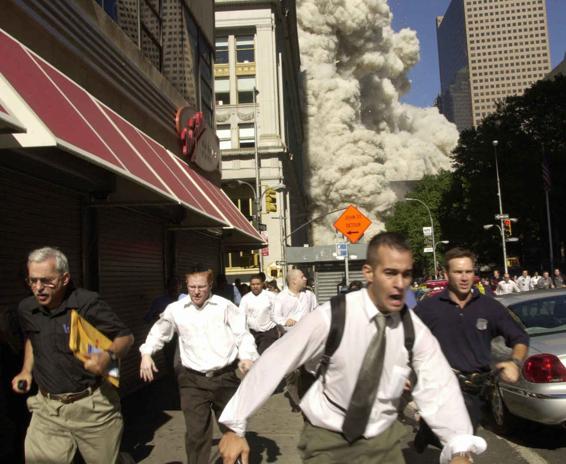
Gregory Fried, executive chief surgeon, NYPD: Your brain couldn’t adjust to the concept of the World Trade Center coming down on you.
Ian Oldaker: We started running south. We ran right up to the water. There’s a guardrail there—a big iron handrail. A lot of people ran up with us. There were a couple of hundred people right on this handrail. You’re looking in, and you’re looking down, and it’s, “Hudson. Smoke. Hudson. Smoke.” A lot of people looked down really temptingly at that water.
James Filomeno, firefighter, Marine 1, FDNY: We were docked near the pier. I was watching people running toward us like a herd of cattle. I watched debris coming down on them. People were jumping headfirst onto the deck and screaming. People were trying to hand me their kids: “Take my baby. I don’t want to stay here. Take the baby.” People fell in the water. It was horrible.
James Cowan, Harbor Unit, NYPD: We were yelling for people in the water to answer us. There were dozens of people in the water.
Vanessa Lawrence, artist, North Tower: I only just got out of the building when it was coming down. I started running across the road to the subway, and the big blast came up. As soon as I put my foot down on the sidewalk, the building was down, and I couldn’t see anything.
Chief Joseph Pfeifer, Battalion 1, FDNY: I heard all the crashing and the steel and then the street went totally black. As a firefighter, you expect blackness inside a burning building. Outside in broad daylight, you don’t.
Bruno Dellinger, principal, Quint Amasis North America, North Tower: In about five seconds, darkness fell upon us with an unbelievable violence. Even more striking: there was no more sound. Sound didn’t carry anymore because the air was so thick.
Melinda Murphy, traffic reporter, WPIX TV, airborne over New York Harbor: This incredible dust cloud came up, and it looked like all of Lower Manhattan was gone.
Dan Potter, firefighter, Ladder 10, FDNY: Then it started—the rain of the debris. Everything hitting around you. I dove to the floor, covered myself up. I figured: This is it. The force buckled the metal doors of the firehouse. They blew out every window. The ambulance that was up in the front there was crushed.
Dr. Charles Hirsch, chief medical examiner, City of New York: The pummeling by debris seemed to go on forever. It was probably a minute or so.
Edward Aswad Jr., officer, NYPD: I could feel stuff going up my legs, the soot and the debris.
Lt. Joseph Torrillo, director of fire education safety, FDNY: I got hit over the head with a piece of steel, and my whole head was split open. Huge chunks of concrete were hitting my body. Every time another chunk hit me, I could hear my bones snapping.
William Jimeno, officer, PAPD: I felt a lot of pain, I grabbed my helmet, and I grabbed for my radio, which was on my left lapel, and I was yelling “8-13!,” which is Port Authority police code for “officer down.” “8-13! 8-13! Officers down! 8-13! Jimeno, we’re down! Our team is down!” We were getting pummeled with debris. I was trying to fight for my life. At one point, something hit my left hand, my radio went flying. A big piece of concrete must have hit my helmet, it came flying off—ripped the chin strap right off—and I covered my head. As fast as this was happening, it ended.
Sgt. John McLoughlin, PAPD: I thought I had died. I lost all sense. I had no sight. I had no smell. I had no hearing. Everything was just silent.
Al Kim, vice president of operations, TransCare Ambulance: I was burning. I remember being really hot, like head to toe, like, This is bad, really bad—like hotter than a sauna or steam room. My shirt was gone. It was all ripped and burned. I lost all my nostril hair. I lost a part of my eyebrows and all my eyelashes were gone too.
Elia Zedeño, financial analyst, Port Authority, North Tower, 73rd floor: I tripped over something, and I ended up on top of somebody, a police officer. He was screaming, “My eyes are burning!” and at the same time telling me, “Don’t worry, everything is going to be fine.” I think that is the mind of somebody who is trained like this. He was screaming—I am talking about screaming—and at the same time saying, “Well, don’t worry, everything is going to be fine, we are getting out of here.”
Capt. Sean Crowley, NYPD: I’ve never heard screaming like I did on that day. It was all men. It was unbelievable screaming. I’m thinking about how I’m probably going to die and about my kids.
Tracy Donahoo, transit officer, NYPD: People were screaming. I was screaming, “Shut up! Shut up! Shut up!” Everyone calmed down. I was like, “I’m a police officer, we’re gonna get outta here!” I don’t know how far my voice can carry in there, and I didn’t know if we were really encapsulated in cement and would never get out.
Vanessa Lawrence: I remember at one point feeling amazingly calm. It always feels strange to say this, but I thought I couldn’t breathe anymore, and I actually got really, really calm, and went, Okay. It’s fine. I can’t breathe anymore and this is okay. Then I got this feeling in my stomach that went, No, you can do it. You can do it. Do it. I got this boost again and it was, Okay, I can fight this—I can. That was one of the strangest feelings of them all, that calmness of going, I give up, but then that pound in my stomach.
I also then felt this arm beside me, and this voice. I clung hold of it, and this voice says, “We’ve got to wait till it settles.” I remember turning and looking, and he’d got his coat and put it over us both and then I saw his badge and it was a fireman. I remember grabbing tight hold of him. The power of it—having somebody there beside me—helped me.
Tracy Donahoo: In the academy, they said, “If you think you’re gonna die, you’re going to die.” So I’m not gonna die here. This is not my day, I’m not dying here.
Lt. Joseph Torrillo: I was buried under the South Tower. I can’t breathe. I’m suffocating. It’s darker than midnight. I could see nothing.
Det. Sgt. Joe Blozis, crime scene investigator, NYPD: After the building collapsed, there was a calmness that I’ll never forget. When the dust cloud came, you heard nothing and you saw nothing.
Monsignor John Delendick, chaplain, FDNY: People I was standing with were all of a sudden dead. I looked one way, and they went another way and didn’t make it out.
Tracy Donahoo: I was thinking of my family, and I was thinking of my annoying little puppy I had at home that was driving my mother crazy, and I was like, She’s gonna kill me, being stuck with this dog.
Elia Zedeño: I was trying to breathe, and I was trying to spit out what I had in my mouth, but I couldn’t, so I had to dig my hand in. I dug my hand into my mouth and pulled out a lot of stuff. I was going to be able to breathe, but the moment that I pulled the stuff out, more stuff came in.
Capt. Sean Crowley, NYPD: Picture taking a handful of flour and sticking it up your nose and in your mouth. That’s what breathing was like.
Elia Zedeño: There were these desperate moments. I couldn’t breathe. I kept digging, and digging, and digging, and digging, until my mouth, until the dirt started to settle a little bit, and I was able to get that first breath.
Heather Ordover, English teacher, HSLPS: I crouched next to a man with a green-striped Oxford cloth shirt. I helped him cut it with my Swiss Army knife scissors so he could put a piece over his nose and mouth. We shared water.
Ada Dolch, principal, HSLPS: Everyone kept saying you had to put water on tissues or on a piece of cloth, wash your face, or put something over your mouth so you don’t breathe in that smoke.
Heather Ordover: I caught up to a police officer: “Do you know where we’re going?” He said, “No, Staten Island Ferry?” “Have you been trained for this kind of thing?” Half-laugh. “Sort of.”
Ada Dolch: I felt like I was choking. I got up, and I could take tiny little bits of swallow—I couldn’t do a deep swallow because it hurt. A man said, “You have to take water and spit.” I didn’t have water, but I remember saying to him, “I’m the principal, I don’t spit.” You teach the kids that’s not what you do. He said, “You need to take water and you need to gargle.” He was standing by an old antique water fountain in the park. I took water. I spit. I cleaned my throat. I spit.
Rosmaris Fernandez, student, HSLPS: The air cleared out a little. I found a couple of my friends, and I felt less worried. I knew that I was not alone anymore. A teacher from the nearby High School of Economics and Finance asked every student to follow him to the Brooklyn Bridge and so we did. I then lost him and kept on walking north on the FDR Drive.
William Jimeno, officer, PAPD: There was a lot of dust. I looked up, and about 30 feet above me I could see light coming in—apparently there was a hole there. I started feeling a lot of pain on my left side. I could see a big thick wall of concrete on me. I was trying to get my bearings, but I couldn’t really see. That’s when I heard Sergeant McLoughlin say, “Sound off! Where is everybody? Sound off!” Dominick Pezzulo was buried to my left in a push-up position. Dominick said, “Pezzulo!” I said, “Jimeno!” That’s all we heard. For the next two minutes, I would yell, “Chris!” for Christopher Amoroso. And “A-Rod!,” which was Antonio Rodrigues’s nickname. “A-Rod! Chris! A-Rod! Chris!” That’s when Dominick said, “Willy, they’re in a better place.”
“Sir, authority to engage?”
Inside the PEOC
Underneath the North Lawn of the White House, the vice president and assembled aides attempted to comprehend the crisis from inside the Presidential Emergency Operations Center, a.k.a. the White House bunker, and tried to figure out how many more hijacked planes were in the air. They knew of at least one: United Flight 93.
Mary Matalin, aide to Vice President Dick Cheney: We saw [on TV] the building collapse.
Commander Anthony Barnes, deputy director, Presidential Contingency Programs, White House: There was a deafening silence, and a lot of gasping and “Oh my god” and that kind of thing.
Mary Matalin: Disbelief.
Commander Anthony Barnes: There are four or five very large, 55-inch television screens in the PEOC. We would put the different news stations—ABC, CBS, Fox, NBC—on those monitors. I remember Cheney being as flabbergasted as the rest of us were, sitting there watching on these monitors. Back in those days, a 55-inch TV monitor was a really big TV. It was almost bigger than life as the Towers collapsed.
Dick Cheney, vice president: In the years since, I’ve heard speculation that I’m a different man after 9/11. I wouldn’t say that. But I’ll freely admit that watching a coordinated, devastating attack on our country from an underground bunker at the White House can affect how you view your responsibilities.
Mary Matalin: We had to go right back to work.
Richard Clarke, counterterrorism adviser, White House: Many of us thought that we might not leave the White House alive.
Matthew Waxman, staff member, National Security Council, White House: One of the things we were all very conscious of down in the PEOC was that the White House Situation Room was staffed with our close colleagues and friends who were staying in those spots despite a clear danger. The Situation Room, which is only half a floor below ground, was abuzz with activity. Some of the colleagues who continued to work in it were people who wouldn’t normally be posted there, but they felt a responsibility to stay there to help manage the crisis. Especially early in the day, there was a palpable sense that close friends and colleagues might be in some significant danger.
Ian Rifield, special agent, U.S. Secret Service: There was a sense of frustration too, because we were sitting there. Everybody wanted to fight back. We’re trained to go to the problem, and we were sitting there. There was a lot of tension in that regard. You wanted to do something to protect the complex and the Office of the President even better than we were, but we were doing the best we could with what we had.
Condoleezza Rice, national security adviser, White House: Norm Mineta, the transportation secretary, was tracking tail numbers of the aircraft on a yellow pad. He was calling out: “What happened to 671? What happened to 123?” He was trying to make sense of what was going on.
Nic Calio, director of legislative affairs, White House: Norm Mineta was sitting in front of these TV screens that had all these planes on them. It was pretty remarkable when you saw the number of planes in the air.
Condoleezza Rice: My first thought was, Get a message out to the world that the United States of America has not been decapitated. These pictures must have been terrifying. It must have seemed liked the United States of America was coming apart. My test was to keep my head about me and to make certain that people around the world didn’t panic.
Nic Calio: The activity was so high and things were happening so quickly, at least for me, there wasn’t any time to be afraid.
Matthew Waxman: There was this stark contrast between the chaotic information bombardment about what was happening around Washington, around the country—some of it accurate, some of it inaccurate—and the calm and careful deliberation of a lot of the senior decision makers.
Nic Calio: The vivid memory I have was we were in this cocoon—receiving and sending all this information, at the same time not knowing where our families were. It was probably midafternoon before we were able to try and contact our families. That was worrisome. I didn’t know where my kids were. There was an overriding uncertainty about what was going on, what would actually happen, and what would have to follow.
Col. Bob Marr, commander, NEADS, Rome, New York: We were in foreign territory; we are used to protecting the shores, way out overseas. Our processes and procedures weren’t designed for this.
Maj. Gen. Larry Arnold, commander of the 1st Air Force, NORAD, Tyndall Air Force Base, Florida: We can’t see the aircraft. We don’t know where it is because we don’t have any radars pointing into the U.S. Anything in the United States was considered friendly by definition.
Lt. Heather “Lucky” Penney, F-16 pilot, D.C. Air National Guard: Our chain of command didn’t go up to NORAD, didn’t go up through the 1st Air Force, which oversaw operations in the United States. They had no method to be able to reach down—or even be able to know that the D.C. National Guard was there and available. There were no rules of engagement. I hadn’t even thought about what that kind of mission might be like on American soil.
Commander Anthony Barnes: I was running liaison between the ops guys who had Pentagon officials on the phone and the conference room where the principals were. The Pentagon thought there was another hijacked airplane, and they were asking for permission to shoot down an identified hijacked commercial aircraft. I asked the vice president that question and he answered it in the affirmative. I asked again to be sure. “Sir, I am confirming that you have given permission?” For me, being a military member and an aviator—understanding the absolute depth of what that question was and what that answer was—I wanted to make sure that there was no mistake whatsoever about what was being asked. Without hesitation, in the affirmative, he said any confirmed hijacked airplane may be engaged and shot down.
Col. Matthew Klimow, executive assistant to the vice chair of the Joint Chiefs of Staff, Gen. Richard Myers, Pentagon: No one had ever contemplated the need to shoot down a civilian airliner.
Maj. Gen. Larry Arnold: I told Rick Findley in Colorado Springs [at NORAD’s headquarters], “Rick, we have to have permission. We may have to shoot down this aircraft that is coming toward Washington, D.C. We need presidential authority.”
Maj. Dan “Razin” Caine, F-16 pilot, D.C. Air National Guard: I handed our wing commander the phone to talk to the high levels of government to get the rules of engagement.
Dick Cheney: It had to be done. Once the plane became hijacked—even if it had a load of passengers on board who, obviously, weren’t part of any hijacking attempt—having seen what had happened in New York and the Pentagon, you really didn’t have any choice. It wasn’t a close call.
Matthew Waxman: That really grabs you by the collar, when you hear the vice president giving the order to shoot down an unidentified aircraft flying toward the national capital. That stands out as one of the most frightening moments of the day, partly because it highlighted the sense of continuing danger. There was also the realization of the enormous dilemmas that faced decision makers at that moment with very little time and imperfect information.
Commander Anthony Barnes: I knew, without a doubt in my mind, that that was a historical precedent—that never before had we given permission to shoot down a commercial airliner. I got back on the phone—it was a general of some sort in the Pentagon—and on that secure line I was talking on, made sure that he understood that I had posed the question to the National Authority and the answer was in the affirmative. We made sure that we did not stutter or stumble because the emotion at that point was very, very high. Fortunately we didn’t have to use that authority.
Josh Bolten, deputy chief of staff, White House: Vice President Cheney was very steady, very calm. He clearly had been through crises before and did not appear to be in shock like many of us.
Commander Anthony Barnes: The president was safer aboard Air Force One than trying to come home, and Mr. Cheney—without question—he was in charge. He was in charge of the space and we would bring him information.
Dick Cheney: As bad as the events of 9/11 were, some of us had practiced exercises for far more dangerous and difficult circumstances—an all-out Soviet nuclear attack on the United States. That helped—that training kicked in that morning.
Eric Edelman, principal deputy assistant to the vice president for national security affairs, White House: He was a calming influence on people because you’d sort of be embarrassed to, in front of him, betray any sense of, Oh my God.
Condoleezza Rice: There were times that day that it felt like an out-of-body experience. But you keep functioning, even though you don’t really believe it’s happening.