“Is it War of the Worlds?”
Live, on Air
As radio and TV stations interrupted their regular programming with footage of New York, word spread nationally of the attacks and transfixed the country. It was a shocking way to wake up for those not on the East Coast, and uncharted territory for broadcasters covering the event.
Bob Edwards, anchor, All Things Considered , National Public Radio (NPR): I went into the studio and started doing our entire program live. I concentrated on words I was trying not to say. I didn’t want to use the word “terrorism.” I thought about the Oklahoma City bombing—how people speculated that Arabs were responsible.
Preston Stone, resident, North Dakota: I woke to a friend’s voice on my answering machine—his speech was halting and anxious, and he was saying something about a car bomb at the State Department. I learned about the attacks in-depth from NPR. Bob Edwards was hosting, and I clearly remember his long pauses in response to the scenes being described to him by reporters in the field.
Bob Edwards: I was also trying not to say things like “Holy shit!” In situations like this, your gut reaction is to use crude words that people say in everyday life, but you can’t say them into that microphone.
Anne Worner, resident, Texas: I was out for my morning walk. Just as I got back into the house, the phone rang. My girlfriend called in hysterics, saying, “We are at war, we are at war. Turn on your television!” Shaking, I went into the living room and turned on the TV. I cried and cried, sitting there watching the coverage.
Jason Fagone, resident, Ohio: I was on a long-distance cycling trip with some college friends that month, biking down the East Coast from Maine to Pennsylvania. We were somewhere in New England on the morning of September 11th. We happened to be close to a Best Buy, so we went there and watched the news on the TVs in the Best Buy. Every TV in the store was tuned to CNN or another live news feed, dozens of TVs showing the Twin Towers and the dark gray smoke. The employees let us sit on the floor and watch. They were watching too.
Rosemary Dillard, Washington, D.C., base manager, American Airlines, and wife of Flight 77 passenger Eddie Dillard: I arrived at my American Airlines management job at Ronald Reagan Airport and went to a meeting. Early in the meeting, we heard screams from the Admirals Club nearby. We went to see what the commotion was and returned to the meeting after seeing a sketchy TV news report. About 15 minutes later, we heard screams again and saw that United Airlines Flight 175 had hit the South Tower of the World Trade Center. The meeting was adjourned and I walked to my office.
Katie Couric, anchor, The Today Show, NBC: During a break when Matt [Lauer] was doing an interview, I ran into that back workspace and called my parents and told them to get into the basement. It felt like the world was coming to an end. I felt like, “Is it War of the Worlds?”
“Everyone’s pager started going off”
At Emma Booker Elementary School, Sarasota, Florida
A thousand miles south of New York, President George W. Bush had arrived at Emma Booker Elementary School in Sarasota, Florida. At 8:55 a.m. he began what he thought was going to be a quick stop before heading back to Washington for lunch and the evening’s congressional picnic at the White House.
Karl Rove, senior advisor, White House: We were standing outside the elementary school. My phone rang. It was my assistant Susan Ralston, saying that a plane had hit the World Trade Center—it wasn’t clear whether it was private, commercial, prop, or jet. That’s all she had. The boss was about two feet away. He was shaking hands. I told him the same thing. He arched his eyebrows like, “Get more.”
Dave Wilkinson, assistant agent in charge, U.S. Secret Service: Eddie Marinzel and I were the two lead agents with the president that day. The head of the detail was back in Washington. We heard, “There’s an incident in New York.”
Andy Card, chief of staff, White House: We were standing at the door to the classroom, when a staffer came up and said, simply, “Sir, it appears that a twin-engine prop plane crashed into one of the World Trade Center towers.” We all said something like “What a tragedy.” Then the principal opened the door and the president went into the classroom to meet the students.
Brian Montgomery, director of advance, White House: Mark Rosenker, the head of the White House Military Office, said to me, “Dr. Rice needs to talk to the president.” There was this group of students, all young ladies in uniforms, and teachers, all oblivious to all of this.
Natalia Jones-Pinkney, student, Emma Booker Elementary: Everyone had their hair done and new bows and everything.
Sandra Kay Daniels, second-grade teacher, Emma Booker Elementary: Our principal introduced him to the children, and he shook a couple of the kids’ hands and introduced himself, tried to lighten the room up a little because the kids were in awe. They were like little soldiers, quiet, struck by the sight of the president. He said, “Let’s get started with reading.” The story was My Pet Goat from our reading series.
Brian Montgomery: The president was very gracious and greeted them, and then said, “I need to go take an important telephone call.” He went into the holding room and went directly to the STU-III, the secure telephone.
Ari Fleischer, press secretary, White House: There’s always a secure telephone waiting for the president, but in the nine months he’d been president, I don’t think we’d ever used one before an event like that.
Dave Wilkinson: We’re asking ourselves, Is there any direction of interest toward the president? That’s the phrase, “direction of interest.” Or is this just an attack on New York?
Sandy Kress, senior education advisor, White House: I was back in the media room. There was some buzz about the first plane, people were watching it on a TV. Then there was a stampede across the media room as they saw the second plane hit.
Rep. Adam Putnam (R-Florida): I was brand new—a freshman congressman. We’d gone into the media center to wait for the president and the children to read together in the other room. We were clustered around the TV and watched the second plane hit.
Col. Mark Tillman, presidential pilot, Air Force One: We were all getting ready, based on the estimated departure time. All of us had already shown up at the plane.
Master Sgt. Dana Lark, superintendent of communications, Air Force One: There were two TV tuners, worldwide television tuners at my workspace on Air Force One. They were like old-school rabbit ears—UHF and VHF frequencies. We didn’t have the ability to tune into CNN, Fox, or anything else. It was the Today Show, the strongest signal that day, and they’re showing pictures of the Towers, smoke billowing out. I saw the second airplane strike. Oh shit. I dropped everything and ran downstairs to get Colonel Tillman: “You’ve got to come see this.”
Col. Mark Tillman: It didn’t make any sense. It’s a clear-and-a-million day.
Staff Sgt. William “Buzz” Buzinski, security, Air Force One: We protect the plane 24 hours a day, even after the president has left. One of the advance Secret Service agents had told us about the first plane. Then, about 17 minutes later, I saw the same guy sprinting across the tarmac. He said, “Another plane hit the Towers.” I knew instantly it was terrorism. We started to increase security around the plane—made it a tighter bubble.
Staff Sgt. Paul Germain, airborne communications system operator, Air Force One: Big airplanes just don’t hit little buildings. Then, as soon as that second plane hit, that switchboard lit up like a Christmas tree.
Col. Mark Tillman: Everything started coming alive. We were hooked into the PEOC—the White House bunker—and the JOC—the Joint Operations Center—for the Secret Service. They’re all in the link now.
Andy Card: I was thinking that we had White House people there—my deputy, Joe Hagin, and a team were in New York preparing for the UN General Assembly. I was thinking that Joe was probably at the World Trade Center—that’s where the Secret Service office was, in the basement.
Mike Morell, presidential briefer, Central Intelligence Agency: I was really worried that someone was going to fly a plane into that school. This event had been on the schedule for weeks, anyone could have known about it. Eddie Marinzel, the lead Secret Service agent, wanted to get the hell out of there as fast as possible.
Rep. Adam Putnam: There’s some debate within the staff that I can hear about how the president needs to address the nation. They’re saying, “We can’t do it here. You can’t do it in front of fifth-graders.” The Secret Service is saying, “You’re doing it here or you’re not doing it at all. We’re not taking the time to do it somewhere else.”
Dave Wilkinson: We’re beginning to get the motorcade up and running, getting the motorcycle cops back, we’re ready to evacuate at a moment’s notice. All of a sudden it hits me: The president’s the only one who doesn’t know that this plane has hit the second building. It was a discomfort to all of us that the president didn’t know. The event was dragging on, and that’s when Andy Card came out.
Andy Card: A thousand times a day, a chief of staff has to ask, “Does the president need to know?” This was an easy test to pass. As strange as it sounds, as I was standing there waiting to talk to the president, I was reflecting on another time that I’d had to be the calm one: I’d been acting chief of staff to President George H. W. Bush when he threw up on the Japanese prime minister. I was all business in that moment. He’d refused to get in the ambulance—he didn’t want anyone to see the president get in the ambulance—and in the limo, he’s still sick and he’s getting sick on me. In the hotel, I take out my laminated “in case of emergency” card. I went down my checklist. I was telling people, “He’s not dying, he’s still the president.” My job that day was to be calm, cool, and collected. Not the same magnitude, of course, but I knew my job on 9/11 was to be calm, cool, and collected.
Karl Rove: I remember Andy Card pausing at the door, before he went in, it seemed like forever, but it was probably just a couple heartbeats. I never understood why, but he told me, years later, that he needed to spend a moment formulating the words he wanted to use.
Ellen Eckert, stenographer, White House: There are six stenographers who work for the White House Press Office. One of us always travels with the president. I always said I typed fast for a living all over the world. That morning was uneventful until Andy walked in.
Andy Card: I knew I was delivering a message that no president would want to hear. I decided to pass on two facts and an editorial comment. I didn’t want to invite a conversation because the president was sitting in front of the classroom. The teacher asked the students to take out their books, so I took that opportunity to approach the president. I whispered in his ear, “A second plane hit the second tower. America is under attack.” I took a couple steps back so he couldn’t ask any questions.
Mariah Williams, student, Emma Booker Elementary: I remember him being all happy and joyful. Then his expression changing to very serious and concerned.
Lazaro Dubrocq, student, Emma Booker Elementary: I can remember seeing his expression change dramatically.
Andy Card: I was pleased with how the president reacted—he didn’t do anything to create fear.
Gordon Johndroe, assistant press secretary, White House: Having been in that room—and it wasn’t an issue until the Michael Moore documentary [Fahrenheit 9/11]—it would have been odd if he’d jumped up and ran from the room. It didn’t seem like an eternity in the room. He finished the book and went back into the hold room.
Karl Rove: When the president walked back into the staff hold, he said, “We’re at war—give me the FBI director and the vice president.”
Ellen Eckert: As we walked out of the classroom, everyone’s pager started going off.
Rep. Adam Putnam: Matt Kirk, our White House liaison, said to Rep. Dan Miller, the other congressman traveling with the presidential party, and me, “We might be the only plane back to D.C. today.” We went and got in our vehicle in the motorcade. You could see the windows and hatches of the motorcade open up, the visible expression of the armaments that are always around the president.
Karl Rove: Eddie Marinzel came up to the president—he was sitting in one of those tiny elementary school chairs—and Eddie said, “We need to get you to Air Force One and get you airborne.” They’d determined this might be an effort to decapitate the government.
Dave Wilkinson: We ended up with a compromise—Andy Card said we have a whole auditorium full, waiting for the next event. There was no imminent threat there in Sarasota, so we agreed the president could give a statement before we left.
Brian Montgomery: He went to the auditorium. I remember looking at the students when he said, “America is under attack,” and these girls, their faces were saying, What’s he telling us?
David Sanger, White House correspondent, New York Times : I’ll never forget the look on his face. He was ashen. He must have known his presidency had changed forever, that it would be measured from that moment forward by what he said, how he said it, and how well he could calm the nation.
Andy Card: He gave a very brief statement, he started off and I cringed right away. He said, “I’m going back to Washington, D.C.” I thought, You don’t know that. We don’t know that. We don’t know where we’re going.
Gordon Johndroe: I told the press we’d be leaving right for the motorcade. We had this joke, mostly with the photographers—no running. No running to catch the president. This time, I told them, “Guys, we’re going to have to run. We’re going to have to run to the motorcade.” Going down the highway, our 15-passenger van was barely keeping up.
Dave Wilkinson: The motorcade left there, and in a very aggressive fashion we got to the aircraft. Intelligence information is always sketchy. When we were riding was the first time we hear there’s something vague about a threat to the president. That ratcheted things up.
Rep. Adam Putnam: On the motorcade back, there are all these protesters—it was still all about the recount—signs like, “Shrub stole the election.”
Andy Card: In the limo, we were both on our cell phones—he was frustrated because he couldn’t reach Don Rumsfeld. It was a very fast limo ride.
Dave Wilkinson: We asked for double motorcade blocks at the intersection. Double and triple blocks. Not just motorcycle officers standing there with their arms up, but vehicles actually blocking the road. Now we’re worried about a car bomb. The whole way back, we were using the limos as a shell game, to keep the president safe.
Col. Mark Tillman: As the motorcade’s coming in, I’ve got the 3 and 4 engines already running.
Andy Card: When the limo door opened, I was struck that the engines on Air Force One were running. That’s normally a protocol no-no.
Buzz Buzinski: I was on the back stairs watching as they pull up, wondering, What’s the president thinking? What’s Andy thinking? You could feel the tension. We’d been attacked on our soil. You could see it on their faces—Andy Card, Ari Fleischer, the president.
Mike Morell: They re-searched everyone before we could reboard, not just the press. They searched Andy Card’s briefcase, he was standing right in front of me in line. They went through my briefcase—which was filled with all these classified materials—but I wasn’t going to object that day.
Eric Draper, presidential photographer: Andy Card said at the top of the stairs, “Take the batteries out of your cell phone. We don’t want to be tracked.” That brought up: “Are we a target?” I wasn’t thinking of that.
Col. Mark Tillman: President Bush comes up the stairs in Sarasota. We watched him come up the stairs every day with that famous Texas swagger. That day, no swagger. He was trucking up the stairs. As soon as the passengers are on board, I fired engines 1 and 2.
Rep. Adam Putnam: There was one van, maybe a press van, that was parked too close to the plane’s wing. I remember a Secret Service agent running down the aisle; they opened the back stairs, and he ran down to move the truck. He never made it back on board. They didn’t wait for him.
Andy Card: We were starting to roll almost before the president gets into the suite.
Arshad Mohammed, White House correspondent, Reuters: My notes say we took off at 9:54 a.m.
Gordon Johndroe: That thing took off like a rocket. The lamps were shaking because they’d fired up the engines so much.
Karl Rove: The pilot stood that thing on its tail—nose up, tail down, like we were on a roller coaster.
Ellen Eckert: We were climbing so high and so fast I started to wonder if we’d need oxygen masks.
Staff Sgt. William “Buzz” Buzinski: You could see fear and shock. People couldn’t believe what they had seen.
Col. Dr. Richard Tubb, presidential physician, White House Medical Unit: The people who are the permanent, apolitical staff—the medical unit, the flight crew, the military aide—they were all well-versed in their emergency action plans, irrespective of who the president was, but we didn’t have the relationship yet with the political staff. Over time, you build those relationships, and there hadn’t been that much time. That particular transition was so abbreviated, and ugly as the 2000 campaign was, it was even harder. Those guys were still trying to put their government together.
Andy Card: President Bush took office on January 20, 2001—but the responsibility of being president became a reality when I whispered in his ear. I honestly believe as he contemplated what I said, he realized, “I took an oath: Preserve, protect, and defend the Constitution. It’s not cutting taxes, it’s not No Child Left Behind, it’s not immigration, it’s the oath.” When you pick a president, you want to pick a president who can handle the unexpected. This was the unexpected.
Eric Draper: Soon after we got on board, I see the president pop out of the cabin. He’s heading down the aisle. He says, “OK, boys, this is what they pay us for.”
“That’s a strange accident”
First Reactions in D.C.
The attacks in New York interrupted business across Washington, D.C., as officials at the White House, on Capitol Hill, and elsewhere puzzled over what to make of the odd events unfolding up the East Coast.
Gary Walters, chief usher, White House: It was a little bit before 9:00 a.m. when Mrs. Bush came downstairs—I met her at the elevator. As we were walking out, I remember we were talking about Christmas decorations.
Laura Bush, first lady: My Secret Service agent, the head of my detail, Ron Sprinkle, leaned over to me as I got into the car and said, “A plane has hit the World Trade Center.”
Brian Gunderson, chief of staff for House Majority Leader Richard Armey (R-Texas): As we walked into our morning staff meeting, I could see on the TV screen—like any congressional office, there were a lot of TV screens around—that a plane had struck one of the World Trade Center towers. We assumed it was a small plane. I thought it was going to be more along the level of like a bad school shooting somewhere—the kind of event that dominates national news, but it doesn’t really change what Congress does that day.
Condoleezza Rice, national security adviser, White House: I thought, Well, that’s a strange accident. I called the president. We talked about how odd it was. Then I went down for my staff meeting.
Adm. James Loy, commandant, U.S. Coast Guard: There was almost a hopeful tone in the early broadcasting, “We’re not exactly sure how this happened or why this happened, but, boy, it happened, and it’s tragic.”
Ted Olson, solicitor general, U.S. Department of Justice: I heard of the disaster occurring at the World Trade Center. There’s a television in the back of my office. I turned it on and watched with horror the film being replayed, the airplanes crashing into the World Trade Center. Barbara’s plane, could that be one of those planes? I made a mental calculation. Oh, thank goodness, it can’t be her plane. There wasn’t enough time for that airplane to have gotten to New York.
Sen. Tom Daschle (D-South Dakota), Senate Majority Leader: Sen. John Glenn, a dear friend, came by. I said, “Did you see that? A pilot flew into the World Trade Center.” He said, “Pilots don’t fly into buildings. That wasn’t a pilot.”
Matthew Waxman, staff member, National Security Council, White House: I had started about six weeks earlier as Condi Rice’s executive assistant. At about nine o’clock, we would have a daily Situation Room meeting for the national security adviser and all the senior directors. It was during that meeting that the second plane hit.
Mary Matalin, aide to Vice President Dick Cheney: I was with the vice president when the second plane hit, and we knew instantly that this was not an accident.
Condoleezza Rice: It was the moment that changed everything.
Matthew Waxman: We went into full crisis response mode.
Rep. Porter Goss (R-Florida), chair, House Intelligence Committee: I was upstairs in the committee room, which was then up in the House attic, with a few senators and congressmen. Sen. Bob Graham and I were hosting a breakfast meeting for Mahmud Ahmed, the head of the Pakistan intelligence service. We’d been in Pakistan the week before and had invited him to Washington to continue the conversation. He was actually sitting there in our inner sanctum when my staff handed me a note saying a plane hit the Trade Towers. Then we got the second report. Ahmed turned absolutely ashen and was escorted out of the room. I think before we even left the room, the words “al-Qaeda” had appeared in our discussion.
Mary Matalin: We went right into work mode. While we were in his office making calls to New York, making calls to the president, making calls wherever they needed to be made, the Secret Service barged into his office.
Dick Cheney, vice president: Radar caught sight of an airliner heading toward the White House at 500 miles an hour.
Lewis “Scooter” Libby, chief of staff to Vice President Dick Cheney: We learn that a plane is five miles out and has dropped below 500 feet and can’t be found; it’s missing. You look at your watch and think, Hmmm, five miles out, 500 miles an hour. Tick, tick, tick.
Dick Cheney: My Secret Service agent said, “Sir, we have to leave now.” He grabbed me and propelled me out of my office, down the hall, and into the underground shelter in the White House.
Mary Matalin: My jaw dropped and the jaws of my colleagues dropped because we had never seen anything like that.
Condoleezza Rice: The Secret Service came in and they said, “You have got to go to the bunker.” I remember being driven along, almost propelled along. We had no idea where it was safe and where it wasn’t. We didn’t think the bunker of the White House was safe at that point.
Dick Cheney: They practice this—you move, whether you want to be moved or not, you’re going.
Mary Matalin: There was a call to evacuate—initially we were ordered to evacuate to the mess, which is the lowest floor accessible in the West Wing. We all sat around there for some minutes. Then out of nowhere came this call: “Run, run, run, they’re headed for the White House, run for your life!” I was in a purple pencil skirt and red patent leather Charles Jordan spiked heels. Not the best outfit to run for your life in.
Gary Walters: The Secret Service officers started yelling, “Get out, get out, everybody get out of the White House grounds.” I remember early on, the chaos. People running, screaming. Fear was in my mind.
Rafael Lemaitre, staff, Office of National Drug Control Policy, White House: I wasn’t sure where to go. All I knew is that I should run away from the White House, and I sure as hell wasn’t getting on Metro [the subway] either. I briskly walked northbound on 17th Street. An image I’ll never forget was of a blind homeless man, standing on his regular corner near the Farragut North Metro exit, begging for change. He seemed oblivious to the fact people were rushing the opposite way of the regular morning rush hour pedestrian traffic. He was still asking for change. It was an absurd image.
Christine Limerick, housekeeper, White House: The look on the faces of the Secret Service agents who were told that they had to stay—I will never forget that because we had at least the opportunity to flee.
Ian Rifield, special agent, U.S. Secret Service: We were fairly confident that plane was going to hit us. The supervisor in the [Secret Service’s] Joint Operations Center basically said, “Anybody who survives the impact, we’ll go to an alternate center, and we’ll continue.” It wasn’t a joke.
James Davis, supervisory special agent, FBI Headquarters, Washington, D.C.: There was this overwhelming feeling that we were on the run. They evacuated the building; it was so frustrating because agents want to do something. I stayed behind and realized suddenly I was all alone on the fifth floor. It’s just me. I wondered if our building was going to be hit next; I thought, I wonder if this is going to hurt?
At the White House, Secret Service agents hustled the vice president and other top aides into the bunker underneath the North Lawn, a facility known as the Presidential Emergency Operations Center (PEOC) that dates back to World War II and is meant to protect the president from an incoming attack.
Dick Cheney: A few moments later, I found myself in a fortified White House command post somewhere down below.
Commander Anthony Barnes, deputy director, Presidential Contingency Programs, White House: Vice President Cheney arrived in the bunker, along with his wife. The PEOC is not a single chamber; there are three or four rooms. The operations chamber is where my watch team was fielding phone calls. Then there’s the conference room area where Mr. Cheney and Condi Rice were—that’s the space that had the TV monitors, telephones, and whatever else.
Mary Matalin: It took a while for everybody to actually get to that area. It hadn’t been used for its intended purpose—which was to be a bomb shelter—since its inception.
Commander Anthony Barnes: Shortly thereafter, I looked around and there was Condi Rice, there was [White House Communications Director] Karen Hughes, there was Mary Matalin, there was [Transportation Secretary] Norm Mineta. Mr. Mineta put up on one of the TV monitors a feed of where every airplane across the entire nation was. We looked at that thing—there must have been thousands of little airplane symbols on it.
Mary Matalin: The vice president was squarely seated in the center. It was emotional, but it was really work, work, work. We were trying to locate first and foremost all the planes. Identify the planes. Ground all the planes.
Commander Anthony Barnes: Things really began to happen very fast.
Matthew Waxman: I was still in the Situation Room, and I got a message saying Condi Rice had requested I come down to work with her in the PEOC. I wasn’t really sure what it was like above ground in the White House. I wasn’t sure anybody had shut the national security adviser’s office. During the day, there are open safes and highly classified information sitting on her desk or my desk. Perhaps the scariest moment for me was when I went back up to check on the office, standing by myself in the national security adviser’s office, realizing the White House had been totally evacuated. For all I could tell, I might have been alone in the West Wing. That was the moment at which it most hit me that perhaps I was in some grave personal danger.
Commander Anthony Barnes: Every one of my guys in the watch room have at least two phones to their ears. I was talking to the Pentagon Operations Center on one line. I had a line to FEMA [Federal Emergency Management Agency], and people are asking us for directions on what to do and how to do it.
Matthew Waxman: The TV feeds would occasionally go down. The vice president was pretty ticked off about that. There were technical glitches that day. One of my jobs was to stand with a phone in my hand to make sure that there was an open line between the PEOC and some of the other national security officials. So that if the vice president or the national security adviser needed to speak to one of them, we had a direct line out with me at one end and a counterpart on the other.
Commander Anthony Barnes: That first hour was mass confusion because there was so much erroneous information. It was hard to tell what was fact and what wasn’t. We couldn’t confirm much of this stuff, so we had to take it on face value until proven otherwise.
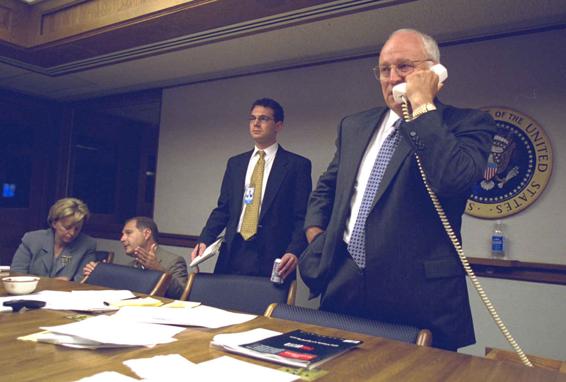 Waxman, left, with Cheney in the bunker.
* * *
A few miles from the White House, across the Potomac River, the military’s leadership at the Pentagon—including the Office of the Secretary of Defense and the service branches’ Joint Chiefs of Staff—realized the nation was at war.
Donald Rumsfeld, secretary of defense: I was at a breakfast with congressmen and someone came in and said that a plane had hit a World Trade Tower. The breakfast ended, and I came back for my intelligence briefing. I was sitting there when someone said that a second plane had hit the other tower.
Col. Matthew Klimow, executive assistant to the vice chair of the Joint Chiefs of Staff, Gen. Richard Myers, Pentagon: My first inclination was to turn around and draw the draperies shut in the office, thinking maybe there’d be a bomb blast. I was worried about flying glass. Every time I think about that I think of how futile it would have been if the plane had hit my part of the building.
Victoria “Torie” Clarke, assistant secretary of defense for public affairs: We went in to talk to the secretary, who was at his stand-up desk. We were saying, “Here’s what’s going on, and what we know. The command center is going to start getting spun up.” He said something like, “Well, let’s take a look at my schedule, maybe we will have to move something.” His special assistant said, “Everything is coming off your schedule—this is your schedule today.”
Joe Wassel, communications officer, Office of the Secretary of Defense: We all started thinking, What’s next? What are we doing? What can be done? We had a discussion and my coworker actually said, “We could be next,” meaning the Pentagon.
Staff Sgt. Christopher Braman, chef, U.S. Army: My wife called about 9:25, frantic on the telephone, and told me a plane had hit the Trade Center in New York. I remember reading that morning there was an Afghan Northern Alliance general that was assassinated over the weekend. I told my wife, “You know I bet you that had something to do with it.” Then I realized my wife didn’t want to hear that—she just wanted to know I was OK. I told her, “Not to worry. I love you.”