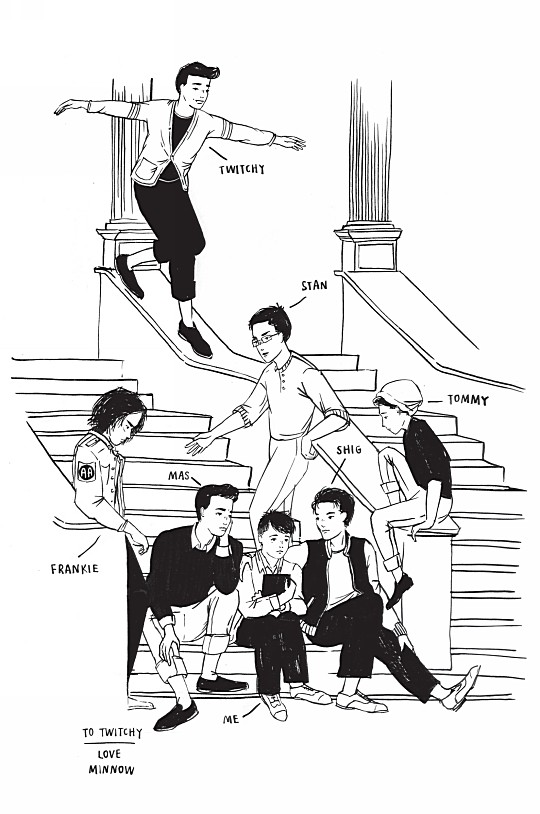
XVI
Home
Minnow, 17
February–March 1945
I wake to the murmur of voices, the sound of someone snoring, and the creak of army cots. For a moment, it sounds so much like Topaz that I think I’m back in camp.
But when I open my eyes, it isn’t the low ceiling of our barrack looming over me but the high rafters of the Buddhist church gymnasium, and I remember.
I’m back.
It’s my first morning in San Francisco after almost three years.
Nearby, someone snorts and rolls over as I sit up, rubbing my eyes. Since the camps are supposed to close before the end of the year, most of the men are here alone, looking for work or apartments to rent so that when their families come to join them, they’ll have somewhere to go. In the light filtering through the gym’s slatted windows, the men shuffle back and forth from the restroom at the far end of the gym, towels draped over their shoulders and toiletry kits in their hands.
Sliding my suitcase from beneath my cot, I lift a stack of sketchbooks into my lap. I’ve filled four of them since 1942, and each one is overflowing with extra doodles I drew during class, comics I did for the Rambler, studies of the mess hall, the guard towers, my mom. Carefully, I open the topmost book, leafing through my old drawings.
Light on the distant mountains.
Kids playing in the coal piles.
Twitchy and the fellas horsing around on the back of the commissary truck.
It all seems so far away now: the war, the evacuation, Tanforan, Topaz, the loyalty questionnaire, the way everyone left, one after another, drifting away like ash on the wind until no one remained but me.
In one of his letters, sent just after Twitchy died, Mas said that us being separated over the past few years was like having the best, most alive parts of him slowly stripped away. It feels like that now, like if I drew a self-portrait, I’d draw myself sanded down to the bones, my friends and family peeling from my skeleton.
Mas, my head. Frankie, my fists. Twitchy, my arms and legs.
Stan, my guts. Tommy, my lungs.
Shig, my heart.
I hope for a second that none of it happened, that I’ll walk out onto Post Street and nothing will have changed. Tommy will have a new record to play for us. Yum-yum will be practicing arpeggios, the notes wafting through her window onto the block. Twitchy will be doing tricks with his butterfly knife while he waits for Shig and me to emerge.
We’ll be together.
I’ll be whole.
I tap my pencil twice on a blank page and do a quick sketch of the gymnasium: the men, the rows of military cots, the trunks and suitcases, the nightstands made out of produce crates, nothing permanent, everything able to be packed up and moved and abandoned, all of this, on and on, stretching into the distance, like if you looked closely enough, the beds and the men and the luggage would reach all the way back to Utah.
At the bottom, I write, Miss you, brother, and seal the drawing into an envelope addressed to Shig.
In the bathroom, I lock the stall door and stare down at the toilet with its clear bowl of water. Out of everything here, this seems the most out of place.
Or I seem the most out of place, here.
To wake up. To walk to the bathroom without stepping outside. To stand before a flushing toilet instead of a latrine. It feels like a dream.
Tentatively, I press the handle and almost jump back as the pipes roar. The water circles the bowl, around and around until it disappears down the drain in a single, violent gurgle.
We can’t stay in the Buddhist church hostel forever, so after breakfast, Mom and I set out in search of an apartment. Something small, for the two of us. No Mas, no Shig, who returned to Chicago after Twitchy’s funeral.
Although we have some money for an apartment—Mom’s twenty-five dollars from the government and a little savings besides—it’s not enough to splurge on bus tickets, so Mom and I walk through the old neighborhood in our Sunday best, clutching a list of addresses and knocking on doors.
I guess I should have known things would be different when we came in on the ferry last night. The fog-thick air had a surreal quality to it, the lights of the Bay Bridge like spirit lanterns, the streets like a labyrinth. I didn’t even know we’d reached Japantown until we got off the bus in front of the Buddhist church.
But in daylight, I realize it wasn’t a dream. The neighborhood really has changed. Most of the old Japanese-owned businesses have been turned into nightclubs and saloons that cater to the sailors who stop in San Francisco on shore leave. “That used to be Mr. Fujita’s tailor shop,” Mom says as I help her over a splatter of vomit on the curb. “That used to be a laundry.”
We pass the old Katsumoto Co., and at least it’s still a grocery, but the name Katsumoto has been scraped from the windows, and the only remains of the I AM AN AMERICAN sign are the painted-over nail holes above the doorway.
We walk all morning, but no matter where we go, it seems there are no rooms available. Every place was rented last week, or yesterday, or an hour ago.
At one apartment building, a hakujin man in a white undershirt says, “No rooms available,” and puts his hand on the doorframe like a skinny Japanese kid and his five-foot-tall mother are going to try to enter by force. His undershirt is stained at the armpits, the color of urine when you haven’t had enough to drink.
For a second, I feel like I’m fourteen years old again, being hounded by ketos just because of the way I look. For a second, I want to crawl into the gutter. I want to run home to Mas and Shig.
But Mas and Shig won’t be there.
And I have nowhere to run.
“There’s a ‘For Lease’ sign in your window,” I point out.
“Yeah.” The man sucks his teeth. “I’ve been meaning to take that down.”
I stare at him. Long enough to let him know I know the truth: that he won’t rent to us because of the slant of our eyes.
But he stares back, daring me to say it.
“So sorry,” Mom says in her accented English. She starts to bow, but seems to think better of it halfway, and she kind of bobs up again before turning away, stiff-backed like she’s trying to remain dignified, even though it’s hard to be dignified when you keep getting rejected.
Gaman again.
Sometimes I’m so sick of gaman.
I’m sick of the distrust in these hakujin faces, the cowardice in how they won’t admit it, the way we have to swallow their lies with a polite nod, the way Mom has to say, “So sorry,” even though she has nothing to be sorry for. She’s allowed to be here. We all are, now.
We’re supposed to be, anyway.
When we reach the street corner, I turn back to see if the sign’s still there.
It is.
For lunch, Mom and I stop at a diner where we used to go when Dad wanted to take us out for a treat. The five of us would cram into a vinyl booth—Mom and Dad on one side; Mas, Shig, and me on the other—and Dad would order us a milkshake, which he’d split evenly among five cups. We’d have to take turns picking the flavor, but Dad would always give Mom the cherry on top.
Now we sit in a booth that feels uncomfortably large, waiting for one of the servers to notice us. A minute goes by, then two, then five, the waitresses passing our table without so much as a glance, the cooks glaring at us from the kitchen, the other diners watching us furtively as they tuck into their hamburgers and scoops of pie. For what seems like the tenth time, Mom straightens the silverware on her napkin.
Reaching across the table, I take her hand. Her skin feels thin, like tracing paper. “Come on, Mom. Let’s just go.”
As we leave, I look back at the other diners and wonder what they’re waiting for. Do they think we’re going to loose some mustard gas and shout “Banzai!” as we run out the door? Do they think we’re going to scream at them for not doing anything when we were forced from our homes, shipped to racetracks and fenced enclosures like animals? For not doing anything now?
Most of all, I am struck by how almost none of their faces look like mine, how alien I feel in this diner I used to love. I guess I took it for granted, seeing people who look like me every day. When we were evacuated, we lost our homes, but we were still surrounded by our families, our friends, our traditions. We kept them, tried to hold on to them, even as we were sent across the country, across the world, our community dissolving, little by little, as pieces of it moved farther and farther from home.
Now I am home, but without Mas and Frankie and Stan and Tommy and Twitchy, without Shig, my older brother who was always there to bail me out, to cheer me up, to wake me from my nightmares, this is just a building, these are just streets, this is just a city that doesn’t belong to me anymore.
Late that afternoon, someone finally tells us, “No Japs,” and to be honest, it’s almost a relief to know I wasn’t imagining things. I wasn’t getting worked up over nothing.
At least now I know if I hate them for hating me, I’m not wrong.
Defeated, Mom and I trudge back to the hostel. My feet are throbbing from walking all day in my dress shoes. Mom’s even worse off, leaning on me for support and wincing every time she puts her left foot down.
Limping along together, we pass Mr. Hidekawa’s steps, where I sat with Mas and the fellas after they rescued me from the ketos. The turtle-shaped bell over the door is gone.
“Do you know when Mr. Hidekawa’s coming back?” I ask.
Mom squeezes my hand. “Mr. Hidekawa passed away in camp.”
I stop so quickly, she almost stumbles. I catch her arm, steadying her. “What?”
“He died in one of the prisoner-of-war camps in 1943.”
Two years, Mr. Hidekawa’s been gone. I didn’t know. I wonder how many other people are just never coming back, and we’ll stare at their vacant steps or their old businesses and wonder what happened to them, never knowing if they died or just moved.
“But he was so healthy,” I say.
“The relocation was a blow to all of us. Some people didn’t recover.” Squeezing my hand, Mom tugs me onward. “Some people never will.”
That night, I sit with Mom in the common room of the hostel, rubbing her arches while she looks over a new list of possible apartments. Shig used to rub her feet for her. He’d do it for Mas, too, after a long day of work. I wish he were here now to rub mine.
“Cheer up, Minnow,” she says. “We’ll find a place tomorrow.”
“What if we don’t?”
She frowns. “Of course we will. There are still good people in this city, and more nihonjin are arriving every day. Someone will rent to us.”
“What if we didn’t stay, though?”
She inhales sharply as I start kneading a particularly tough knot by her heel. “What do you mean?”
I mean I never thought I’d miss being in camp, but after today, I wish I could crawl back into my cot, with my drawings pinned to the walls above me and Mas’s Silvertone radio piping quietly in the corner. I want to be welcomed into the Rambler offices by guys who have already left Topaz. I want to eat the thin, mess-hall miso soup because I’ve gotten so used to it, it’s the only kind of miso soup I like now. I’m homesick for a place that’s already being dismantled, the baseball leagues closing down, the recreation centers shuttering their doors, the schools emptying out like drainpipes, people departing for different parts of the country every day.
I’m homesick for camp the way I used to be homesick for San Francisco, and that makes me want to leave here even more.
“No one says we have to stay,” I say. “We could move to Chicago with Shig.”
I picture us going to baseball games and walking along the river. Shig showing us the Japanese churches, and community centers, and markets where we can buy kamaboko and mochi rice. The three of us crammed into an apartment with the snow coming down outside in winter, and Mas back from the war, his medals displayed in a frame Mom proudly hangs over the mantel.
A new home. One without so many ghosts.
Mom’s lips flatten, and I tense up. She’s got that look she used to get when I’d ask for new clothes instead of hand-me-downs, turkey sandwiches instead of musubi, a milkshake of my own because Mas always picked strawberry and I hated strawberry.
“Your father and I moved to this city when Masaru was two years old. You and Shigeo were born here. This is where we raised you. This is where your father died, and where I will die too one day,” she says. “I will not leave again.”
Two days later, we’re no closer to finding a place to live, and I’m hanging around the ferry building, waiting for Stan Katsumoto, who’s supposed to arrive today. He’s coming to find a job and an apartment for his family, who are at Tule Lake until they have a place to stay in the city.
Leaning on one of the pylons, I watch the nihonjin milling around the dock. Some are hoisting duffle bags onto their shoulders. Others are juggling infants who are so young, they must have been born in camp. The whole scene reminds me of the evacuation: the luggage, the harried families, the way people keep snapping at one another in travel-strained voices.
It’s like we’ve been kicked out of camp the same way we were kicked out of San Francisco three years ago.
The only thing that’s missing are the ID tags.
When Stan Katsumoto finally comes down the gangway, I almost don’t recognize him. I haven’t seen him in a year and a half, and he’s gotten so thin, you could turn him sideways and he’d disappear. His cheeks are bony, and his black eyes seem sort of sunken behind his taped glasses.
But it’s Stan. A little piece of home.
“Minnow!” Dropping his suitcase, he wraps me up in his long arms. “Boy, are you a sight for sore eyes!”
I hug him. To my surprise, my chin fits right on his shoulder. I don’t even have to stand on tiptoe and I’m almost his size.
“You’ve gotten tall!” He laughs, thrusting me back. “You been drinking your milk like a hakujin kid or something? I bet you’re taller than Mas now.”
“Oh.” Taller than Mas? I can’t even imagine it. In my head, Mas is a towering figure, stronger and smarter than everyone around him, especially me. “I don’t think so.”
“You heard from him lately?” Stan asks, picking up his suitcase again. Together, we head for the busy intersection outside the ferry building, the people rushing about, the cable cars clanging their bells.
“He’s still on the French-Italian border, I think. I guess they’re not seeing a lot of action.”
“That’ll be good for him.” Stan’s glasses flash in the light. “After what they went through.”
I nod. Sometimes I wonder what Mas will be like when he comes back. If he comes back. Frankie said that after what happened to Twitchy, Mas was diagnosed with battle fatigue and sent back from the front.
I can’t imagine that, either. Mas coming apart. I write to him often, even though I don’t know if it does any good, because my brother is made of stone, and if stone cracks, it can never really be made whole again.
I wish he’d come back. I’d even take him yelling at me about my grades and not joining the football team, if it meant he was the same old Mas.
Stan and I make our way through the trolleys and buses and crowds of sailors in their navy uniforms and crisp white caps. I tell him Mom and I are staying at the Buddhist church, that we haven’t had any luck finding an apartment.
“They were afraid of us then. They’re still afraid of us now,” Stan says.
“But we didn’t do anything.”
“What d’you mean, Minnow?” Stan smirks, but there’s a hard edge to his expression, like the blade of an axe. “We exist.”
That night, Stan takes me out to see Count Basie at the Golden Gate. We’re so far in the back of the theater that we can hardly see him up there at the piano, but the music’s loud enough for everybody: Black, white, nihonjin. The band plays hits like “Pennies from Heaven” and “One O’Clock Jump,” and the crowd goes wild over every solo, every bright note, every swinging beat.
Boy, it feels good to let loose for a night. Those blazing trumpets. Those syrupy saxophones. They’re a riot of color in a world of graphite, like everything for years has been dull, dull, dull, rendered in grays, and all of a sudden I’m remembering rainbows, sunsets, forests, reds.
I lean over to Stan. “Tommy would’ve loved this!”
Stan’s got one of those smiles so relaxed, it’s almost one long laugh. “Let’s get him a new recording once we’ve got a little saved up! Give him a head start on his collection when he gets back!”
After the show, we go traipsing back into the fog with the rest of the concertgoers, dizzy with music. People split off in different directions, skipping across the cable-car tracks on Market or heading up Taylor to the Tenderloin district. All these different kinds of people bound for a couple of hours, held by the spell of Count Basie’s music, and then . . . poof. We disperse again. Is that what life is like? People coming together and drifting apart, coming together and drifting apart, over and over until there’s no one left?
Will we come together again, after all that’s happened to us? Can we, when we are so broken?
As Stan and I turn toward Japantown, he starts singing, “Between the Devil and the Deep Blue Sea,” swinging around streetlights like he’s in a Hollywood musical, even though he’s got a voice like a raven.
“C’mon, Minnow, sing it with me!”
Three years ago, I would’ve shaken my head and hung back with Tommy while braver guys like Shig and Twitchy whooped it up, but there is no Tommy, no Shig and Twitchy. So I open my mouth and out comes the most terrible note anybody’s ever sung.
Behind us, a couple of Black ladies who followed us out of the theater start laughing, cigarette smoke trailing from their mouths.
I blush, but Stan gives them a bow. “Well, gals, think we can cut a record?”
One of them shakes her head. She’s got an easy, lopsided smile that reminds me of Shigeo’s. “You can cut one,” she says, “but no one’s going to pay to listen!”
We laugh. It feels good to laugh with strangers, walking the length of a city block, talking about our favorite songs of the night. Then, at the next corner, we go our separate ways, us strolling toward Japantown, the ladies disappearing in a cloud of smoke, the lit ends of their cigarettes seeming to float between their fingers like distant stars.
Coming together.
Drifting apart.
Since I’ve been treading these streets, looking for an apartment, picking up Stan, catching a show, I feel like I’m wearing in the city the way I’d wear in a secondhand pair of shoes. It’s not mine. It stopped being mine the day we boarded that Greyhound bus for Tanforan. But for the first time since I’ve been back, I wonder if it could be mine again, someday.
A week later, Stan and I are sitting on the steps across from the Oishis’ apartment building, waiting for a bunch of ketos to emerge from Yum-yum’s old place.
Mr. Oishi’s been back in town for a few days, trying to evict one of the white families who rented from them while they were gone. I guess the ketos in the lower flat didn’t want to surrender their apartment to a bunch of Japs, even though the Oishis own the building.
Yum-yum’s dad finally had to get the police involved, and now the ketos are supposed to be out by noon.
I’ve brought my sketchbook, and Stan’s brought a bag of popcorn, and we take turns tossing kernels into each other’s mouths. I miss more than I catch, but Stan doesn’t seem to mind. We’ve gone through half the bag by the time the moving truck pulls up to the curb, and the ketos finally start coming out of the building.
Picking up my pencil, I draw them lugging their tables, their mattresses and trunks down the steps, and I think of me and the guys carrying Yum-yum’s piano to the sidewalk, the way she played her heart out on the street.
“Good riddance,” Stan says, tossing popcorn in their direction like he’s at a propaganda show, throwing garbage at onscreen Germans.
They’ve almost filled the truck when they march back inside. There’s the sound of breaking glass. Something heavy crashing to the floor.
“They’re trashing the place,” I whisper.
Stan clicks his tongue. “Soldiers salting the earth.”
“But we’re not at war with them.”
He laughs. “What, d’you think we were let out of the camps because FDR woke up one day and realized, oh shit, he was wrong? You can’t just lock up a hundred thousand people and call it good? C’mon, Minnow. We had to fight for that. We’re fighting all the time, whether we know it or not.”
I add silhouettes behind the curtains in my drawing. “But we’re already fighting a war out there. Why do we have to fight one in our own country, too?”
Stan nods across the street, where there are the sounds of raised voices now, as if in argument. “Do you think they think this country belongs to us?” He shrugs.
Before I can answer, a girl comes out of the Oishis’ building, slamming the door behind her. She must be around my age, maybe a year or two younger, in her worn sweater and scuffed saddle shoes. Across the road, our gazes meet.
Stan waves at her, smirking.
She frowns, and for a second I think she’s going to scream at us for kicking her out, or for being Japanese, but then her fists unclench, and she trots down the steps, crossing the street in a few quick strides.
Up close, her skin is flushed, and there are tears in her eyes. If I was going to do a portrait of her, I’d do it in watercolor—splashes of paint on her cheeks and lashes.
“Is that building yours?” she asks.
“A friend’s,” I say.
The girl bites her lip. “I’m sorry . . . for what my parents are doing. I tried to get them to stop . . .”
Stan looks her up and down. “Were you the one yelling?”
She nods.
He offers her some popcorn.
Taking a few kernels, she nibbles them fretfully, like a rabbit.
I don’t think anyone knows what to say. In the Oishis’ apartment, there’s the sound of wood breaking.
“She plays the piano,” I tell her. “Our friend.” Flipping through my sketchpad, I find a picture of Yum-yum as a constellation over Tanforan, stars winking over the barracks and barbed-wire fences.
We’re all there, on the infield below. We’re all alive, and together.
I swallow the lump rising in my throat.
The girl stares at the paper for a second, her gaze darting back and forth across the page. I watch her carefully, wanting to know that she’s seen it, that she understands.
“This is where you were sent?” she asks finally.
I nod.
She lifts a finger, almost touching one of the guard towers. “It wasn’t right, was it? It should’ve never happened.”
“Nope,” Stan says. “But it’ll happen again, if we’re not careful.”
The girl nods silently. Across the street, her family is appearing again, piling the last of their belongings into the truck.
She glances over at them, then back to us. “I’d better go,” she says, slowly backing down the steps.
For a second, I’m scared—not of the girl or her family, but that this moment was too short, too small, that she’ll just go away like nothing has changed. She’ll go back to her normal life, and in a few weeks, she won’t remember ever having talked with the two Japanese boys fresh from the camps. Maybe one day, she’ll even be sitting in a diner watching a mother and son wait and wait for service, wait and wait because they aren’t white, they don’t belong here, and she’ll keep eating her grilled cheese or her Cobb salad like nothing at all is wrong.
Standing, I tear the drawing of Yum-yum from the sketchbook and offer it to the girl. “So you remember,” I say. “So you won’t forget?”
This happened. This happened to us. This happened to kids like her. This can happen again.
We cannot allow it to happen again.
With a nod, the girl takes the sketch and tucks it into her pocket.
“Keep yelling,” Stan adds. “Maybe they’ll hear you one day.”
A smile flashes across her lips. As she heads back to her family, they glare at us from the other side of the truck.
Smirking, Stan and I wave.
When we get back to the Buddhist church hostel, there’s someone lounging on the steps, watching passersby.
I squint.
I recognize that slouch.
It’s Shig.
Shigeo.
My brother.
As he stands, I see my drawing of the church gymnasium in his hands.
Am I talking? My mouth is open. Am I running? I’m barreling toward him.
“Miss me?” he asks.
I charge into him so hard, I can feel the air go out of him.
“Easy, Minnow!” he cries.
I finally find my voice. “You’re here! You came!” I’m crying and I’m hugging him, and I feel Stan slam into us both from behind.
“You son of a bitch!” Stan’s saying. “You sneaky son of a bitch!”
Shig laughs, squeezing us both so tight, I don’t think he’ll ever let go. “Chicago’s for suckers. It’s too damn cold there to have any fun at all.”
“What about your job?” My voice is wet with tears, but I don’t care. Shig is here. He’s here.
“Eh, it was too much work.”
“Why didn’t you tell us you were coming?” I say.
“And miss the look on your faces?” Shig laughs again. “Never.”
I don’t know how he does it, but Shig’s return changes everything for us. He, Mom, and I help Yum-yum’s dad clean up the mess the ketos left in his building. Since the rest of the Oishis are still in Topaz, we’re going to stay with him until we find an apartment of our own.
Shig and I share a room, like we used to. I don’t realize how much I missed the sound of his breathing until I fall asleep to it the first night, quicker than I’ve fallen asleep anywhere since he left for Chicago.
The Katsumotos agree to rent out the upper flat, and Stan’s going to see about applying to UC Berkeley in the fall. He wants to be a lawyer, maybe work for the American Civil Liberties Union of Northern California, which fought for Fred Korematsu all the way up to the Supreme Court.
At our new address, we get letters from our friends.
Aiko’s considering moving back to San Francisco, since she’s going to be seventeen this year, to work for one of the officers’ families who live in the Presidio. Until their parents leave for Japan, though, both she and Tommy will be staying in Tule Lake. Although, she adds, with so many Tuleans renouncing their citizenship, who knows when the repatriates will be sent back?
Keiko’s going to move back with her parents to get the old Japanese school Soko Gakuen running again.
Bette insists that New York is the greatest city in the world and says we’re all welcome to visit her. I bet when Frankie gets out of the war, he’s going to take her up on that.
Mas tells me I’d better go back to school ASAP and graduate or else. It’s nice to hear him sounding like himself again.
So with only a couple of months left in the semester, I re-enroll at George Washington High School. On my first day back, Shig walks me all the way to campus. Together, we pass Mr. Hidekawa’s steps, the corner where the ketos jumped me, the new nightclubs, the old Katsumoto Co., the Jewish Community Center, and when we get to school, we stand on the 30th Avenue sidewalk, looking out over the football field, the concrete bleachers, the other students trudging past us—Chinese kids and Mexican kids and nihonjin kids and white kids and Black kids all together.
Shig puts his arm around my shoulders. “Study hard, Minnow, or Mas will have my head.” After a second, he adds, “But not too hard, or Twitchy will come back to haunt you.”
To my surprise, I laugh. It just kind of bubbles out of me, thinking of Twitchy flying around, a free-floating ghost boy cupping his hands to his mouth and going, “Woooo!”
“You know, for a long time, I didn’t think I could ever come back from losing him?” I say. “I didn’t think I could make it in a world without him.”
“I know, Minnow. Me too.” Shig squeezes me to him. “But here we are.”
I grin at him as the first bell rings, and there’s a sudden storm of chatter, doors opening and closing, the other students rushing to class.
I’m about to head in too when the Golden Gate Bridge appears out of the fog, stopping me in my tracks—the red towers, the flaking paint, the sections in need of repair. For some reason, it looks smaller, more fragile, like if we’re not paying enough attention, if we’re not constantly working to keep it upright, then one day, we could turn around and it’ll have collapsed on us.
But it’s still my bridge. My favorite view in the city.
Shig gives me a nudge. “Hey, you’re gonna be late.”
“I know.” Turning back, I take a breath, drinking in the sight of it: the school, the bleachers, the bridge, the fog curling into the bay. Beside me, I feel Shig breathe in too.
We made it, brother, I think.
We’re home.