XV
Japanese/American
Tommy, 19
December 1944
Japanese
In the mornings,
we wake before dawn
to run the dusty roads of Tule Lake.
We are no more
than the whisper of gray cotton sweats,
our frozen breaths.
Through the snowfall,
the bugles call, red as suns
on white flags.
At sunrise, we assemble
in front of the administration building,
and bow to the East.
American
I don’t always bow.
When we were little,
and the other kids
pledged allegiance
to the flag
of the United States of America,
Shig and I would cover our hearts
and sing “I’m Popeye the Sailor Man.”
And to the republic—
I’m Popeye the Sailor Man!
for which it stands—
I’m Popeye the Sailor Man!
Our teacher’s frigid glare—
our pyrotechnic laughter.
We were indivisible
then.
Now
I watch everyone bend
like waves collapsing,
breakers red with daylight.
Now
I am surrounded,
waist-deep in their rising sea.
Japanese
To understand the origins
of Hokoku Seinen Dan,
the Young Men’s Organization
to Serve the Mother Country,
one must first understand:
They were American boys once,
fearless, patriotic, wholesome, polite,
but then the evacuation,
then the camps, then segregation,
and if these things did not happen
to American boys, then they could not be
American boys, but they wanted to be
something. Not American?
Okay, then, Japanese.
They were going to prove themselves
dutiful, loyal, courageous, good,
healthy, strong, and mentally sharp,
if not for America, okay, then.
For Japan.
American
After the announcement that the camps are closing,
the army sends interviewers to Tule Lake.
Will you renounce
your American citizenship?
Will you renounce
and stay in Tule Lake?
Cut off from civilization,
we don’t have many sources:
gossip, propaganda, hearsay.
So when we get a piece of news
(like that slippery word and),
we seize upon it feverishly
and circulate it like a disease.
Choose a side, Tommy.
Renounce and stay.
Be American and go.
You cannot have both.
Japanese
But why be American? We hear
America only promises
wholesale bloodshed and violence—
nurseries burned, barns bombed,
wounded soldiers, back from Europe,
shot in train cars. In America,
it’s still open season on Japs.
In here, we are safe,
as long as we’re disloyal
Japanese.
So my parents request repatriation.
My mother ties obi made from wire.
My father wears the fence like armor.
My parents pin barbs in my sisters’ hair
like chrysanthemums and stare expectantly
at my bowed head, my frozen hands.
A son should remain with his family.
He should knot the barbed wire at his waist
like a sword belt.
Make a decision, Tommy.
In here, we can be together,
though we will not be free.
American
Frisco, 1939: I was singing
“Over the Rainbow”
to get baby Fumi to sleep.
I know it’s stupid, but I wanted to believe
if I kept singing, I’d fill her dreams
with bluebirds, stars, and lemon drops,
so when she closed her eyes,
I didn’t stop.
I didn’t know our father was lurking
in the doorway, staring at me,
like I was an intruder in his home.
“Cut that out,” he said,
and I did,
but he had already turned away,
his back and hunched shoulders
disappearing down the hall.
He never could stand to look at me
for long.
I kept flunking Japanese.
I broke my arm in judo.
I flinched when he hit me.
I sang a lullaby to my little sister
like a woman.
If I renounce my citizenship to prove
I am not American, I am disloyal,
I am his son,
will he turn around again
and see me?
Japanese
In the dream, my parents like me.
On the table, my mother births me,
red and wrinkled as a pickled plum.
There is no screaming in the dream,
no crying.
My father holds me in his arms,
studies my puckered mouth, my nose,
declares, “He has my eyes!”
A blanket enfolds me
like a furoshiki.
My mother cradles me
like a gift—
warm,
silent,
wanted.
American
Kiyoshi and Kimi are teaching their mom to swing
to Ella and the Duke, duetting on a borrowed radio.
They scuff the floorboards,
heels kicking,
hands waving,
their mom saying,
“What is ‘doo-wah’?”
and scatting inexpertly
when they explain it to her:
“Doo-wah, doo-wah, doo-wah . . .”
I used to own this record.
I used to dance like this
with my sister Aiko,
hopping and jiving
on weekday afternoons
before our parents
returned from work
and yelled at us to stop.
The snare pops. The trumpets squeal.
Laughing, Kiyoshi’s mom embraces him
as the next song begins.
I try to imagine my parents swinging,
but it’s like trying to imagine boars
clodhopping to a shamisen.
Some things are too painful to watch.
Japanese
My mother believes in Radio Tokyo
like some people believe in the gospel.
Japan has taken Formosa,
Leyte, Morotai; Japan shall cover
all the world under one roof—
forever and ever, hakkō ichiu.
She doesn’t believe it when the papers say
the reports are false. Japan is losing.
“American propaganda. You fool.”
She sweeps imaginary dust
from the doorway.
“Whose side are you on?”
My mother believes the rumors:
If true Japanese return to the homeland,
they will be endowed with property,
jobs, accolades, gestures of gratitude
from the emperor himself.
“But the homeland will have nothing left,”
I say, “when the war is over.”
Crack! A red handprint
burning on my pale cheek.
“If you were a good son,
you wouldn’t doubt your mother.”
American
“Mom’s losing it.”
Aiko has callused fingertips,
nearly a thousand cranes, and a wish
she was going to spend on Twitchy.
“She’s just confused,” I say.
“You always make excuses for her.”
Aiko folds cranes from comic books
Hokoku would frown upon—Superman
and Captain America—cranes that punch Nazis
and Japs.
Taking a fresh page, she turns it
into a triangle, a square, a kite,
the paper transforming under her hands:
not a blue-eyed hero but an origami bird.
I wait for it to breathe.
“She’s our mother,” I say.
Nearly a thousand cranes—
I can almost hear them
rustling in that old shoebox,
scratching, restless, at the lid.
“Since when has she ever
been a mother to you?”
Japanese
This was not how Hokoku began,
but this was what Hokoku became.
Tule Lake, 1944: The camp swells
with misinformation. Stewing
in our own fear, our confusion,
our anger, we tear ourselves to pieces
over a rumor, speculation.
Pick a side, Tommy.
Grow a backbone, Tommy.
Under enough pressure,
everything
warps—
True Japanese
speak Japanese,
study Japanese,
wake at dawn,
run the camp,
serve the emperor.
True Japanese
obey their parents
when they’re told
to join Hokoku.
And my parents always dreamed
of having a good Japanese son.
American
Stan Katsumoto said no
at first.
But under enough pressure,
everything splits—
If you’re not in Hokoku,
you’re not true Japanese,
and if you’re not true Japanese,
you and all your family
could be inu.
You know, dogs.
Spies.
American.
So when one of the cooks was arrested
(he was an officer in Hokoku)
and Mrs. K. took his job in the mess hall,
people said she was sicced on them like
a little bitch.
True Japanese spat
in her food, hounded
her daughter, attacked
her husband, beat
her sons, threatened
her life.
Two days ago,
Stan became a true Japanese
like me.
Japanese
A thousand voices ricochet through camp.
“Washo! Washo!”
We touch our toes—stretch—clap.
“Washo!”
On my forehead is the rising sun
worn by the sons of Japan.
“Washo! Washo!”
Four rows down, Stan’s a grim scarecrow,
glasses fogging.
“Washo!”
Under his eye, a week-old shiner,
yellow as miso.
“Washo!”
We lock eyes. Our silence,
a shrieking kettle.
“Washo!”
American
If Twitchy could see me now,
he’d be laughing his ass off.
I can just picture him,
arms flapping, screeching,
“Washo! Washo!”
like a demented albatross.
“What’re you doing, Tommy?
You don’t believe in this shit,
do you?”
Japanese
My mother loves the idea of me
more than she loves me.
She clings to the dream of me
like she clings to the dream of Japan:
silk kimonos, rice-paper screens,
cherry blossoms she hasn’t seen
since she was sixteen years old.
In her dream, her son is obedient,
speaks Japanese without an accent,
is stoic, good with money,
going into engineering or
another profession of equal pay.
She dresses me in his clothes:
shoes, suits, overcoats so big,
they swallow me.
What is the sound
of one boy drowning
in his mother’s dreams?
American
Upon their departure from Tule Lake,
every evacuee will be compensated
with twenty-five dollars and a train ticket.
In my head, I’m composing a song
featuring Benny Goodman on clarinet:
Twenty-five dollars and a train ticket.
Twenty-five dollars for a ride outta town.
Twenty-five dollars for your trouble, sirs.
Japs, get moving! We don’t want you around.
Stan’s writing again, like if he can write
enough letters, the ink will carry us back
to each other, like rivers carrying souls
to the sea. Even though he knows,
with Bette in New York, Shig in Chicago,
Mas and Frankie somewhere in France,
Twitchy gone like a flashbulb,
there’s no going back to Japantown
the way it was before Pearl Harbor, 1941.
“Twenty-five dollars—”
Stan’s voice, a rock tumbler.
“—to start Katsumoto Co. from scratch.”
“Or rent a room,” Aiko adds,
with a glance in my direction.
Twenty-five dollars and a train ticket . . .
If Twitchy were here, he’d sing it with me:
Twenty-five dollars and a ticket in your pocket.
Golly, boys, it’s the American Dream!
Japanese
My mother slaps
the renunciation form
in front of me.
“You must renounce,
or we will be separated.”
I stare at my name, my desire
to give up my country,
transcribed in my mother’s hand.
“You must renounce.”
My father shoves
a pen across the table.
“No son of mine
abandons his family
for a country
that’s given them nothing
but disrespect.”
Across the barrack, Aiko makes a crane
out of a candy-bar wrapper
and extends its wings for flight.
Do something, Tommy.
“You must renounce.”
“You must keep
the family together,
son.”
American
From Topaz, Minnow writes to tell us
he’s moving back to San Francisco.
“It’s time to go home, Tommy.”
Taking the letter, Aiko folds a final crane,
which she places in my hands.
A gift.
A wish.
A demand.
“This is your chance, Tommy.”
I think of Frannie and Fumi, only five.
If they leave America, will they forget America
the way our mother forgot Japan?
Forgetting the fences, the word “Jap,”
the horse stalls stinking of manure?
What will they have left of America
besides Aiko’s bedtime stories of softball,
Charleston Chews, comic-book heroes,
and boys from San Francisco?
If they dream of me, what will they dream of?
A fragment of a song they barely remember—
something about wishing stars and rainbows?
“I don’t want to leave you,” I say.
“Yeah.” Aiko shrugs.
“But do you want to stay?”
Japanese
The renunciation applications of Hokoku members
float through the system like dead leaves in a current.
Renunciation approved.
Renunciation approved.
Want to be Japanese? Renunciation approved.
Want to stay with your family?
On December 27, seventy Hokoku officers are arrested
for being “undesirable enemy aliens.” No longer American,
nor truly Japanese, these sons of the Mother Country
are bound for a prison camp in Santa Fe.
Dead leaves caught in a net.
Upon their departure, they are accompanied to the gates
by forty armed guards and a parade: buglers, banners,
people calling “Banzai!” like it’s a summer holiday,
a time for picnics, fireworks, and swimming in the river.
American
The signature line
of my renunciation—
untouched as new snow.
Japanese
Offering our sympathies to the parents
whose sons were sent to Santa Fe
begins with a walk beside my father.
His silence, a cold fire, a coal bucket,
a chore undone.
In her barrack temple, a Hokoku mother
sits by the fire, serene as a toad.
Her son, a martyr. His portrait, a shrine.
“You’re sorry?” she croaks.
Her umbrage. Her throat bulge.
“My son has proven his loyalty.
My son is a true Japanese.
My son is the pride of this family.
Offer your congratulations, not your pity.”
“Son”—a sore subject for my father.
His mouth twists, as if she’s prodded him
in an open wound. He bows—
a gesture of shame. “Congratulations.”
“And you?” Her eyes swivel to me.
“Have you renounced?”
Man up, Tommy.
What’s it going to be, Tommy?
My existence, a wart. I say nothing,
undeniable as a bitten tongue.
An amphibian smile.
“You have my sympathies, Mr. Harano.”
American
Returning to the barrack
is an ice-age migration.
My father’s silence yawns,
black as a tar pit, waiting
for me to stumble in.
Mounting the step, he looks back—
it’s 1939 again. He’s staring at me
like I’m a stranger again, unwelcome
as always.
“You’ve got one more day
to sign that application.”
He turns away—I’m thirteen again,
wishing he could see me again.
Hear me. Want me. Just once.
I take a breath.
But he’s already leaving,
his back and hunched shoulders
vanishing into the barrack.
Well, Tommy?
I think of Aiko.
“This is your chance, Tommy.”
I turn away, to the empty street,
where the silence rings with possibility:
stillness waiting to be broken,
songs waiting to be sung.
At the edge of the camp,
the barbed wire hums—
Japanese-American
In the morning,
I wake before dawn
and run the dusty roads of Tule Lake.
I am everywhere—in the air,
beyond the fence, fast as a crane
or a boy named Twitchy.
Removing my headband,
I leave it in the snow
like an old bandage.
A message for my parents:
I am not the son you wished for.
But I am the son you have.
In the assembly, I find Stan
and take him by the shoulders.
“What’re we doing, Stan?
We don’t believe in this shit,
do we?”
His laughter, a swinging gate.
My singing, an ocean breeze.
We peel away from the sunrise,
turning, on the final day of ’44,
west toward San Francisco.
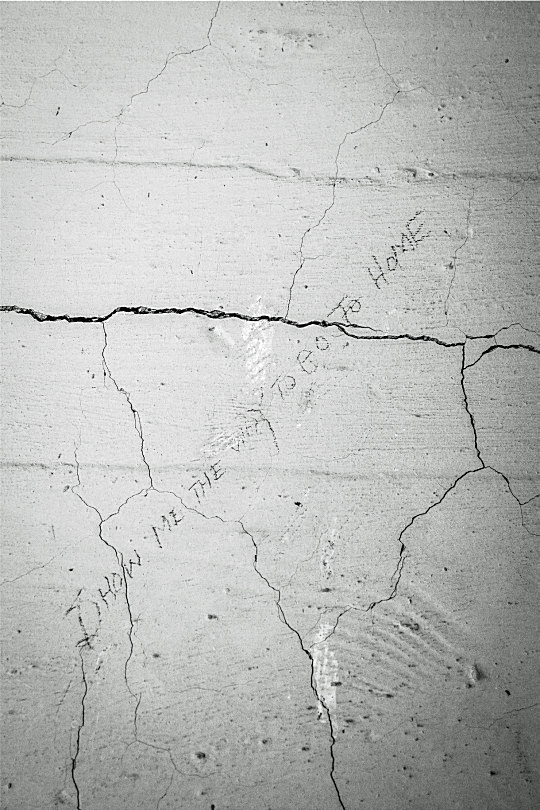 Graffiti, Tule Lake Segregation Center, California