XI
Twice as Perfect
Mas, 22
January–March 1944
Monday, January 10, 1944, 2145 hours
Camp Shelby, Miss.
Dear Dad, I try to be the kind of guy other people go to for help. A rock, a support, a foundation. In Japantown, I bailed Frankie out of fistfights. I taught Shig to drive. I fixed Twitchy’s bicycle when he banged it up jumping over those trash cans. I sat with Minnow at the kitchen table, doing math problems long into the night while the rest of the house dreamed—nothing but the scratching of the pencil and the dogged certainty of algebra. Steadfast, reliable. That’s the kind of guy you taught me to be.
But I couldn’t help Stan.
November: I went to my sergeant as soon as Tommy told me what was going on at Tule Lake. Knew it was a long shot. They don’t like you doing stuff like that in the army. They want you focused, soldier! They want your head in the game! Know what happens if you’re not paying attention? You and the guy next to you—dead. Forget what’s happening on the other side of the country.
But everything we’re fighting for is on the other side of the country, you know? Shig, Minnow, Ma . . . behind the barbed wire. And it was Stan, Dad. I had to do something.
I’ve told you about my sergeant before, haven’t I? Caucasian guy? Short as some of the Nisei boys, but with a Napoleon complex like you wouldn’t believe? Around the barracks, we call him Little Emperor, and if he ever finds out, we’ll never hear the end of it. He said: Get your head out of your ass, soldier. You’ve got a war to fight, and it’s not in fucking Tule Lake.
Tuesday, January 11, 1944, 0630 hours
Camp Shelby, Miss.
4x4x4s, punishments, holes. The motion: dig and heave. The earth rattling from the spade. The memory: you, coming home with dirt in the lines of your palms. You, and the smell of loam. I think of the times you brought Shig and me to work with you, of us pulling weeds from the hedges. Those damp clods of soil and roots and earthworms. Did you know I once dared him to eat one? He slurped it right down like the last of a milkshake. Laughed until we piled into the Chevy.
Next time, I went over the Little Emperor’s head. (Get it?) Boy, did I catch hell for that one. Two weeks of extra detail, two weeks restricted to post. They learned my name, my face. I wasn’t just another Jap anymore. I was Mas Ito, and every time they needed someone for kitchen patrol, for latrine duty, for any of the unsavory jobs they give to army grunts, it was me. My fingers stinking of cleaner. My palms blistered from shoveling. Times like these, I try to remember what you taught me. Chin up. Back straight. Turn the other cheek. One day, they’re going to see they were wrong.
Sunday, January 23, 1944, 1000 hours
Camp Shelby, Miss.
Dear Dad, Sunday KP isn’t so bad. It’s two meals instead of three, and a break between them if you finish up after breakfast quickly enough, which, of course, we did. I’ve gotten KP duty so many times now, I can scrub a pan spotless in two seconds flat. Boy, I think of all those times Ma made Shig and me wash the dishes again because we’d left grease on the pots. If only she could see me now.
Maneuvers start Friday. The whole unit will be in the field, all four thousand of us. We’ve done smaller problems before: a squad of five or six guys, then a platoon of three or four squads, the units getting bigger every time, a company with all its platoons, and finally a battalion of eight hundred soldiers. But this will be the first time the entire 442nd Regimental Combat Team (three infantry battalions, the field artillery battalion, all our supporting companies) will be fighting together. I gotta tell you, Dad, I’m looking forward to showing everyone what a bunch of Nisei boys can do.
Thursday, January 27, 1944, 2100 hours
Camp Shelby, Miss.
A letter from Tommy: The army has started drafting Japanese-Americans. That means Shig can be drafted. Can you imagine? Shig, in the army? Or Stan, or Tommy, or any of the No-No boys at Tule Lake? Boys who said they wouldn’t fight? Boys who were beaten? Imprisoned? I volunteered. I wanted to serve. They didn’t—don’t.
I think a lot about your flag, the one you flew every morning before you left for work. Those red and white stripes rippling over our steps. When I think about home, I think about that flag as much as I think about the building, or the street, or the city. The way you folded it every night before sundown, that starred triangle in your arms. I think of you when I carry the flag, when I put on my uniform. Not a thread out of place.
I heard that it was our performance at Shelby that convinced the army to open the draft to the Nisei. In rifle qualifications last year, we had sixty experts and ninety sharpshooters in my company. It was a Camp Shelby record. But it wasn’t enough, not for us. We wanted to be perfect. We had to be perfect. No, we had to be twice as perfect to be considered half as good.
Looks like all we proved was that the Japanese-Americans still in camps could be useful to the war effort.
Maneuvers start tomorrow, and if all goes well, we might be deployed soon after. Maybe if we fight hard enough, we’ll end this war before any of the draftees see action.
Sunday, February 6, 1944, 1930 hours
DeSoto National Forest, Miss.
Dear Dad, we wrapped up the last of our first three problems today. Out here, umpires run around with flags to simulate fire. A mortar, a red ribbon. You, you, and you, KIA. But there aren’t enough umpires, and the ones we have are overworked, so the guys keep picking fights about who won which engagement. Frankie said his company (Item Company over in 3rd Battalion) started a fistfight yesterday because the enemy wouldn’t admit their position was lost. Can you imagine? Good old Frankie, throwing down his rifle to sock a guy in the face. If only all our problems could be solved so easily, huh?
Sometimes, I think about how we used to play at war. It was Buchanan Street, and it was No Man’s Land. Remember Frankie leading banzai charges up the sidewalk? Remember Tommy hiding behind Mr. Hidekawa’s steps? Shig and Twitchy manning the cannons, their cheeks inflated with the sounds of imaginary explosions. Ka-pow! Stan coordinating operations from the fire escape. And you, waiting on our steps with apricots from Katsumoto Co. and the American flag waving overhead. It feels the same, and it feels different. We were soldiers, and we were children. I mean, we are.
Wednesday, February 9, 1944, 2345 hours
DeSoto National Forest, Miss.
A guy got killed on maneuvers today. We were crawling under machine-gun fire, the bullets loud above us, loud as a storm in the desert: the thunder crashing, the hail falling on the sand, the barbed wire twitching and jumping in the wind. Except in this case, you didn’t look up to watch for lightning. Except in this case, the bullets were hot. You keep your head down, you keep moving forward, and whatever you do, you don’t look up.
He was in my platoon. Johnny Tsujimura from Seattle. Good kid. Always got chocolates from his sweetheart in Detroit. Always shared them with anybody who was around. He wanted to study radio engineering after the war. You’d have liked him, I think. Good kid, but not all there. Here’s what I want to know: Where did he think he was? Not in the middle of the Mississippi wilderness, but back home? Back in Minidoka? I wonder if he heard someone call his name, and he looked up to see if it would be his mother or his brother or his sweetheart standing there, with the storm thrashing overhead?
Sometimes I think I hear you. I know you aren’t here, but sometimes when I’m down at the Service Club or walking across the parade grounds, I think I hear you calling my name. Four years since you died, and it’s getting hard to remember your voice, but I’d know it if I heard it. I mean, you. And, just for a second, I think if I look up, I’ll see you standing on our steps in Japantown, holding a bowl of apricots, glowing like a sun in your hands. Only I don’t. Look up, I mean.
I don’t remember a lot about your funeral, but I remember this. The smells: flowers, incense, something chemical and strange. The unbalanced equation: your body in a pine box, and then your body was gone. I know you were cremated, but how could an urn really hold you, I mean, all of you? Your dreams, your loyalties, the future you should have had with us? Or were you somewhere else, somewhere like an ocean current, or a wind, unseen, billowing in the fabric of an American flag?
Thursday, February 10, 1944, 1245 hours
DeSoto National Forest, Miss.
Dear Dad, we’ve got less than a week of maneuvers to go, but it’s gotten colder, wetter, and everyone is counting down the days until we head back to Shelby. Last night, falling asleep to the sound of the rain on the pines, I dreamed of that trip to Big Sur when Minnow was six. The smell of the redwoods. The salt in the air. I dared Shig to lick a banana slug, which made his tongue go numb. Ma scolded me; you laughed, wide. On the hike back to the car, you stopped to look at something: a fungus, a leaf, or the rain falling through the canopy like applause in a cathedral. We didn’t know. We kept going. And when we looked back, we couldn’t find you. Dad? Dad! For a minute, five minutes, you were gone. That deep drop of panic, like a fall from a great height. A world where you were missing, where you were not with us? Shig’s legs pumping as he ran back along the trail, his shriek of joy, of relief, and anger, when he found you. Don’t scare us like that!
I was there when they took off Johnny’s helmet. Brains everywhere. The only good thing I can think about it is that there was no fear, no pain, no time for his mind to signal the rest of the body, You’re going to die, before the bullet turned everything off, like lightning striking a power line.
I started writing to you the day after your funeral. I wanted to believe that if I wrote to you, I wouldn’t lose you. You weren’t gone. You were here, reading, your eyes crinkling at the corners, or your smile appearing or disappearing, as if you were at the kitchen table looking over my report card. A in Mathematics. A in Civics. A– in English. S in Citizenship. This morning, I woke up looking for you in the rain, in the water coursing out of the branches, as if you were stooping to examine a footprint, a downed branch, a drowned beetle, and if only I turned this bend, if only I climbed out of this dell, I’d find you.
Tuesday, February 15, 1944, 2015 hours
Camp Shelby, Miss.
I remember the day we found out I was going to UC Berkeley. I got the letter in the afternoon, but I waited to open it until you came home. I remember you, in the doorway, with your flag behind you. I remember you, smelling of grass cuttings. I remember you, telling me, for the first time, for the only time, that you were proud of me. You told me I was your American dream.
The dream: a gardener’s son, a college graduate, an engineer, a doctor, a boy, a man who builds things or fixes them. The promise: five times what you can make in Japan. Opportunity, equality, freedom, prosperity. You know you’ll be discriminated against. You know you won’t be accepted as one of them. Your name is too foreign. Your skin is too yellow. Your tongue skips too lightly over their language. You still go. You won’t have citizenship. You won’t have property. You might not even have safety. But you still hope. This is the dream. A better life for your children and your children’s children and their children. For Shig, and Minnow, and me.
Maneuvers ended this afternoon. Now we’re resting our feet. We’re cleaning our rifles. Soon we’ll be reviewed, and if we’re good enough, if we’ve proven ourselves, we’ll be going to war.
Saturday, February 19, 1944, 2200 hours
Camp Shelby, Miss.
By some miracle, I held on to my weekend pass this week, so today I went into town, where the theater was playing Blood on the Sun with James Cagney. I don’t know what I was expecting. I knew it was a propaganda film, but I guess after everything, I’d dared to hope.
Blood on the Sun: An American journalist in Tokyo uncovers a Japanese plot to take over the world. The boys would have hated it, Dad. I hated it. As usual, all the principal actors were Caucasian, even the ones who were supposed to be Japanese. (How could they have Japanese actors? We’re all in camps.) I had to watch them parade across the screen in their fake eyelids, butchering both of my languages every time they opened their mouths. The sounds in the theater: the actors’ tongues heavy as axes, the rapt silence of the audience absorbing every hateful scene, one guy behind me muttering “dirty Nips” again and again and again.
I looked around at the people in the audience, their faces almost translucent in the projector light, their hate bubbling inside them like boiling water.
The morning after you died, Ma didn’t get up, and we didn’t ask her to. I made breakfast for Shig and Minnow. The sounds of the kitchen: foghorns on the coast, Yum-yum practicing Beethoven a block away, cereal tumbling into white glass bowls, Shig letting the milk fall from his spoon. “Dad’s flag,” he said, and the three of us looked toward the front hall, where your triangle of stars was laid on the table by the door.
I flew it after you were gone. I had to learn to fold it after you were gone. Halved lengthwise and halved again. Turned at the corner, over and over and over, until all that was left was a wedge of blue and white. I followed the creases you had left, or at least, I tried to. I wanted to keep your flag when we left San Francisco, but there wasn’t enough room.
Sunday, February 20, 1944, 1945 hours
Camp Shelby, Miss.
Today I strolled around town for a while. Did you know they have separate drinking fountains here for “white” and “colored”? Separate entrances, separate seating sections, nothing equal? Back in Japan, did you know, when you dreamed of America, that it was never equal? Did you understand? Did I?
I met another soldier, Leonard Thomas, a Black guy from Los Angeles. Small world: He knows Stan’s friend Yosh’s sister, Kimi. He used to share his lunch with her when they were in elementary school. She liked cherries, he said, laughing. “We used to throw the pits at our kid brothers.” He and I were standing on the curb, talking, as a group of Caucasian guys approached us, walking three abreast, like they were a great white plow rolling down the sidewalk. Without even thinking about it, I stepped aside, Leonard stepped aside, and I wondered at how we’d been trained to do this, to recede, to shrink, so that Caucasians can have more space. As they passed us, one of them brushed up against Leonard’s arm, where the American flag is stitched.
The Caucasian guy, snarling: Out of the way, boy!
I’m still thinking about that. Leonard is a grown man, a man in uniform, a soldier, an American soldier, and to them, he was still “boy.” He stiffened, but only for a second, so fast that if you weren’t watching closely, you’d have missed it, like for a moment, he was electrified, hot and angry. Then, a second later, he had averted his eyes, as if by doing that, he could make it so the Caucasians would walk away, would not demand an apology, would not pursue him further.
I’ve seen people do that before. I’ve done it before, many times. A month after you died, I pruned the Aldermans’ flowering plum trees, the way you’d done for two years. They watched me clip branches for hours, and when I was done, they told me they wouldn’t pay me because I wasn’t the Jap they hired. In January 1942, I was followed back to the Chevy, to your Chevy, by four Caucasian men, who told me Nips weren’t wanted in their neighborhood. I watched half of Japantown on the sidewalk with their luggage, with all the things they had left in the world, while armed soldiers herded them onto buses to be shipped away from the only homes they had ever known.
Leonard and I said nothing about it until it was time to return to Shelby, and he was forced to sit in the back of the bus while I hesitated, like I always do, on the border of the “colored” section, before sitting down in a seat marked “white.” Although I am not white, never have been, not in America. I thought of Stan and his friend Yosh standing up to the army in Tule Lake, the same army whose uniform I wear, that Leonard wears. “This isn’t right,” I said to him, in the seat behind me. We were surrounded: white faces, white ladies, white gloves, white men. We were soldiers, and we were enemies, and there are so many fronts on which to fight. Leonard shook his head, murmuring, “You just figuring that out?”
I felt the air go out of me, like a flag that’s suddenly been deprived of wind: no longer a high-flying beacon but merely cloth, beaten and limp. I knew, I had known it a long time, I had just never wanted to admit it, like you had never wanted to admit it, you with your dreams, what this country was and has always been.
Monday, February 21, 1944, 2130 hours
Camp Shelby, Miss.
Dear Dad, I try to remember what you taught me. Chin up. Back straight. Turn the other cheek. But if we never say anything, will they ever know they were wrong?
We received forty replacement officers today, lieutenants and up, all Caucasian. All of our officers are Caucasian. (The 100th Battalion had a Korean-American officer before they were deployed, but now they’re fighting at Monte Cassino in Italy.) How long have Caucasians been telling us what we can and cannot do, where we can and cannot live, who we can and cannot love, who we are and cannot be? You wanted me to be able to choose: a gardener’s son, a college graduate, an engineer, a doctor, a boy, a man who builds things or fixes them.
Minnow is on the high school newspaper staff in Topaz now. Can you believe it? He’s already in the eleventh grade. He sends me a copy with every letter he writes, pointing out which comics he drew and which articles are his, and I think of you and me at the kitchen table, reviewing homework, quiz scores, report cards. I think you’d be proud of him, Dad. He says he’s thinking of becoming a journalist, of telling things like they are to the people who need to hear it.
Is that what I’m fighting for, Dad? Minnow’s right to decide what he’ll become? His right to tell the truth? To say something without fearing for his safety? I thought I knew why I was here, why I volunteered: to prove we deserved freedom, liberty, and justice, like everybody else.
But only a few, a Caucasian few, have ever had those things.
Everyone says the new officers mean we’re going to be deployed soon. The question: Atlantic or Pacific? Europe or Japan? People who look like our officers, or people who look like us?
Saturday, March 4, 1944, 2100 hours
Camp Shelby, Miss.
We were reviewed today. They lined us up on the parade grounds to be examined by the Chief of Staff. You should’ve seen us, Dad. We looked like soldiers: rigid, focused, not a thread out of place. A+. The Chief of Staff didn’t say much as he walked down the line, asking a question of this man or that. The sounds: a murmured comment, a “Yes, sir,” the American flag snapping in the wind, crack! crack! crack!
Later, at the Service Club, I told Leonard that the Chief of Staff was pleased. Leonard sighed and lifted his glass. “Then you’d better kiss your ass goodbye.”
Twitchy ran up, clinking Leonard’s mug with his own. Lucky boy, his furlough came through. He’s going back to Utah. He’s going to say goodbye to his family, to Shig, to Keiko, whose picture he carries in his pocket.
They say it’s going to be soon now. Less than a month, probably, before we get our orders. Leonard and I raised our glasses again. “For Mom,” he said. His mother, who didn’t want him to go, who said this country wasn’t worth giving his life for; and my mother, who knew it’s what you would have wanted. “And apple pie,” I added softly.
We didn’t say: For honor, for the paychecks, for the knowledge that we rose above. We didn’t say: For the insults we had to swallow, for the times we had to avert our eyes, for all the ways they’ve found to hurt us, for the curfews and confiscations, for the thousands of evacuations, for the camps, the lynchings, the segregation, for the grandfathers who were enslaved, for the mothers who pray for better, for the fathers who came with dreams of freedom, for the fathers whose dreams are unfulfilled, for the way it is and has always been, for the future, and the way we hope it to be. We didn’t have to. We’re fighting for those things, whether we want to or not.
In the background, the Nisei boys were singing “You’re a Grand Old Flag.”
Sunday, March 12, 1944, 1115 hours
Camp Shelby, Miss.
Shig’s applying for resettlement in Chicago. He’s been yakking about it since last year, but I never thought he’d actually do it. The work involved and all. Dumb kid doesn’t even have a job lined up or a place to stay. You know Shigeo: jump first, think later. I told him to write to the WRA field office in Chicago to set himself up, but he says he’s going to stay in one of the hostels they have for Japanese-Americans and get the lay of the land for a while. You can’t tell that boy anything, can you?
I’m worried about him, Dad. I’m worried about the Jap hunting licenses, the Niseis who have been attacked in train cars, the windows that have been smashed in Japanese homes, the fires that have been started on old nihonjin farms in the West. I’m worried about him out there in America.
I want to believe in right and wrong. Here is what’s right. Here is what isn’t. Here is the line. Here is the question: If I go to war for America, if I kill for America, if I support an America that doesn’t support me, am I supporting my oppressors? Am I killing their enemies so they can later kill me? I volunteered. I wanted to serve. But who am I serving, Dad? What am I doing here?
Wednesday, March 15, 1944, 1630 hours
Camp Shelby, Miss.
Dear Dad, we got our orders last night: POM. Prepare for Overseas Movement. We’re going to clean the equipment, send out for new uniforms, crate the guns, the jeeps, the mortars. We’re going to shutter the barracks and nail the latrine doors closed. We’re going to scrub our mess kits so we don’t get sick in the field. Not long left in Shelby, and then . . . your son is going to war.
Right now, the whole barrack is crackling with nervous energy, like static. A guy runs past you, and you get zapped. It reminds me of the evacuation. Someone tells us we have to go, and we go. No one knows where. No one knows what it’s really going to be like. The only familiar things are what you can fit on your person: a letter, a snapshot, a piece of home. The rest, you leave behind. The rest of you, you leave behind.
I left the best of me behind, I think, with Shig and Minnow, with Stan and Tommy, Frankie and Twitchy. It’s like pieces of me are scattered across this continent: Topaz, Tule Lake, Shelby, Chicago. I tried to be a rock, a support, a foundation. But I’m crumbling without them, Dad. I told you I started writing to you the day after your funeral, believing that if I wrote to you, I wouldn’t lose you, but I think I’ve lost you. I think I’ve lost myself.
Would I know your voice if I heard it?
I wish I’d gotten my furlough, like Twitchy, who’s leaving in a week. He’s going to get Minnow to sign something for him, I think. A drawing. Minnow’s a great artist, Dad, really great. I wish I’d seen it sooner. I wish I could’ve told him I was sorry for being so hard on him. And to disregard my dreams for him, because they’re not as important as his own. I wish I could tell Ma I love her . . . and not to worry, even though I am worried. I’m scared, Dad, not just of dying, but of dying for the wrong cause.
Did you know Shig dared me to flunk a math test once? I couldn’t do it, couldn’t give it anything less than my best, couldn’t bear to watch you read the F at the top of my paper, your smile disappearing. I volunteered for this. I said I would fight. So I will.
I wish I could tell Shig I’m proud of him for being braver than me.
Dear Dad, if I die out there, they’ll give Ma an American flag just like yours. My very own triangle of stars. But I don’t know if I’m going to want that, when the time comes.
I don’t know if I want it now.
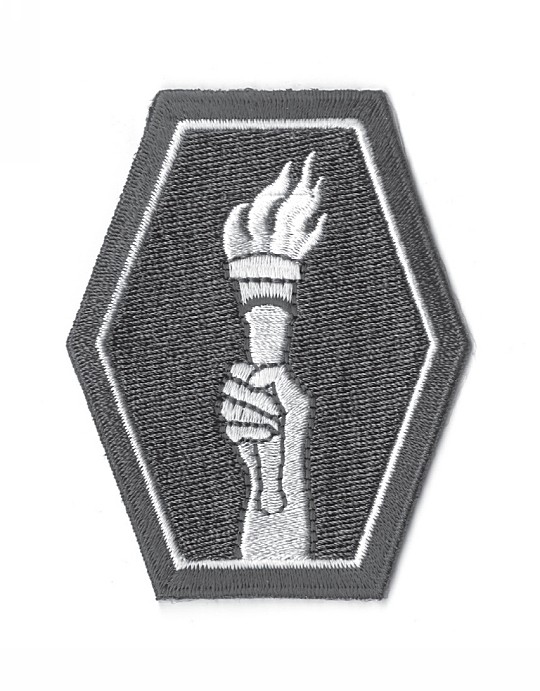
Hey, Keiko, I’m sending you one of our 442d RCT patches, like we wear on our uniforms. See how it’s got the torch of liberty and the national colors? You better keep it safe, huh? Keep it in your pocket or under your pillow so you dream of me at night, ha ha.
Be home to you soon.
Twitchy