VIII
With a Cherry on Top
Yuki, 16
October 1943
I’m waiting at the Main Gate with the other girls as the bus drives in. I’m so excited, I can’t stop smiling, even when my cheeks start to hurt.
It’s our first away game since we arrived in Topaz, and I am ready. Last year, things were too disorganized, everyone was still too scared of us, and no one cared enough about girls’ sports to give us a proper team. But this year, we’ve taken our destiny into our own hands. Not only have we organized a girls’ high school softball team, but we’re also playing in a real league like anybody else.
What a wonder, I think, to be like anybody else! Overhead, the nearby watchtower is empty. In fact, since the No-Nos left camp, every one of the watchtowers is empty. The gates are left unlocked all day and night, with only one guard on duty at the Main Gate after sunset. Best of all, we can come and go as we please. I squeeze through the strands of barbed wire on my daily conditioning runs. Last weekend, Mother and Father even took Bachan and me on a family picnic in the desert. Bette would have hated it—Sitting on the ground! All those bugs!—but Bette’s in New York now, and it just felt so normal. Like, after all the restrictions and the evacuation and the questionnaire and everything, we were finally regular Americans again.
Now we get to play Delta High, the closest school to ours, and show them that we’re just as good at the old American pastime too.
Since they’re basically our neighbors, the Delta Rabbits are our de facto rivals, but the Topaz teams love playing any Caucasians. We like beating them. We like hearing about other teams beating them in the news briefs from the other WRA camps. It’s like we’ve got something to prove, since we’re shorter and smaller and under-equipped and all that.
Not that I hate Caucasians or anything. I don’t hate anyone. Like, our coach, Miss Jenkins, is great. She’s one of the elementary school teachers who lives in the staff housing on the south side of camp. She has mousy-brown hair and porcelain skin Bette used to complain about all the time. How does she do it? Does she have no pores? Miss J. is also probably one of the nicest people ever, although she’s probably too nice, if you know what I mean. She’s lucky she’s a good coach, or no one would ever listen to her.
We clamber onto the bus, laughing and gabbing, and our bus driver, Mr. Gregson, nods at each of us as we board. “Afternoon, young ladies.”
“Hiya, Mr. G.” I flash him a grin and slump into the second seat, behind Miss J.
“Feeling good about the game today?” he asks.
I like Mr. Gregson, too. He lives in Delta, but he does a lot of the driving and work on the buses for the camp, so he’s here all the time. If you aren’t paying attention, he looks like he’s always cross, because there are all these lines on his forehead, and his mouth is always turned down at the corners like an upside-down melon rind, but his blue eyes are always twinkling with humor. I know he’s got kids at Delta Junior High, but I like to think he’s secretly rooting for us.
I nod as he starts the engine. “You bet!”
We rumble through the Main Gate, onto the dirt road that leads to Delta, and the girls let out a cheer. Across from me, Aki “Mori” Morikawa, our star chucker, pops her gum and winks at me.
I laugh. I like a lot of things about softball, but my favorite is that zing in the air before a game, like the other girls and I are electric, and sparks are flying from our feet and fingertips, and no matter what else is going on in school or camp or whatever, I’m sure, at that moment, that we just can’t lose.
Most of the team is fixing their hair for the game, because we can’t show up looking like a bunch of slobs, but every so often, someone starts up a cheer to teach the new girls, the ones who have only just gotten to senior high school or the ones we had to get to replace our No-Nos, like Mary Katsumoto.
“Hey, Rams!” Jane “Abunai” Inai calls, half standing in her seat. “What’s that sound in the air, I wonder?”
The rest of us start chanting, “It’s the Rams, ’cause we hit like thunder!”
“What’s that flash in the sky so frightening?”
We’re stomping on the floor now, our cries echoing off the metal ceiling, and good old Mr. Gregson is just tapping his hand on the steering wheel. “It’s the Rams, ’cause we run like lightning!”
“Boom! Rabbits, you’re gonna get beat!”
“Aki Morikawa’s bringing the heat!”
Then it starts all over again for a different girl, until we’ve gone through the whole lineup, and we all go back to talking and fixing our hair as we pass the chicken and hog farms that line the road to Delta.
Delta’s a sleepy little town, at least compared to San Francisco, but to us, who’ve been cooped up in camp for so long, the main drag is like a metropolitan paradise, even though I don’t think Bette would agree. There’s a deli, a secondhand store, a Bank of America, and Smith Grocery and Fountain, and everything closes at six p.m. As we roll down Main Street, I watch the Smith Grocery shop clerk serving up ice cream cones to a couple of blond-haired, pigtailed girls.
Boy, do I miss real ice cream. The prepackaged Eskimo Pies and Good Humor bars at the co-op store just aren’t the same—and that’s if you can get them, because even if you wait in line for an hour, they still might sell out.
By the time we reach the high school, the whole team’s buzzing with excitement. Quickly, we grab our gear from under the bus and start trotting toward the visitor dugout.
Except for me. I stop at the edge of the diamond with my chest protector and shin guards dangling from one hand, my mitt and helmet from the other, and I take a long, deep breath.
Mary and I used to do this before each game, just take it all in. The blue of the sky. The crack of the bat. I used to joke that this should be one of our inalienable rights: life, liberty, and softball. She used to roll her eyes.
The other girls are beginning to warm up. I guess our replacements aren’t bad, but our infield could’ve been better, I think, with Mary and Aiko, but they’re in Tule Lake by now. I wonder if they’re playing ball out there.
I hope so. I hope they’re showing those Tuleans how Topaz does things.
I kneel in the grass—it’s real grass here, not Topaz dust—and touch the ground. The blades scratch my palm, prickly as Mary herself. “Wish you were here,” I say.
My fingers catch on something smooth and cool. It’s a nickel, half-overgrown with grass. I pick it up, rubbing dirt from its faces. It feels like a sign.
Standing, I flick the coin into the air and catch it again before jogging off toward the rest of the team. Here we go, I think. Can’t lose.
Aki and I throw the ball around a bit to loosen up before we really get into it, and then it’s thwack! thwack! thwack! Ball after ball strikes my mitt. It feels good. It feels right.
Once it’s game time, we all stand for the national anthem, and as we salute the flag, I wonder how often Mas and the boys hear this song at Camp Shelby. I picture them on the parade grounds in perfect rows, except for Twitchy, who probably fidgets and makes faces at Frankie through the whole thing.
Then the Delta girls trot out onto the field, and we gather in the dugout, ready to take our turns at bat.
Thanks to Mary and Aiko’s help, I’m batting cleanup this year, which is pretty great, if I do say so myself. I worked my butt off all summer, and it’s nice to have something to show for it.
Boy, are the Rabbits going to be surprised.
I take my place on the bench as our leadoff hitter, Jane “Abunai” Inai goes up to bat.
“Abunai!” we shout. “Abunaaaaaai!” Danger! Daaaaanger!
She looks so glamorous in the on-deck circle, with long eyelashes, big hips, and a swagger like one of the boys. Before she steps into the batter’s box, she glances over her shoulder and gives us a wink.
We start cheering and whistling, howling up a storm.
There’s that feeling again, like we’re lightning about to fork down out of the sky, like we’re going to leave scorch marks in our tracks.
I touch the nickel in my pocket for extra luck. Can’t lose.
I lied. My favorite thing about softball is the feeling after the game, when you know you’ve held nothing back—you’ve obliterated the competition, and you’re on top of the world because you gave it everything you had, and everything you had was more than good enough.
We destroy the Rabbits. We beat them seventeen to three. We’re better on defense. We’re quicker to the ball. Aki strikes out one after another, the Delta girls swinging and missing every trick pitch. Jane lives up to her nickname and gets on base every time she’s at bat. I hit a grand slam in the third inning—my first ever!—and they shout my nickname as I round the bases, blowing kisses to my teammates.
“Yeah, Whitey!”
We’re like queens out there. No, like goddesses. We dominate the diamond.
When we get back, I plan on telling Minnow all about it. The Topaz Times never really cares about girls’ sports, but Minnow’s on the staff of the high school Rambler this year, doing drawings for them, and I’m going to make sure the camp hears about this, one way or another!
The sun is setting by the time we all scramble back onto the bus, sweaty and victorious and loud. “Good job, young ladies,” Mr. Gregson says with one of his slim smiles.
I climb into my seat near the front and congratulate the rest of the team as they pass.
“You did great today, Yuki,” Miss Jenkins says, taking her usual place in front of me as Mr. Gregson drives off.
“Thanks, Miss J.!”
“If you keep this up, you could play for the All-American Girls Professional Baseball League one day.”
“Me? Not a chance,” I say, laughing. “Those girls are the greats.”
I read about the AAGPBL in Father’s newspapers over the summer: the Belles, the Blue Sox, the Comets, the Peaches, Helen “Nickie” Nicol, Dorothy “Kammie” Kamenshek, Gladys “Terrie” Davis.
Miss Jenkins tilts her head. “Who knows? You could be one of the greats too.”
Grinning, I lean back, imagining myself in a Peaches uniform. Yuki “Whitey” Nakano, because my first name means “snow” in Japanese. Through the windows, there’s another one of those blazing Utah sunsets, the colors melting together like sherbet.
Like ice cream.
“It’s almost six o’clock!” I cry, bolting upright.
Miss Jenkins glances back at me, one thin eyebrow arched quizzically. “So?”
“So it’s almost closing time at Smith Grocery! What d’you say we make a stop for some ice cream, Miss J.?”
“Yeah!” Aki cries. She begins pounding on the seatback, chanting, “Ice cream! Ice cream!”
The rest of the team joins her. “Ice cream! Ice cream!”
Miss Jenkins looks flustered, her pale face turning pink. “Girls!” she cries.
“Don’t you think we deserve a little treat for our hard work?” I ask in my most reasonable Don’t be unreasonable, Miss Jenkins voice. “It was a good day, right? We won—no, we crushed—our first away game—”
There’s a chorus of whoops from the girls.
Miss Jenkins bites her lip, but I can tell she’s starting to cave. “I don’t know . . .”
“Please?” I ask, doing my best impression of Bette, who can charm anyone into anything. “Pretty please? With a cherry on top?”
She glances at Mr. Gregson in the rearview mirror. He shrugs, though his eyes are smiling.
“All right!” she says at last. “All right, you’ve convinced me!”
We cheer.
“But you’re not all going in,” she adds, attempting to be stern. “Smith Grocery doesn’t need you girls invading its aisles ten minutes before closing.”
We groan.
“Except for you, Yuki.” Miss Jenkins points at me. “You want to be the ringleader; you can come with me and carry the ice cream back for the rest of the team. What do you girls want?”
In a sudden flurry, everyone begins combing through coin purses and calling out orders. I grin as Miss Jenkins frantically scribbles everything on the back of our lineup.
We pull up alongside Smith Grocery with seven minutes to spare. From outside, the shop seems to glow with this yellow light, like a paper lantern or something. Inside, past the weekly deals and markdown notices, I can see the clerk in his white apron, wiping down the counter. He has a ruddy face and a few wisps of brownish-gray hair sticking out from under his paper soda-jerk hat, with blue eyes like Mr. Gregson’s.
Miss Jenkins and I hop off the bus. I’m so excited, I can barely keep from skipping into the store and doing a pirouette in the middle of the checkered floor.
The bell above us jingles as we enter the shop. The clerk looks over at us, but I only have eyes for the ice cream case: luscious chocolate, pale-pink strawberry, creamy butter pecan . . .
But when I glance up again, I recoil.
The man behind the counter is glaring at me, his eyes hard as chips of glass.
I glance over my shoulder. He’s probably seen the bus outside and doesn’t want to serve anyone so near closing time, I guess. But I don’t think seventeen scoops of ice cream—because we’re getting one for Mr. Gregson, too, obviously—is really all that bad, is it?
I let Miss Jenkins do the talking, since she’s a pretty white lady, and stand with my hands behind my back as we approach the counter, like I can make myself less intimidating that way.
“Good evening,” Miss Jenkins says brightly, even though the man doesn’t seem to hear her. “I hope it’s not too late to get some ice cream. The girls just won their game, and . . .”
Her voice kind of peters out at the end as she realizes the man isn’t even looking at her.
He’s looking at me.
I’m already pretty small—in the AAGPBL, they could call me Yuki “Shorty” Nakano—but as the man glares at me, I wish I could make myself smaller. I take a step back.
“Um . . .” Miss Jenkins clears her throat and glances at the slip of paper with our orders on it. “One strawberry on a sugar cone, please, two fudge ripples in cups, one chocolate on a waffle cone . . .”
The clerk’s face is getting red now, redder and redder with every second, his eyes turning sharp and dangerous.
Abunai, I think.
I try to stop her, tugging her sleeve. “C’mon, Miss J., let’s just go, okay?”
But she ignores me, or doesn’t hear me, or doesn’t want to, because she keeps going, “One chocolate chip with a cherry on—”
“WE DON’T SERVE JAPS HERE!” he bellows, like he can’t hold it in anymore. His voice is so loud, it echoes in my head.
JAPS
JAPS
JAPS
Unlike an echo, it doesn’t get any softer.
I stagger backwards a little, blinking. This isn’t the big city, where Bette gets called “Jap” by strangers. The Deltans know us. They work alongside us. They’ve played on our baseball diamonds. They’ve performed talent pageants for us, same as we’ve done for them. They know we’ve never done anything wrong.
How can they still hate us?
Miss Jenkins stiffens like she’s the one who’s been called a dirty word. She grabs my hand so tight that at first I think I’ve done something wrong.
But then I see her teary, scared-looking face, and I know I haven’t done anything. Angrily, I jerk out of her grasp and storm outside. Overhead, the bell jingles dissonantly in my ears.
Miss Jenkins is sobbing as we walk back to the curb. It’s fully dark now, the sky a sort of mulberry purple. Behind us, I hear the door lock with an audible click. I don’t turn around. I don’t want to see his blood-filled face, his hateful eyes.
“That man!” Miss Jenkins is saying, her voice weepy. “That horrible man! I’m so sorry, Yuki—”
I cut her off. “Stop crying, Miss Jenkins.” Like I’m the adult and she’s the kid. Like I’m scolding her for something she should’ve known. Because shouldn’t she have known? “Let’s just get back to camp, okay?” I try to soften my voice, like she’s the one who needs protecting, even though she’s the one who’s older.
And white.
I don’t know why, but I kind of hate her for that. For being white. For putting me in that position. For not standing up for me. For being so weak that I have to be the strong one.
I kind of hate her the way I hate the clerk. And the girls of the All-American League, because I know now I’ll never play with them. And I hate myself a little bit too, for thinking it could’ve been any other way.
Nodding, Miss Jenkins hiccups a few times and wipes her eyes. I glare at the back of her head as she boards the bus in silence.
Mr. Gregson watches me solemnly as I climb the steps. “I’m sorry, young lady,” he says.
“Yeah.” I don’t look him in the eyes when I say it. He’s got blue eyes, like the man behind the counter. Without a word, I sink as low as I can into my seat, where I can’t be seen.
I thought things were normal again. I thought I couldn’t lose.
But maybe it’s my fault, because it took me until now to realize it—as long as this is our normal, people like me can always lose.
The sky has been drained of all color now, and in the darkness, the only sign that we’re nearing camp is the sour miasma of livestock. Through the window, I see the silhouette of the Main Gate watchtower.
Laying my forehead against the glass, I stare at the camp grounds as the bus stops and the engine dies.
The guards may be gone, but the towers and the cattle fences haven’t been torn down. The camp hasn’t been dismantled. We may have said “Yes” and “Yes” to the questionnaire, but we’re still here.
I collect my gear, shivering. If they still treat us like this, what is it going to be like for Mary and Aiko, in the segregation camp with all the Japs who refused to say they were loyal to this country?
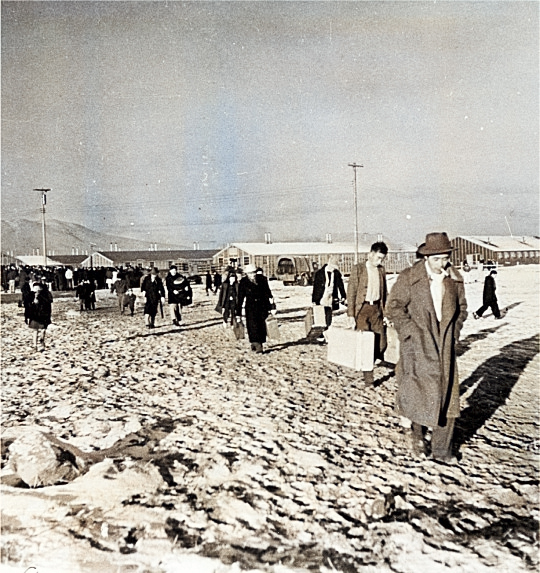
Tule Lake Segregation Center, California