VII
Team Player
Aiko, 14
March–September 1943
The day after the shooting, they don’t just cancel school, they cancel everything. No work, no co-op, no nothing! All the normal camp stuff screeches to a halt, and what’s left is this sudden turn, like everything has gone sideways.
Peeking through the curtains, I watch people running through the streets with shovels and pieces of lumber. It’s like they grabbed whatever they could get their hands on and thought, This’ll do some damage.
“Aiko!” my mom cries. “Get away from there!”
I ignore her. I do that a lot. It’s my older brother, Tommy, who’s the obedient one, even if our parents never give him credit for it, just like it’s Tommy who draws me away from the window.
At the back of the barrack, our mom grabs my wrist and yanks me down to the floor where she’s sitting with my younger sisters, Fumi and Frannie. She doesn’t thank Tommy for bringing me over, of course, but no one expects her to. She and our dad demand a lot from Tommy because he’s the oldest and a boy, but no matter what he does, it never pleases them.
I plop down cross-legged, pouting.
Our dad takes my baseball bat from the stand near the coat rack. Okay, if you want to twist my arm about it, it’s technically Tommy’s bat—our dad gave it to him when he was ten and I was seven, to try to make him more active, I guess. But Tommy never did anything with it, so it’s mine now, or at least I think so.
Our dad turns away from us. Sometimes when I think of our dad, all I can picture is the back of him: shiny black hair, thick neck, hunched shoulders.
“Stay here,” he tells us. Our mom cries out again in protest, but that doesn’t stop him from walking out the door.
For a while, we huddle on the barrack floor. Mom tries to keep Fumi and Frannie occupied with their dolls, and I flip through an issue of Captain America I’ve read so many times, I could describe each panel with my eyes closed.
But it’s hard to concentrate with the crowds roaming the streets outside. Every so often, we hear someone cry for justice for Mr. Uyeda.
There’s a knock at the door.
Our mom squeaks. Tommy jumps.
I’m already on my feet when our mom catches my wrist again. “Let your brother get it.”
I tap my foot impatiently as Tommy creeps toward the door. “Who is it?”
“It’s Mas.”
I brighten immediately.
I know it’s stupid, but for a long time, I was sure Mas Ito was a superhero in disguise. I mean, just look at him, there in the doorway: broad shoulders, big chest, more muscles than I know the names of. He looks like Superman. Put a cape on him, and I’m telling you, he’d be able to fly.
“It’s getting bad out there,” he says to Tommy. “We’re going to see if we can calm things down a bit. Want to come?”
Tommy glances back at our mom, who shrugs.
It stings, the way she doesn’t care about Tommy, but not bad enough to stop me from raising my hand and saying, “I do!”
Mas smiles at me. That’s another thing I like about him: he never treats me like I’m just Tommy’s kid sister. “Someone’s got to stay behind to look after the family,” he tells me.
I straighten at that, even though I know it’s just a nice way of telling me I can’t come. Like always.
Sometimes, I wish me and Tommy could trade places. Then our mom and dad wouldn’t give him such a hard time, and I’d get to hang around with the Japantown guys without them always telling me to go home.
Through the doorway, I see a group of people run past, yelling in Japanese.
“Don’t worry, Mrs. Harano,” Mas says, even though all of us know she never worries about Tommy unless he’s doing something she thinks will reflect poorly on her, “we’ll bring him back safe and sound.”
As soon as they close the door, I squirm out of our mom’s grasp and shove my feet into my shoes. I’m always the one who has to stay behind. I’m always the one who gets left out.
Not this time.
This time, I’m not a kid anymore. I’m fourteen. Plus, no one’s around to stop me.
“Aiko!” my mom snaps. “Don’t you—”
“I’ll be back soon!” I race out of the barrack after Tommy and Mas. From a distance, I watch them join up with Shig, Frankie, Twitchy, and Stan Katsumoto, and they head into the furor, breaking up fights and stopping acts of vandalism. Boy, I wish I could be up there with them!
But I trail behind, far enough that they won’t notice me and tell me to go away.
Actually, no one seems to notice me at all. They’re too busy yelling and getting in each other’s faces. It’s like I’m invisible, slipping past grown men with their rakes and makeshift clubs.
I lose track of the guys in the big crowd by City Hall. It’s noisy and people are crammed together like tsukemono in a jar, turning sour in their own anger. I hang around by some steps in the back, searching for Mas’s superhero silhouette.
But before I can spot him, the gates open, and the military police flood into camp. They take up positions in front of the administration buildings, yelling at everyone to disperse. The barrels of their Tommy guns make black arcs in the February air.
The crowd panics.
I try to run, like the Flash, but I’m too slow. People charge past me—they’re loud and they smell like fear and sweat—and suddenly someone rams into me from behind. I hit the ground, hard, and someone tramples my hand. There’s this pain in my fingers, sharp as the crack of a bat. Everyone is so much bigger than me. They can’t even see me, down here in the dust. I’m too small, too invisible.
I’m going to be crushed.
Then someone shouts, “Aiko!” and I look up.
Mas Ito is barreling toward me, flanked by the Japantown boys. He scoops me up in his arms, and all of a sudden, the roar of the crowd gets really, really quiet, and I hear Tommy shouting, “Aiko! Ike, are you okay?”
I look around. Above me, Mas is breathing hard, but he’s carrying me so carefully, I’m not even being jostled. Next to us, the other guys are pushing people out of our way, Frankie laughing like he’s having the time of his life. I smile. “I am now.”
The military alert is called off the next day, so the soldiers can’t have riot weapons anymore. But they keep their side arms, and a lot of men in camp still carry around wrenches and clubs for protection.
Topaz City simmers with fear and anger. Our dad goes out early, and he takes my baseball bat with him. School remains closed, and the work stoppage continues, so no one goes out to the fields.
But people have still got to be taken care of, so the hospital and dining-hall staffs report in as usual.
I wonder if Twitchy and Stan will, too, since they’re in charge of delivering the food for the dining halls. All morning, I wait by the window to see if they’ll drive past, and when the truck comes, I run after them, ignoring my mom when she tells me to come back.
When I arrive, panting, there’s a crowd already there, and at first I think they want to help too, but then I realize they’re shouting while the boys jump out of the truck.
They’re calling Stan and Twitchy “traitors” and “strikebreakers.” As the dining-hall employees come out to help bring in the food, the crowd yells at them, too, shaking their fists.
I screw up my face the way our mom hates and start forward to help.
Someone catches me by the arm.
Tommy. He must have come after me. He’s out of breath as he says, “No, Ike.”
I tug away from him, disgusted. “Come on, Tommy. Those are your friends out there. What would Mas do if he were here?”
He swallows. After a moment, he nods.
Before anyone can stop us, we grab one of the potato sacks. The hand that got stepped on yesterday spasms, and I almost drop my side of it before I get my grip again.
“Aiko? Tommy?” Stan Katsumoto says. Behind his glasses, his eyebrows go way up into his hairline. “What—”
“Tommy!” someone snaps.
I know that voice. Eyes wide, Tommy and I turn, still clutching the potatoes.
It’s our dad. He’s standing there, his jaw tight like it gets sometimes, and he’s holding my baseball bat. It looks scary in his hands, like it’s not something you use to play games, but something else, something used to hurt people.
“Put that down,” he says.
Tommy flinches.
“We just want to help?” I say. It sounds like a question, even though I don’t mean it to be. The potatoes are getting heavier in my arms, and my injured hand is starting to throb.
“You shouldn’t be helping them.”
“Morning, Mr. Harano,” Stan Katsumoto says, coming to stand beside me. “Looks like you’re having a productive morning.”
Twitchy snickers. None of the guys like my dad very much because of the way he treats Tommy. I don’t really like him for that either, but, well . . . he’s my dad.
I look up at Stan. Tommy said he was there when Mr. Uyeda was shot. The internal police held him and Mr. K. all night for questioning and didn’t let them go until it was time for them to register.
Now the Katsumotos are No-Nos, like us.
Like our dad. And probably the rest of the crowd too.
But Stan’s still here, with his friends. So is Tommy. And so am I.
My dad’s eyes narrow at Stan. “The ketos are never going to listen to us if we’re not united.”
“So you’re harassing the cooks.” Stan’s words are pleasant, but his tone cuts. “Great strategy, Mr. Harano. I feel more united already.”
My dad glares at him, but it’s me and Tommy he barks at: “Tommy, Aiko, go home.”
“But Dad—” Tommy begins. There are tears in his eyes and a waver in his voice.
Don’t cry, I think. Dad hates it when you cry. Especially in front of people.
“Now!” our dad shouts.
But Tommy doesn’t move, the tendons in his neck sticking out with his effort to hold back the tears, until Twitchy nudges him gently. “We’ve got this, Tommy. It’s okay.”
The sack of potatoes makes a scraping sound as we slide it back onto the truck.
Tommy’s fists are tight at his sides as we walk away from the crowd. Tears make streaks down his face, but he doesn’t bother trying to hide them now.
I take his hand, which, after a moment, relaxes into mine.
The tenth day after the shooting, all the military police except one guard at the gate are withdrawn, and for a while, it seems like things are going to return to normal.
Except it’s like the shooting broke something in camp, and nothing can fix it.
Some people return to their jobs after a while, but for others, Mr. Uyeda’s murder was the last straw, and they’re finished cooperating with the Caucasians. For months, our dad doesn’t go to work at the hog farm. Instead, he meets with other No-Nos to talk about how they can protect themselves. In the streets, there are arguments between “loyals” and “disloyals.” They say we’re troublemakers. They say we’re ungrateful for all the things America has given us. There’s talk of shipping us off to another camp, maybe a prison camp like Santa Fe, which is run by the Department of Justice, not the WRA.
One Sunday in April, a reverend is attacked for being a No-No. A couple days later, some people find the guys who jumped him and chase them down with two-by-fours whittled into clubs.
Some people stop talking to me because I’m from a No-No family. I feel their cold stares on me at school and in the dining halls.
More and more, the camp separates. We’re being wedged apart by the Caucasians and their questionnaires, by guys like “Old Issei,” who wrote that editorial saying all the No-Nos should be shunned, and guys like my dad, who say the Yes-Yeses are sniveling cowards.
But us Japantown kids stick together.
We walk to school as a group, No-Nos and Yes-Yeses both. We eat dinner on the same block, usually the Katsumotos’, because Mrs. K. works there, and she knows how to turn the limited rations the administration gives us into nice Japanese meals.
Mas organizes basketball games on the weekends. When Yum-yum hears I’m failing math, she offers to tutor me, and my parents actually agree, because one thing they hate more than Yes-Yeses is bad grades. One Friday night, Bette invites all the girls to her barrack, where she makes us try on lipsticks and rouges and talk about who we have a thing for.
I don’t really like it—I don’t think anyone does, except Bette—but everyone humors her. Luckily, Mary Katsumoto is there too, and she’s so grumpy and annoyed that it makes the rest of us laugh.
I like it better when Twitchy teaches me and Keiko to pick the locks on the iceboxes where the commissary keeps its produce and cheeses. I can hardly believe he lets me tag along, but when I say I want to come, he just winks at me and ruffles my hair. “Delinquent in the making, huh? Don’t tell your brother.”
At the beginning of May, the night before Mas, Frankie, and Twitchy leave for basic training with the 442nd Regimental Combat Team, Shig throws a party. Mrs. Ito clears out of the barrack to spend the evening with her knitting club, and the boys have the whole place to themselves. They mix up some punch from water, dissolved jellies, and slices of fresh fruit I bet Twitchy stole from the commissary. They stack the beds against the walls and set out chairs for the wall-flowers.
Best of all, they let me come.
I’m the youngest kid here, but I don’t mind. I sit off to the side with Minnow, who’s got his sketchbook in his lap.
I’ve always resented Minnow—a little bit, at least—because he got to hang around with the Japantown guys, even though he’s only a year older than me and can’t even help them out in a brawl.
Since they’ve started inviting me to stuff, though, I’ve started hating him a little less.
Now he’s drawing the dancers, legs kicking, skirts flying. Everyone’s just a few squiggles, but somehow, he’s getting down every leap, every dip.
“Say, you’re really good,” I tell him.
He glances at me, smiling shyly.
“You should be on the Rambler staff or something,” I continue. “I bet they could use a guy like you on the school newspaper.”
Mary Katsumoto slumps down between us, arms crossed like she isn’t having any fun at all.
“What’s the matter?” I ask.
She glares at me, even though I know she’s not mad . . . not at me, anyway. “Stan didn’t let me bring a book.”
By nine o’clock, the apartment is so full, you can barely hear the sound of Mas’s Silvertone radio playing in the corner. People are laughing and talking and dancing, and when someone complains how hot it is, I get up to wrestle open the windows while Twitchy sidles over to the punch bowl with a flask in his hands.
When I sit back down again, Tommy won’t let me have any more to drink, so I watch the others.
Keiko stands in the doorway, flapping the back of her shirt in the cool night air, while Twitchy stands next to her, close but not touching. He’s always real careful around Keiko, I’ve noticed, like she’s a queen and if he touched her by accident, he’d have to chop off his own hand for offending her.
. . . Except when they return to the dance floor, and their hands are all over each other.
I look around for Mary, trying to catch her eye, but she’s curled up in the corner, reading one of Mas’s books.
“—thinking of applying for resettlement,” Shig is saying on the other side of the room. “It’s time to get outta here. Maybe I’ll go to Chicago, the City of Light!”
Bette fluffs her blond wig. “That’s New York, you dolt.”
“New York’s the City That Never Sleeps.” Yum-yum laughs.
Bette looks dismayed. “But it has all those lights!”
Frankie chuckles, but he’s watching Bette like he’d still adore her, no matter what she said. I don’t think she notices.
“Having fun, Aiko?” Mas sits down next to me. His shoulders are so wide, he has to scoot over so he doesn’t crowd me.
I nod so hard, I’m afraid my head’s going to topple right off my neck. “It’s a great party!” I say a little too enthusiastically. “Are you excited? About leaving tomorrow?”
He shrugs. For a second, I think he’s going to do that thing boys do when they try to act tough, but he doesn’t. Mas doesn’t need to act tough, because he is tough. “More nervous than excited, I think.”
Nervous? Mas Ito? “Why?” I ask.
He laces his fingers together and stares at the floor for a second before looking back at me. “You know how, after Pearl Harbor, it felt like everyone in America was watching us? And it felt like we had to be extra careful not to give anyone the idea that we still had ties to Japan? Because if we slipped up, it didn’t just mean that we were un-American, it meant that everyone—our family, our friends, everyone—was un-American and didn’t belong here?”
I nod solemnly. It makes me think about how our mom and dad treat Tommy, too, how they act like everything he does or doesn’t do represents them somehow, even though Tommy’s his own person.
“It’s going to be like that, I think,” Mas says. “But . . . more.”
“Don’t worry,” I say loyally. “You’re going to be the best soldiers the army’s ever had.”
He smiles, but it’s strained at the corners. “We’d better be.”
Before I can say anything else, Bette calls him over. She’s corralling the guys off to one side so she can take a photo with the camera she ordered back in February. Frankie glares at her. Stan Katsumoto’s wearing a smirk like it’s an old comfortable jacket. Mas stands at the center of them all, beaming, with each of his brothers under one arm. Shig’s laughing, but if you’re paying attention, you can see he’s gripping Mas so tight, it’s like he doesn’t ever want to let go. Minnow’s hand is out, trying to pass a folded piece of paper to Twitchy, who’s pulling faces at the camera.
Tommy’s in the foreground, smiling like he never smiles when he’s with the family, because here, no one expects him to be something he isn’t. Here, he’s accepted just as he is.
Just as we all are.
Have you ever noticed how cranky people get in the heat? It’s like the hotter it is, the meaner they get. In June, two guys get in a fight with rocks and razors. A week later, there’s a brawl in one of the rec centers. People are taking bets on where the government is going to send the No-Nos.
Heart Mountain, in Wyoming?
Amache, in Colorado?
Jerome, in Arkansas?
I don’t think it matters where we’re sent. They just want us gone, even kids like me who weren’t old enough to answer the loyalty questionnaire for ourselves.
To make matters worse, without Mas, the group just kind of dissolves. First, Shig takes over Twitchy’s job driving the commissary truck, but my parents won’t let Tommy join them. Then Yum-yum starts working at the summer camp my dad won’t allow me to go to, and Keiko gets a job at the commissary office, so hardly anyone’s around anyway. There are no more basketball games, no more girls’ nights, at least not that I’m invited to.
It’s only Yuki who keeps some of us together. She wants to improve her batting average for next season, so she ropes me and Mary into practicing with her.
As much as I love softball, though, I can’t really get excited about it. I’m going to be in tenth grade, which means I’ll be old enough to play with them on the new high school team . . . if the government hasn’t sent us No-Nos to another camp by then.
Plus, Dad still has my bat.
The adults and boys usually take up the baseball diamonds on Blocks 15 and 21, and they never let us play, so we have to use the recreation area between Block 36 and the fence.
“That’s where Mr. Uyeda got shot,” Mary points out.
“I know.” Yuki bites her lip. “But where else can we go?”
By July, though, we’re tired of drills. We want to play a real game.
And I want the group back together.
It takes some wheedling, but I convince everybody to meet on the Block 15 baseball diamond. With nine of the Japantown kids left in Topaz, we’ve got a team, and Yuki’s bossy enough to make the boys who are already there agree to play us.
I mean, it’s not like we’ll win. Bette’s chatting with a couple boys in the outfield. Tommy’s dropped every ball that’s come his way. Minnow couldn’t hit the broad side of a barn. At third base, Shig’s not even that great, even though he makes up for it in trash talk.
It’s lucky we’ve got Yuki behind home plate in the catching gear we borrowed from the rec center. And Mary, who’s playing shortstop like usual, fields everything between second and third.
Keiko’s the biggest surprise, playing first base. She just has to stretch out her glove, and the ball goes straight into it, like it’s effortless. She doesn’t even have to look.
But me, Yuki, Mary, and Keiko aren’t enough to carry the team. By the fifth inning, we’re down seven to two. At third, Shig’s smacking his mitt and chattering, “Hey, batter-batter-batter, swing, batter-batter—”
He stops abruptly at a commotion behind him in the barracks. Someone’s shrieking.
It’s a man, I realize, as a figure comes scrabbling out from behind the recreation building. He’s off-balance, clawing at the dust.
Seconds later, two guys come running after him. They’re kicking him into the dirt. This far off, I can’t hear him grunt, but his body makes a sharp angle like the wind’s gone out of him.
I’m thinking a million things at once.
Is he a No-No?
Are they?
Does it matter?
What would Mas do?
I take off before anyone can stop me. I race past Mary, who’s watching me, dumbfounded, the ball still clasped in her throwing hand.
“Ike, wait!” Shig cries.
I ignore him.
The attackers don’t notice me coming up behind them, which I guess gives me the advantage of surprise, but what am I going to do? They’re grown men, and I’m just a girl.
But before I reach them, the ball comes whizzing past me. Thwock! It strikes one of the attackers’ shoulders, making him crumple.
I glance behind me. Mary’s thrown down her glove, and she’s running for them now, her face set like she’s going to bowl them both over if they get in her way.
Everyone else is with her too. Shig’s closest, but Keiko and Stan aren’t far behind, and even Bette’s running in from right field, her black hair flying out behind her.
Then I’m there in the attackers’ faces, my lips peeled back from my teeth in a snarl as mean as Frankie’s, yelling at them to back off.
It’s a good thing Twitchy taught me how to punch. Maybe I can hit one of them hard enough to knock him out of the fight.
The men hesitate. Maybe they’re wondering if they can beat up a girl.
But I’m not just a girl anymore.
I’m all of us. Shig and Mary are right there beside me. And Stan and Keiko and Tommy and Minnow and Bette and Yuki, who’s got a bat!
She’s screaming, “Leave him alone!” Bette’s trying to calm her down, but she just raises the bat like she’ll crack them good if they try to cross her.
I thought I’d get a kick out of seeing us together ready to brawl, but I don’t. I mean, we’re just kids. We should be playing the game. Why can’t they just let us play the game?
The attackers turn and run. We watch their retreating forms turn the corner of the rec center.
Tommy and Minnow help the guy on the ground to his feet. There’s blood coming from his nose, speckling his shirt.
“That was pretty stupid, Ike,” Shig says, but he’s grinning. “Frankie would be proud.”
Stan rolls his eyes. “ ’Cause we should all be worried about what Frankie Fujita thinks.”
His remark doesn’t bother me, though, because we do care what Frankie would think, just like we care what Twitchy or Mas or any of us thinks.
I smile, but it doesn’t feel like a real smile, because the game is over. Shig and Stan help the beat-up guy to the hospital. Everyone else just kind of drifts off until only Yuki and I are left.
“You okay, Ike?” she asks.
Not looking at her, I grind the tip of the bat into the dust. “We lost.”
The next day, we get the news. We know for sure. Segregation’s going to start in September, and all the No-Nos are going to be shipped off to Tule Lake in California.
All through August, we pack. Our dad and Tommy take lumber from the scrap piles and refashion it into crates. Our mom goes through the barrack, tagging items for Tule Lake, for friends we want to leave them to, for the trash.
It reminds me of the days before we left San Francisco, only this time, we have less. We don’t have Tommy’s phonograph or his record collection. We don’t have a decade of comic books. We don’t have Fumi and Frannie’s kokeshi dolls or our mom’s shamisen she brought from Japan.
But it still hurts. It’s like we’re pulling up our roots, coming out of the dry soil, all our fragile threads breaking.
Snap! There goes the softball team I could’ve belonged to.
Pop! That’s Tommy’s hopes of getting into college.
Worst of all, the next time we’re all together in the dining hall, Bette announces that she’s going to apply for resettlement.
“I just have to fill out a form,” Bette says with a shrug that looks like she practiced it in the mirror. “Since the WRA’s set up field offices all over the country, I don’t have to have a sponsor or a job or anything. I don’t even have to wait for a background check like they used to.”
Like they used to before the loyalty questionnaire, she means.
I clench my fists.
She can do this because she said “Yes” and “Yes.”
“Just one form,” she repeats gaily, “a photo ID, and, Bob’s your uncle, I’m a free woman!”
“How could you?” I shout.
Bette blinks. “Aiko, I don’t—”
“You could have waited!” I explode out of my seat, towering over her, fists shaking. I don’t know when I’ve been this mad. “You could have waited for us to leave before you broke us up!”
“Aiko,” Shig says in that easy, reasonable voice of his, “c’mon, you know she didn’t—”
I shrug him off angrily. “But you just couldn’t wait for us to be gone, could you? You just had to get out of here sooner than that!” She’s staring at me. There are tears in her eyes, but I don’t care. “Well, we don’t need you!”
I storm out.
The wind swirls around me, blowing me back a few steps before I charge forward again.
I don’t know where I’m going. I just want to go somewhere.
No, a little voice inside me says. I want to stay. I want everyone to stay.
I don’t make it very far when someone catches up to me. It’s Keiko. I can tell from how she kind of sways when she walks, but not in an annoying way like Bette. I let her walk with me.
The sun sets. Overhead, the sky is a blaze of reds and oranges, like the world is burning down around us.
“Everyone’s leaving,” I say.
I’m not looking at her, but I think she shrugs. “Everyone always does.”
I remember belatedly that her mom and dad are still gone. And Twitchy. For a second, I feel guilty and stupid, but then I’m angry again, and I stop in the middle of the street. “But it’s not fair,” I say.
One of her eyebrows goes up, and she flicks her fingers like she’s brushing away a bit of lint. “Life’s not fair, Ike. Haven’t you figured that out by now?”
My face twists again in the way that Mom hates, but I can’t help it. I don’t want to cry in front of Keiko.
I just . . . want things to be fair, and they’re not, and I can’t stop them.
I couldn’t stop Japan from attacking Hawaii. I couldn’t stop the U.S. from locking us up and pitting us against each other. I couldn’t stop Mas and Frankie and Twitchy from leaving.
Or Bette.
Or anybody.
I want to believe that if I were bigger, or older, or stronger, or a boy, or a superhero from one of my comic books, I’d have been able to do something. Stop something. Punch a bad guy. Storm into the White House. Shield Mr. Uyeda. Stand up to my dad. Snap the fences. Something.
But I don’t think that’s true either. I want to believe in superheroes, but I think some things are just too big for one person, even a super one.
And that’s not fair. That’s not fair. That’s not fair.
Keiko keeps walking, and I trail after her, hiccupping, trying not to let the tears fall, trying not to let her see that I’m not as tough as her.
Because Keiko is really tough. Not in the way that Frankie’s tough. Not in the way that Mary or Bette is tough.
She’s kind of weathered, if you know what I mean. She’s like one of those bonsai trees Mr. Hidekawa used to collect from the Sierras, all curved and windblown and beaten down by snow, but graceful and strong. Life’s not fair, but she doesn’t need it to be fair, because she can take anything life throws at her, and she won’t break.
A little over three weeks after Bette submits her resettlement paperwork, she gets her indefinite leave clearance.
Indefinite leave. That means she doesn’t have to come back. Ever.
She says goodbye to us at the Main Gate. “I’ll write,” she says, tweaking my chin gently.
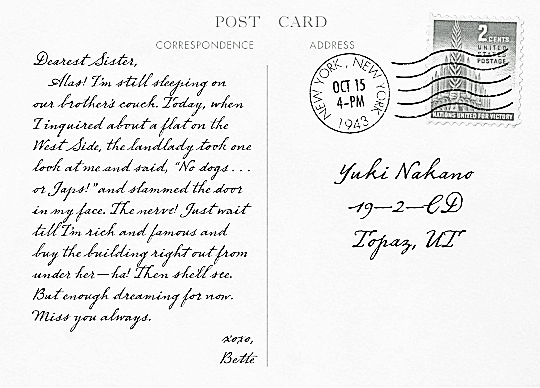
Then, without a party or anything to mark the departure of yet another of us, she hops on a bus to Delta, where she’ll board a train to New York.
I hope she’s happy there in the big city, under the bright lights.
The night before we leave, I can’t sleep. Even when I close my eyes, all I see is the barren apartment. The empty shelves. The hungry closet. For hours, I flop and turn, curling and uncurling, my cot creaking under me.
I don’t know what time it is when my dad gets up, but the light through the windows, which no longer have curtains, is blue and cold as he walks across the floor. He’s standing in the doorway, and all I can see is the back of him. Tight shoulders. And my baseball bat in his hand.
I sit up. I don’t know where he’s going. There hasn’t been an attack in days. There’s no one to retaliate against. No one to hurt.
But maybe he’s like me.
Maybe he wants to do something. Break something. Make a statement. Say, This isn’t right. Say, I’m not okay. Say, Goddamn you for all of this.
“Dad,” I say.
He freezes, one hand on the doorknob. “Go back to sleep, Aiko.”
I stand, ignoring him. The Masonite is cold and smooth under my bare soles. “Give me the bat,” I say.
He almost turns. I almost see his face. “What?”
I advance on him, padding slowly across the blue-tinged floor. “It’s mine. It’s for baseball. It’s for games. It’s not for . . . for whatever you’re planning.” I extend my hand, fingers trembling. “Give it to me.”
I don’t say “please.” I don’t need to.
He owes me this.
Or, well, someone owes me something, and if it can’t be any of the other things that would bring us back together in this stupid world, then it might as well be my baseball bat.
He doesn’t hand it over, though—he drops it, and it lands on the floor with a clatter, bouncing a little from knob to end cap.
Frannie and Fumi start crying.
Our dad walks out the door.
As Mom and Tommy get up to comfort the twins, I collect my bat and crawl back into bed, leaning the bat against the side of the cot, where I grip it tight.
Slowly, the barrack quiets down again, and everyone drifts back to sleep.
Except for me. I stay awake for a long time, clutching that baseball bat. Under my fingers, the wood has been worn smooth from all the times we played pickup games or Three Flies Up, from all those hands that have touched it, and I wonder if they’ve left their mark somehow, soaked into the grain like sweat or blood or love—Mas’s hands, Frankie’s hands, Twitchy’s, Bette’s, Yuki’s, Yum-yum’s, Keiko’s, Shig’s and Minnow’s and Stan’s and Mary’s hands.
And my hands.
And Tommy’s hands.
I fall asleep like that, one hand closed around my bat, and I’m still holding on when I wake.