III
I Am Not Free
Yum-yum, 16
May–June 1942
Day 1
It’s a shock at first. One minute, Mom, Fred, and I are traversing the roads of San Bruno, California, like we’re on a road trip down Highway 101, headed for Los Angeles. The next, we’re being ordered off the buses between guard towers and armed soldiers, a barbed-wire fence separating us from the rest of the city—its streets, its schools, its citizens, wandering free.
As we’re herded toward the nearest buildings, I wonder if we’ll ever be allowed to wander again.
Between Mom and me, my younger brother, Fred, fidgets and tugs at our hands. At nine years old, he’s small for his age, with a cowlick at the back of his head that won’t stay flat, no matter how much you comb it. Mom likes to say it’s as unruly as he is.
I pull him closer.
Ahead, the crowd splits. Men are shuffling into one building; women, into another. Medical examinations, someone says. They want to make sure we’re not diseased.
Bowing, Mom approaches one of the soldiers. “My son is only nine years old,” she says in Japanese, clinging to Fred like the rush of people will take him from her the same way the FBI took my father last December—swiftly, almost soundlessly, so quick we barely had time for last words. “He has no one to accompany him.”
Sensing the soldier’s impatience, I translate quickly.
“What about her husband?” the soldier asks.
“Missoula,” I tell him. Montana. My father is a good man—he’s always done right by us. But now he’s in a prisoner-of-war camp almost a thousand miles away, and he looks to me to do what he cannot.
The soldier shrugs. “These are the rules.”
My mother doesn’t need to be fluent in English to understand his indifference. Her grip on Fred tightens.
I waver. We can’t be separated. I can’t let us be separated.
“Beishi!” Fred squeals suddenly, wriggling out of Mom’s grasp as he chases one of his friends from Japantown into the men’s line.
Mom tries to cry out, but she doubles over, coughing.
So I’m the one who acts. I have to be. I dive after him, but a soldier shoves me back. “Men this way. Women that way.”
“But—”
“These are the rules.”
Standing on tiptoe, I catch a glimpse of Fred’s cowlick as he squeezes into the men’s building. For a moment, I wish for my father, and for my father’s advice. He’d know what to say. He’d know how to keep us together.
But then I remember how docilely he went with the FBI agents that night: the hollow clop-clop-clop of his heels on the sidewalk, the stoop of his shoulders, the moonlight on the back of his bowed head. And I know he would have done the same as I do now—the same as we all do.
Obey.
The examination room has curtained cubicles to undress in, but the hakujin nurses are careless with the partitions, and the women cover their chests and bellies as best they can with their hands, avoiding one another’s eyes.
“Here? In front of everyone?” Mom coughs—a delicate sound, hastily smothered, like a secret.
“The faster we do it, the sooner we can find Fred,” I assure her, though I feel anything but sure.
In the cowed quiet, every noise is as loud as a landslide: sniffles, shifting feet, shame. Somewhere nearby, one of the Issei women begins weeping.
A few cubicles down is Hiromi Nakano in her blond wig. The day she wore it home, her father was furious, thinking she’d dyed her hair. He raged at her for almost ten minutes, his face turning red as a plum, before she finally took it off, laughing and waving it in his face. She still wears it when she’s feeling rebellious.
Today, she removes it when she’s ordered to, the wig dangling limply from her hand as a nurse inspects her scalp for lice.
In the cubicle, I disrobe beneath the impersonal stare of my nurse. As I look away, embarrassed, I spy Keiko Kimura across from me. Her parents were teachers at Soko Gakuen, one of the Japanese schools, before they were taken by the FBI the same night as my father.
She and I are the same age, but we went to different schools, joined different clubs, had different friends. I’d see her around, of course, but we rarely spoke to each other. Through a gap in the curtains, I can see her bare shoulder, her hip, the length of her thigh.
Unlike with Hiromi, or anyone else in the examination room, we lock eyes. For a second, her gaze flicks over me, almost carelessly, and she grins, mouthing something I cannot hear even in the stifled quiet.
“What?” I whisper.
She does it again, but her words are still unintelligible.
“What?”
Exasperated, Keiko rolls her eyes. “I said, ‘Nice kabochas’!”
I gasp. Everyone—the women, the nurses, the guards—they all turn to glare at me.
“Keiko!” someone says sharply.
“Shitsueri!” Rude!
“Sukebe!”
Then Hiromi Nakano snorts. Someone else starts giggling. Mortified, I try to cover my breasts, my face, my everything. I bury my face in my shoulder, but there’s nowhere to hide.
Nowhere to run.
After our examinations, we’re reunited with Fred and assigned to our new home.
Except it isn’t home.
I lean against the splintering doorframe. Home was our San Francisco apartment—its carved banisters, Mom’s fine china, the worn velvet cushion where I used to practice at my piano for hours, the music drifting out over the busy street below. Home smelled of wood polish and fermenting tsukemono and Dad’s cigars.
This is a horse stable—a twenty-by-nine-foot stall stinking of manure, sweat, and lime. Besides our army-issue cots, there’s no other furniture, no running water, no source of heat. Fred and I are to share the front half of our stall; Mom will have the back.
A stable meant for a single horse will now house a family of three.
It would have housed four, if Dad had been with us.
If he had been with us, I think, he would have tried to find hope in the cobwebs and the dirty floors. He would have looked around and said, Adversity is the crucible of the spirit.
So I try to do as he would have done. I cajole Fred into sweeping while I fetch straw for our mattresses. We spend the day cleaning and dusting and trying to appear chipper, but as soon as evening roll call is over, we climb into our cots, cold and weary and heartsick.
Still, I can’t sleep.
I try playing one of Chopin’s nocturnes on the edge of my blanket, but I stop after twelve measures. The sounds here are all wrong: I should be hearing cars passing on the street and foghorns in the distance, not our new neighbor snoring next door and worried snippets of Japanese from the far end of the stables.
Sighing, I turn onto my side. In the light from our narrow window, I can see shapes whitewashed into the wall: protruding nails, bits of straw, petrified carcasses of spiders, trapped before they could run away.
Mom shifts in her cot, coughing. The last time she was sick, she had to be hospitalized. Dad and I barely held it together the month she was gone, and I’ll be the only one left if she falls ill again.
Please, not here. Not now.
As if in response, she coughs again.
Abruptly, I get up. Across the room, Fred is curled under his covers with his teddy bear, Kuma. The stuffed animal took up half his suitcase, but Kuma is Fred’s most precious possession, and he’d never leave him behind.
Shoving my feet into my boots, I sneak into the open air, toward the bathrooms. At this hour, the latrines are empty. Bare electric bulbs illuminate our toilets—a long board with a row of circular holes cut into it.
I decide I don’t have to go after all.
Turning away, I find Keiko Kimura sitting on the stoop of a barrack. My cheeks grow hot again. “Oh,” I say, as coolly as I can. “It’s you.”
“Well, if it isn’t Kabochas.” Her voice is low and velvety, like a viola.
Defensively, I pull my coat closer around my chest. “My name’s Amy,” I correct her, “but my friends call me Yum-yum.”
She smirks. “I’m Keiko . . . and my friends call me Keiko.” After a moment, her expression softens. “They took your dad too, right?”
I nod.
She pats the stair next to her, and I sit. “You know the last thing my dad said to me before they took him?” she asks. “He told me to be a good girl.”
“How’s that going?”
She winks. “It isn’t.”
I can’t help but smile.
Keiko is staying with her aunt and uncle here in Tanforan—it was that, or go with the other orphans to Manzanar. But Keiko isn’t an orphan—her parents would be with her now, if our government hadn’t imprisoned them.
I wonder if she still feels like an orphan, though. If she still feels alone.
For a moment, we’re silent. Overhead, the moon flits in and out of the clouds. “Mine told me to look after the family,” I say finally.
No I love you. No I’ll miss you. No goodbye. Just, Take care of them, Amy.
And I will, I promise myself. Because he believes in me. Because he’s counting on me.
Because they’re all counting on me.
Day 4
We’re finally settling in, learning the new addresses of our old friends and neighbors, when we get a letter from our father, who tells us he’s taking a carpentry class from another of the Missoula inmates. Self-edification is important, he reminds us, especially in these uncertain times.
He asks how we are, but I don’t know what to tell him.
Dear Father, I wish you could make us some furniture.
Signs of construction are everywhere in camp: work crews, half-finished barracks, piles of leftover lumber continually scavenged to make tables and shelves for the bare stalls. We need something to put our belongings in so we don’t have to keep living out of our suitcases, but we don’t have any tools, and even if we did, I wouldn’t know where to begin.
“How hard can it be?” Keiko says one morning while I sift through Fred’s clothes, trying to determine which are dirty and which are clean. “Saw, saw, hammer, hammer. Just borrow some tools and figure it out.”
“Yum-yum?” Hiromi laughs and fluffs her blond wig. “Make furniture? Your dad wouldn’t like it.”
No, he wouldn’t. He would tell me he didn’t pay for a piano and ten years’ worth of lessons for me to ruin my hands with woodworking.
But he’s not here.
And with my mother’s cough worsening every day, it falls to me to do it. So I trek across the infield to my boyfriend Shig’s barrack to ask if he’ll teach me to make some furniture. He smiles crookedly when he says hello, his gaze falling briefly to my lips before lifting back up to my eyes.
I blush and clear my throat. “You can use a hammer, right?”
He grins. “Yeah, you hit stuff with it.”
I roll my eyes and explain my dilemma to him. Of course, he agrees to help. I’ve seen him carry groceries for his neighbors, fix our fence when my dad was away on business, wash a dirty word from a Japanese business without anyone asking. That’s the kind of guy Shig is.
When I leave, and no one’s looking, I give him a quick peck on the cheek.
An hour later, Shig and his older brother, Mas, arrive with tools and discarded planks. While Mom lies in the back room, resting, the boys show Keiko and me how to draw up a plan, how to use a saw, how to fasten two boards together.
Eventually, Fred wanders back from wherever he’s been, bearing new scratches on his knees. Seeing Keiko, he darts up to her. “Tickle me, Keiko! Tickle me!”
With a cry, she abandons her tools to chase him around the front room. When she catches him, she pins him to the floor, tickling him until he’s shrieking with laughter.
For a while, he joins us, and the boys let him hammer in a couple of nails, but he quickly grows bored. “Can I go play with my new friends?” he asks me.
“What new friends?”
“From Barrack Twelve.”
“What are their—”
“Thanks. Bye!” Before I can stop him, he scampers off.
Shig glances up from the table he’s sanding. “Want me to go after him?”
I almost say yes. Dad would want Fred to learn. Dad would want me to know exactly where Fred is at all times.
But Dad isn’t here, and if Fred’s stuck with us, moping and complaining that he’s bored, it will only slow down our progress, so I just sigh and pick up a saw. “He knows to come back before dinner.”
Through the open door, I can see Dad’s letter sitting unanswered on my cot. Dear Father, do you really want to know how we are? I drive the blade into a piece of wood. Fred is wilder than ever.
Mom is sick again.
I wouldn’t have to do this alone if you were here.
Day 12
For a while, I try to be the daughter my father wants me to be.
I brush my teeth in a horse trough and tell myself I’m “roughing it” like we did on our vacation to Yosemite last year.
I walk the perimeter with Keiko and Fred, watching the cars on El Camino Real. To pass the time, we invent lives for the motorists: jobs as bank tellers and shipping clerks, trips to Monterey. Sometimes I picture myself driving down Highway 1, surrounded by the whisper of the tires, the purr of the engine, the hiss of the wind . . . until Fred starts pestering me again, and I realize I’m not going anywhere.
I finish up my studies of chemistry and civics with Hiromi, who’s determined not to be left behind whenever school starts up again.
From an old textbook, we learn how wonderful we are, how lucky, how endowed by our Creator with certain inalienable rights.
Because we’re American citizens.
Because we’re free people.
Not like my father, or Keiko’s parents. They’re not wonderful, lucky, endowed Americans like me, here behind the barbed wire.
The days pass. I stand in line for the mess hall, for the canteen, for the post office, where I collect letters from Dad. He writes to us about his victory garden, his Bible study, his work thinning sugar beets, his instructions for us to keep busy and be good.
For him, for all of us, I try to hold it together as best I can: I help Mom to the latrine. I bring her soup and warm compresses. I do the laundry at four a.m. before the hot water is all gone. I try to keep track of where Fred is when he’s not at home, which is more and more often as our mother’s condition worsens.
At mealtimes, I glare at Fred while he pushes cubes of liver around his plate.
“Eat it,” I tell him.
He sticks his tongue out. “You eat it.”
“I did.”
It made me gag. They’ve fed us beef innards for three days in a row—our last passable meal was watered-down stew from a can, a special feast the white administrators held to prove to the International Red Cross how good we have it here. But it’s my job to set a good example for Fred, even if it makes me sick.
“Liver-eater! Liver-eater!” he chants, his voice growing louder and louder in the crowded hall. “Liver-eater!”
People turn to glare at us. Nearby, one of the Issei bachelors mutters, “Gasa-gasa.” I look away, red-faced with shame.
“Liver-eater!”
The days pass. My composure flakes. I yell at Fred for spilling his juice. I threaten to throw Kuma in the garbage if Fred leaves him on the floor one more time.
Screaming, he snatches the bear from my hands. “I hate you!”
From the back room comes Mom’s faint voice—“Fred, listen to your sister”—followed by a long spell of thorny, hacking coughs.
Suddenly quiet, Fred sits down on the edge of his cot, clutching Kuma to his chest. I sit down opposite him, head in my hands. Between my feet, I can see streaks of dirt on the linoleum floor I just swept yesterday.
I imagine my father’s disapproval.
I hate my father’s disapproval.
Or maybe, I think, I’m just beginning to hate my father.
Day 19
On May 24, we get a letter from Dad, addressed to all of us, as usual. He writes that he’s proud of me, that I’m a good girl, and I almost laugh.
I almost cry.
I want to say, It’s been over five months since you’ve seen me. You don’t know me at all.
For the first time, I don’t write back.
Day 26
One night while I’m with Fred at dinner, one of our neighbors checks our mother into the camp hospital. When we arrive, she’s lying beneath the blankets, skeletal and pale. In the harsh infirmary lights, her eyes seem sunken; her skin, fragile as paper.
As soon as he sees her, Fred backs away, clinging to the waistband of my pants.
Mom tries not to look hurt, but I know she is. While I stand awkwardly at her bedside, she coaxes Fred into a nearby chair, where he sits, squirming, as she combs his cowlick with her fingers until he turns to me and says, “Can we go home now?”
This isn’t home, I think as I tuck Kuma under the blanket beside Fred later that night. I try to ignore the darkness and the silence in the back of the stall, where my parents should be.
“Does Dad know about Mom?” Fred asks, interrupting my thoughts.
“How could he? She just checked into the hospital today, and he’s all the way in Montana.” I try to mask the sour note in my voice. “Someone needs to write to him.”
Someone who isn’t me.
“Can you show me where Montana is again?”
I sigh. How do you explain three states and a thousand miles to someone who’s never been out of California? After digging out a textbook I never bothered to return to the camp library, I flip to a map of the United States. “We’re here.” Pointing to the San Francisco Peninsula, I begin tracing a diagonal line across the page. “If you go northeast, over the Sierras, you reach Nevada . . . then Idaho . . .”
He watches my finger intently, like it’s really traveling the mountain roads, the high, flat desert, to our father.
“. . . then Montana.”
“That’s far,” Fred says.
“It took him three days to get there by train.”
He frowns. “There are train tracks outside the fence.”
I nod. Sometimes, when Keiko and I walk by, I imagine I’m sitting on the velvet cushions of a luxury car, with the plaintive sounds of a string quartet playing in the background. There are no mess-hall lines, no stinking latrines, no one to tell me they hate me. Just me, the rhythm of the rails, and amber waves of grain rolling past the windows.
“But we can’t get to them,” I say. This time, I can’t keep the bitterness out of my words.
When Fred finally falls asleep, I climb into my cot and try to play Chopin on the edge of my blanket, but it’s like I’ve forgotten the notes, the music drained out of me in Mom’s absence.
Take care of them, Amy.
In the darkness, the walls seem to close in around me. The smell of horse grows fouler. I’m being pressed, gasping, into my cot by an invisible weight, and if I don’t do anything, I’m going to be crushed.
Lurching to my feet, I grab my boots and stumble for the door, staggering out into the night air, where I collapse, shivering.
I don’t know how long I sit there, but eventually I hear a voice: “Is that you, Kabochas?”
I blink. “Keiko? What are you doing out here?”
“Nothing good.” Winking, she sits beside me. “What’s the matter?”
I tell her everything. How Mom is in the infirmary. How I stopped writing to Dad. How I’m the only one left.
“I’m sorry.” She puts her arm around me. “You want to get out of here?”
I draw back. “What?”
“Not beyond the fences or anything.” She grins. “But who wants to be cooped up in the barrack all night?”
“Won’t we get in trouble?”
“Not if they don’t catch us.”
I hesitate even as she pulls me to my feet. I shouldn’t leave the stall. I shouldn’t leave Fred. I should be good, obedient.
But what did obedience ever do for me?
Someone should have told me. Breaking the rules is wonderful. We’re sneaking between the barracks and the showers and the recreation centers, and at any moment we could be caught.
But we aren’t.
Out here, darkness shrouds the fences and the sentries with their rifles, watching the perimeter, and if you don’t look closely, you can pretend you’re somewhere else. Someone else.
I laugh as we reach the edge of the racetrack. I’m sprinting across the infield, unchecked, the wind cool in my hair and the grass wet on my ankles, and I’m dancing, twirling under a black, star-spangled sky.
Then I trip. A man grunts. I tumble forward and feel flesh, warm and moist, under my hands. A woman squeaks in surprise.
And I’m me again, obedient and meek. My cheeks go hot as I realize what they’re doing out here together. “Sumimasen!” I gasp. Excuse me!
I don’t hear if the couple answers. Keiko’s fumbling for my elbow, hauling me up. We’re tearing across the field, the hems of our nightgowns wet with dew.
We don’t stop until we reach my barrack, where she doubles over, laughing.
“Shhh!” I whisper. “That was so embarrassing!”
“For who? They don’t care. I wouldn’t, if I were . . .” She waggles her eyebrows.
“You—” For an instant, I imagine her on the infield with a boy on top of her. “You mean you would—”
“I said if!” She waves me off, rolling her eyes. “I didn’t say I’d do it.”
“Well, I wouldn’t either!”
Would I?
Not if I was Amy Oishi.
But if I was who I was tonight, uninhibited, jubilant, free?
Keiko grins, like she can read my thoughts, and saunters off, singing, “Good night, Kabochas.”
But I don’t go inside yet.
I sit outside my stall, watching the sky. Would Shig meet me out there, under the stars, if I asked him to? Would he fondle my hair and kiss me in the darkness, lips roving down my neck, over my collarbone?
I blush again. Amy Oishi would never think such scandalous thoughts.
But I don’t want to be Amy Oishi anymore.
Amy Oishi is compliant. Her mother is sick and her father is a prisoner and they’ve left her alone to care for her shrinking family.
Amy Oishi is trapped.
I don’t want to be her. I want to be different. I need to be different. I can’t be the same girl I was on the outside. If that girl is in a detention center, an American citizen imprisoned without trial or even charges, then the world doesn’t make sense.
But if I’m someone else, then it’s easier to accept that the world now operates by different rules.
Up is down.
Wrong is right.
Captivity is freedom.
Day 27
After that night, things change.
During the day, I am myself. I am the obedient daughter, the dutiful sister, the high-strung disciplinarian. While Mom is in the hospital, I make sure Fred is bathed and clothed and fed. I pick up the toys he always leaves on the floor. I weather his tantrums. I put him to bed.
But at night, I am someone else.
I sneak out after he’s fallen asleep, and I wander the camp. Sometimes Keiko joins me. Sometimes we meet up with Shig and the boys and Hiromi in her blond wig.
Sometimes we’re out for hours. Sometimes minutes.
But for those hours, those minutes, we pretend there is no roll call, there is no barbed wire, there is just darkness and rebellion and laughter ringing out into the night.
We’re young, we’re reckless, and we’re just like anyone else. We’re not Japanese-Americans, we’re just Americans. This isn’t a detention center; it’s just another neighborhood in San Bruno. My father isn’t in prison for suspected espionage; he’s just working late. My mother isn’t in the hospital; she’s just back home—we have a home—padding through the hallways in her slippers, peeking into Fred’s room while he sleeps soundly inside.
Day 32
After we defeat the Japanese at the Battle of Midway, Twitchy steals us a cask of sake, and we celebrate on the infield once the rest of the camp has gone to bed, toasting the brave men of the U.S. Navy. The liquor is sweet on our tongues, and we drink until our skin is hot and our eyes are bright as stars.
Shig puts his arm around my shoulders, and I lean into him, pressing my mouth to the tender area at the corner of his jaw. He tastes like the ocean.
In the sake-slick darkness, I am blurry and happy and warm. Around us, Twitchy and Keiko turn cartwheels in the grass, competing to see how many they can do before they collapse in a giggling heap. Hiromi, Frankie Fujita, and Stan Katsumoto are arguing about their favorite films. Tommy and Minnow lie on their backs, connecting stars with the tips of their fingers, creating new constellations, constellations that look like us. “It’s Frankie, see? He’s fighting a couple of ketos.”
Frankie chuckles. “And beating their asses, right?”
“Right!”
“And there’s Yum-yum.”
I squint, blearily, at the sky. “Where?”
“There,” Minnow says, pointing. “You’re playing a piano.”
I imagine keys of starlight under my fingers, melodies like the singing of distant galaxies.
“Ooh, there’s Mas!”
“That’s a square, Minnow.”
“I know!” Minnow laughs like it’s the funniest thing he’s ever heard, but he yelps and scrambles to his feet as Mas charges him. They race circles around us until Mas finally tackles him. When Mas gets up, he raises both fists in the air like he used to when he threw a winning touchdown. On the ground, Minnow is still laughing.
There, in the dewy grass, with the guard towers nearly indistinguishable against the foothills of the Santa Cruz Mountains, the war seems almost over.
We’re almost victorious.
Almost free.
Day 36
But the war doesn’t end. And we’re still here.
When I visit my mother in the infirmary, she doesn’t seem to be getting any better. In fact, she seems to be getting weaker. “Are you eating?” I ask.
“Never mind me. Are you getting enough sleep?” She reaches up to brush a lock of hair from my forehead, and I resist the urge to lean away. “You look so tired.”
“I’m fine, Mom.”
“What about Fred? Where is he?”
“Playing baseball.”
“Tsk. Tell him to come visit his mother.”
“Yes, Mom,” I say, though I know he won’t. He’ll do almost anything to avoid seeing her like this, including picking fights with me.
In Dad’s letters, he continues exhorting us to be good and take care of your mother. There’s no sign that he even cares I’ve stopped responding.
Fred keeps writing, though. He’s pinned the map of the United States to the wall above his cot, Missoula, Montana, circled in red. Around it are crude drawings of trains, his latest fascination.
When he asks me why I don’t write, I tell him, “I just don’t have anything to say.”
Dear Father, I got so drunk the other night I threw up in my hair.
Dear Father, sometimes I think you wouldn’t recognize me if you saw me now.
Sometimes I’m glad.
After that, I stop reading my father’s letters, leaving every one unopened on Mom’s bedside table.
Day 40
Nights with Fred are the worst. He doesn’t want to go to bed. He doesn’t want to put away his toys. He doesn’t want me telling him what to do.
Tonight, I’m chasing him around the stall with a washcloth while he throws things at me, screaming like I want to murder him instead of just wipe his face.
Maybe I should murder him, I think as I dodge the book he hurls at my head. The next one hits me in the shins, and I cry out as I stumble on the wooden train he keeps leaving out. Then I’d never have to wipe his face again.
Taking a flying leap, I wrestle him, flailing and shrieking, to the linoleum. “Ha!”
From the other side of the stables, someone shouts at us to be quiet.
“It’s cold!” Fred kicks at me. One of his feet catches me in the stomach.
I grunt, scrubbing his cheeks with the damp cloth. “It would’ve been warm if you’d let me do it sooner!”
When I finally let him up, he stomps to his cot. “I hate you!”
“I hate you too!” I shout.
I don’t mean it. Of course I don’t.
But I say it.
The shock of it brings tears to his eyes. He dives into his cot, curled toward the map on his wall. “I wish I was with Dad!”
“So do I,” I snap.
Buried in his covers, Fred doesn’t reply.
That night, when the others retire, I ask Shig to stay. We’re standing in the eucalyptus grove, and above us, the moon is a bright disc through the sickle-shaped leaves.
“Want me to walk you home?” he asks.
“That’s not home,” I say.
“Yeah.” He traces the inner curve of my wrist. “Want me to walk you back?”
He tries to lead me away again, but I’m not going back—not there, not tonight, not yet—and I tug him to me, swiftly, hard.
Beneath the eucalyptus trees, I kiss him. I’ve been wanting to kiss him like this for weeks—urgently and wrapped in shadow.
His tongue grazes my lower lip, touching the edge of my teeth, and I moan. I want to breathe his breath. I want to devour him. I want to be changed.
He leans into me, hands sliding up my neck, into my hair, pulling me closer. Briefly, I wonder if he can feel my heart thrumming in my chest.
He chuckles, his mouth moving along mine. “Oishii,” he murmurs. Yum.
Laughing, I swat at him and pull back.
In the moonlight, I can see his lopsided grin, the faint gleam of sweat along his hairline. “You’re full of surprises.” His voice is huskier than I’ve ever heard it, dark with want.
I grin and throw myself back into his arms.
We kiss for hours, long and slow and hard, until I can taste him in every tender corner of my mouth. We kiss all night, until the skies turn gray and the camp begins to stir.
“Shit,” Shig says. “We’re going to miss roll call.”
Hand in hand, we race back to the barracks, where, in front of my door, he pauses, breathless, and kisses me again. “See you soon,” he whispers.
Then he’s gone, and the sun is breaking over the rooftops. This time, I stayed out until dawn. This time, I was alone with a boy. This time, for the first time since we entered camp, I breathe in the day and feel different.
Hopeful.
New.
Day 41
As soon as I enter the stall, I know something is wrong.
Fred’s suitcase is missing, as is Kuma. Above his cot, the map of the United States has disappeared. My head spins.
Fred’s gone.
He’s gone to find our father in Montana.
Or, at least, he’s going to try.
Someone knocks at the stable door.
Roll call.
I freeze. What do I say? What do I do?
I think of the soldiers combing the camp for a little boy.
I think of their guns.
“All here!” My voice is taut and hoarse.
There’s a pause, and for a second, I’m sure they know I’m lying. They’re going to burst through the door, brandishing their rifles.
But then there’s another knock, not on our door but on our neighbors’. “All here,” he calls.
I sink to my knees.
Fred must still be in camp, right? If they’d caught him trying to squeeze under the barbed wire, we would have heard a siren.
Or a gunshot.
Unless he got out without them noticing. I imagine him walking along the highway with his suitcase and teddy bear. I imagine the police, the army, the National Guard, the manhunt.
No. He’s still here. And I have to find him.
I race to Shig’s barrack, where he dispatches Minnow to fetch Keiko and the rest of the group, and it’s not long before everyone’s assembled: Tommy, Frankie, Stan and Mary Katsumoto, Hiromi and her younger sister, Yuki, who’s almost as fast as Twitchy, bouncing lightly from foot to foot in the dust.
“Don’t worry; we’ll find him,” Keiko says. “We would’ve known if he’d tried to get out.”
“Twitch, Yuki.” Shig’s voice is as level as ever. “Can you check the fences?”
Nodding, Twitchy flicks us a salute and sprints toward the perimeter with Yuki hot on his heels.
“Let’s try the usual places. The Okimuras, the Aoyagis . . .” To my surprise, Shig begins ticking off a list of Fred’s old friends from Japantown, sending Minnow and Tommy off to knock on doors.
I tell the others about Fred’s new friends, his favorite mess halls, how he might be at one of the recreation centers, the baseball field, the pond, the grandstand. One by one, the others race away.
Then it hits me.
Fred and his obsession with trains.
I turn to Hiromi. “Stay here in case he comes back.”
And I run.
I run past the eucalyptus trees, past the infield, past people stumbling to the latrines in their handmade zoris, past the breakfast lines, until I reach the gate near the train tracks.
But Fred isn’t there.
The dust isn’t even disturbed where he might have crawled under the fence.
I haven’t cried since we got here, but I cry now. I collapse against the back of the nearest tarpaper building, sobbing. I was so stupid, staying out all night, pretending that everything was okay, that I didn’t have a brother to watch, that my parents were here and well, that here wasn’t a racetrack-turned-prison because our own government was afraid of us.
Hated us.
Beyond the barbed wire, the city of San Bruno is stirring. Cars drive by, windows flashing in the dawn light. People are going to work, the grocery store, the beach. They avert their eyes from the fences, from the guard towers, from me, like if they pretend hard enough, we’ll disappear.
But I know pretending doesn’t change things. I’m still here, still trapped as I was when my father was taken, when my mother got sick, when my brother—
I look up suddenly, blinking tears from my eyes. There’s still one place I didn’t think to check.
Standing, I turn my back on the world beyond the fence and race to the infirmary.
I find Fred curled up on the end of Mom’s bed like a cat, Kuma pillowed under his head.
“Fred!” I launch myself at him, pinning him to the mattress.
“Hey! Get off!”
But I just hold tighter. “I’m sorry,” I mutter into his cowlick. “I don’t hate you. I could never hate you.”
At my words, he relaxes. After a moment, he whispers, “I don’t hate you either.”
“I thought you’d gone to find Dad.”
“I did. But I got scared.”
“I was scared too. I’m scared a lot.” I’m scared that Dad will never come back. I’m scared that Mom will die in this hospital. I’m scared we’ll be deported. I’m scared we’ll be shot. I’m scared of failing. I’m scared of being trapped.
“Really?”
“All the time.”
“Is that why you’re so mean to me?”
I laugh, but before I can answer, Mom stirs. “Amy? Fred? What are you doing here so early?”
Fred looks at me. I shrug.
“Nothing,” we say in unison.
He grins at me, like he used to when we were keeping something from our parents. A popsicle we shared before dinner. A fight he got in with one of the neighborhood boys.
I grin back.
Mom glances at his suitcase, sitting in the corner. Then she says, “Amy, you look tired. There are bags under your eyes.” She takes a hand mirror from her bedside table, but she doesn’t show me my face. In the reflection, I see a kiss-shaped bruise on the side of my neck.
My hand goes to my throat. My cheeks burn.
“What’s that?” Fred asks.
Our mother ignores him. “I left a case of powder in my top drawer,” she says to me. “It worked wonders for me when I was your age.”
I blink. Mom? How many love bites did she have to cover up when she was younger? How many nights did she sneak out of her parents’ farmhouse back in Japan?
Before I can thank her, she leans over again, selecting one of my father’s letters from the bedside table. “This is for you.”
I shake my head. “No, I—” But I stop when I see the salutation.
Dear Amy,
This is the first time he’s written to me—only to me. Maybe he did care, after all.
I tuck it into my pocket. “I guess we’d better get going, then.” Out of habit, I almost grab for Fred’s arm before he can run away, but I stop. “Ready to go home, Fred?” I extend my hand to him.
After a moment, he takes it.
They’re all there when we get back, crammed into our stall—Keiko, Shig, Minnow, Tommy, Twitchy, Frankie, Hiromi, Yuki, Stan Katsumoto, Mary—shoulder to shoulder on the cots, leaning back in chairs I made myself, filling both the tiny rooms.
With a cry, Keiko races up to Fred, twirling him around and around as he throws his head back and laughs. On my cot, Hiromi is making Mary try on her blond wig, saying things like, “This color suits you!” Mary looks furious.
Dashing forward, Twitchy takes Fred’s suitcase. Plopping down, he opens it. “What’s this? Canned sausages? Where’s the chocolate bars? The M&M’s?” Looking up, he shakes his head. “Freddy, you better talk to me before you run away next time. I’ll—”
“There won’t be a next time,” I interrupt.
“Of course not.” Twitchy winks at Fred, who clumsily tries to wink back.
Gently, Shig takes my hand. “You okay, Yum-yum?”
“No.” Taking Dad’s letter from my pocket, I place it on my dresser until I can read it. Dear Amy. “But we will be.”
All around me, my friends are making tea, tuning a Silvertone radio I recognize as Mas’s, shuffling a deck of playing cards, talking, joking, laughing. Outside is the camp, the barbed wire, the guard towers, the city, the country that hates us. But in here, we are together.
We are not free.
But we are not alone.
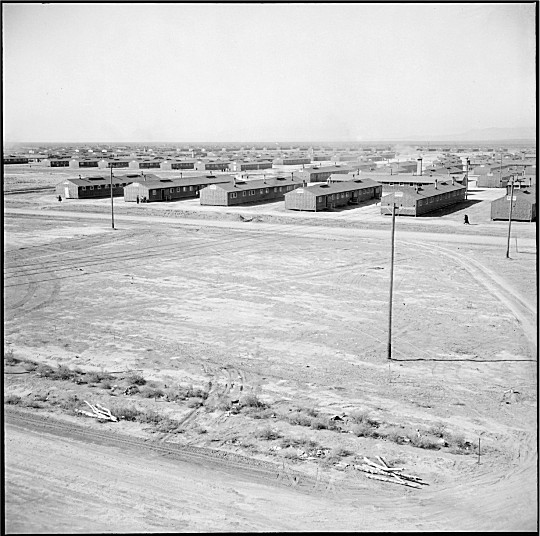
Topaz, Utah