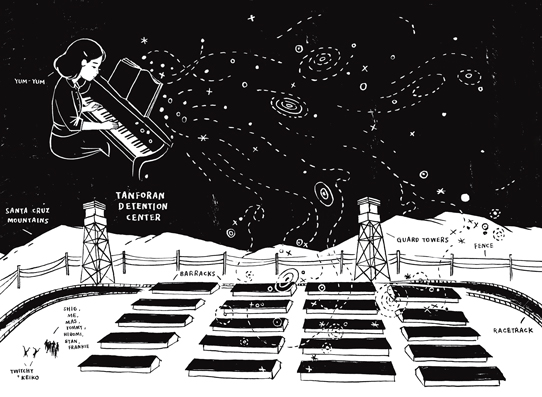
II
What Stays, What Gives, What Goes
Shig, 17
April–May 1942
It’s a Friday in April, and me and Twitchy are on our way to school when we see the crowd in front of the Civil Control Station. The building and the Japanese school in it used to belong to the Japanese American Citizens League, but last month they just rolled over and handed it to the War Relocation Authority, the government agency in charge of rounding us up, neat as you please.
You’d think the JACL would’ve put up a fight or something, but they’ve been doing all sorts of wacky stuff to help Roosevelt and his cronies. After the attack, they helped arrest Issei leaders like Mr. Hidekawa and Yum-yum’s dad, Mr. Oishi. They told us all to cooperate when the WRA started packing us off to desert camps. I bet they’d bend over and kiss their own asses if Washington asked them to.
“You see this?” I elbow Twitchy as we head toward the crowd. “What’s the government want now, our used underwear?”
“No one wants your dirty drawers, Shigeo.” Twitchy elbows me back. “Maybe Mike Masaoka’s resigning in disgrace or something.”
Mike Masaoka’s the JACL executive secretary. What d’you wanna bet a big shot like him isn’t going into camp with the rest of us?
I scoff. “Nah, I checked the weather report. Hell’s showing no signs of freezing over.”
We shoulder our way through the wall of hats and backs toward some official-looking notices pasted to the Civil Control Station walls. I end up sandwiched between Mr. Inouye, who always wears a flat cap because he’s embarrassed about losing his hair, and Mrs. Mayeda, who always smells like coffee breath and Chantilly perfume.
Through the crowd, I catch a glimpse of the notices—CIVILIAN EXCLUSION ORDER NO. 20—and I know. I know even before I read the rest of it.
Mike Masaoka’s not resigning.
The JACL’s not protesting.
The evacuation has come to Japantown.
Halfway down the page, there’s a paragraph describing the borders of the evacuation area—it’s the whole north half of the neighborhood, only missing my apartment by a block.
“Tommy’s family lives up there,” Twitchy mutters.
“And Stan’s,” I add. Two of our best friends in the world are going to be torn from their homes, and no one’s doing a damn thing about it.
Between my teeth, I can feel a low buzz, like a power line inside me is busted and I’m going to start breathing sparks if I open my mouth.
I shake my head, and the humming subsides—you can’t fight the federal government, not unless you want to end up in prison—and I glance back at Twitchy with a lopsided grin. “You know, all of a sudden I don’t feel like going to school.”
He chuckles. “You never feel like going to school.”
“Yeah, but why bother now?” There’s that buzzing again. I taste electricity on my tongue. “They’re going to kick us all out in a couple weeks anyway.”
When no one’s looking, we climb the fire escape three stories to the roof of the Toyo Hotel, where we always go when we ditch because no one will find us up there. It’s even got a couple bottles of soda and a bunch of comic books we stashed in a box near the ledge overlooking the intersection at Post and Buchanan.
Below, people are milling about like ants. All those people who’re gonna be gone.
There’s my girl, Yum-yum, and her friend Hiromi, who’s wearing a blond wig, on their way to school. There’s Mr. Tanaka, who works at the YMCA—he’s trailing a cloud of smoke because he wants to get in one last cigarette before he clocks in. There’s Jim Kitano and his brother, Shuji, those bullies who used to pick on Minnow in elementary school. There’s Tommy Harano—you can recognize Tommy anywhere, he’s so short. The kids used to call him ebi—you know, like “shrimp”—but that was before me and Mas adopted him into our group. No one’s called him that in years because they all know they’d have to answer to us.
“Hey, Tommy!” Twitchy jumps up, waving his arms like he’s bringing a plane in to land. “Tommy!”
Tommy looks around, but so do Yum-yum and Hiromi and Mr. Tanaka and the Kitano brothers. Yum-yum frowns up at us, and I blow her a kiss before I pull Twitchy back down. “You wanna get us caught?”
“Nah, but Tommy—”
“You got anything to throw?” I turn out my pockets. I’m carrying: the homework I won’t be turning in, my student ID, thirty-eight cents, a candy-bar wrapper, and the key to our apartment, which won’t be our apartment soon, I guess.
Together, we peer over the edge of the roof. Below, Tommy’s already crossing the street.
Twitchy wads up some of my homework and hurls it at Tommy’s back. It falls short by a yard.
Quickly, I take the first page of an English essay and fold it in half lengthwise. The paper’s crisp. The creases are clean.
“Hurry up, Shig.” Twitchy jiggles my shoulder. “He’s getting away!”
“Quit shaking me!” I make a couple diagonal folds and bend the flaps into the shapes of wings.
Then, standing, I let it fly.
The paper airplane soars out over the street, turning and wheeling almost like it’s alive. It strikes Tommy in the neck before he’s even made it to the other side of the road.
“Direct hit!” Twitchy laughs.
Tommy turns again, rubbing the back of his neck, and this time he sees us beckoning him up to the rooftop. His big eyes widen, and he beams up at us, waving, as he runs back toward the Toyo Hotel fire escape.
“What’re you doing up here?” he asks as he scrambles onto the roof. “Aren’t you going to school?”
Twitchy and I glance at each other. Tommy always takes things harder than the rest of us. How do we break the news that he’s getting kicked out of the only place he’s ever lived?
We sit him down between us and tell him about the exclusion order. “Your family’s in the first group,” I say as gently as I can, because right now, Tommy looks like someone’s kicked him in the teeth.
“At least this way, you don’t have to go to school either,” Twitchy adds.
Tommy just stares down at the rooftop between his sneakers.
Gently, I crumple the second page of my essay and press it into his hands. “Here,” I say, pointing at Bob Tomioka, who’s standing on the street corner in those oxford shoes he keeps shined up like mirrors. “Bet you can’t hit Bob over there.”
Tommy’s hand closes around the ball of paper, and he gives me a weak smile. “How much?”
The rest of the morning, we throw things at passersby, laughing when they spin around, trying to find us.
Goodbye, student ID. It’s not like I’m gonna need you anyway.
Goodbye, last three pages of my English essay.
Goodbye, candy-bar wrapper.
Goodbye, biology notes I was supposed to study.
Goodbye, goodbye, goodbye.
That night, Mas tells me and Minnow to start making lists. The evacuees can take only two suitcases each, he says, so we’ve got to be smart about what to bring when it’s our turn to go.
“Smart?” I laugh. “Have you met me? ‘Smart’ isn’t in my vocabulary.”
He fixes me with one of those stares, you know, the ones where he tries to act like our dad instead of our older brother. “You’d better study up, then,” he says.
So here goes, I guess.
THINGS TO BRING WHEN IT’S OUR TURN TO LEAVE
money
clothes
more money
Over the weekend, signs pop up all around the neighborhood. EVACUATION SALE. FURNITURE SALE. CLOSING OUT SALE. BIG SALE. PRICES SMASHED. Some are printed, but most are handwritten in squashed block letters.
Me, Mas, Minnow, Twitchy, and Frankie get together to help out the guys who have to leave. At Stan Katsumoto’s family grocery, we sort through the shelves, marking down prices on rice and kombu and tea. When Mas isn’t paying attention, I tag him with a 50% OFF sticker, and Twitchy adds a 5¢ tag to the seat of his pants. One of the other fellas snickers. Mary, Stan’s younger sister, glowers at us. Me and Twitchy smother our laughter and stick Mas with six more tags before Mrs. Katsumoto looks up from the counter and goes, “Aiya, what are you doing? Masaru’s a handsome boy—we can get at least a dollar for him!”
I wish I could tell you what Mas’s face looks like, but me and Twitchy are already out the door, running down the block as Mas roars after us.
When we break for lunch, Mrs. Katsumoto posts a note on the door beneath the words, I AM AN AMERICAN. It’s a message to their customers, thanking them for twenty years of patronage.
Stan stares at it for a second, then cocks his eyebrow. “You sure about this, Ma? We don’t want them to get the wrong idea about us.”
“What wrong idea?” Mrs. Katsumoto asks.
“That we’re decent people or something.”
“What’s wrong with that?”
“Decent people don’t kick out other decent people, so if we’re decent, they can’t be decent.” He fans out his hands. “You’re going to cause an existential crisis, Ma! If white people aren’t decent, are they anything?”
She sighs and presses down a bit of tape with her thumbnail. “It’s the right thing to do,” she says, “for us.”
For us? The buzzing returns, sharp and metallic. You thank other people to make them feel good, and good is the last thing anyone should feel about what’s happening to us.
Mr. Katsumoto says nothing. He lowers his head over the counter, silently marking down packages of umeboshi.
After lunch, we go to help Tommy’s family lay out their belongings on the sidewalk: dishes they brought from Japan when they immigrated, kitchen appliances, extra towels, desks, Tommy’s record player and all his beloved records, their washing machine, lamps, rugs, books.
The bargain hunters descend before we’ve even got half the Haranos’ things out of the apartment. They come with pinched faces and tight fists, offering ten cents to every dollar’s worth of stuff.
For a while, we try to entertain Tommy’s three younger sisters. We let Aiko, who’s thirteen, hop and chatter around us as we move pieces of furniture onto the ketos’ trucks. Twitchy makes faces behind the bargain hunters’ backs for the littlest ones, Fumi and Frannie, who laugh and clap. But things get harder as the day wears on. Aiko accidentally drops a lamp and has to sit out the rest of the afternoon on the stoop. The twins start crying when their kokeshi dolls are sold, and nothing us or Tommy or their mom does can make them stop. Mr. Harano is stonefaced when their sofa goes for three bucks; their beds, for two each.
At the end of the day, they’re left with a few hundred dollars. A few hundred dollars for a lifetime of things that can’t go with them.
THINGS YOU CAN’T PUT A PRICE ON
the most perfect sand dollar I ever found at Ocean Beach, wrapped in a handkerchief Yum-yum gave me on our third date
The first families move out on Tuesday, April 28. They line up in front of the Civil Control Station in their Sunday best—the men in suits, the women in veiled hats and gloves—like they’re going to church instead of an internment camp. I wonder why they bother.
From the stoop across the street, me and Twitchy watch the bags stack up on the curb: first the steamer trunks, then the suitcases, and the canvas bundles expertly knotted at the top. The piles grow so high in places, you can’t see over them to the keto guard and his Springfield rifle posted by the doors of the Civil Control Station.
We say goodbye to Tommy, who promises to write, and to the rest of the Haranos. As they board their Greyhound bus, Fumi and Frannie start crying and grabbing at Mrs. Harano’s hair, and she shoves one of the twins at Tommy, who bounces her gently in his arms.
We can still hear them wailing as they drive away.
When the day’s over, there’s still bits of baggage left on the sidewalk: duffle bags, crates tied with rope, trunks painted with English and Japanese names. Relatives and friends are lugging away what they can, but there are people without relatives or friends, and their things are still on the pavement when the street lamps go on.
The night the last families are evacuated from the north side of Japantown, me and Frankie Fujita walk through the neighborhood together.
The deserted streets.
The abandoned businesses.
The boarded windows.
The darkened homes.
Half of this community amputated, the people I’ve grown up with shipped off to who-knows-where.
There’s hardly anyone around now—just me and Frankie and the shadows and the streetlights haloed in fog. We walk down the middle of the road like the kings of a hollow kingdom.
He’s practically humming with anger. I can feel it like a current coming off him.
Hell, I can feel it coming off me, too, growing stronger with every vacant house we pass.
My fists are electric.
We break into a noodle house. There’s not much left. The tables and chairs have all been sold off. There are a few blank spaces on the walls where wood carvings used to hang, but the rest is papered with menus in kanji and hiragana and English, peeling at the corners.
We rip it apart. We tear the daily specials from the walls. We throw napkin dispensers and empty tubs. Frankie shreds a string of paper cranes, sending them limply into the air like confetti. In the kitchen, I find a maneki-neko, a ceramic good-luck cat—big eyes and calico spots—and drop-kick it into the dining room, where it shatters.
One of the neko’s red ears skids to a stop in front of Frankie. He stares at it for a second. Then he laughs. It’s a horrible, humorless laugh, and his open mouth looks desperate and hungry, like he wants to devour the whole world.
When we make our way outside again, we find the Kitano brothers, Jim and Shuji, smoking on the corner of Bush and Laguna. Beside me, Frankie picks up the pace. He’s practically running at them, shouting, “Hey, Jimmy, you ugly son of a bitch, where’s that two dollars you owe me?”
I don’t remember Jim owing Frankie money, but he is a son of a bitch, and I’m itching for a fight, and who the hell cares anyway?
Before either of the Kitano brothers can say anything, Frankie slugs Jim in the jaw. Not hard. I’ve seen Frankie hit like a hammer, and this is nothing. This is a love tap.
He wants Jimmy to fight back.
And he does. Jim comes up swinging, and then they’re grunting and grappling on the curb, stumbling into the street.
Before Shuji can do anything, I clobber him. It feels good to hit something. To make something hurt.
We’re throwing punches. We’re getting bloody. The Kitano brothers are yelling, but me and Frankie are stern and fierce and the only sound we make is our breathing. Exhaling anger.
Shuji gets me good in the mouth, but I hardly feel it. No, I welcome it. I eat up the pain like breakfast.
Lights go on down the street. Someone’s shouting at us. Sirens wail in the distance.
We scatter into the night—Jimmy and Shuji in one direction, me and Frankie in the other—swallowed up by the empty street.
We finally come to a stop in an alley. We’re doubled over, breathing hard. When he stands, I see he’s got a black eye and a bloody nose—backlit from the street, he looks like a young samurai, glowing and wrathful.
“Goddamn it all,” he says.
I straighten, tonguing my split lip.
Yeah.
I spit blood.
Goddamn it all.
THINGS I’M HOLDING ON TO
my anger
When I get home, Mom’s waiting up for me. She’s wearing her old robe, fraying at the cuffs, as she kneels in the living room, sorting our things into piles.
What stays behind: the carpets, the coffee table, boxes of Dad’s old clothes I didn’t know she’d kept.
What goes with us: sheets, blankets, cups and bowls and silverware for each of us, a hot plate, a kettle.
She looks up at me, pursing her lips, and for a second, I think she’s going to scold me. But she doesn’t. She just pats the bare floor until I sit next to her. “What happened to you, Shigeo?” she asks, turning my chin to the light.
I don’t meet her gaze. “Got in a fight.”
“With who?”
“The Kitano brothers.”
She clicks her tongue. “Those bad boys.”
I laugh—quietly, because Mas and Minnow are sleeping.
“You shouldn’t be fighting.”
“I know, Mom.” I sneak the last of Mas’s yearbooks from the “stay” pile. It’s filled with notes from his friends: Chinese friends, hakujin—white—friends, friends who have been evacuated. “But I wanted to fight something.”
She sighs. “You can’t change our situation with your fists.”
“But it has to change, Mom. Doesn’t it?”
She tugs at a stray thread on her sleeve. It unravels. “No, Shigeo, it doesn’t.”
Angry tears fall onto the pages of Mas’s yearbook, and I wipe my eyes with the back of my hand. “Then what do we do?”
She puts her hand on my shoulder and squeezes once. “Gaman.”
The word means something like persevere or endure. It’s a word for when you can’t do anything to change your situation, so you bear it patiently . . . or as patiently as you can, I guess.
I think of Mrs. Katsumoto and her thank-you note. I think of the people dressed in their best for their own eviction.
But I can’t do it. I can’t suffer nobly while we’re displaced. I can’t not feel this electricity inside me. I can’t not be hurt and angry and want to wrench things from the walls.
I don’t think “gaman” is in my vocabulary, either.
When CIVILIAN EXCLUSION ORDER NO. 41 tells us we’re being forced to leave, Twitchy steals one of the flyers. We sit behind the YMCA, where we know Mr. Tanaka won’t come chase us off, because Mr. Tanaka’s gone. Together, we read the instructions over and over, like the next time we read them, the words will be different.
We won’t have to evacuate.
We’ll be allowed to stay.
But nothing changes.
“I bet we’re going to Tanforan,” Twitchy says finally.
The Tanforan Assembly Center’s an old racetrack fifteen miles south of the city. That’s where Tommy and Stan ended up.
I don’t say anything as I tear the evacuation order into a square, ripping away the signature at the bottom—J. L. DeWitt of the Western Defense Command. He’s convinced we’re all a bunch of Jap spies, and I guess he’s convinced everyone else of it too, because, well . . . here we are.
I toss his name in the trash, where it belongs.
“That wouldn’t be so bad,” Twitchy continues. “It’s not that far from home, and at least we’d be together . . .”
I’m hardly listening. I’m creasing and pleating and bending the notice into something different, something other than what it is: the piece of paper that’s going to uproot us.
Under my hands, it becomes a square, a diamond, a crane with a long neck, a sharp beak, and the words “alien and non-alien” visible on one wing.
They can’t even use the word citizen for us Nisei, can they?
I want to crush the paper bird in my palm, like that would unmake every sentence of the exclusion order and all the men who wrote it.
“Hey, where’d you learn to do origami?” Twitchy asks, interrupting my thoughts.
I twirl the paper bird by its pointed tail. “Kinmon Gakuen,” I lie.
He makes a disbelieving sound. “Where was I that day?”
“In time-out,” I tell him with a smirk, “like usual.”
“Ha ha.” He eyes me like he knows I’m fibbing, but he doesn’t push me.
We don’t stay out, not like last time, because now we’re the ones who’re leaving. We have to go home. We have to help our families pack.
On the step next to me are black smudges where Mr. Tanaka used to stub out his cigarettes. I leave the crane perched next to them like a temple offering.
THINGS NO ONE KNOWS I HAVE
one of Dad’s hats
Don’t tell anyone, but Dad’s the one who got me into paper folding. He used to do it when he was happy, or when he was working through something he wasn’t ready to tell Mom about, but mostly when he was happy. I can remember Sundays when we went to Ocean Beach to fly kites and look for shells, and he’d be sitting in the sand, folding a piece of newspaper.
He didn’t make a fuss about it, either. You’d see him toying with a candy-bar wrapper or something, but you’d never see it take shape. He might leave it somewhere for you to find, if he was especially proud of it, but usually, it would just be gone. I don’t know if he threw them away or what.
Now I do it too, even though no one really knows about it, not even Twitchy. It’s kind of private, you know? It’s something just between me and Dad, even though he’s gone, too.
On Wednesday, Mas comes home with a fistful of ID tags. We have to mark all our luggage, and on the day of the evacuation, we have to wear them. Like we can’t be trusted to remember our own names.
I’m Ito, Shigeo.
NO. 22437.
INSTRUCTED TO REPORT READY TO TRAVEL ON: Saturday 5/9, 11:30.
That’s five days. Five days to pack up our entire lives.
They couldn’t even give us a week.
THINGS THAT HAVE TO STAY
the tin canister of marbles and baseball cards we buried somewhere in the backyard
the dent in the wall where Mas’s shoulder hit it when we were wrestling
the names we carved into the baseboard: MAS, SHIG, and a little fish for Minnow
Vultures.
The white people come around again, sniffing out bargains.
The Kitanos’ whole dry-cleaning business, equipment and all, goes for fifty dollars. I know because you can hear the ketos crowing about it as they head back to their Cadillac. Across the street, Jim Kitano steps out onto the sidewalk, and I meet his gaze. He’s got a greenish-yellow bruise on his jaw where Frankie punched him last Friday.
I nod at him.
He nods back, lighting a cigarette, and leans against the door of the pool hall, where Frankie used to dupe guys out of their money when he got bored. It’s abandoned now, its windows papered over.
Next to me, a couple of ketos are haggling over the American flag Dad used to fly from our stoop every day. One of Mas’s eyelids is twitching the way it does when he’s trying not to cry. He loves that flag almost as much as Dad did, kept flying it after Dad died.
Gaman, I remind myself.
Grin and bear it.
Bend over and kiss your own ass.
But ever since that night out with Frankie, my anger’s been filling me up. Every day, it’s there inside me, buzzing louder and louder like a malfunctioning transformer until sometimes it’s all I can hear or feel.
“No deal,” I say suddenly. “Get outta here!” I wave my arms at them, and they hop away like irritated gulls.
“Shigeo!” Mom says.
“What?” Buzzing. “That’s Dad’s flag. It’s worth more than a quarter.”
She combs my hair with her fingers, like she used to when I was little, but even that doesn’t quiet my anger. “It’s not about what it’s worth,” she says. “It’s not about what we deserve. It’s about what they’re willing to give us.”
“Shit,” Minnow says, looking up from his sketchpad. “All they’re willing to give us is shit.”
“Watch your mouth, Minoru,” Mas snaps. He looks like he’s about to crack in half like a brick in an earthquake.
But he doesn’t. Not even when Dad’s flag goes for fifteen cents an hour later.
No, it’s Mom who breaks, that afternoon.
She’s wrapping a set of red-and-black lacquerware, placing tissue paper between each dish to protect it, and she just starts crying. It was her grandmother’s lacquer set, you know? One of the nicest things she brought over from Japan when she married Dad.
She never let us or Dad touch it, not even to clean it. She displayed it on the highest shelf in the living room and dusted it herself with a soft brush. It was hers, and it was precious.
Now some hakujin strangers are going to take it. They don’t want our alien faces in their neighborhoods, but they don’t mind our lacquerware in their homes.
Inside me, the buzzing is so loud, I can barely hear Mom crying in my arms.
The vulture shifts uncomfortably as Mas passes her the lacquer set, but she doesn’t do anything, at first. Guilt and pity pool behind her glasses.
After what seems like a full minute, she tries to hand him another dollar. A whole goddamn dollar. It hangs limply from her fingers like a dead thing.
He doesn’t take it. “We already agreed on a price,” he says flatly.
“But—”
Mas crosses his arms. He’s almost six feet tall with the build of an Olympic wrestler. He can be real intimidating when he wants to be. “Thank you for your business,” he says, and she scurries off, the dollar flapping uselessly in her hand.
In one of the trash piles, I find a shoebox full of origami: frogs and birds and balloons, pinwheels and boats and even a potbellied pig.
I guess Mom knew the whole time. She must have been collecting all those little things Dad was making.
And we can’t keep them. We don’t have the space.
THINGS THEY’VE TAKEN
my home
my friends
my community
I’m with Yum-yum when her mom sells her piano.
Lucky for them, they own the building, so they can rent it out while they’re gone. Or, technically, Yum-yum owns it. It’s in her name, because the California Alien Land Law doesn’t allow Issei to own property here.
But, homeowners or not, they’re as Japanese as the rest of us, so they still have to move. They still have to store or get rid of the things they can’t rent or take with them.
We would’ve lent them a hand even if Mr. Oishi hadn’t been arrested, but me and the guys make an extra effort to help Yum-yum’s family. Together, we heave the piano down the stairs and onto the sidewalk to be picked up by a Bekins Moving and Storage truck.
Don’t tell her, but we all hated hearing her play at first. The piano was already old when she got it, beat up and out of tune, and you could hear every swampy note as she banged out her scales, up and down the keys.
But she’s good now, and we all lean in when she sits at the piano bench and lays her hands on the keyboard one last time.
Yum-yum’s always been pretty, but today she’s beautiful, and strong, too, sitting there, fingers still, like she’s saying goodbye with her silence.
She begins—loud, then real soft. The music is heavy as fog crawling down the San Francisco streets, heavy as the footsteps of two guys out at night, wanting to break things.
It builds and builds, getting darker and darker, when all of a sudden it speeds up, and the notes are sparks, they’re catching things on fire, the whole street is filled with them. They’re explosions. All the buildings collapse, crashing into the road in heaps of luggage-shaped rubble. If she could, I bet Yum-yum would tear down the whole city with her music.
But by the end, it’s soft again, and her face doesn’t betray any of the violence and turmoil inside her. Standing, she walks into my arms, and I hold her until the truck comes to take her piano away. She doesn’t cry.
And I get it, finally. Gaman.
The ability to hold your pain and bitterness inside you and not let them destroy you. To make something beautiful through your anger, or with your anger, and neither erase it nor let it define you. To suffer. And to rage. And to persevere.
When I get home, I find out we got a letter from Tommy.
Dear Mas, Shig, and Minnow,
Well, we’re all settled in at Tanforan now. The house, or horse stall, has two rooms. Mom, Dad, and the twins sleep in the back; Aiko and I sleep in the front. They do a head count every morning at six thirty (and again in the evening), and since I’m the oldest, and the only boy, in the front, it’s my job to tell them we’re all here.
I don’t know if you’ve gotten your evacuation notice yet, but wherever you go, bring your saw, hammer, and sockets. There’s no furniture anywhere except the army cots, so everyone’s having to make chairs and tables out of scrap wood. If you find out you’re coming here, I’ll try to save some for you.
The food is pretty bad. Yesterday we had potatoes, meat innards, and bread. It’s served by hakujin workers they hire from outside, and they touch everything with their bare hands. When we eat, there’s a line two or three blocks long, so you better get in line early!
Mas, some men in camp are driving instead of taking the buses. They load their cars with all sorts of things, like canned fruit and handmade soap. Maybe you can pack up the Chevrolet and bring in some food from outside. I’ll take a chocolate bar as a thank-you.
Take care of yourselves,
Tommy
P.S. Say hello to Twitchy and Frankie.
P.P.S. I’m sorry for writing in pencil, but I’m trying to economize on ink.
THINGS WE HAVE TO FIND SPACE FOR
tools
food
gaman
It’s the night before we have to leave, and me and Minnow are lying on the floor of our bedroom. The walls are bare. The mattresses have been sold off. All we’ve got are our suitcases and the things Mas is going to pack into the Chevy.
And the shoebox of origami I rescued from the trash. Mom must not have thought anyone would pay for it.
There’s the buzzing again. A hot electric current running under my skin. If I’m not careful, I’m going to ignite every paper creature between my hands just because I want something to burn.
“What’s that?” Minnow says, propping himself up on his elbows.
“Dad’s.”
“What is it, though?”
“None of your business,” I say, and regret it immediately. I don’t usually snap at my little brother—that’s Masaru’s deal. “Sorry, Minnow.”
He looks at me, and even though he’s almost as small as Tommy, he seems older than fourteen all of a sudden. He’s been everywhere these past couple weeks: drawing the mountains of luggage, doing portraits of the families waiting for the Greyhound buses, sketching the army soldiers and hakujin photographers the government sent in, his fingertips black with charcoal.
He’s always drawn a lot, but there’s something different about him lately. He used to disappear into the background like he was part of it. Now when he draws, you can’t miss him. He’s there in the middle of things, with this new ferocity, like if he doesn’t capture this moment, he’ll never get the chance.
That’s how it is these days. You hesitate, and your neighbors have vanished. You look away, and your friends have been stolen from you. You blink, and you’re gone.
I open the box.
“I always wondered where these went,” Minnow says, holding up butterflies and stars so the overhead light shines through them, making them glow.
I guess Minnow noticed Dad doing origami too. It shouldn’t surprise me. Minnow notices a lot of things—that’s what makes him such a good artist.
“Should we give it to Mas?” he asks. “I bet he could find space in the Chevrolet.”
I shake my head.
“We could carry it. I don’t think anyone would notice.”
But that doesn’t feel right to me either. I want to do something good with these scraps nobody would pay for. I want to change things, the way Dad changed all these old envelopes and ticket stubs and potato-chip bags. I want to do what Yum-yum did with her piano, what Mrs. Katsumoto did with her thank-you note.
I want to show they haven’t beaten me.
“I’ll tell you what,” I say. “I’ve got a plan. You wanna help?”
After Mas loads up the Chevrolet and drives off, me, Minnow, and Ma report to the Civil Control Station, where we weave between the curbside luggage, the army guards, the lines of weary people waiting to board the Greyhound buses.
Under one arm, I’ve got the box of origami.
Twitchy comes to see us off, and he doesn’t bat an eye when me and Minnow tell him the plan—you gotta love Twitchy for that—he just takes some of the paper figures as carefully as he’d handle his old butterfly knife and gives us a smile.
While we wait for our turn to go, we put on party hats me and Minnow made out of newspaper and, with big, flashy smiles, we march through the crowd, distributing Dad’s origami to the kids. We’re not evacuees today—we’re kings in a parade, we’re cheerleaders at a pep rally, we’re three beardless Japanese Santa Clauses, and Christmas has come early this year!
I give Jeannie Kitano, Jim and Shuji’s sister, a crane that flaps its wings when you pull its tail, and baby Don Morita a box he instantly crushes in one of his chubby fists. The Abe sisters get a ball they can blow up and bat around. Minnow hands Toshie Nishino a fox. Twitchy tosses her brother a cat. Every kid gets something on Evacuation Day!
When it’s almost 11:30 a.m., I turn to Twitchy, who’s not leaving until tomorrow, and press forty-five cents into his hand. It’s all the change me and Minnow could find in the apartment last night. “Get some candy for tomorrow’s evacuation,” I tell him as me and Minnow stuff our pockets with the last of the origami. “To give to the kids.”
“We were thinking malt balls or something,” Minnow adds, tossing the empty shoebox onto a mound of baggage.
Twitchy frowns, jingling the coins in his palm. “Your mom would want you to save this for a rainy day or something,” he says.
“C’mon, Twitch—”
“But I’m fine blowing it on chocolate!” He grins.
Me and Minnow grin back. We’re standing on a street corner with everything we’ve ever known about to come crashing down around us.
And we’re angry.
And we’re smiling.
And we aren’t broken.
THINGS THAT DON’T TAKE UP ANY SPACE AT ALL
my humor
my courage
my joy
When our group is finally called, we’re the last people to board, and as me and Minnow follow Mom to the back of the bus, we fish into our pockets for dogs, koi, turtles, and gulls, passing them out to the other families.
The Greyhound becomes a menagerie on wheels, a circus, a traveling zoo of paper animals, filled with the kids’ delighted shrieking and the imagined sounds of elephants and zebras and monkeys.
As we drive away, I see Twitchy standing on the steps where we watched the first families leave Japantown, waving like he’s trying to bring a plane in to land.
It doesn’t take long to get to Tanforan, but it feels like hours. I spend the ride unfolding and refolding the last piece of origami, following the creases Dad made years ago, a rabbit appearing and disappearing in my hands like a magic trick.
There and gone.
There and gone.
We see the barbed wire first. The chatter in the bus quiets. The fence seems ten feet tall, with guard towers at regular intervals, like it’s a prison.
Like we’re criminals.
Then the grandstand, the muddy racetrack, the tarpaper barracks, and now no one’s speaking.
You will not beat me, I think.
There are things you can’t take.
Mom reaches for my hand. She’s already holding Minnow’s.
I turn Dad’s origami rabbit in my fingers. It’s already starting to split along the creases, gaps opening up at the corners.
Gaman, I think.
We drive through the gates.