Have the Conditions for Secession Been Met?
In America, more than in any other country in the world, treason is just a matter of dates. “In the long run, all countries are dead,” Ryan Griffiths says. “The same will happen to the United States.” The History of the Fall of the American Republic, author still unborn, will no doubt recognize who and what to blame: the nihilistic hyper-partisanship of Newt Gingrich; Bill Clinton allowing China into the WTO on the mistaken assumption that capitalism and democracy were inevitably linked and that the American middle class would rise on the world’s swelling tides; Bush v. Gore; the suspension of civil liberties in the aftermath of September 11; the wars in Afghanistan and Iraq; the explicit rejection of the “reality-based community”; the Tea Party; Citizens United; Obama’s failure to unify on immigration and health care; Mitch McConnell’s decision not to consider the appointment of Merrick Garland; the presidency of Donald Trump. And there are thousands upon thousands of politicians who put private and party interests ahead of the interests of the institutions, who developed contempt for government in and of itself and rode contempt to power. Apportioning blame makes for a satisfying game. It’s a kind of retrospective partisan politics. Blame misses the point. Blame hides the underlying structural weaknesses.
The conditions necessary for separatism to become real are (1) that there’s a will to disunion and (2) that the political differences inside the country amount to distinct identities with geographical boundaries. The will to disunion is not yet a majority position, but it’s growing, and it’s growing consistently across the country. Partisan identity is now a deeper division than race or religion: See Dispatch Two. The distinct geographical boundaries are not set, but they’re simple enough to imagine, given the maps of America’s political and cultural divisions.
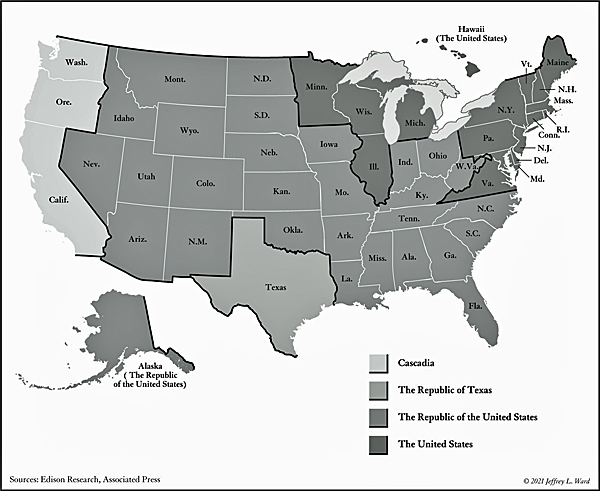
These regions already possess distinct identities, distinct politics, distinct ways of life, and increasingly distinct realities. Obviously, this is nothing more than a rough projection. Border states like Virginia, Georgia, Nevada, and Oklahoma would have to decide by plebiscite where they belong.
But the final requirement for secession would be the most difficult to achieve: goodwill among the negotiating parties. The structure of the United Nations means that the US government would have to let the states that wanted to separate go. The stewards of the United States would have to recognize that their great experiment had ended.
What Would a New North America Look Like?
Disunion would be the death of one country but it would be the birth of four others. These countries would all be sizable and powerful.
The main difference between the American separatist movements and those in the rest of the world is that the countries that emerge from the separation could join the world quite comfortably as independent nations. If Texas were a country, it would have a GDP of $1.59 trillion, tenth in the world, slightly below Brazil and slightly ahead of Canada. It would certainly look like a country, forty-seventh in population, fortieth in size. California is even larger. With a GDP of $2.88 trillion, it recently passed the UK to become the fifth-largest economy in the world. It would rank thirty-sixth in population, with the world’s largest technology and entertainment sectors. It would have the largest national median income in the world. Unlike many other regions searching for independence, California and Texas could work as independent countries. Scotland, if it ever left the United Kingdom, would need to belong to NATO and the European Union to ensure its security and its economic viability. The Scottish National Party, in effect, wants to transfer itself to a different superstate from the one it was forced to join in 1707. Quebec separatists believe national sovereignty is required to preserve their survival as a people, but whether or not they belong to Canada, they will still be a tiny French minority in an Anglo continent, with trade and all other matters of importance happening in English. Texas and California share none of those vulnerabilities. California and Texas are the new economy. Both states are donor states: they give more in federal taxes than they receive. Military infrastructure wouldn’t be a problem, either. California hosts the most active-duty personnel, followed closely by Texas.
The North would not be a superpower anymore but it would continue to be a major power. The economy of the states between Pennsylvania and Maine is the size of Japan’s. The South would find itself much poorer and unhealthier and less developed than its neighbors. The federal government currently subsidizes the Southern states considerably. South Carolina alone receives $7.87 back for every dollar in taxes it pays. Life expectancy in the South is considerably shorter than in the rest of the country. Infant mortality rates are much higher. But Florida and Alabama have a combined economy as large as Mexico’s, and the twelve Midwestern states produce more than Germany. The citizens of a new Confederacy would find themselves in a much Blacker country than the United States: 55 percent of the African American population lives in the South.
What could these countries become? It’s a fascinating proposition. Currently, both sides are hobbled by their affiliation. Outside of the United States, a new Confederacy would be liberated to fulfill its political destiny. It would have to define itself on its own terms, rather than against federal authority. It could re-create itself as a Christian nation, banning abortion and gay marriage outright. It could permit no restrictions on any weaponry. It could end any progressive taxation. It could make government small enough to drown in a bathtub, as the saying goes. The North, for its part, would no longer be hobbled by a political system weighted heavily to rump parties who increasingly don’t want government in any form. It could enact meaningful policies on health care, police reform, gun control, and the environment. The Union, as it stands, is preventing both sides from becoming the people they want to be.
And wasn’t that always the point of the United States of America? Wasn’t it set up to allow people to become who they want to be?
The Loss and the Gain of Separation
Disunion could be liberation. Even without the possibility of a violent civil war, the current state of permanent conflict in the United States makes basic policy more difficult to enact and life harder for its citizens. These four new countries would not be anywhere near as powerful as the current iteration of the United States of America, but they would probably be saner, more normal. It’s also worth acknowledging that a grand thing would be lost if the United States disunited.
The American experiment was, at its core, a statement of radical faith in the power of openness to difference. It offers a fantastic piece of dialectic, the permission for contradiction. And the founders went all the way, without exception almost: in religion, in speech, in the structure of power, there would be disagreements. They believed that those disagreements would ultimately lead to deeper truths; that was their faith. “This policy of supplying, by opposite and rival interests, the defect of better motives, might be traced through the whole system of human affairs, private as well as public” was the view of the Federalist Papers. Argument, not conclusion, was the hope of the future. Everyone was entitled to their opinion, and those opinions would not be fixed. It is the essence of equality: to be a human among other humans, entitled to an opinion. Jews and Hindus and Christians and Muslims would coexist. Nobody could have a monopoly on truth. The simple grandeur of this basic proposition is its faith in human nature, expressed politically. It has never been rivaled.
F. Scott Fitzgerald famously said that “the test of a first-rate intelligence is the ability to hold two opposed ideas in mind at the same time, and still retain the ability to function.” Everything distinctly American has been a fusion of what should be opposites: North and South, white and Black. Self-determination is a moral state and not simply an economic one. How else would so many new religions, new art forms, be born out of a single country? America is its freedom and its openness, its vast production of stories, seemingly without limit, its generation of new technologies, new religions, constant new ideas, its willingness to embrace the new.
Even if breaking up is the sensible option, even if it’s better for ordinary Americans, let’s be clear about the stakes here. If the American experiment fails, and it is failing, the world will be poorer, more brutal, lesser. The world needs America. It needs the idea of America, the American faith, even if that idea was only ever a half-truth. The rest of the world needs to imagine a place where you can become yourself, where you can shed your past, where contradictions that lead to genocide elsewhere flourish into prosperity. Now that America is ceding its place of authority, the source of its power is becoming clear. The American empire was built on the story it told itself. It was an empire built, in perhaps its ultimate contradiction, on the belief in self-determination. And now that its story is crumbling under the weight of its contradictions, the world will miss it.
At the heart of tragedy is the tragic flaw: What makes the hero great destroys him. America’s tragic flaw is its openness. Perhaps it was a failure right from the start: slave owners preaching freedom and equality. But it would be a lie, an evil lie, to say that the American experiment did not give the world a glorious and transcendent vision of human beings: worth affirming in their differences, vital in their contradiction. That is still a vision of human existence worth fighting for.
Conclusion: A Note on American Hope
I don’t consider the dispatches in this book to be worst-case scenarios. Neither are they best-case scenarios. I have tried, with the best available evidence, to describe, as simply as I can, what is happening. So I hope I will be taken seriously when I say that, even in the current period of darkness, the American hope is real. The power of hope in America should not be discounted by anyone who wants a sensible analysis of its current predicament.
The American experiment has always been an experiment in hope. Hope shines from its face. Hope lives in its guts. The pilgrims on Plymouth Rock were bewildered by hope, a hope not just for prosperity and freedom but for a type of divine reflection on earth, “a shining city on a hill.” America has filled itself with new hope all along the way: the eyes turned to the Statue of Liberty, the mothers clutching their babies in the Arizona desert. The world pumps a steady supply of dreamers into the United States even when the United States despises and abuses them. It is the Golden Door.
America’s place in the world has always been distinguished by its hope. When its foreign policy descended into cynicism and brutality, it worked like other empires and other nations. But a cynical history of the United States would be an incomplete history. For huge swaths of the world, for much of the nineteenth and twentieth century, America was synonymous with hope. The radical generosity of the Marshall Plan in Europe was unprecedented: for any other people, at any other time, the idea that you would rebuild the economy of an enemy who had attempted to annihilate you would be taken as outright insanity. The Americans tried hope. The hope worked. It’s also true that hope has sometimes misled America. After the disaster of the Iraq war, John Bolton upped his naivete with sickening arrogance: “What we should have done is said to the Iraqis: ‘You’re on your own. Here’s a copy of the Federalist Papers. Good luck.’ ” Obama has been selling hope his whole career; his hope always manages to sell even when it’s rotted on the shelf.
None of the crises described in this book are beyond the capacity of Americans to solve. It would be entirely possible for the United States to implement a modern electoral system, to restore the legitimacy of the courts, to reform its police forces, to root out domestic terrorism, to alter its tax code to address inequality, to prepare its cities and its agriculture for the effects of climate change, to regulate and to control the mechanisms of violence. All of these futures are possible. There is one hope, however, that must be rejected outright: the hope that everything will work out by itself, that America will bumble along into better times. It won’t. Americans have believed their country is an exception, a necessary nation. If history has shown us anything, it’s that the world doesn’t have any necessary nations.
The hope for the survival of the United States resides in what I can only describe as its spirit. I understand that American spirit is a rarefied and indistinct phenomenon for such a hardheaded book. It is real even if vague. I have always believed that the most beautiful quality of American life is the way Americans talk to each other. You notice it the moment you arrive from a foreign country. The agents behind the airline counters gossip more freely. The cabbie and his fare argue directions more openly. They don’t whisper, the way people do in Cuba. They don’t talk placidly and exchange endless nothings like Canadians, either. The frankness of American speech is felt more often than recognized, as much a part of the background as the smell of stale tobacco or running engines in the airport. Americans themselves don’t notice the way that they talk because they have this habit of assuming everyone is like they are. It’s why so many foreigners, myself included, feel jumbled, both liberated and lost in space, on arrival. Frankness is obvious in the most everyday interactions, but it is political, too, the essence of being a citizen rather than a subject.
The United States needs to recover its revolutionary spirit, and I don’t mean that as some kind of inspirational quote. I mean that, if it is to survive, the United States will have to recover its revolutionary spirit. The crises the United States now faces in its basic governmental functions are so profound that they require starting over. The founders understood that government is supposed to work for living people rather than for a bunch of old ghosts. And now their ghostly Constitution, worshipped like a religious document, is strangling the spirit that animated their enterprise, the idea that you mold politics to suit people, not the other way around. Does the country have the humility to acknowledge that its old orders no longer work? Does it have the courage to begin again? As it managed so spectacularly at the birth of its nationhood, the United States requires the boldness to invent a new politics for a new era. It is entirely possible that it might do so. America is, after all, a country devoted to reinvention.
The situation is clear: the system is broken, all along the line. Once again, as before, the hope for America is Americans.