The Situation at the Outbreak
Both the right and the left have structural advantages. The right will benefit from the ferocity and militarization of its base, significant infiltration of the radical right into institutional life, and the legacy of the Senate and the Electoral College. The left, for its part, makes up the majority of the country, and they have the money. Biden-voting counties in 2020 accounted for 70 percent of the national GDP. With each side’s respective strengths, there will be no overwhelming force or clear winner from the outset.
The Impossible Solution
For Daniel Bolger, the problem of counterinsurgency is fundamentally not a military one: “A succession of winning firefights makes exactly no difference. The local people have to run their own government.” When you read Bolger’s book Why We Lost, you keep waiting for the losses. The Americans win nearly every engagement, and totally. They have excellent plans that are well-executed. Their collection of victories is irrelevant. “By definition, you’re the occupier, and everything you do just proves to the local population that their ‘local government’ is nothing but a proxy or a tool,” he says. It’s the classic case of if you lose, you lose, and if you win, you still lose.
The tactical considerations of battles between the military and the militia forces on United States would be completely irrelevant. No one with any tactical expertise can imagine anything other than a one-sided engagement. Professional military forces are professional. No one with any political expertise in counterinsurgency could imagine that any of those victories would matter. Rather, every time the Marines demolished another outpost of resistance, it would only exacerbate the underlying crises.
In Dispatch One, I outlined what an engagement between the US military and anti-government patriots might look like. In the opinion of every military expert I talked to, there was no question of who would win the battle. But the United States has lost a series of wars in which it has won the vast majority of engagements. “You will occasionally hear people say, ‘I’m not worried about an insurrection because the army’s got all the tanks and the air force has bombers,’ ” Bolger says. “Look, if that’s what you’re reduced to, just going in and killing people, you’re not solving the insurrection. In fact, you’re spreading it. You’re guaranteeing more of it.” You cannot punish people out of hating you. The military is an instrument of punishment. Its very function makes it useless. For Bolger, who has seen this futility from every angle, counterinsurgency strategy is a contradiction in terms. It is a game in which the only winning strategy is not to play. But not everyone has the luxury of not playing.
Retired colonel Peter Mansoor has a different perspective. For Mansoor, a successful counterinsurgency is next to—but not quite—impossible, a vital distinction. For one thing, insurgencies fail when they are unpopular with the local population, as in the cases of the Shining Path in Peru and Che Guevara in Bolivia. “The most important thing is to get the politics right, and if you get the politics right, you’re going to be able to win a counterinsurgency,” Mansoor says, while acknowledging that “the reason these insurgencies occur in the first place is because of politics.” The role of the military, in Mansoor’s view, is to clamp down on violence so that political progress can be made. “If you have so much violence going on, the politics is frozen,” he says. That need for stability to promote dialogue was the assumption behind the Surge in Iraq in 2007. And there, an expanded counterinsurgency strategy did make politics possible. It’s just that the parties found themselves exactly where they started before the violence.
Ingrowing Despair
The solution to the next civil war will be the solution to the crises America already faces. The military at best could provide the space that the United States currently possesses to negotiate its problems. If America cannot solve these problems now, why would it be able to solve them after widespread violence?
Once counterinsurgency starts, it’s nearly impossible to extricate your forces. How can anyone manage to maintain perspective in the middle of a fight for survival? “You get focused because it’s life-or-death on patrols, ambushes, night raids, because your life is on the line,” Bolger says. “You’re hopeful, as you’re doing that, that somebody way up the chain is thinking, ‘Hey, I’m making these guys do this because this is getting us towards whatever we want.’ My experience was that they were making us do it because that’s what we did. I don’t think they had an overall plan that I could detect. When you’re talking about your own country, the stakes would be much higher.”
JP 3-24 has a nifty graphic explaining how to win a counterinsurgency. It involves three neat political goals.
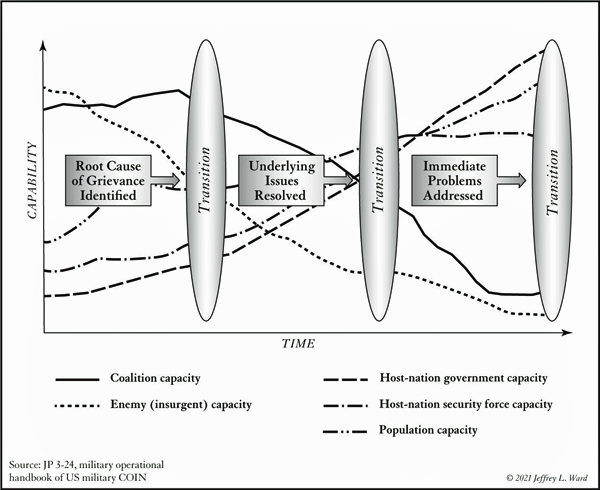
Do I need to point out how impossible this is in the case of the United States? There are whole libraries devoted to identifying the root causes of American grievances. Addressing the country’s immediate problems is increasingly beyond the capacity of the government no matter who forms it. And as for the “resolution of the underlying issues,” what would such a question even mean? The resolution of a country devoted to liberty but founded on slavery? The resolution of a political order built on revolutionary overthrowing? How do you resolve the glorious contradictions of the Republic, the contradictions that have made it great? What would that even look like?
The Evanescence of Democracy
The stakes would keep rising, as every attempt to contain the violence would lead to more resistance, and the rising violence of the resistance would lead to more ferocious attempts to contain it. Mass shootings at military bases, which have already occurred, will spark retribution and more intense security strictures. Atrocities will blossom into brighter and brighter flames. The wealthy, in gated communities, will up the quantity and quality of their private security. The poor, as they do now, will fear gangs and join them. The machinery of American democracy will continue to function. The country will hold elections. Parties will change power. But they will increasingly matter less and less. Once the state gets involved in political violence, the machinery of the peaceful transition of power is superfluous. The insurgents will want political power. If you deny it to them, which must happen to preserve the state, its machinery is useless.
The Unlikelihood of a Hard Coup in the United States
One of the reasons that hard coups—militaries taking over civilian governments—have become so rare generally is that partisans the world over have found them increasingly unnecessary. “There are many different ways to remove the president,” Taeko Hiroi points out. Impeachment is much quieter. The supporters of indicted presidents—in Brazil, in Israel—consider the transitions that overthrow their leaders “coups,” but the mechanisms aren’t extra-constitutional. “Soft coups” or “self-coups” are the preferred methods by which a sitting executive consolidates his or her power. (The term, in Spanish, is autogolpe.) In 1992, in Peru, democratically elected president Alberto Fujimori sent tanks to the legislature so he could reform the system to guarantee his own power. Neither Erdogan in Turkey nor Putin in Russia found the need. There is a way to walk the line: following constitutional procedures while ensuring that all the power concentrates in the hands of the executive.
A self-coup is well underway in America already. The rise of executive power is the rare case of a truly bipartisan trend. The use of executive legislation, bypassing Congress, began in earnest with Ronald Reagan, continued under Clinton, expanded under Bush, and became standard under Obama and Trump. What was once an exception made for cases of national emergency now goes unremarked.
The Prospect of Trying to Control the United States
For Mansoor, the sheer scale of the United States in terms of geography and population would present a massive military problem. “You need a troop ratio where you have a lot of security forces to clamp down on violence. The United States is a very large continent with a large population. I’m not sure we could ever have that many people in uniform to make it happen. What you would see is the rise of militias on both sides.” The military’s role will be to clamp down on violence. The only way to clamp down on violence would be to put the country on lockdown.
“You have to control the population,” Mansoor says. “In Baghdad we did that by segmenting off the city with cement barriers, by instituting martial law and censuses. There was a curfew. There were checkpoints all over the place. We went into people’s homes in cordon-and-search operations looking for arms and munitions. We had a full-scale intelligence operation to ferret out the terrorist and insurgent leaders. We had an unblinking eye over the city taking 24/7 surveillance. It’s very invasive for civil rights. It became essentially impossible for the terrorists and insurgents to move or communicate.” Areas of population were broken down by ethnicity and by twelve-foot, steel-reinforced blast walls. Citizens were interrogated every time they left or entered their neighborhoods. Anyone suspicious was arrested. “This is the other thing that would occur. Massive detention centers across the United States, where people who were suspected of being disloyal or who were disloyal would be warehoused on a massive scale,” Mansoor adds. The United States is already the most incarcerated society in the world. A civil war would make it vastly more so.
An insurgent conflict in America, the only country in the world where there are more guns than people, would eclipse all previous insurgent conflicts. It is much more diverse than any other country in the world, with a hugely heterogeneous population. It exists in explicit resistance to state control.
The Cycle of Spectacular Violence and Repression
Spectacular violence isn’t new to America. In 1867, the New York Times reported on a public fund set up in Colorado. “At a mass meeting held in one of the little towns in that Territory recently, a fund of $5,000 was subscribed for the purpose of buying Indian scalps, and $25 each is to be paid for scalps with the ears on. From this it would seem that the citizens of that delectable Territory cannot trust each other in a matter which they represent to be of such vital importance to themselves, and so require the ears to be produced with each scalp lest some dishonest cut-throat should make two out of one, and so obtain more than his share of blood money.” If a second civil war comes to America, it will not lack for precedents of annihilating fury and indiscriminate murder.
The horrors of this kind of conflict are bottomless: the rage feeds on itself, the spectacle builds. In the Syrian civil war, government forces stuck heads on pikes to display their intent of total war. Insurgent resistance forces committed genocides against smaller tribes. Any international agreements about the Laws of War—the ban on chemical or biological weapons, say—meant nothing quickly. Torture became standard practice.
The use of torture is the ultimate folly of counterinsurgency. Whatever its uses in individual cases, which can be significant, torture has never been broadly effective. You cannot clamp down on violence by elaborating suffering. The French learned its corrupting seduction during the Algerian war of independence. Without torture, by almost all assessments, they would have lost the Battle of Algiers, and if they had lost the Battle of Algiers, they would have lost Algeria. But by their use of torture, they lost Algeria anyway, and their own souls besides. Albert Camus had the clearest view of it: “Torture has perhaps saved some at the expense of honour, by uncovering thirty bombs, but at the same time it has created fifty new terrorists who, operating in some other way and in another place, would cause the death of even more innocent people.” Pierre-Henri Simon, a close observer, witnessed the deeper futility of the whole process. By the use of torture, the policeman “injures in himself the essence of humanity.” But it is worse with the military: “It is here that the honour of the nation becomes engaged.” America is already engaged in torture, and has been for generations. In 1999, the US Congress voted to close the United States Army School of the Americas, acknowledging the atrocities they had spawned.
How long could such repression last? “We’re talking about a future civil war in the United States, so the effort would extend indefinitely because of the passions that would invoke,” Mansoor says. For Bolger, as a historian as well as a retired officer, what is extraordinary is how little the United States has learned from even the insurgencies on its own soil. The British Army won nearly every pitched battle in the Revolutionary War. They could not hold the country against the will of its inhabitants. “The United States has had and has dealt with a significant amount of political violence from the beginning,” he says. The Constitution is the document of a revolutionary people. Like the Yugoslavian and Algerian constitutions, the document retains elements of its revolutionary origins; the Second Amendment insists on the rights of militias. It was written by militia men.
The failure of Reconstruction after the first Civil War reveals the near impossibility of holding Americans under a political regime they won’t tolerate. The North won the war but couldn’t stomach occupation. “What really happens? The Northern forces struggle, undergunned, undermanned, with provisional support from the government, a very small occupying force up to 1877, and every year everybody’s looking at their watch saying ‘Are we done yet?’ ” Bolger says. “So what happens? The African American population that’s nominally free becomes peons with almost no rights by 1877, basically disenfranchised in every practical sense, and the people in the North accepted it because they knew they couldn’t do anything about it. They weren’t going to kill every single Southerner.” The compromise of 1877 was ultimately the retreat of federal power. “The South got essentially home rule,” Bolger says. Reconstruction was in a sense the first failed American occupation.
The Exhaustion
You won’t recognize your own country. You won’t recognize your own time. You’ll still have a job. You’ll go to work. You’ll raise your kids. It will be possible, just, to cling to a sense of normalcy, although it is exactly normal life that becomes impossible. Your city will burn. Your hospitals will fill. Your police will take sides. You will have to have papers to go out and to go home. Your children will need papers to get into school. You will constantly be in contact with military personnel. Rights that you’ve taken for granted your entire life will be suspended. The stories will accumulate: ever-expanding factionalism, ever-deepening loathing, the stakes of the monstrous spectacles rising. You won’t know what to believe after a while. All information will become propaganda. The news will fill with hate crimes, public lynchings, summary executions of right-wing figures in retaliation, urban riots that spill over, people dragged to their deaths behind trucks. When will you be one of the stories?
The De Facto End of the Union
To ordinary people, to Americans trying to live their lives caught between the random violence of terrorists and the grinding repression of the state, victory and defeat will look much the same. “If you’re in a situation where you’re using armed force to try and quell a population, you’re either going to have to kill a bunch of them or you’re going to pull out and let them have local control,” Lieutenant General Bolger says. “You’re never going to talk them into seeing it your way.” The United States, as an entity, survived one civil war. The question for the next civil war is not necessarily whether the United States would survive but whether it would be recognizable afterward.
What Victory Would Mean
The typical conclusion of insurgency conflicts is not victory by either side but exhaustion by all. Exhaustion would reshape the American political landscape. “What bargains or deals would be struck with local authorities to stop the violence?” Bolger wonders. A devolution of power wouldn’t even require any formal legislation. The transition could be quite surreptitious. It’s a question of what laws the federal government would choose to enforce. There is precedence. Women in some states could vote fifty years before it was federal law. “Would what resulted look much like the America we know today?” Bolger asks. “I don’t know. The question is at what point does it cause the society as a whole to fracture. At what point does it go too far, and you say ‘Okay, this is no longer a country’? We’re all just pretending it’s the same thing.” That question is not just for future Americans. It is impinging on the present. With or without a civil war, Americans are going to face an existential question: Are they the same country anymore? Or are they just pretending?