Nonlinear Climate Change
“New York would be incredibly high on the list of vulnerable cities,” notes Vivek Shandas, director of the Institute for Sustainable Solutions at Portland State University in Portland, Oregon. The Institute for Sustainable Solutions deals with the way cities will adapt to climate change. Some of the infrastructure in cities on the Eastern Seaboard dates from the eighteenth century, a disaster waiting to happen even before the compounding effect of multiple vulnerabilities from climate change. “Much of New York is relatively flat. Even modest levels of sea level rise are billions of dollars of infrastructure impact, and the available space to move is more concentrated as well,” Shandas says. “Then you have heat waves that occur. We see deaths every year. Then there’s urban flooding, because you have storm and sewer systems that are relatively outdated.” Miami will see intense heat waves, sea level rise, and hurricanes happening at the same time. But Miami is just a great town. New York is New York; 88.3 percent of the world’s foreign exchange pours through it.
Superstorm Sandy in 2012 was a warning shot. Across New York State, $32.8 billion was required for restoration. For a storm that was not technically even a hurricane when it hit New York, Sandy wrecked eight tunnels and stranded millions of commuters between Brooklyn and Lower Manhattan. New Jersey transit was shut down for nearly a month. The South Ferry subway station flooded with 15 million gallons of salt water and only resumed service in 2017. To repair and improve the subway, the Metropolitan Transportation Authority spent $4.5 billion. They are preparing for large storms by making it possible to seal terminals with retractable stairwell covers and other flood protection measures, including “flex gates,” waterproof Kevlar belts to be unrolled, and “resilient tunnel plugs”—air balloons. But they can only prepare for what they know and for what they might expect. What would a Category 5 storm with an extra half a foot of sea surge do?
The Cascading Failure of Urban Systems
City failure happens incrementally and then by cataclysms. “The incremental failures are often things like the sewer systems can no longer handle the water coming in and the investment in the sewer system is no longer what the city can handle,” Shandas says. “What failure means is a cascading failure of systems.” It’s a feedback loop. When population declines, the tax base declines. When the tax base declines, funding to deal with mitigation and adaptation declines, which leads to infrastructure breakdown, which leads to the inability to provide services, which leads to a population decline. “How much energy would a city need to continue sustaining itself?” Shandas asks. “How much do we want to keep subsidizing the activities within cities to keep them going? When do we say enough is enough? When can we no longer do it? What we haven’t had a serious conversation about is managed retreat.” Instead, the most likely scenario is that those with enough resources will flee, leaving behind the poor and vulnerable. The markets will respond after the crises without any mitigation of human costs. This is already happening in some places. Mexican Americans live on polluted areas that are totally unprotected near the Rio Grande. In 2020, California banned insurance companies from dropping homeowners’ policies, a step to protect ordinary homeowners. But it means that nothing will stop people from continuing to build houses in unfeasible locations. The state will not take action on climate change, and they are preventing the market from taking action.
Eventually, climate change will force adaptation. Without the political will for investment—and remember that nobody ever got elected preventing a catastrophe—the forces driving managed retreat will be market forces. Insurance companies will tell homeowners they can no longer insure their properties. Those properties will lose their value because they can’t be insured. Developers will build in safe areas because that will be the only real estate that holds its value. Some researchers in the field describe the effect as “climate gentrification”—tighter labor markets, increased property values where property survives, and more inequality. The rich will be able to afford the security of safe places, and the poor will live on the margins, in the darkness on the edge of town.
A marketplace retreat will produce a Fortress America, an America of walls, an America to keep out the sea, an America to keep out foreigners, an America to keep out the poor. Stable real estate will require more investment to maintain. “Then you have these massive events like Hurricane Maria in Puerto Rico, short-term and incredibly intense events that wipe out populations,” Shandas says. This is a model well known to ecologists. It’s how species go extinct.
The Crossing
Alone in her Gowanus apartment, the Producer is waiting for the event. Thirty-six hours before landfall, the NOAA upgrades Muriel to Category 2. Everybody receives the message on their devices simultaneously, a faint buzzing over the whole of New York. The Governor now implores the people of the city to evacuate. “If you can leave, leave. If you must stay, know what you’re getting into. Muriel is going to pick up a good chunk of the Atlantic Ocean and dump it on us. Winds are going to reach 110 miles per hour.” Most New Yorkers hear only that the storm was Category 2. Everybody knows that the wall can withstand up to Category 3.
The Producer listens to the Governor’s warning but doesn’t consider leaving. She has a story to make. To her relief, the tenants in every other unit evacuate. They have to force their way across the bridges. All twenty-one bridges fill with last-minute evacuees. The tunnels have already flooded.
Then the storm surge comes. In Brooklyn, the surge rises from the canal, the tide drifting from the northwest, bringing with it the detritus from the surrounding houses and businesses, a flood of books and papers, art and the displays from the Whole Foods on Gowanus. Several witnesses report seeing a baby floating in a stroller. Others remember a kind of foam of vegetables on the surface. Something, someone, had failed.
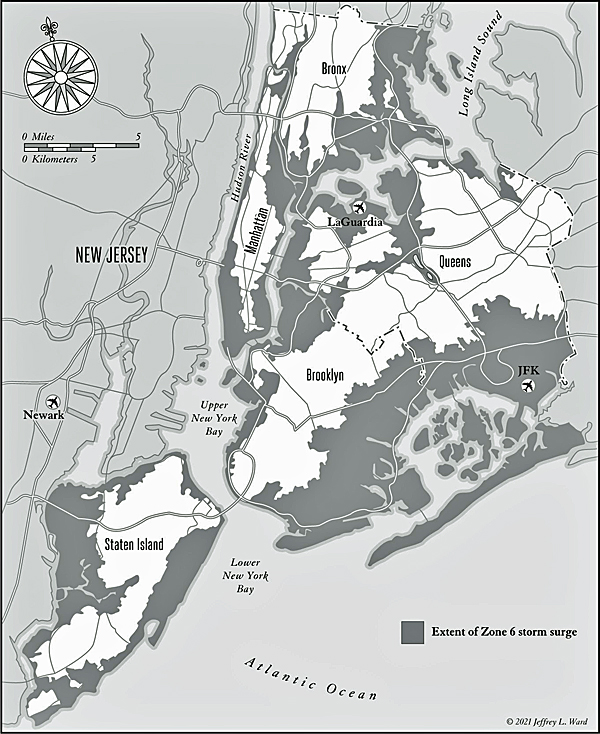
Within a few hours, the tidal surge floods JFK and LaGuardia airports. The power goes off for Manhattan and Staten Island at 8:37 p.m. By 9:45, power cuts out for most of the outlying boroughs. Red Hook, the most vulnerable New York neighborhood, no longer exists. In downtown Manhattan, Greenwich Village, Tribeca, and the East Village flood. Wall Street floods. The winds that follow the surge reach 116 miles per hour.
From Iowa, the Producer’s husband calls, imploring her to leave. The chance to leave has passed. She will need to wait until the first effects of Muriel subside. She spends several days inside, in fear. The Governor calls the National Guard. A hundred thousand soldiers are making their way into the city.
After a few days, more out of curiosity than fear, the Producer half floats, half swims through the flotsam-blanketed seep over Fourth Avenue. The water has receded enough to walk there. She heads up the hill to Prospect Park. Prospect Park isn’t Prospect Park anymore. The trees have tumbled. Whole families are curled up inside the sweep of horizontal branches. People are sleeping under the bushes, in a daze of upended lives.
The Producer heads back to her apartment. She didn’t take out enough extra cash, she realizes. She barely has a few thousand. She fills a duffel bag with food and water and batteries. She tucks her Glock into her belt. Other than her chargers and her phone, she needs nothing else. She goes to the safe to remove the passports. The family Bible is in there, too, brought over from the old country. The thing’s the size of her chest and weighs as much as a load of bricks. She can’t take it. She can’t bear to leave it. So she tells herself she’ll come back. Her daughter’s violin in the corner of the room, the furniture, the framed doll’s dresses, the candlesticks she and her husband received as a wedding gift—she tells herself she’ll be back for all of it.
Wading back onto Fourth Avenue, she joins in with the stream of other refugees along the old route to JFK. She’s glad to have her Glock. A few hours down the road, the crowd of refugees slowly starts to thicken. She overhears rumors that the storm had been bigger than Category 3. Up ahead she can see groups standing, unsure what to do, where to go. The road has slopped into the water.
It’s almost beautiful, the way the arch of the highway’s concrete dips into the black waves. It reminds her of a Mayan ruin she once visited in Belize, a grand center of trade fifteen hundred years earlier, fitted with glamorous temples, now overrun by jungle. Here, for the first time, she asks herself: Did New York survive? What happened to the city she loved?
Boats of all types offer transport across the water: fishing vessels come down from New England, pleasure craft from the Jersey Shore, skiffs and motorboats that probably shouldn’t be on open water. The new shoreline is abuzz with negotiation. Most of the transporters start at five grand a seat. But some of the heavier, safer craft go for ten, and the motorboats for as low as two. Most of the refugees, like the Producer, have little or no cash. Some of the deals are barter, for trade. The Producer watches a young couple, sitting on a cooler, pooling their jewelry, wedding rings and all. Other transporters can process credit cards on their phones. A gentlemanly fifty-year-old strides onto one of the larger skiffs, tapping his phone, as if paying for a latte at Starbucks.
The Producer realizes at that moment that she’s a refugee. She’s a refugee in her own country. They’re all refugees in their own country, all these strangers on the new New York shoreline. How did Americans become refugees in their own country? What brought them to this?
On the other side of the waters, the army is loading the refugees into buses. On the bus to Iowa, the Producer finds she can tell who’s a New Yorker and who’s an Iowan. She always believed, when she lived in New York, that she could tell Midwesterners from locals. Now she knows she can. The New Yorkers look scared. The Iowans look bored.
The Imminent Crisis of Climate Change Refugees
The current best estimate for the future number of climate refugees from coastal areas is 13 million. Using historical patterns and machine learning to connect direct and indirect effects of climate change, a team of computer scientists and demographers working at multiple universities in 2020 came up with this model (see map on page 143), which is based entirely on sea level rise and no other environmental affect. The darker the square, the more refugees will be arriving.
The View from Climate Change Refugees
Climate change is already reshaping the United States. It is already upending people’s lives. For decades, John Toto’s family owned a traditional Italian family restaurant, Joe and John Toto’s, across from Midland Beach in the Ocean Breeze neighborhood on Staten Island. The family lived across the street. During Sandy, Toto left when the water reached his knees; the restaurant had unmoored from its foundations by then. Sections of sidewalk had crumbled. “My house got pushed two hundred feet off the foundation,” he remembers. “It was like The Wizard of Oz. My entire existence got turned upside down.”
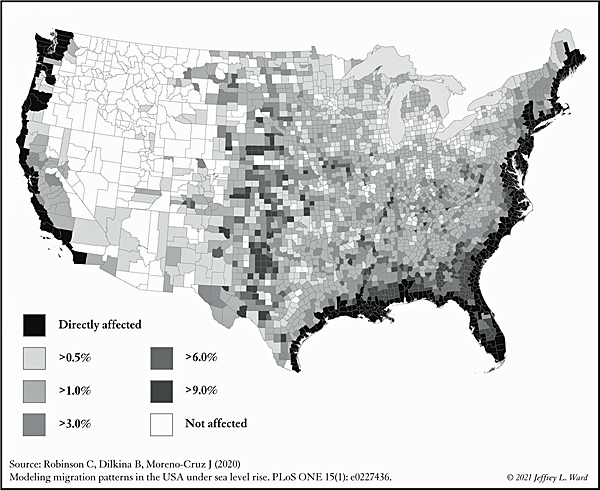 The Producer will be one of those dots moving from the coast to the center as the sea level rises.
Ocean Breeze and Oakwood Beach were declared eligible for state buyouts at pre-storm values. New York bought six hundred homes. Federal flood insurance for houses damaged by Sandy has risen by as much as 25 percent. The area around the restaurant is gap-toothed. Toto points out the houses of some residents who were underwater on their mortgages before their houses went literally underwater. Since Sandy, Toto sold the restaurant to new owners who are turning the place into a barbecue joint. Some who can’t afford to leave, or who are too old to start over, have stayed. Their new houses stand on stilts. One structure, an attached unit, has one intact, inhabited side and one crumbling, abandoned side. “It’s a mixed bag,” Toto says. The Ocean Breeze neighborhood was originally a salt marsh and never should have been built on. The land is returning to nature.
On the deck of the new place, Toto has left a painting on the wall, a mural of the waves at the height the waters reached during Hurricane Sandy. It hangs about level with your shoulders if you’re sitting down. You can have a lovely meal, Staten Island barbecue, and see right where the water will rise to. “I wanted them to put that there as a reminder,” Toto says. “People have no clue what this experience is. I do. And I do think it will happen again.” Everybody knows it will happen again. They’re still eating there.
Toto came back to Staten Island to rebuild because of massive investment by the state. It’s unclear whether that would be possible after a massive outflow of its population. A different possible response to climate change catastrophe followed the Camp Fire conflagration in Paradise, California. Fifty-two thousand people evacuated. Only half of them ended up staying in California. The wealthier people moved to the nearby town of Chico. On the Facebook group Camp Fire survivors use to share their stories and to stay in touch, they have registered their presence in forty-eight states. They’ve also left records of the randomness of their lives:
I find myself in Washington with no family around. And life is still hard. But I’m working on it. I finally found a job, I got a travel trailer. I made it work but yes we are still struggling and we might be for a while but will be okay. Me and my kids miss our lives but there’s nothing we can do about it. We miss our family, we miss our friends, we miss our home, and we miss our stuff. I still haven’t went to counseling like my mom said I should but I think I might need it. Because I find myself crying over the littlest things. We are strong, I just keep telling myself at least we’re alive.
I’ve arrived at Murphy, North Carolina now, staying at an air B and B rental cabin here. It’s the first chapter in a new adventure to have moved across the US at 66, disabled and knowing NO one here where I’ve moved. Now to find a new long-term home—fingers crossed!
I am now in a new state, in a beautiful town. Everyone here is so nice, and I have a new home as well. I know I should just feel lucky to be alive, but something inside me died that day and cannot be recovered. I miss my pets, my home, and my neighbors and it sickens me that some did not make it. I dream each night of my pets who died and the idea of their suffering terrifies me. I cannot eat or sleep normally now; nothing brings me pleasure anymore. I am bereft. I cannot abide the death of my community.
I have decided to give myself one year, until November 8th, 2019, to see if anything will change. Sometimes I wish that I too had died that day.
After Hurricane Katrina, around 100,000 citizens were trapped in New Orleans. That disastrous evacuation—a case study in emergency mismanagement—resulted in several hundred deaths by heat and dehydration within a few days. Eventually, 1,800 died there; 1.36 million applied for assistance. The scale of human destruction for a hurricane hitting New York would be exponentially greater.
The Politics of Climate Change Refugees
Robert McLeman studies migration patterns and climate change at Wilfrid Laurier University in Waterloo, Ontario. He has a disarmingly cheerful, upbeat way of describing the spread of total pandemonium. Climate change can bring about political chaos, in large part through migration. The rise of temperature or sea level won’t necessarily break people. It’s what you don’t expect that breaks you. I’m Canadian, so no cold snap, no snow dump, can break me. I’m used to it. I know what to do. But I wouldn’t know what to do in the case of even a mild drought. Bangladesh, to take an example, will typically not experience mass migration due to flooding, because people in that region have been dealing with floods for thousands of years. But a drought could cause a serious crisis, causing waves of migration into India that result in political chaos.
What could Americans adapt to? And what could break them? Most worrying to McLeman is the fact that American populations are growing in the areas that are most vulnerable to unpredictable catastrophes. They include coastal New York, coastal New Jersey, Florida, coastal Louisiana, the Carolinas, the Valley of the Sun, the Bay Area, and Los Angeles. Many Central Americans who were separated from their children at the American border were fleeing gangs and political instability, but they were also fleeing drought. “Environmentally related migration already happens; we’re just seeing the thin edge of the wedge right now,” McLeman says.
You cannot read a history of fascism that does not attribute its popularity, in part, to the deeper trends of the Great Depression. A 2012 study from the National Bureau of Economic Research confirmed “the existence of a link between political extremism and economic hard times as captured by growth or contraction of the economy.” The future of America will involve severe drought, economic downturn, and the erosion of major coastal cities. The political scenarios in the previous two reports reveal the dangers of these realities. The rise of the hard right and hyper-partisan Washington emerged, tangentially, from the collapse of the housing market in 2008. The rising chaos works both ways. American institutions respond weakly to emergencies. The emergencies weaken the American institutions, which, in turn, diminish their capacity to respond to emergencies. It’s a cycle. American families are chewed up.
No policy solutions, not even the most extreme, would prevent what I have described here.
The Thanksgiving After the Fall of New York
The Producer didn’t travel home for Thanksgiving that year. She was already there. Months after the fall of New York, there’s no longer reliable data on suicide rates or food insecurity. There are large drifting groups of human wreckage exploding in random violence or moving away from fear and toward the hope of safety. For the Producer, the relief of escape and reunion have passed. Vanished New York is worse than a wound to her. It’s a cauterized future. It’s a closed escape hatch while the waters are rising. The Producer fought so hard to break out of Iowa, to climb her way to the center of the world. And then the center of the world disappeared. She had some amazing audio footage of her escape from New York in the end. There was no one to sell it to.
At first, no one doubted that they would rebuild New York. Everybody talked about “New York tough,” and writers published pieces written about the surprising joys of having to take the Brooklyn Ferry again, and sidewalk vendors hawked FUCK YOU, MURIEL, YOU BITCH T-shirts outside the World Trade Center. After the Second World War, Germany and Japan rebuilt Berlin and Tokyo. After the earthquake of 1755, the Portuguese rebuilt Lisbon. But in all those cases, they assumed that their cities would not face such an uncertain future. If New York is forever more vulnerable to hurricanes, why rebuild it? How to rebuild it? The city and state and the federal government face an insuperable challenge, tasked with the almost incalculable cost of rebuilding the bulk of New York City’s infrastructure for an unpredictable future. And how could they raise the money when the people have fled? Who was going to pay the taxes?
The Producer’s husband has moved back to New York by then, and crossing the country is too much, even for Thanksgiving. He’s part of a salvage crew in the Bronx, digging up the abandoned subways for precious metals. All that devastated infrastructure has become the richest scrap metal in the world.
As for her nephew, he vanished one morning, leaving a note: He went to look for his father in North Dakota. When he bought a phone, he would call them. That’s what the note said.
His mother took his note seriously. She had to. But the Producer knew better. Her nephew had become one of the untraceable, the phoneless. He could have joined anyone. The Dakota Gadsdens. The local branch of the Atomwaffen Division. One of the separatist communes forming across the country. Or just one of the roving gangs. Still, they left his room exactly as he had left it, plastered with the historical Nazi and Allied propaganda, vintage images of Sharknado and Dawn of the Dead, the ceiling with dangling models of bombers.
At least they still have the garden. The Producer and her sister built an electric fence around the edges of the property after a few thieves snuck in, looking for marijuana and chickens. She was glad she’d brought the Glock with her from the city, but she bought a couple of Mossberg pump-action shotguns too.
As she sets the table for the family in the long dining room, the Producer finds herself recalling the Thanksgiving her cousin Rose returned from the Iraq War back in the early 2000s, the cackle of her mother’s laughter in the kitchen, her uncle and her dad in the hubbub of some argument, who can remember about what. All those happy memories are burdened with the sense of defeat now. Is it just the passing of time? Nobody’s life goes the way it’s supposed to go. Everybody knows the numbing sting of what might have been. She thought she would have grown into maturity by now, into security, into property, into control over her own life, a legacy to offer the future, if only some wisdom.
At the Big House, the sisters live in the shadow of their mother’s exhaustion. They know, with a shared sense of guilt they don’t have to acknowledge, that their own stalled lives have burdened their mother. They should be inviting her to Thanksgiving at one of their houses. But they’ll never own anything.
The food this Thanksgiving is a little better. Not enough for leftovers but plenty for now. They have turkey again, and mashed potatoes with real butter. The garden did well with a little more rain. They made beans with slivered almonds and carrots and beets and sweet potatoes and shredded cabbage. The whole family gathers around as it always had. Everybody agrees that rice stuffing with sage tastes better than bread stuffing.
What happened? The Producer won’t know as she looks back, trying to figure it out. The systems that keep us alive are ghostly, invisible. When they’re gone, we won’t even be able to say with any certainty what we’ve lost. She will sometimes blame herself and sometimes blame her times, and she’ll be right both ways. She, like her country, has stumbled from crisis to crisis. And the hardest fact is that the catastrophes they’ve lived through—the crash, the drought, the fall of New York—are only preludes. Worse is to come. They remain the lucky ones—for now.
I. While there’s no such thing as a typical American family, there is an average one, and I’ve tried to reflect the average in family structure and jobs. The average American family has 3.14 members. Half of American marriages end in divorce.
II. In February 2020, the Trump administration called a halt to the building of the New York Harbor Storm-Surge Barrier. At the moment of writing, the Army Corps of Engineers considers the project “indefinitely postponed.” Another way of putting that statement is that New York’s safety has been indefinitely postponed. I have conceived of this Dispatch under the assumption that the basic sanity of the Seawall proposal will eventually prevail. This is a significant assumption. Needless to say, if the Seawall is not built, New York will be vastly more exposed than the description in this Dispatch.