DISPATCH THREE: THE FALL OF NEW YORK
There is politics. There is policy. Then there are people’s lives. Assassination and rebellion are the dramas of the breakdown—but the causes of the drama and its ultimate effects are more subtle, more difficult to see. It’s not just large American institutions that are vulnerable. American families are, too.
There is no such thing as a typical American family. America is much too diverse and, frankly, much too weird to produce anything so fixed. For this dispatch, I have imagined two related families, one multicultural, coastal, and urban; the other white, central, and rural. These two sisters, one in New York and the other in Iowa, while by no means an adequate proxy for the country, represent the dangers across the main political and economic and geographic division in the country.I
The catastrophes are coming for everyone. They will seem to come out of a blue sky.
The Coming of the Storm
In the late summer, the NOAA (National Oceanic and Atmospheric Administration) National Hurricane Center upgrades its hurricane watch to a hurricane warning. The storm forming in the mid-Atlantic, picking up power from hot, moist conditions, needs a name: Muriel. New York goes about its business as usual. The name that will come to mean the end of the city is just another name.
Nobody cancels their trips to the Hamptons because of Muriel. The psychiatrists still take their month off. The Yankees have to cancel their series with the Blue Jays, but in the sweltering of New York in August, the idea of a solid rain seems, to some, like it might offer a break, refreshment. They have the wall by then. That’s the source of New York’s confidence. The Greater Manhattan Seawall, conceived after Superstorm Sandy and costing upwards of $119 billion,II will have already prevented several storm surges up to Category 3. As the storm comes on, they will close the gates at the East Rockaway Barrier, the Jones Inlet Barrier, and the East River Barrier.
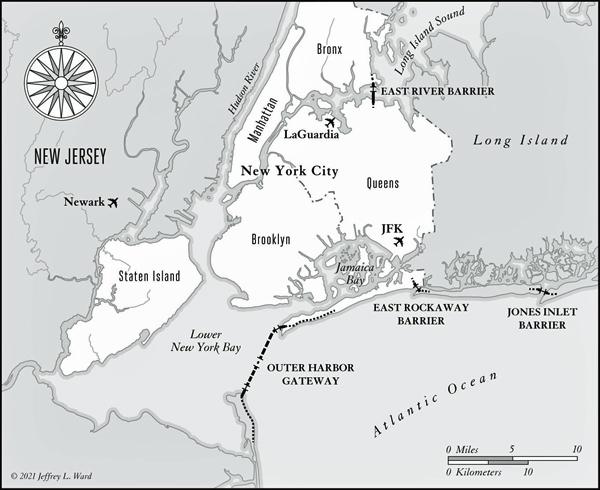
The Seawall embraces the city like the arms of a protective father. It makes the city feel safe.
The following afternoon, under dark skies, the Governor gives a press conference: “For most families in the Tri-state area, the correct decision is to evacuate. If you have family away from the coasts, if you can find a place to stay in the interior, go there,” he says. “If you make the decision to stay, please prepare. Gas and electricity will be subject to massive interruptions. Most of the conveniences that you take for granted will not be available. If you know of any handicapped people, any elderly people, who have not found access to services, help them find those resources.” Most New Yorkers take the Governor’s statement as tacit encouragement not to evacuate. It’s the standard statement before a storm, and superstorms on the Eastern Seaboard are no longer a rarity.
One of the New Yorkers listening to the Governor’s warning is a producer at WNYC, the local public radio station. She works mainly on the daily pop culture and politics podcast, but she makes occasional documentaries, too. Like every other New Yorker, she worries about Muriel but not enough to change her plans. The Producer lives in Gowanus in a two-bedroom with her husband and their teenage daughter. The place is smaller than they would like, but they never had an opportunity to find better. They were too busy living through Covid, and then the crash, and then the drought. When the storm first sets in, she has an idea for a story, an audio essay, a kind of This American Life–style piece, about riding out a storm in New York, a combination of personal confession with an up-close investigation of the effects of climate change. They send journalists to war zones. How bad could New York get?
The Producer and her husband talk it over. At first they can’t see a reason for any of them to leave. But the city’s sticky with the heat and she wants to be alone to produce the piece, and the sound of her husband and child in the background would be complicating. Besides, her daughter hasn’t seen her grandmother since the Thanksgiving before. So the husband and daughter head out to Iowa for a couple of weeks while the Producer stays in New York. They have to take the train down to Philadelphia for the flight because the airports in New York are too full. The Producer’s sister, unemployed and living with their mother, doesn’t understand why they all don’t just move to Iowa. The Heartland is safe for them, at least from hurricanes.
The Precariousness of the Twenty-First Century
Right now, at this moment, wherever you happen to be, you live in a period of cheap food and safe cities in an orderly world. The cheapness and the safety and the order cannot last. The systems by which we go about our lives, and which we take for granted, are growing more threadbare. America’s paralyzed and half-legitimate government won’t be able to respond with adequate measures. The radical instability will have political consequences. Climate crises and mass inequality have been preludes to civil war and to revolution everywhere—Europe, Africa, South America, Asia—and they’ll be preludes to crisis in the United States as well. But the consequences of the new instability transcend politics. Over the next fifty years, American lives are destined to become much more precarious. Some lives will shatter.
The Three Principal Threat Multipliers
Economic and environmental instability are what the US military calls “threat multipliers,” destabilizing forces that brew underneath the surface. The instability feeds into the chaos and rage that explodes. There are three principal threat multipliers facing the United States today: economic inequality, drought, and property vulnerability.
The Boredom Problem
One of the reasons why the stability crises of the twenty-first century are stubbornly difficult to solve is because they’re boring. They don’t make good stories. The forces that threaten to destroy the world don’t have faces. They offer no satisfying conflict between protagonist and antagonist. Inequality and climate change are collective failures requiring collective solutions. Who survives and what survives and in what condition they survive will be determined by the dreariest of questions: taxation levels and environmental regulation on an international level. Their dreariness has consequences; ordinary people don’t care.
The Democracy Problem
Inequality and climate change will cause the disasters that ordinary Americans are going to feel most acutely. They already do. But to address these problems requires massive, concerted political action, both domestically and internationally. And the United States can’t even convince its citizens not to drink at bars during a plague. Democracy—as a system balancing the rights of individuals with the interests of the state—contains inherent limits on collective action: the American political system, with its structure of checks and balances, was never designed to deal with collective crises. In its current state of hyper-partisanship, the US government is effectively paralyzed. One of democracy’s deepest flaws is that no one gets elected for catastrophes they’re going to prevent. Even after foreseeable catastrophes strike, Americans tend to forgive their leaders. They, too, didn’t want to believe the worst was coming.
Covid as a Pretest
Covid represents exactly the problems facing the twenty-first century. It’s not an enemy with a face but a crisis of systems. Controlling Covid required scientific consensus, effective policy, and social solidarity. Countries that came to the wrong scientific consensus, like Sweden, suffered. Countries that enacted the wrong policies, like England, suffered. Countries with low levels of solidarity, like Russia, suffered. The American response to Covid was unique. Of all countries with populations higher than 5 million and at least $25,000 per capita gross domestic product, the United States had the highest death rate. Political dysfunction was the obvious cause.
If you were to ask, “What was America’s Covid response?” you would get no answer. Part of the government said to wear masks, while part of it banned them. Even the most basic questions of public health became toxic: mask deniers and mask proponents physically attacked one another. At a moment when the safety of each individual required the most basic collective action—“Wear a mask”—Americans refused to stop infighting, even though their infighting led to higher risks for everybody and mass death. Failure to listen to scientists and failure to act on their insights have consequences. And, in the case of Covid, the science was clear, the cost of action was low, and the consequences were direct. Compared to the crises that are coming, Covid was nothing. Covid has been like an easy pop quiz before a punishing final exam.
The Covid Thanksgiving
As she waits for the storm to hit New York, the Producer remembers the Covid Thanksgiving—the Thanksgiving right after Biden was elected. Nationally, Covid had reached the beginning of its third wave, with a little more than 200,000 cases and 2,000 deaths a day. Pfizer had announced a vaccine, but it had yet to be approved. Unemployment had steadied at 14.7 percent. One in nine Americans were on food stamps. The CDC urged people to stay home, not to travel, but nobody seemed to be paying attention. Even though she trusted the CDC, even though she knew better, they went home for Thanksgiving that year. The Producer felt they had to. Her mother hadn’t seen the baby.
She wasn’t a producer at WNYC then, just an audio freelancer. Her husband was making good money as a web designer. They had their little girl in February, a few weeks before Covid overran the hospitals. So many of her friends fled to the country, or to other countries, but they had to stay. They needed their in-network clinic. She remembered they ran out of places to bury the dead on Hart Island. Then the businesses started closing: Dizzy’s Diner went down, and her favorite, Cocoa Bar in Park Slope, too. Still, she felt safer in the city. A friend in Wyoming wore a mask in a grocery store, and a guy in the parking lot screamed at her, “Why do you believe all that Communist horseshit?”; she ended up driving to Colorado for groceries. The Producer’s sister back home didn’t believe Covid was real.
Home, for the Producer, would always be the farmhouse her great-grandfather built at the turn of the twentieth century in the cornfields outside Davenport, Iowa. The family called it the Big House. If she closes her eyes, she can still see herself running down from her childhood bedroom on the third floor, past the window on the stairs where the rich wood of the dark paneling gave out to the limitless fields of swaying corn, through the front door, and to the bus for school. Her great-grandfather had overseen every detail of the Big House’s construction, designed it to the specifications of the large Eastern properties he had envied as a poor boy growing up in Vermont. A real estate agent might describe the place as a large five-bedroom in the Federal style with a classic wraparound porch—if the property weren’t so remote that no real estate agent would ever have a reason to describe it. When her father had decided to switch from farming to insurance, he sold most of the surrounding acreage to the neighbors, which they, in turn, sold onto corporate agribusinesses, but the Producer’s parents kept living in the Big House. When her father died suddenly in his sixties from a brain aneurysm brought on by lymphoma, her mom stayed on, though the Big House needs more upkeep than a single elderly woman could properly provide. The Big House is the family’s piece of America.
When the Producer made the decision to return to Iowa during Covid, her sister set them up with a trailer behind the Big House. That year her sister’s boyfriend had left for the Dakotas, looking for work, and she started the job at the Ram dealership, and his trailer was available. The Producer agreed with her husband that it would be best to have limited contact with the Iowa side of the family, to keep six feet apart, not to enter the Big House. But within a few minutes, those rules, so carefully negotiated, were all broken. Her mom had to cuddle the new baby. Her niece and nephew, who were six and four then, wanted their hugs too.
Mom prepared the classic American feast. They had a sixteen-pound turkey and pork chops and sausages. The family macaroni and cheese, made with nutmeg. Tater crumble, cheese on ground beef on tater tots. And the harvest of the backyard garden: mashed potatoes with gravy, and beans and peas and beets and corn and carrots and shredded cabbage cooked with pork. For dessert, they had Swedish pastries, cinnamon cookies, and a tusenbladstårta, a thousand-layered torte—traditions inherited from some forgotten Scandinavian ancestor. As they sat down to eat, they viewed the future with hope even in the middle of plague. Maybe life would return to normal? They weren’t doing too bad for Covid. Car sales had risen 6.2 percent over the year, so the dealership was flourishing. Her sister had to greet customers behind plexiglass, which she didn’t mind. With a mask on, she could say what she liked and nobody was sure what she’d said.
The sisters didn’t know, because nobody ever knows, that these were the good times.
The First Threat Multiplier: Inequality
You know the problem of inequality is serious when rich people have started to worry that they’re too rich. In the United States, the wealthiest of the ultrawealthy, the kind who wouldn’t notice $10 million one way or another, are forming political action committees opposed to the concentration of wealth in their own hands. The Patriotic Millionaires formed in 2010 with two extraordinary goals: to lobby politicians to increase their taxes, and to explain to ordinary Americans how unjust the economic order is. Two of the richest men in the world, Bill Gates and Warren Buffett, have publicly called on the government to raise their tax rates. “I have a message for my fellow filthy rich, for all of us who live in our gated bubble worlds,” warned early Amazon investor Nick Hanauer in 2014. “Wake up, people. It won’t last.” He couldn’t be more right. The Koch brothers have recently shifted their charitable endeavors from libertarian politics to the problem that the new generation will be worse off than the old.
The rich know what historians know: every society in human history with levels of inequality like those in the United States today has descended into war, revolution, or plague. No exceptions. There are precisely zero historical precedents that don’t end in destruction. Since 1980, inequality has been growing globally, but in the United States the growth is most dramatic. In 2015, the top 1 percent of American families made 26.3 times what the 99 percent did, garnering 22 percent of all income—the highest share since the peak of 23.9 percent before the Great Depression. In 1965, a CEO made roughly twenty times the typical worker’s pay. Now it’s 271 times. From 1980 on, the poorest 50 percent of the population has consistently seen a decline in their share of income. American inequality is now worse than it was in 1774.
All of the political loathing in the first two dispatches of this book, the hyper-partisanship and disunion, the sheer rage—all of it dates, in large part, from the 2008 financial crisis. That’s when sovereign citizenry spiked; that’s when negative partisanship, the Tea Party and Occupy Wall Street, originated.
The Effect of Income Inequality on Market Cycles
Economic models are, at best, weakly predictive. Covid, again, provided a good test. Not one analyst of note predicted that the economy would crater, unemployment would spike, and then the stock market would rise. That prediction wouldn’t have made any sense. A crash is coming, though. It always is: Look at 2008, 2001, 1987, 1973, 1966, 1929, 1907, 1901, 1857, 1837, 1819, 1792, 1763, and 1640. Crashes are an inevitable feature of modern capitalist economies. Capitalism works in cycles or, to be precise, it has always so far worked in cycles. Extreme inequality makes a market crash much more likely and a recovery much more difficult.
What will life look like just before the crash? It will look like right now. At the time of writing, the long-term yields on government bonds have fallen below the short-term yields on government bonds. This condition, which should be an economic impossibility, has predicted a major crash in every previous occurrence in history. Some sovereign bonds have a negative yield, which means the lender pays the borrower for the loan. If this sounds like it doesn’t make sense, that’s because it doesn’t. Most asset classes worldwide—equities, bonds, real estate, commodities—are approaching all-time-high prices. With interest rates at a hard low, no market correction in recent memory, and the expectation that the Fed will always inject more money no matter what the crisis, people and companies are borrowing too much. Once borrowers can no longer repay loans, loan values collapse. If the values of their assets drop, their own lenders start calling in loans or refuse to lend them new money. That’s how death spirals start.
The standard policies for alleviating financial crises—lowering interest rates, cutting taxes, and quantitative easing—will all be unavailable because of current US policy. Interest rates cannot be lowered any further. In Europe, they have recently begun the practice of negative interest rates. In the United States, the cost of borrowing money is slightly above zero. Similarly, American taxes are at historic lows and deficits are at record highs. Quantitative easing, once an emergency measure, is now standard practice. The amount of cash in the financial system today is about four times as much as in mid-2008. Nobody knows why or how the crash will come, but when it does come, there will be highly limited room to move. The Federal Reserve will be “out of bullets.”
Jonathan D. Ostry, deputy director of the research department at the International Monetary Fund, knows the dangers of inequality to any economy. Low inequality is emerging as a part of the Washington consensus, the conservative credo of macroeconomics. Even they have figured out that inequality strangles economies. The right-wing consensus has been that free trade, moderate marginal tax rates, and low interest rates lead to longer periods of growth. They do. But Ostry’s research, undertaken before the Arab Spring, before the Occupy movement, found that, as Ostry says, “low levels of inequality are robustly protective of growth duration. High levels of inequality seem to be associated, in all different times and all different countries, with the premature end of a growth spell. This is a striking finding.” From a policy point of view, neither increasing inequality nor decreasing inequality are good in themselves. Both can lead to deeper prosperity and stability: when China decreased its redistribution of wealth, the move sparked growth; when Brazil increased its level of redistribution that, too, sparked growth. For most of the world, about three-quarters of the countries Ostry studied, increasing redistribution would increase growth and preserve the length of growth. The United States belongs to that group.
Inequality makes it vastly more difficult to deal with the fallout of a crash. “Think of a society that’s very unequal and bumping along, experiencing decent economic growth, and suddenly something bad happens to it, an oil shock or a virus or its biggest banks go under or it has a typhoon or whatever, and growth collapses,” Ostry says. “That could be a blip and it could get back on its feet very rapidly. The way you would avoid having this bad shock turn into something more sinister [is] you would have to adjust economic policies, and whenever you make such adjustments, there can be pain. The buy-in from the population for the kind of adjustments needed to get the economy back on its feet—there is much less buy-in in unequal societies.” If society’s wealth has accrued to the top 1 percent during periods of growth, then the other 99 percent don’t have any incentive to sign on for short-term pain if they’re still going to live in a society where the top 1 percent prosper exclusively. Inequality lessens social cohesion. “That sounds airy-fairy but it’s really supported in the data,” Ostry says. “When you’re very unequal, there’s not just inequality of outcomes but inequality of opportunities. People are not going to have access to health care, to education, to the political process, so you’re going to be leaving a lot of your population disenfranchised and not participating. It’s going to mean that your economy is being run by a very small group. Those societies are going to be more brittle and less resilient to shocks.” Inequality leads to crashes, which lead to further inequality.
Bailouts are inevitably unfair. People who have saved suffer most. The irresponsible are the first to receive relief. As governments decrease spending, cutting into Social Security and Medicare, it is the poorest who lose the most. Typically, in unequal societies, financial markets are eager to extend credit to people who can’t afford to service their loans. The borrowers have a low capacity to consume and must borrow to sustain their consumption. The buildup of debt fuels vulnerabilities in financial markets. Inequality feeds into crisis, which feeds into inequality.
Inequality as a Problem Without a Solution
Inequality has no solution. Even extreme efforts at redistribution, for which there is little to no political appetite in the United States currently, tend only to slow inequality’s rise. Even communism only decreased inequality by destroying wealth. But you don’t need prediction to know that the American economic system is entering a deeply contradictory state. Economic growth has been artificially raised to a fever pitch, while life expectancy has been in decline for three years—a first for an advanced economy in history. Each subsequent American generation does worse than its predecessor. The current American generation will feel the decline over the course of their lives.
n. As a newspaperman, I was fascinated.
It was the newspaperman’s fascination that prevailed—or at least predominated—and left me dissatisfied with every analysis of Nazism. I wanted to see this monstrous man, the Nazi. I wanted to talk to him and to listen to him. I wanted to try to understand him. We were both men, he and I. In rejecting the Nazi doctrine of racial superiority, I had to concede that what he had been I might be; what led him along the course he took might lead me.