Epilogue
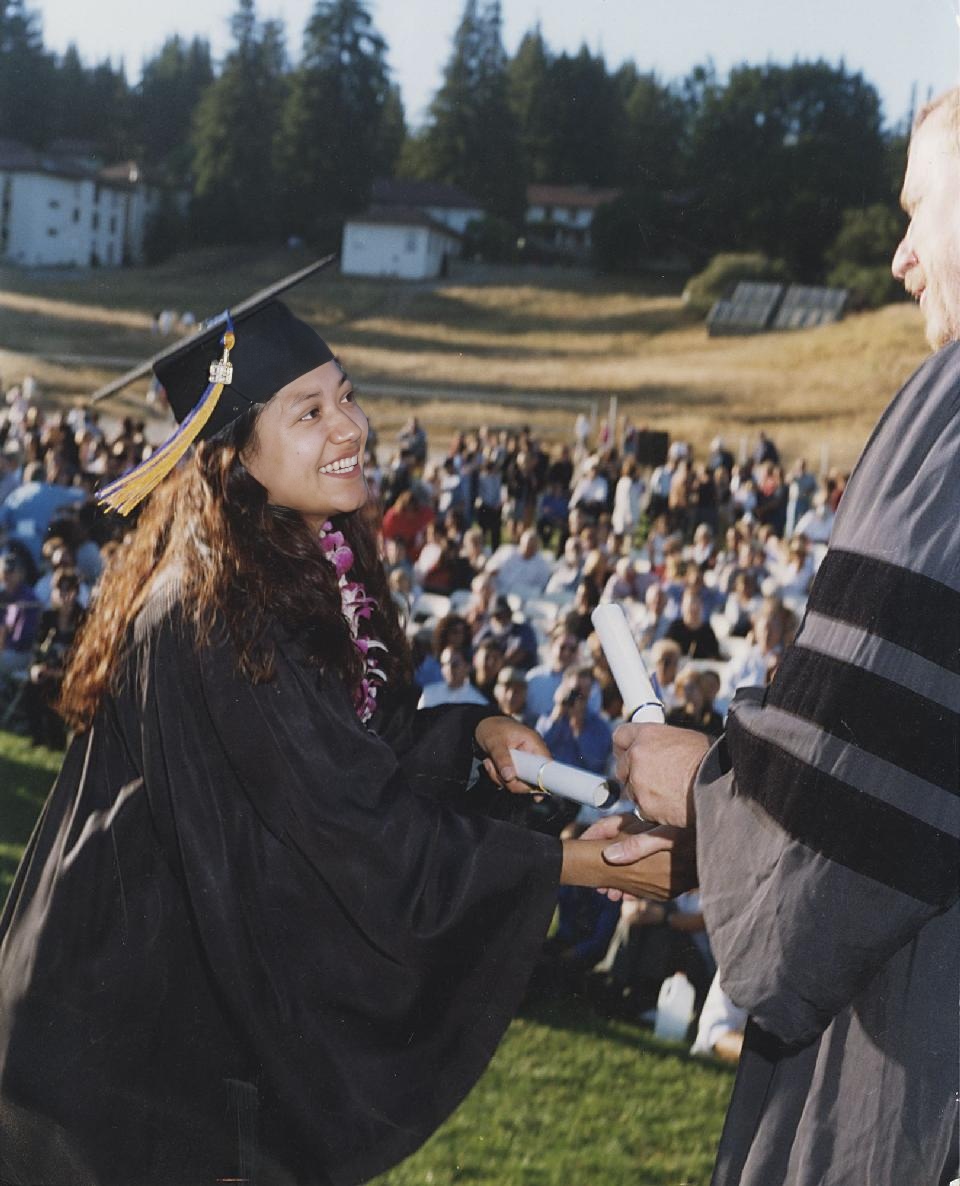
Reyna at UCSC graduation, 1999
IN JUNE OF 1999, I became the first person in my family to graduate from college. At UCSC I earned my BA in creative writing and in film and video and graduated with college honors, honors in the major, and Phi Beta Kappa. My family was there to celebrate that accomplishment with me: Mago, Victor, and their two children; Carlos, his wife, and their daughter; my mother and my brother Leonardo; Betty, her boyfriend Omar, and their son—and my father.
UCSC has a tradition that seniors are asked to write about a teacher who most inspired them. I wrote about Diana. My essay was chosen as the winner, and Diana was flown up to Santa Cruz so that she could be at my graduation. I gave a speech about her at the ceremony, and that was the first time I ever thanked her publicly for what she had done for me. I haven’t stopped talking about her since.
In 2000, I became an ESL teacher for the Los Angeles Unified School District, where I hoped to be like Diana, an inspirational teacher. I taught immigrant children in grades six through eight for four years, and that was when I learned that my story wasn’t unique. Like me, all the children who walked into my classroom had spent time apart from their parents. In fact, studies show that 80 percent of Latin American children in U.S. schools have been separated from a parent in the process of migration. I’ve also gotten to see the other side of that experience. In 2003, I taught adult school for the LAUSD, where many of my students were mothers and fathers who had left their children behind. In them, I saw my parents.
The cycle of leaving children behind has not ended. Nor will it end, as long as there is poverty, as long as parents feel that the only way to provide something better for their children is by leaving.
In 2002, I became a citizen of the United States. I have now been in this country for twenty-seven years. The United States is my home; it is the place that allowed me to dream, and later, to make those dreams into realities. But my umbilical cord was buried in Iguala, and I have never forgotten where I came from. I consider myself Mexican American because I am from both places. Both countries are within me. They coexist within me. And my writing is the bridge that connects them both.
In 2006, my first novel, Across a Hundred Mountains, was published. The following year it received an American Book Award. In 2009, Dancing with Butterflies, my second novel, followed.
In 2008, I received my MFA in creative writing, and unfortunately I’m still the only person in my family to have graduated from college. But between us, my siblings and I have thirteen children. I know that soon I won’t be the only college graduate in the family.
Diana and I are still close. I have known her for half my life. She has seen me become the woman I am today—a wife, mother, and writer.
Carlos, Mago, Betty, and Leonardo are doing well, trying to live as best they can. Ultimately, that is all we can do.
My relationship with Mila is better than it has ever been. She remained by my father’s side up until the day he died. My father’s illness brought us closer together. She also managed to repair her relationship with her children as well, and they are very close. My children call her “Grandma Mila” and like visiting her.
Our relationship with our mother has gotten slightly better, although I have come to accept that there will always be a distance between us. My siblings and I have done our best to forgive her, and accept her for who she is.
As for my father, when he was diagnosed with liver cancer in 2010, there were times when I had to stop outside the door of his house—and sometimes, the threshold of his hospital room—to tell myself that the father I was about to see was not the same father I had come to live with twenty-five years ago. I had to leave my emotions at the door—anger, resentment, bitterness, sadness, frustration, regret—before I could step inside the room and be able to look him in the eye and feel nothing but concern for his well-being.
There were times when my emotions got the better of me, and I would not go to the hospital on those days. It was the same for my siblings. “He’s gotten what he deserved,” we would tell ourselves sometimes. “He chose to drink, and now he has to pay the consequences.” Or we would talk about the way he treated us when we came to the U.S. to live with him. “He’s reaping what he sowed,” we would tell each other on the days we couldn’t bring ourselves to go see him. “Now he wants us around, and when we wanted to be there with him, he pushed us away.”
But there were also days when I would think of the other father—not the violent, alcoholic one, but the one who left for the U.S. because he wanted to give me something better, the one who did not abandon me in Mexico, the one who would tell me about the importance of an education, the one who taught me to dream big. Whenever I thought about that father, I would spend hours researching liver cancer on the Internet and at the public library hoping to keep him alive as long as possible. I would read books about alternative medicine. I would take him to my neighborhood supermarket which sells organic fruits and vegetables, hormone-free meat, and health products such as milk thistle and stevia. I would cook dandelion soup for him, put it in containers, and then drive over to his house to drop them off.
Then, when he had been in the hospital for two months, when I weighed more than he did, when he needed dialysis every other day and his stomach fluids drained, when his only hope of getting out was by receiving not only a new liver but new kidneys as well, my research and my soup were no longer needed. What was needed was my presence. What was needed was my conversation to help him pass the time.
What was needed was something I was struggling to give—my forgiveness.
The day before my thirty-sixth birthday, I found myself at my father’s hospital bed as his life support was turned off. As I held my father’s hand, and my life with him flashed through my mind, I thought about that question I had often asked myself: If I had known what life with my father would be like, would I have still followed him to El Otro Lado?
You made me who I am, I thought as he took his last breath. And I knew then that the answer to my question was yes.