19
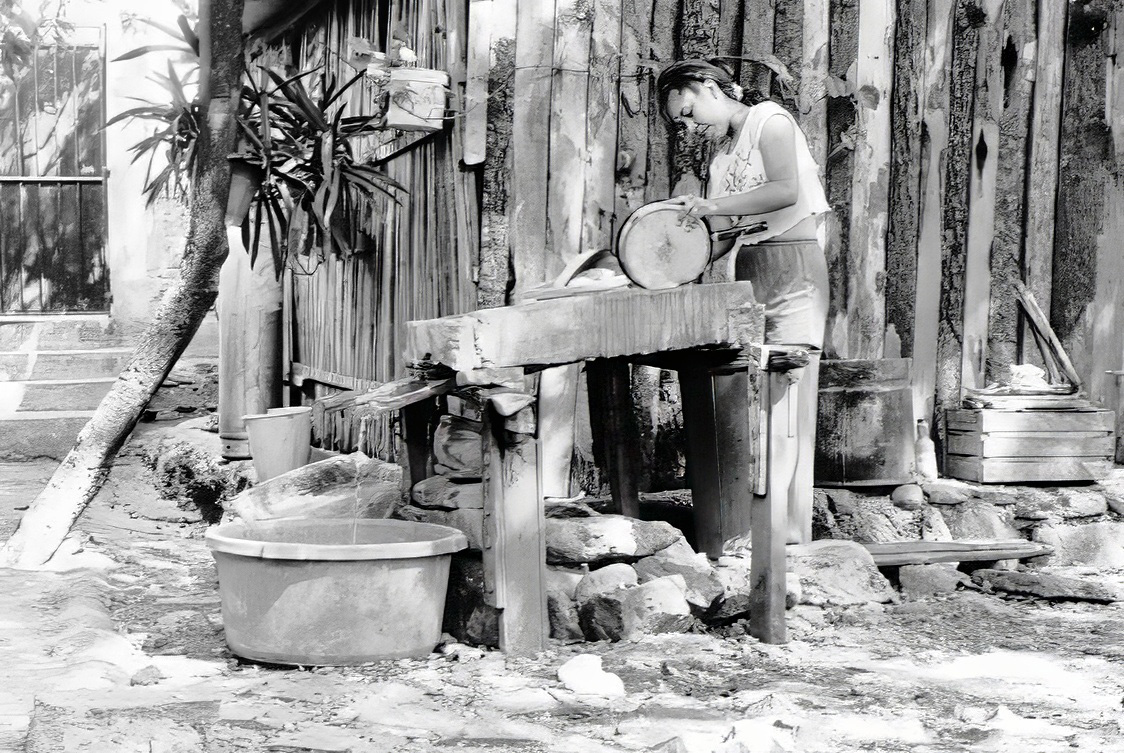
Cousin Lupita washing dishes in Abuelita Chinta’s backyard
IN 1993, DURING my senior year at Franklin, Mago decided to accompany our mother on her upcoming trip to Mexico. Like my father, my mother was also one of the 2.9 million people who’d gotten their legal residency through the Immigration Reform and Control Act of 1986. Ever since she had become a legal resident of the United States, my mother had been going to Mexico every year, sometimes even twice a year. By then, she had quit her factory job and once again had turned to selling Avon, although now she sold those cosmetics at the Starlite Swapmeet, where she rented a booth. Even though we had suggested she learn English and find herself a better job, my mother insisted on living the way she had lived in Mexico or the way she had lived when she was still undocumented. She refused to learn English and how to drive a car. She refused to look for a job that could offer her benefits—such as medical insurance and a pension plan, and where she could finally get off welfare.
Whenever she found herself missing her country, she would pull Leonardo and Betty out of Ninth Street Elementary and take them with her. Rey would remain to tend the booth at the swapmeet, because even though he was now a legal resident, he, just like my mother, didn’t take advantage of the opportunities available to him.
Unlike my father, who was a tyrant when it came to school and who had demanded nothing but perfect attendance from us, my mother didn’t really care that her youngest children were losing out on their education. Even though both Leonardo and Betty had been born in this country, they hardly spoke a word of English. Their education at Ninth Street Elementary was in Spanish, and they were put in classes along with the rest of the immigrant children. Their lack of a good early education—because of both the bad school and my mother’s unwillingness to value education—would put my younger siblings at a disadvantage. So it would come as no surprise when later Betty and Leonardo would both drop out of high school, and Betty would get involved in gangs and end up a teenage mother.
Back then, Mago, Carlos, and I had yet to visit Iguala. When Tía Emperatriz stole my father’s house, he said he would no longer return to the place of his birth. “What for?” he’d said. “I have nothing there.” He did return once, when his mother died four years later in 1997, but he never went back after that. And years later, on his deathbed, he would still mourn the loss of his house and continue to beg Tía Emperatriz to give it back.
I soon found out that the reason Mago wanted to go to Mexico was because her best friend Gaby (whom she met at La Opinión ) wanted to go to Acapulco, which is a three-hour bus ride from Iguala. “I’ll just go with you to Iguala for a few days,” Mago told Mami as we drove over to the travel agency. “Then I’ll join my friend in Acapulco.” I’d thought she wanted to go to Mexico because she missed our family and the place that we had once called home. I know I did.
As we were sitting with the travel agent and going over the details of the airfare, Mago surprised me when she asked me if I wanted to go. “I don’t have any money,” I said.
“When do you ever?” Mago said, rolling her eyes. “I’m offering to buy you the plane ticket. Do you want to go or not?”
I touched my belly button, something I hadn’t done in a long time, and I once again felt that yearning for my home country, although it shamed me to realize that the yearning wasn’t as strong as it used to be. I thought about all those credit-card bills Mago had, her car payments, the bills for the telephone line she’d installed in our bedroom, the money she had to give our father for household expenses. I thought about the student loans she still had to repay for a college education she had given up on.
“I don’t know,” I said, ashamed of myself for not being able to tell her that no, I didn’t want her to spend any more money because I would rather she used it to return to school.
“I know you want to go,” she said. She handed her credit card to the travel agent and purchased our tickets.

Mago, Mami, Leonardo, Betty, and I went to Mexico a few weeks later. Carlos couldn’t come because of his new responsibilities as head of his own household. Papi was furious when he found out I would be missing a week and a half of school to go on the trip, but Mago told him he was going to have to let me go because our tickets were nonrefundable. I felt awful about having to miss school. I could count the times I had missed on one hand: in fifth grade when I had lice, seventh grade when I had the chicken pox, eighth grade when we had to go to the U.S. Consulate in Tijuana to process our paperwork for our legal residency, and now, a visit home in my senior year. In the end, Papi gave in when I came home with the assignments my teachers gave me so that I wouldn’t fall behind while I was gone. As much as I hated missing school and not getting that perfect attendance certificate I loved to get at the end of a semester, I was desperate to return to the country of my birth.
I didn’t know what to expect when I returned to Mexico. Two months from then, I would be celebrating my eighth anniversary in the United States. I was seventeen years old. I thought I was no longer that little girl who had once lived there, although now I realize that little girl will always be inside me.
As we made our way to Abuelita Chinta’s house, we drove over the bridge above the river in which my cousin Catalina drowned. It was no longer much of a river but a dumping ground for trash.
“That’s gross!” Mago said as we got hit with the smell of stagnant, putrid water.
We passed by the train station, and I was shocked to see it completely empty.
“Where are the vendors? Where are the travelers?” I asked the taxi driver.
He told us that a year before, the Mexican government had privatized the railroad system, and the service to Iguala was suspended. There were no more passengers coming through every day. There were no more vendors who sold their wares and food. There were no more people from neighboring towns who would go there to catch the train. Men like my uncles, who had unloaded the freight trains to make a living, had found it even harder to survive.
As we sped down the road, I turned to look at the train station, feeling my eyes burn with tears. It was no longer one of the most important places in Iguala. Now, it was just a relic, an open wound that would never let the community forget that there once had been such a thing as progress.
Since we had too many suitcases, the taxi driver had no choice but to leave us at Abuelita Chinta’s doorstep, instead of dropping us off at the main road. But that meant he now had to drive over the unpaved road that was full of holes and jutting rocks. I felt as if we were on a ship being tossed around by a storm.
“Jesus Christ,” Mago said. “I can’t believe these roads. They would ruin my Tercel for sure!”
As soon as we got to the tamarind tree by Doña Chefa’s house, I knew we were almost there. My heart started to beat faster. We pulled up in front of my grandmother’s little shack. I knew that I had been in the U.S. for too long when the sight of my grandmother’s shack, with its bamboo sticks, corrugated metal roof, and tar-soaked cardboard, shocked me. Had I really lived in this place?
A few feet away from the house was an abandoned freight car left to rust on the tracks. There were five children playing in it, and I felt a pang of sadness that they would never know the Iguala I had known, the lively place travelers would visit. They would never hear the whistle of the evening train or taste the wonderful chicken quesadillas that Mago had once sold at the train station. Seeing those kids’ dusty bare feet, dirty hair, and torn clothing, I knew how my father had seen us those many years ago when he’d returned. I wondered if he had also felt his heart break.
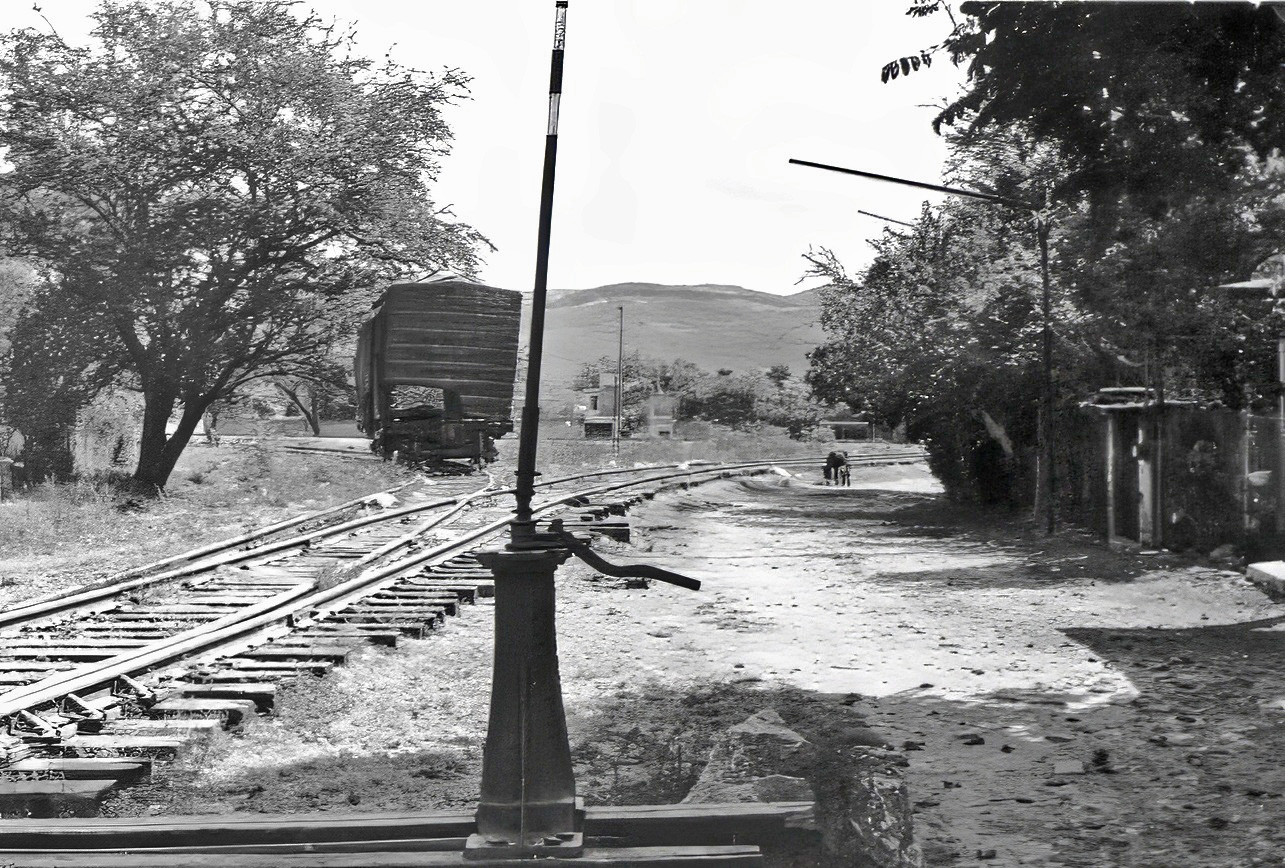
Freight cars left to rust on the tracks by Abuelita Chinta’s house
Tía Güera and Abuelita Chinta came out to greet us. My aunt had built herself a shack next to my grandmother’s. She had returned to her no-good husband even though he would drink his wages away, beat her, and cheat on her. She held a baby girl in her arms. Then she called out the names Lupita and Angel and two of the kids who had been playing in the abandoned freight car came running.
“Say hello to your cousins and your aunt,” Tía Güera instructed them. I hadn’t recognized Lupita. She was a year younger than Betty, so that put her at eleven. Angel was seven, Leonardo’s age. But both my cousins were so skinny and tiny, whereas by then both Betty and Leonardo were overweight from all that junk my mother fed them. Here, next to my cousins, who barely had enough to eat, that extra weight was even more shameful to look at.
My grandmother’s face was mapped with more wrinkles, her hair was mostly gray now, and a few more teeth had fallen out. But when she hugged me, I breathed in her scent of almond oil and epazote, and I couldn’t believe I was back in my grandmother’s arms. Her scent was all I needed to feel that I was home.
“I have prayed for this moment for so long,” Abuelita Chinta said, squeezing me tight. “God has finally answered my prayers.” By then I had grown to my full height—five feet, zero inches. I was so used to looking up at everyone that I felt awkward having to look down at my tiny grandmother, who was three inches shorter than me. How tiny and fragile she seemed to me now.
We went into the shack with her, and not long after we had sat down to eat the meal Abuelita Chinta had prepared for us, Mago began to complain. “Look at my shoes,” she said. “They’re covered in dust. Ugh.”
“Get over it,” I said, thinking about Abuelita Chinta’s feet. Hadn’t Mago seen the layer of dust on our grandmother’s feet, the dirt caked under her toenails? Abuelita Chinta gave her a rag, and Mago went to the washing stone to wipe her shoes and wash her feet.
After our meal, Tío Gary arrived with his children in tow. I was shocked to see how skinny my uncle was. He had a rope tied around his waist because he didn’t have a belt to hold up his pants. After my cousin Catalina’s death, he and his wife had divorced, and now he had remarried and fathered more children. At that time he had four boys; the youngest would eventually die from leukemia because my uncle did not have the resources to help his child.
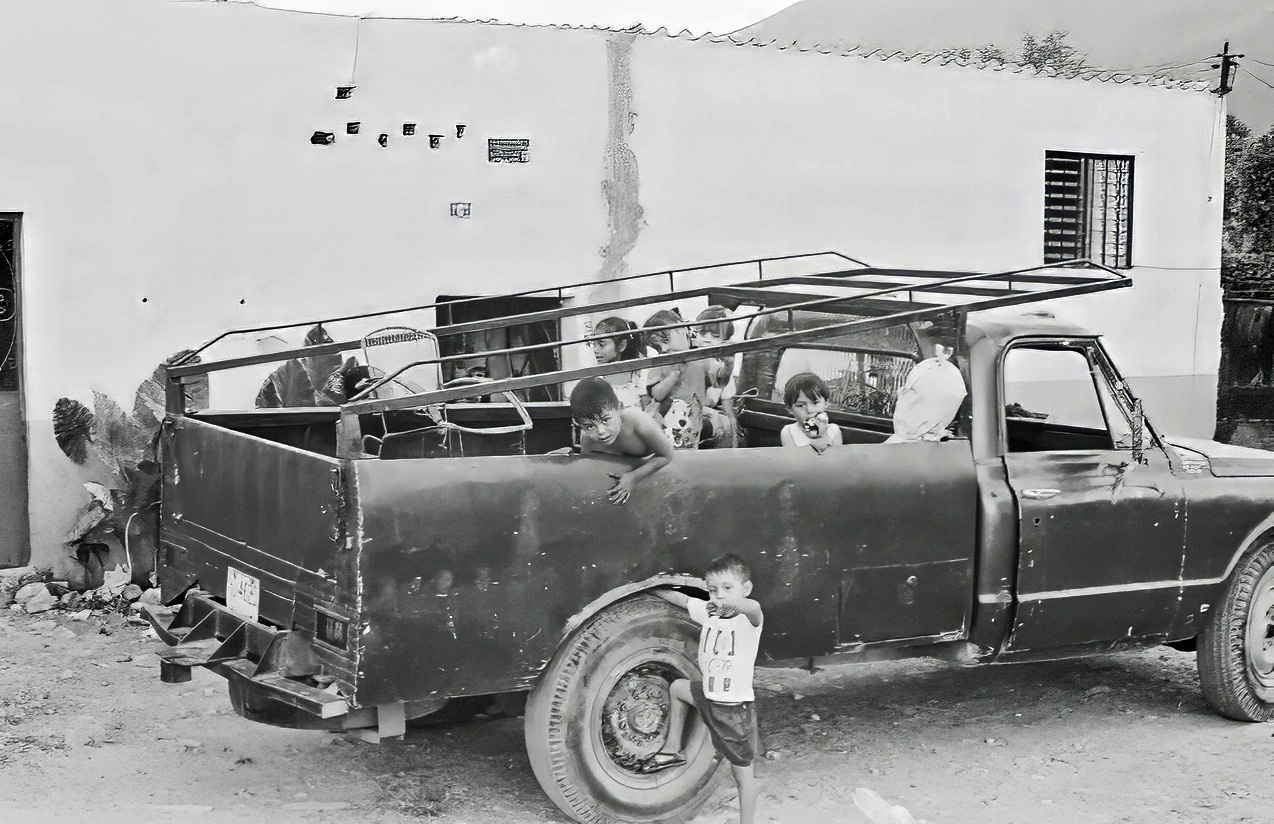
Don Lino’s truck
While we sat outside the shack, we heard the familiar sound of Don Lino’s truck. We turned to see it bumping and jerking its way down the dirt road. All the neighbors’ kids, including my cousins, ran out to meet the truck, just as I had done while living there. For a moment, I felt like running to climb on it. As the truck passed by us, I smiled at hearing the laughter of the children on top of the truck. I waved at them, and they waved back.
Mago scrambled out of the way when Don Lino’s truck sent a cloud of dust toward us. “Ugh!” she said, and went into the shack.
“Why don’t you go to El Otro Lado, Gary?” my mother asked my uncle. “You can give your children a better life if you do.” I watched the kids get off Don Lino’s truck. My uncle turned to look at his own children who were making their way back to us. He shook his head.
“I’d rather be poor, but together,” was my uncle’s reply. I didn’t know then that my mother encouraged my uncle to go north every time she visited. I didn’t know that his reply had never changed. I thought about my father, the choice that he had made to go north, and the price we had paid for that decision. But I also knew that something good had come from that decision. As Papi often said, my siblings and I had been given the opportunity of a lifetime. How could we let it go to waste? As I looked at my cousins walking down the dirt road, I thought of my father, of what he wanted our future to be like, and I understood.

I took advantage of being there and quickly set out to look for the friends I’d left behind. Some of them were already married and had children! Others were still living at home and working as maids, or at the U.S.-owned garment factory nearby, or whatever else they could find. But things had changed. When you come from the U.S., people look at you differently. They treat you differently.
The boys looked at me as if they wanted to marry me there on the spot so that I could take them back with me to El Otro Lado. My girlfriends didn’t invite me into their houses like they used to. Instead, they stood outside with me and blocked the entrance to their houses with their bodies, and I knew it was because they didn’t want me to see the poverty they lived in. They didn’t offer me anything to eat or drink because they couldn’t afford to feed themselves, let alone a guest. They didn’t tell me much about their lives because I knew that they thought it could never compare to my life, now that I was living in that beautiful place they all yearned for.
Instead, I awkwardly stood with my seventeen-year-old friend Meche in front of her shack. I didn’t know what to say to her as she held her baby in her arms and tried to wipe the dirt and mucus off his face with the corner of her blouse. She didn’t look at me. She looked past me, at the huizache trees behind me, her cheeks reddened with the shame of knowing that no matter how hard she wiped, the layer of dirt would never come off.
I was determined to make her see that I was still the same Reyna, but I didn’t know how to do that. In the U.S., the only people I spoke Spanish with were my mother and father. With everyone else I communicated in English, with Mago, Carlos, Mila, and my teachers and friends at school. And as I stood there trying to have a talk with Meche, I kept stumbling on my Spanish words. She laughed and said I spoke like a pocha.
It was an awkward conversation. I tried to think of something else to talk about beside school, marching band, my writing, books, and the colleges I had applied to the semester before. I was afraid to admit that perhaps I might not be the same little girl who used to make mud tortillas and whose only dream of the future was to one day have her parents back.
As I walked away from Meche’s house, I realized there was something else I had lost the day I left my hometown. Even though my umbilical cord was buried in Iguala, I was no longer considered Mexican enough. To the people there, who had seen me grow up, I was no longer one of them.

When I returned to Abuelita Chinta’s house after visiting my friends, Mago was angry at me. “Where have you been?” she asked. “I’m the one who brought you here, remember? You can’t just do what you want. I wanted to leave for Acapulco today. I’m so sick of this place. Now look at what time it is.”
“I wanted to spend time with my friends before we left,” I said.
She pointed to the shacks on the other side of the canal where Meche lived and said, “I don’t know why you want to be over there with that trash.”
“What do you mean ‘trash’? Have you forgotten this is where you come from?” I was so furious, and before I could stop myself, I pushed her.
“Just because I used to live here, it doesn’t mean that I still need to be friends with these people,” she said, pushing me back. “Let them dare call me a little orphan now.”
“You conceited brat,” I said, pushing her even harder.
Next thing I knew, Mago and I were pulling at each other’s hair and tumbling to the ground.
“Reyna, Reyna, leave your sister alone!” Mami yelled. But I couldn’t stop. I didn’t know why I was so angry at my sister. How could she just sever the ties that bind us to this place, to these childhood friends of ours who weren’t able to escape this poverty like we did? I was so angry at her for quitting college and ruining her chances for a successful life. Now I realized that we owed it to them, our cousins, our friends, to do something with our lives. If not for us, then for them, because they would never be able to. I understood so clearly now why Papi said there were so many people who would die to have the opportunities we had, who would kill to get their hands on a green card. Mago’s and Carlos’s refusal to see that angered me more than anything.
“Stop! Stop!” Mami said. And finally I did. Mago looked at me as if she didn’t know me. I ran into my grandmother’s house crying and feeling ashamed. For the first time in my life, I had raised a hand to my sister.
How could I stop myself from feeling sad that Mago no longer cared about Mexico, that she didn’t think of this place as special because it was once our home? Her home was now the United States. Unlike me, she had no accent when she spoke English. Now I knew why that was. Even in her speech, she was trying to erase Mexico completely.
I didn’t know if I ever could. Or would want to.