12
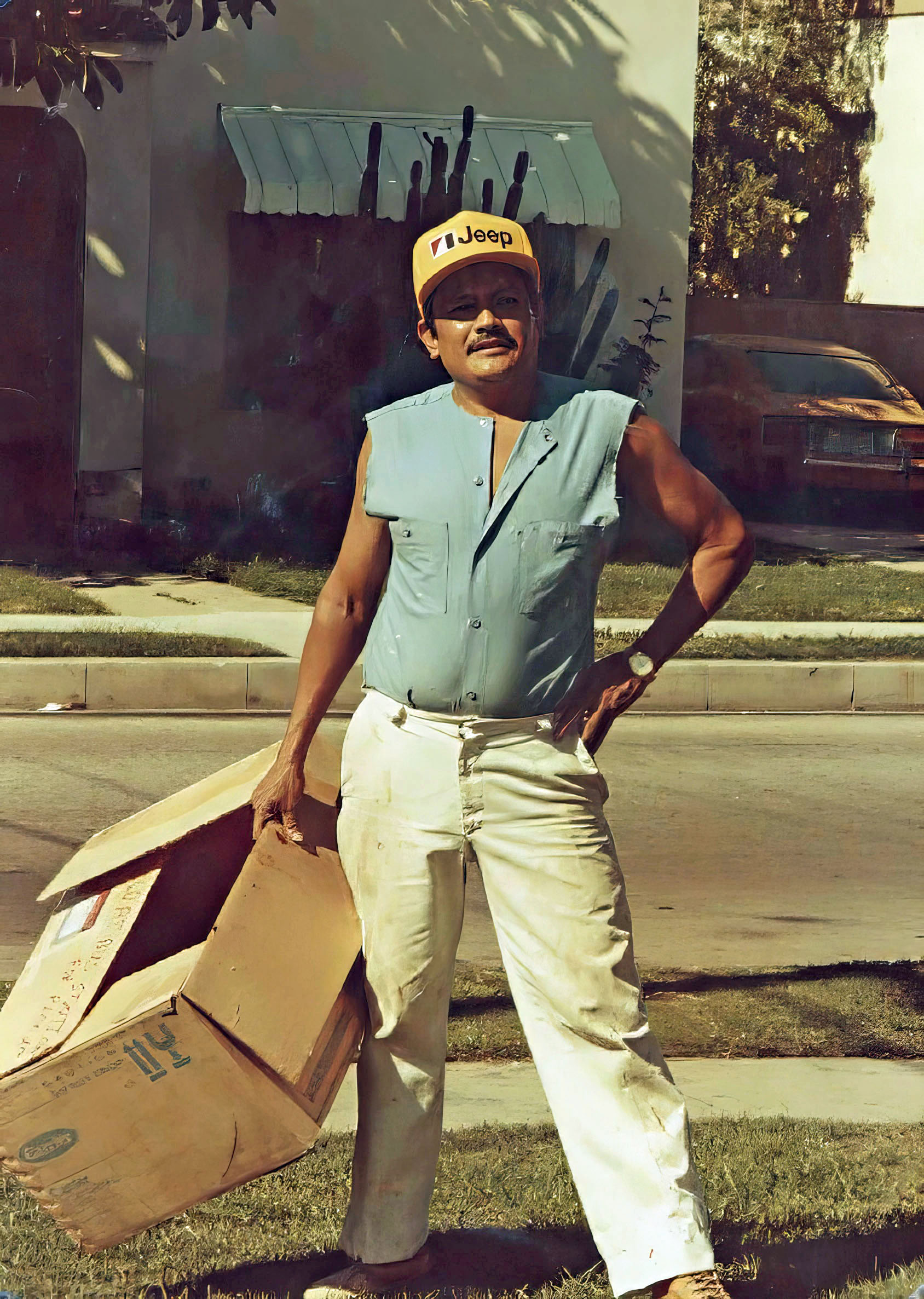
Papi
JUST LIKE ABUELA Evila, Papi did not allow us to go out into the neighborhood to play. He would say, “I want you here, at home, where I can see what you’re doing. I won’t have you hanging out with the wrong kids and becoming cholos.”
We weren’t interested in becoming gang members, but it was hard not to come across them. Highland Park was home to one of the biggest gangs in Los Angeles—the Avenues. There was a family of Avenues living next to us, in fact. Although we tried to stay away from them, they wouldn’t stay away from us. One of the boys, Tino, would sneak into our yard every few nights to fill up his buckets with water from the garden hose. Their utilities were always getting shut off when they didn’t pay their bills on time. The father was in jail for taking the blame for a crime his oldest son had committed, and the mother was usually doing drugs instead of taking care of her children.
Papi would never say anything to them. He’d say, “I’m not going to put our lives in danger for a bucket of water.” But one night, when Papi was coming home from the liquor store with a six-pack of beer, a thug came out from the shadows with a knife and told Papi to hand over his wallet. In the dim light of the streetlamp, Papi caught a glimpse of the cholo’s face and said, “I let you take water from me and now you’re threatening me with a knife?”
Papi later told us that Tino had actually apologized to him and put his knife away. “Good thing I’ve never said anything about the water,” Papi said. “He would have stabbed me right then and there because I wasn’t about to hand over my wallet that easily.”
The firing of gunshots was a regular occurrence in our neighborhood. Almost every night we would hear popping noises in the distance. But one night, what we heard was louder than pops. Mago and I were in the living room watching our favorite soap opera, Quinceañera, and we were so engrossed in the TV we didn’t pay much attention to the noises. But then Papi and Carlos were running into the house and Papi was yelling, “Get down. Get down!” We immediately dropped to the floor.
“What’s happening, Natalio?” Mila asked as she came out of her room. It was now quiet outside except for the barking of a dog and a car alarm going off.
Papi had been outside finishing some repairs he was doing on the plumbing, and Carlos had been practicing his soccer moves in the parking lot. Papi said that a car had driven by and the men inside shot at three cholos that were walking by. The bullets shattered the windshields of the car that belonged to one of their tenants. Carlos was playing just a few inches away from that car.
“One of the cholos got hit,” Papi said. “He’s still out there, but the others took off running.”
When we were sure no more gunshots would follow, we went outside and saw the man who was crawling on the sidewalk. “Help me,” he said, groaning. “Help me.”
Papi stood in front of Mago, Carlos, Mila, and me and put his arms out, keeping us back. The young man’s head was shaved close to his scalp and he was wearing a plaid long-sleeve shirt. He grabbed hold of the front gate and tried to pull himself up. “Help me,” he said again.
I looked at Papi. Why isn’t he helping him? “Do something,” I said, pulling on his sleeve.
“Let’s go inside,” Papi said. He grabbed me by my shoulders and turned me around.
“But he’ll die,” Mago said.
“Go inside,” Papi said again. Mila went straight to the phone and called 911.
“We have to help him!” I said.
“We’ve done all we can for him,” Papi said. “If I go out there and help him, tomorrow I will be the one who gets shot. Or you kids. Those stupid cholos will come seeking revenge, believe me. I don’t want to come home and find you kids clinging to the gate with a bullet hole in your chest!” I recognized the terror in my father’s face. I had seen it once before, at the border, during our third crossing as we were running from the helicopter. It was the look of an animal that can sense danger and is ready to protect its young.
We stood in the kitchen looking at each other. Soon, we heard the sound of sirens approaching the house. Papi went outside and told us to stay inside. Through the window we saw the police and the ambulance arrive. We were too curious to do as we were told, so we went outside just as the paramedics were prying the cholo’s fingers from our gate. They lay him on the sidewalk and tore open his shirt. He wasn’t moving or breathing. To the right of his chest was a small bullet hole. I stared at the pool of blood beneath our gate. I reached to grab my father’s hand, and he squeezed mine tight.

The next day, Papi decided to go to adult school and improve his English once and for all. He was still going through the process of legalizing his status through President Reagan’s amnesty program, IRCA. He hoped that soon that green card he so desired would help him become more than just a maintenance worker. But, first, he had to learn the language. “Once I’m a legal resident, and I speak better English, things are going to change,” he said. “I’m going to move us out of this neighborhood.” So far, he had depended on Mila for everything. She had to write out the checks to pay the bills. She had to take me, Mago, and Carlos to our doctors’ appointments because Papi didn’t feel comfortable doing it. Mila went grocery shopping. Mila went to our parent-teacher conferences because Papi made her go in his stead. Mila dealt with their Asian tenants who couldn’t speak Spanish. Papi would stay in his room and wouldn’t come out, except to go to work or to the liquor store.
Papi bought himself a notebook and borrowed a pencil and a sharpener from me. I even gave him my eraser that smelled of strawberries, for good luck. We watched as he left the house and headed to Franklin High School, where they had night classes for adults. It filled me with pride to see my father go to school. All his talk about education, about the importance of school, seemed to mean so much more when I saw him full of determination to learn. My father’s desire for a better life was palpable. It was contagious. It was one of the things I most respected about him. And I hoped with all my heart that he would be granted amnesty and be allowed to step out of the shadows.

Yet a few weeks after he’d started going to school, Papi found out something terrible. Tía Emperatriz had stolen his dream house. My aunt had finally gotten married, but at that point she had been so desperate to do so that she found herself a man who was much older, who had already been married once, but who could not take care of her. The bitterness of her disappointing marriage changed her. Somehow, she managed to get Abuela Evila to sign over to her the deed to her property, which included the land on which Papi’s house had been built. My father had been allowing her to stay in the house in his absence, since he wasn’t there anyway and he needed someone to take care of it. But he never imagined his sister would outright steal the house from him.
“How could she do that?” Mila asked. “Your own sister. And your mother, why would she hand over your house to Emperatriz, just like that? You’ve been a good son. Look at all the money you’ve been sending her all these years. Without you, she would have starved already.”
“What are you going to do?” Mago asked Papi. We knew what that house meant to him. We knew it was his backup plan in case things didn’t work out for him here in the U.S. It was an investment that had cost us our relationship with our parents, that cost Mami her marriage with my father. The price for that house had been too high to pay, as Mami once said. And now, it had been stolen from him.
“I’m going to go over there and get my house back!” Papi said, slamming his fist on the kitchen table.
“You can’t go, Natalio. If you get caught on your way back, your green card application will be denied. Do you really want to jeopardize your chance at becoming legal?” Mila said.
But Papi wasn’t listening. “I’m not going to lose that house. I can’t lose that house. It’s all I have.”
“But we don’t have money to pay for your plane ticket. We don’t have money to pay for a smuggler to bring you back,” Mila insisted. “We’re barely making it as it is.”
But Papi wouldn’t listen, and by the next day, he was gone.
While he was in Mexico, it took a lot of effort for me to stay focused in school. I wondered what Papi was doing. I wondered if by now my aunt and my grandmother had realized their mistake and given the house back to its rightful owner. It hurt me to know that Tía Emperatriz had acted in such a dishonest way. She’d been so kind to us, and I had always remembered her fondly. Now, she had not only betrayed Papi but us as well.
I wondered if Papi was already on his way back to us. I prayed that he would cross the border safely. I prayed that he wouldn’t get killed or hurt or caught by la migra. My stomach hurt knowing that if he did get caught, he would lose his chance at becoming a legal resident, at finally having that security he desperately desired. And what would become of his dreams, which by then were also becoming my dreams?

Two weeks later, we came home from school to find Papi sitting at the kitchen table, his head hanging low. His face was pale, despite the sunburn he’d gotten while crossing the border. His eyes were red and puffy from lack of sleep. He looked thinner than when he’d left. We rushed to him, happy that he had made it across the border safely. He turned to us and said, “I’m never going back there again.”
I thought about all those times Mago, Carlos, and I had helped to carry bricks and buckets of mortar to the bricklayers. I thought about those nights when we couldn’t sleep because we had been so sore. I thought about the years that Papi was gone, that Mami was gone, so that they could build that dream house.
“What happened, Papi?” Mago asked.
He told us that Abuela Evila was ill and frail, and somehow my aunt had managed to coerce my grandmother into deeding her the property. While he was there, my aunt had said that what was done was done. She said Papi didn’t need a house when he had so much already. Didn’t he live there in that beautiful country? What more could he want? He said that neither his father nor his mother stood up for him, that neither parent fought by his side. He said, “I’ve never felt so alone in my life.”
I wished I could go to my father and wrap my arms around him, tell him that I understood his loss, tell him that it hurt me as much as it hurt him, that he wasn’t alone—he had us, his children. But I didn’t know how to hold him. I didn’t know how to say what I felt, so I said nothing at all.

In the evenings at five thirty, I would look at Papi’s bedroom door and wonder if that day he would finally come out with his notebook under his arm, ready to go back to school. But the door remained closed. After two weeks of looking at his closed door, I realized that the dream house wasn’t the only thing he had lost.