11
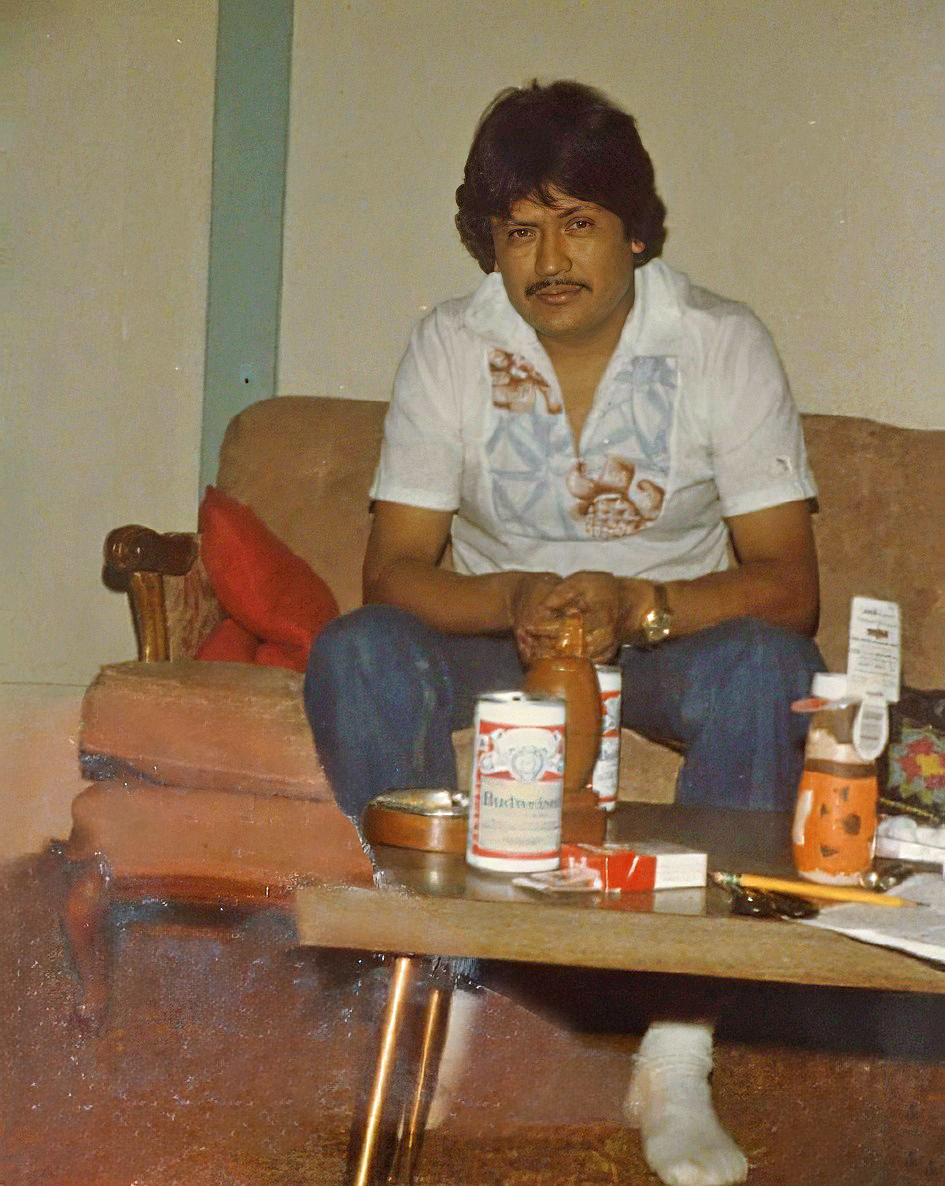
Papi in the United States
SOMETIMES PAPI WOULD sit us down and talk and talk as if he were trying to make up for the eight years he was gone from our lives. But his talks were always about the future, and they always went like this:
“Here in this country, if you aren’t educated, you won’t go very far.
“School is the key to the future.
“Without an education, you’re nothing. So you kids have to study hard. You hear me? Do you hear me?”
He would tell us how important it was to get an education so that one day we could have a good career and not have to ask anyone for anything. “For example, look at your mother,” he’d say. “Isn’t she ashamed to be on welfare? And what’s she doing at a factory? That’s a dead-end job. You get paid under the table, don’t get benefits. She’s not putting money into social security for retirement. That’s not the way to live, not here in this country.” He didn’t mention that he, himself, wasn’t getting much out of his job because he was using a social security card he’d bought at MacArthur Park for a hundred bucks.
Papi would tell us that one day we would have great jobs. Be home owners. Have money for retirement. And never be a burden to anyone.
Sometimes, Betty would also be there at the table. She was six years old and had no interest in retirement either. By then, Mami had finally allowed us to bring her over on the weekends because Betty would cry every time we left to go back home. She wanted to come with us. Every time we left her, I felt that we were replaying that day in Mexico. We’d reassured Mami that Papi wouldn’t “steal” her back. Not so much because he didn’t want to, but because they truly couldn’t afford another mouth to feed, as Mila had said. Betty was too little to have any interest in Papi’s visions for the future, and since she rarely came over, they would not have any impact on her later in life, as they would me.
“But I’m only eleven and a half, Papi,” I would say. “Why do I need to worry about retiring?”
“Chata, one day you will get old,” Papi said. “If you think life is hard now, wait until you get old enough that you can’t even bathe yourself, then you’ll really see how hard life is.”
“Like the old people at Kingsley Manor?” I asked.
“Yes, but you wouldn’t be able to afford Kingsley Manor if you didn’t have a good job before you got too old to work,” Papi said. “But see, if you plan ahead, then you’ll be better off.” I tried to picture myself as an old lady, dressed in a princess dress and walking down the halls of a great mansion, as I imagined Kingsley Manor might look. I decided I really did want to have a good job, as Papi said I should.
“But we don’t have papers, Papi,” Mago said. “How are we going to have good careers with no papers?”
Papi said, “Just because we’re illegal doesn’t mean we can’t dream. Besides,” he said, “our lives are going to change for the better. Soon, that will no longer be an issue.”
Papi had been looking at ways to legalize our status. He and Mila got officially married some months before so that she could use her privileges as an American citizen to apply for our green cards. Also, ever since President Reagan approved an amnesty program eight months earlier, in November of 1986, Papi had been going through the process and was hoping to get his green card through that program. Once he did, he could then claim us and legalize our status if our applications through Mila didn’t work out. Mami had applied for legal residency as well, but unlike my father, she wasn’t concerned about her children’s status.
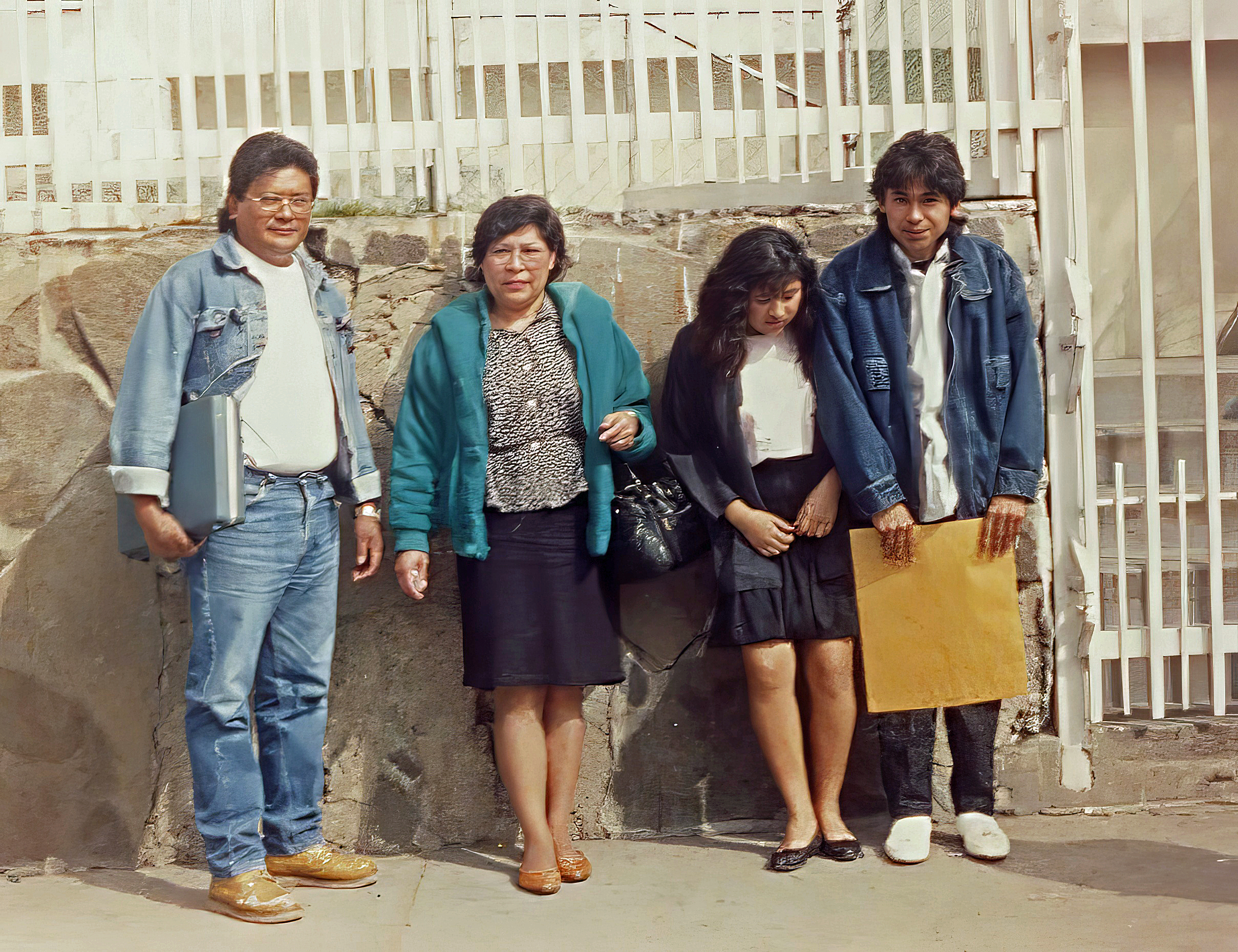
Reyna and family outside of U.S. Consulate in Tijuana finalizing green card applications
“One way or another,” Papi said, “we will stop living in the shadows.”
Back then, I hadn’t known what exactly he’d meant by that, but when I thought about the way Mrs. Anderson had ignored me, about the fact that I couldn’t express myself in class and my lack of English kept me silent, I thought I understood what Papi meant.

In September of 1987, Mago became the first person in our family to go to high school. Papi decided to take her shopping for new school clothes, saying that his “Negra” needed to look her best on such an important day because after this his “Negra” was going to go on to college and make us all proud.
“How about me?” I asked. “I need clothes, too. I’m starting junior high.”
“But you weren’t the first one,” Mago said. “I was.”
Papi told Carlos and me that he didn’t have enough money for us all. Back then, I didn’t know that his small paycheck didn’t go very far to support his three children. I didn’t know that divorcing my mother in order to marry Mila had cost lawyer fees, that the green card applications for the four of us had cost money, and so would the rest of the application process. So when he and Mago left for Fashion 21, I was left behind, angry at my father and thinking him a cheapskate for not taking Carlos and me clothes shopping as well.
I was also angry at my sister. It wasn’t my fault that she was the firstborn. It wasn’t my fault that she would get to do everything before I did. Papi said he wanted us to stop living in the shadows. Whether we got a green card or not, I promised myself that I would stop living in the shadow—of my sister, at least. I would find a way to be the first at something. Something that would make my father proud.

If I thought Aldama Elementary was big, I was overwhelmed when I saw that Luther Burbank Junior High School was even bigger. Thankfully, I would not be alone at school. Carlos was starting ninth grade, and he would be here with me for a year. He took me to my first class, which was Intermediate ESL. Finally, I would no longer be in a corner of my classroom as I learned English. I would be in a room where all the students were English learners.
My teacher’s name was Mr. Salazar. His name sounded familiar, and I couldn’t remember where I’d heard it until he took roll. When he called out my name, he paused and asked, “Grande? Are you by any chance related to Maggie Grande?”
“Yes, she’s my sister,” I said, remembering that Mago had mentioned him to me before.
Mr. Salazar had a huge thick mustache, but even his bushy hair couldn’t cover up that big smile. “Your sister was a wonderful student. She was one of my best and brightest.” He looked at me, as if measuring me up. My stomach churned. I just knew that no matter what I did, he would always compare me to my sister. And even if I did end up being one of his “best and brightest,” Mago had done it first.
Luckily, no one knew my sister in my math and science classes, so there was a chance I could prove myself there without being compared to Mago, even if they were my least favorite subjects. In PE, as the teacher took roll, she stopped at my name and once again, my stomach made a flip. “Reyna Grande?” she asked. “Is that really your name, Reyna Grande?”
I tried to ignore the students’ giggles. Yeah, yeah, I’m a big queen, but I’m only four feet eight inches tall, so what?
“Yes, that’s me,” I said, already thinking she was going to ask me if I was Mago’s sister. But I was surprised when she didn’t.
“You’re too young to be called that, don’t you think?” she asked. Her hair was so blond it was almost white under the sunlight. “Do you mind if I call you Princess?” I was so relieved that she didn’t know my sister that I almost shouted out a big yes!
But I simply nodded, and just like that, I became a princess.

My last class was something called band. Carlos said it was an elective, but I hadn’t chosen it. All the electives, except metal shop and band, were already full, so when the counselor was filling up my schedule, he said, “I’ll put you in band,” without asking me if that’s what I wanted. I knew it had something to do with music, but I didn’t really know what to expect. Carlos asked to be put in metal shop.
As I walked into my classroom, I hit my foot on the leg of a chair. I cried out in pain. The teacher asked, “Are you okay?”
I took a deep breath and answered in English as best as I could, “Yes, teacher. I just hurt my big finger.” I limped toward an empty chair and sat on it, feeling proud of myself for answering him in his own language.
“Your big finger?” he asked. All the students were looking at me weird. “Oh, you mean your big toe!” he said and laughed. Everyone else laughed with him.
“You don’t have fingers on your feet,” he gently explained. “You have toes.”
I wanted to slap myself because I should have known that. I had learned body parts at Aldama. It was just that sometimes I would still forget things like that. In Spanish there is only one word for finger or toe, and that is “dedo,” so you don’t have to worry about whether your “dedo” is on your feet or hands. Why did English have to be so complicated?
When the teacher, whose name was Mr. Adams, asked me what instrument I wanted to play, I didn’t know what to say. He pointed to the closets, where I saw rows upon rows of black cases. He opened several cases to reveal beautiful golden and silver instruments whose names I did not know.
“So, which one do you want to play?” he asked again.
“How much it costs?” I asked, wondering if Papi would even have any money to buy me one of those instruments. They looked expensive.
Mr. Adams laughed. “They won’t cost you a thing,” he said. “They belong to the school, but you can borrow them and take them home with you.”
I found that completely unbelievable. In Mexico, nothing was free in school. Not even a pencil. He asked me again what I wanted to play. I didn’t know much about instruments. Mr. Adams told me their names as he pointed to them: clarinet, trumpet, trombone, piccolo, flute, saxophone, French horn. So many instruments that I could take home!
“Here, try this,” he said. “You need a small instrument.” He handed me a clarinet.
Just then, my eyes fell on the shiny golden beauty in one of the cases. I said, “That’s the one I want.”
Mr. Adams turned to look at where I was pointing. He said, “It’s an alto sax. You sure that’s the one you want?”
“Yes, I’m sure.”
“But you’re so small,” he said. I put out my hand and he handed me the case.

Once all the students had their instruments, Mr. Adams showed us how to play them and taught us some musical notes. The saxophone was heavy and the neck strap dug into my skin. I got dizzy as I blew through the mouthpiece, and at first I couldn’t make any sounds. By the end of class, I had managed to create something that sounded like music. I loved playing an instrument because I knew that it didn’t matter whether I spoke perfect English or not. It didn’t matter that I had a “wetback” accent. Reading music didn’t require me to be fluent in any spoken language. And I didn’t need to speak, just play.

I went home with my alto sax, and as soon as Papi got home, I showed it to him. Mago had never come home with an instrument, so finally I had found something I was first at! Papi held the alto sax in his hand and turned it this way and that. “Are you sure you don’t have to pay for this?” he asked.
“No, Papi, the school lets students borrow them for free.”
Papi was amazed. He asked me to play something. Mago rolled her eyes at me and left us alone. I took the sax from him and played the scale Mr. Adams had taught me, except I didn’t remember it that well. But Papi didn’t criticize me for messing up. Instead he said, “You know, when I was in third grade, my teacher brought some drums to class and started to teach us how to play them. We couldn’t take them home, but still, it was nice coming to school and having the chance to learn to play an instrument. I hoped to join the color guard when I got to sixth grade. But a few weeks later, when I turned nine, your grandfather said I was old enough to join him at the fields, and he pulled me out of school. I never got to play the drum again. And I’ve been working ever since.”
Papi got up and headed to the refrigerator where he took out a Budweiser. Then he went into his room. I sat in the living room to practice my sax, but Mago and Carlos complained about the noise and sent me outside. I went to the yard and continued to practice, and I played with all my heart, for myself and for my papi, who never got another chance to play anything.
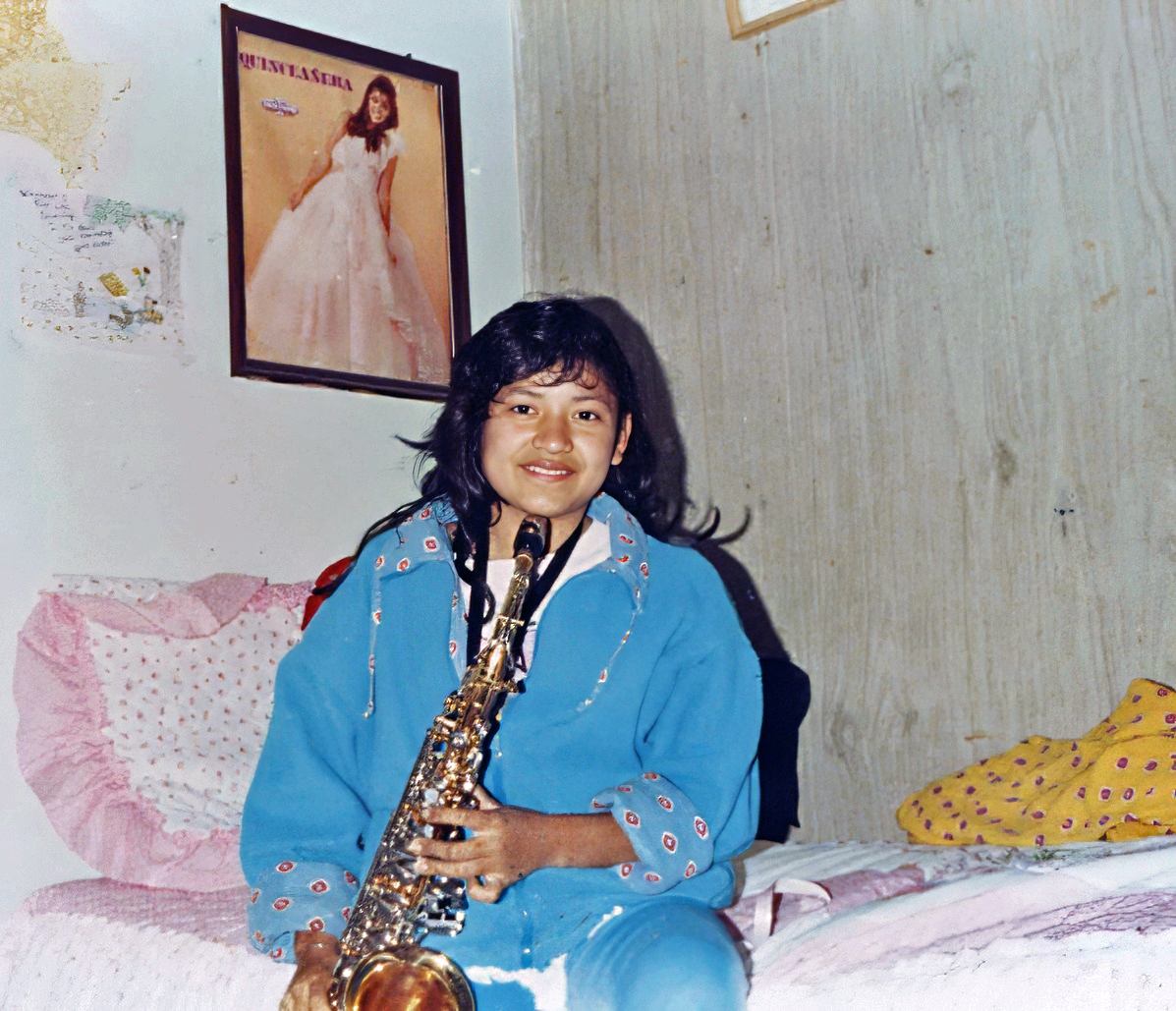
Reyna and her sax