10
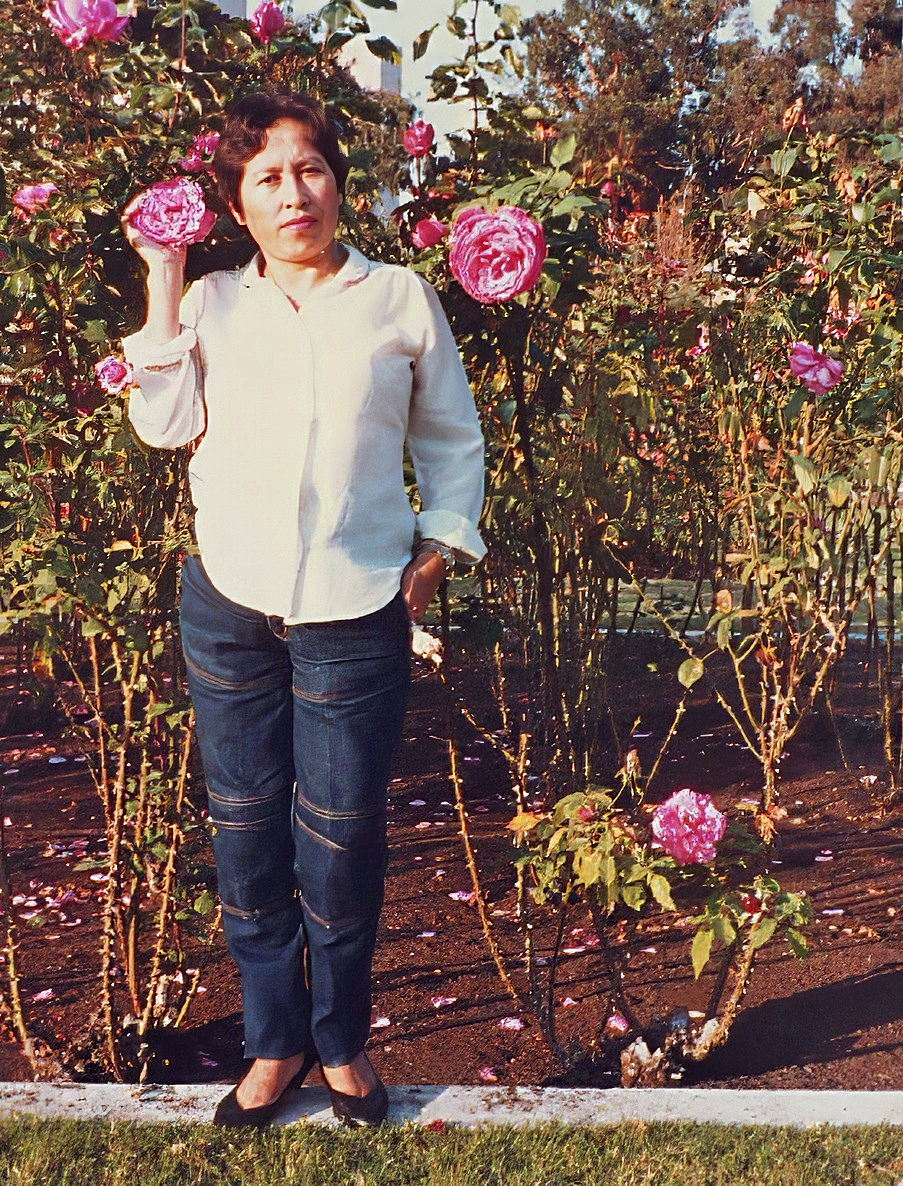
Mami at Exposition Park
IN MAY OF 1986, a year after we’d come to the U.S., Papi fell off a ladder at work and hit his head and injured his knee. He stayed at the hospital overnight for observation, and he had to take a few days off from work until he got better.
Papi wasn’t the kind to stay home doing nothing. Early the next morning, he left for downtown to walk around. He took the bus because the doctors told him not to drive. He came home just as Carlos, Mago, and I were sitting down at the kitchen table to do our homework. He took a sip of the beer he had just taken out of a paper bag and said, “Your mother is not in Mexico.”
We stared at him, not understanding.
“Didn’t you hear me? Your mother is not in Mexico.” I’d thought he was joking. Then I realized that he wasn’t.
“Where is she, then?” Mago asked, lifting her head from her homework. Carlos and I also stopped what we were doing, and we sat there at the kitchen table and looked at our father.
“She’s been in this country for months now, and she hasn’t even tried to contact you kids,” Papi said.
“But how can she be here?” Carlos asked.
“Are you sure?” I asked.
“Of course I’m sure,” Papi said. “I ran into her today.” He told us that he’d waited for the bus to come back home. When it arrived, the last passenger to get off was our mother. She lived downtown on a street called San Pedro.
“Your mother never ceases to amaze me,” Papi said. He laughed, but it wasn’t a happy laugh. It was a laugh of bitter disappointment.
“And Betty?” Mago asked.
“Didn’t I just tell you? Your mother never ceases to amaze me. Where do you think your little sister is?”
Mago, Carlos, and I looked at one another. Where else could Betty be? With Mami of course.
“Your mother,” Papi said, squeezing the empty beer can with his hand, “your mother left your sister in Mexico and came here with her boyfriend.” He threw the can against the wall and grabbed another one out of the paper bag.
“Can we go see her?” Carlos asked.
“Did she tell you where exactly she lives?” I asked.
“You want to go see her?” Papi said. “Don’t you kids have any pride? Your mother doesn’t care about you. If she did, she would have called you when she got here. She’s been here for months. Months. Why would you want to go see her? Have some pride, pendejos!”
“But she’s our mami,” I said.
Papi looked at me, and I could tell in his eyes that I had disappointed him with those words. He shook his head. He touched his bump and winced. He got up and said he was going to go lie down. At the door, he turned and said, “Just so you know, your mother has a new child. A boy, not three months old.”
He left us there in the kitchen. I felt as if I were the one who had hit her head. I felt an intense pressure building up, and I couldn’t breathe, I couldn’t think. All I heard in my head were Papi’s words: Your mother doesn’t care about you … Your mother doesn’t care about you …
But even when the dizziness stopped and I could breathe again, I found that I could not stop myself from yearning to see her.

During the weeks following Papi’s discovery, we couldn’t convince him to allow us to go see Mami. The more we asked, the more he withdrew. He would simply say, “I’m the one who brought you here,” and then would lock himself up in his room. With those words, he was asking us to choose between him and her. We didn’t know how to tell him that it shouldn’t be a matter of choice, that they were both our parents.
It hurt me to think of Betty all alone in Mexico. When Papi and Mami left us there, at least we’d had one another. But Betty, who did Betty have over there? She was like Élida, with no one there to love her except our grandmother. I thought about all those Polaroid pictures we’d sent, of how it must have hurt our little sister to see us here, together, while she was over there all alone.
“Your mother is so selfish, that’s why she wouldn’t let me bring Betty,” Papi said to us. “She used your sister to get back at me.”
Mila said to Papi, “We couldn’t afford another mouth to feed anyway. It’s difficult enough as it is, with the three you already have here, and with the three I have. Even though they aren’t with me, I still have to support them.”
“Yes, but what if I went back—?”
“We’re not going through that again,” Mila said. “I will not take responsibility for raising yet another child!”
“Papi is right,” Mago said to us. “Why should we go see her after what she did? How many times will she continue to abandon us?”
Carlos and I didn’t answer.
But regardless of what Mami had done, the fact remained that Betty was still in Mexico. Mago wrote a letter to Abuelita Chinta to inquire about Betty, and we waited anxiously for a reply. It wasn’t until the end of June that a letter arrived from Tía Güera. She told us our little sister was fine and not to worry. She said that in the summer, she would be leaving Iguala to come here to the U.S. Tía Güera had decided to leave her no-good husband and try her luck in this country. Mami was taking that as an opportunity to bring Betty here. So Tía Güera and Betty would both be making the long journey north together. The only thing was, Tía Güera said, that she would have to leave her own daughter behind with Abuelita Chinta. It made me sad to think of my cousin Lupita, of how now she was the one being abandoned, and I hoped that one day the cycle of leaving children behind would end.

We finally convinced Papi to let us visit Mami when we learned Tía Güera and Betty had safely arrived. We told him—and ourselves—that we really weren’t going to see her, we were going to see our sister. But of course we knew it was a lie. We were once again following the crumbs back to Mami.
We took the 83 bus to downtown L.A. As we walked east on Seventh Street toward San Pedro Street, we were taken aback by what we saw. This was another side of this country I hadn’t seen before. For a moment, I felt as if we had just crossed over into another world.
There were winos everywhere sitting on the ground asking for handouts. Homeless people covered in dirt and dressed in rags pushed shopping carts filled with dirty blankets, old shoes, and plastic bags filled with junk. Women stood on corners dressed in skimpy clothes. Trash littered the sidewalks. Plastic bags whirled up in the air like miniature parachutes. The air was filled with the stench of urine and a rancid smell that was almost overpowering. It made me gag.
We could not believe this was where Mami lived.
“If I didn’t know any better, I would think we were back in Mexico,” Mago said.
“I didn’t think there were places like this in the U.S.,” Carlos said.
In Mexico everyone I knew always thought of the U.S. as the most beautiful place in the world, as close to Heaven as you could possibly get.
We found the address Tía Güera had given us and we knocked. Someone came down the stairs and opened the security door. We didn’t know who the woman was, but we told her we were there to see our mother.
“What’s her name?” she asked.
“Juana.”
“Oh, yes, she lives in Room A.” She started back up the stairs and we followed behind her. The door to Room A was open. We saw Mami before she saw us. She was sitting on the bed holding a sleeping baby in her arms. Her hair was permed into tight curls and cut short. She had put on a bit more weight, and as always, most of it went straight to her stomach. When she saw us, Mami stood up and came to the door.
“I can’t believe you kids are here,” she said, smiling. “Look how much you’ve grown!”
We entered the room and we said hello to Rey, who was sitting at the table. Next to him was Tía Güera. We gave her a hug and told her it was nice to see her. Then my eyes fell on little Betty, who was sitting on the dirty carpet playing with a doll. We rushed to our sister to hug her and cover her in kisses, but Betty pushed us away and rushed to my aunt’s side. “A year is a long time for a little kid,” Tía Güera said.
“Give her time,” Mami said.
“Betty, it’s me, Reyna. Don’t you remember me?” I said, kneeling down to look at her. Betty hid her face in Tía Güera’s chest.
I glanced at Mami, and I thought about Papi, at what he’d said. He was right. It was because of Mami’s selfishness that now Betty didn’t know us. It was her stupid, stupid pride.
I looked at my five-year-old sister and wondered how long it would take for us to finally feel like a family.
Mami lived in a tiny room big enough for a bed, a dining table, a refrigerator, a TV stand, and boxes of clothes piled against the wall. They had to share the kitchen and bathroom with the rest of the tenants on their floor. I thought about the fourplex Mila and Papi owned. He made three hundred dollars a week. Mila didn’t make much more. Between them they had six kids to support, and their many expenses didn’t allow them to give up the rent of the larger units. We had to stay in the one-bedroom unit until things got better. But even though we slept in the living room, we at least had the bathroom and kitchen to ourselves, and we didn’t have to share them with complete strangers. We also had a backyard to play in. Our carpet wasn’t dirty. There weren’t roaches scurrying around the walls like here at my mother’s.
We crammed into the little room as best we could.
“So how did you end up here?” we asked Mami.
She sat at the table holding her sleeping son in her arms. I tried not to look at him. I didn’t want to feel anything for that baby, that brother of mine whose name was Leonardo. Even though he was three months old, I could tell, even then, that he was going to look just like his father. Mago, Carlos, Betty, and I were a mixture of the Grande-Rodríguez genes and anyone who saw us could tell right away we were related. But Leonardo looked nothing like us, and that made it even harder for us to like him.
Mami told us her journey to the U.S. with Rey had happened by chance. A friend of hers had a son who wanted to come here, but he was afraid of making the journey alone. Since Mami had already been here once, her friend asked Mami to accompany her son and to help him once he got here. She even offered to lend Mami the money for her smuggler’s fees. Mami didn’t think twice about it. She and Rey and the young man set out on their journey, but she couldn’t bring Betty, so she left her behind with Abuelita Chinta until she got settled here. In the meantime, though, she started another family with Rey, a boy whose existence we would not have been aware of if Papi had not run into her that day.
Both Rey and Mami worked at a garment factory. Rey operated the steamer, Mami trimmed loose threads. “They pay us miserable wages,” Mami said. She must have seen the look on our faces when we’d first walked in because she added, “As you can tell by where we live.” She glanced around the room, just as we had done. A roach scurried across the wall, and she hurried to squash it with her sandal. She turned to us and said, “But no poverty here can compare to the poverty we left behind. And at least now I am closer to you, my children.”
Mago asked her the question we had all been dying to ask. “Why didn’t you tell us you were here?”
Mami took a deep breath and said, “I wanted to give you kids a chance to get to know your father, and for him to know you, without me coming in between you. Do you understand?”
Strangely enough, we did understand, although we didn’t believe that was the only reason. Looking back on it now, I think it was at that particular moment in our lives that our relationship with our mother finally hit its lowest point. It was then that I finally understood the kind of person my mother had become. And how little space she was willing to make for us in her life. The only thing I could do was to accept her, although I never—even now—stopped hoping that one day she would change.

We began to visit Mami every other Sunday, and although Papi wasn’t happy about it, he knew we needed to see our little sister, so he didn’t stop us. One thing we soon came to like about visiting Mami was that she always had soda, chips, and candy at her house. We were jealous that Betty—and later Leonardo—had an unlimited supply of those snacks. With Papi all we drank was water, and we never got junk food unless he gave us a dollar to buy some. He never took us to McDonald’s, which was one of Mami’s favorite places to eat, or any other fast-food place. It wasn’t until years later, when both Betty and Leonardo were extremely overweight, that I realized how lucky Mago, Carlos, and I had been.
Despite the measly salary Mami earned at the factory, she always had enough money to take us out, like to Exposition Park to see the roses, to the Alley to buy us underwear or socks, to Placita Olvera to see the folklórico dances and have a churro.
But whenever we went anywhere with Mami, she would bring along a plastic bag and would pick up cans from the street or rummage through trash bins. Sometimes she would even make us pick up the cans for her, even in public places. It was so embarrassing for Mago, Carlos, and me that we soon started to say no, absolutely not! Betty would end up being the one to run around picking up the cans without Mami even having to ask her to do it. She would run back to Mami with her find, laughing while beer trickled down her bare arm.
“What do you do with those cans?” Carlos asked. We had seen homeless people around her apartment building pushing carts filled with cans on their way to someplace, but we had no idea where they would take them.
“I sell them at the recycling center,” Mami said. “I get good money doing this.” Good money or not, I couldn’t help thinking that Mila wouldn’t be caught dead picking up cans. Why couldn’t my mother be a bit like her? I’d wonder. Mami’s apartment always smelled like rotten beer and soda because she only went to the recycling center once a week, so the bags of smashed cans would just sit in a corner of her apartment all week long. I knew then why there were so many roaches.

Eventually, we got used to our double lives. Yet as the months went by, I still wished there were a way we could have our family together, in the same place. I especially wished this when I graduated from Aldama Elementary a year later. Although I was happy to see Papi there—he actually took time off from work to come to my graduation—I wished Mami were there, too. But that was where Papi had drawn the line. He didn’t want to see Mami. He said he’d never forgive her for what she did with Betty. Neither he nor my mother were ever willing to accept they had both used Betty as a way to hurt each other, and in the process, had hurt us and my little sister as well.
Mami didn’t ask much about him, either. She embraced her new life in this country with Rey and her new baby boy and Betty. The distance between us wasn’t two thousand miles anymore. But there was still a gap. I hoped one day we could overcome it.
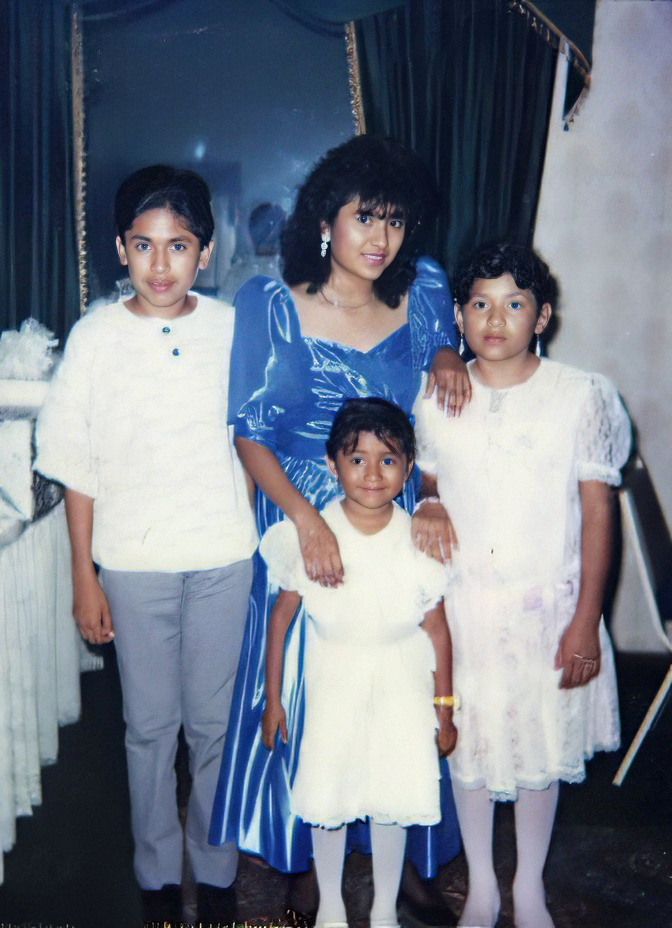
Carlos, Mago, Reyna, and Betty—finally reunited