9
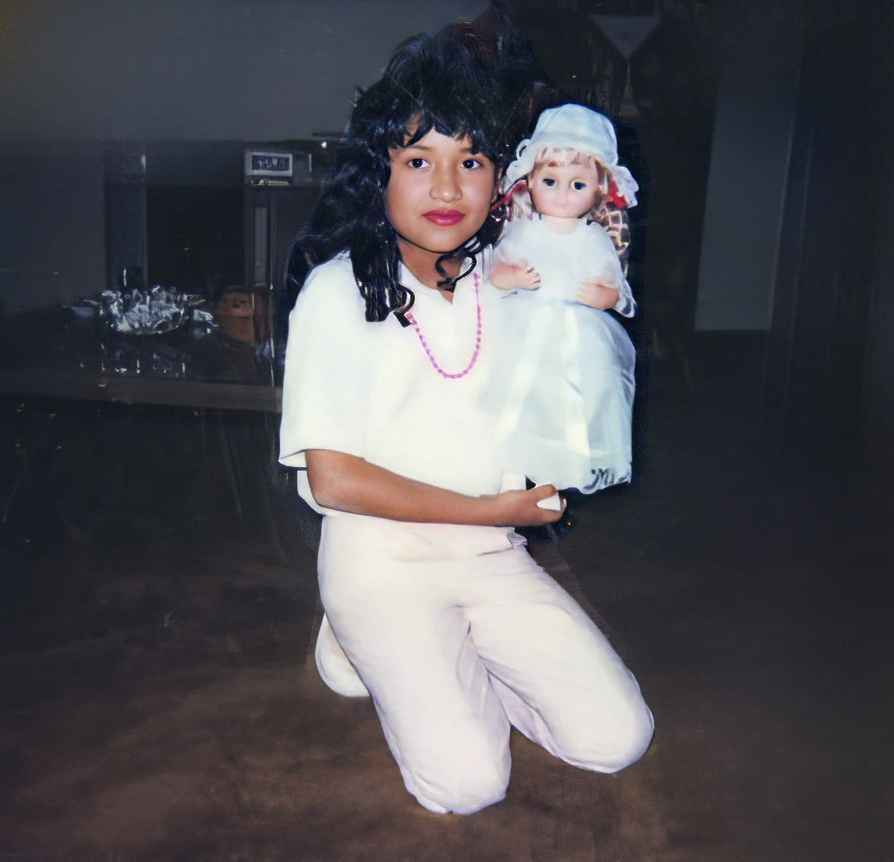
Reyna and her new doll
MRS. ANDERSON ANNOUNCED there was something important she had to tell us. Through Mr. López, I learned there was going to be a schoolwide competition. That week, every student in each class would be writing their very own books, and the teachers would select the best ones in their classes. From there, the selected books would be judged and three lucky winners chosen.
I will finally get my chance to make Papi proud!
For the rest of the week we spent a lot of time working on our projects. Mr. López said we could write our stories in Spanish since that was the language we knew best. At first, I didn’t know what to write. I’d never written my very own story before. I’d always liked to read in Mexico, but here in this country, books for kids my age were very difficult for me to read because of my limited English. The books Mr. López gave me were those for kindergarteners—books with big letters and lots of pictures. I loved looking at the pictures, but the stories weren’t very interesting. See Spot Run!
I missed the literature books I left behind in Mexico, the ones I was given at school. I loved the stories in those books. My favorite one was of a little pine tree that wished his needles were made of gold. He got his wish and his needles turned to gold, but a robber came at night and stole them. Then he wished for his leaves to be made of glass, but they broke when a strong wind came. Then he wished his needles to be big glossy leaves, but the next day goats came and ate them. The little pine tree then learned to like himself as he was.
Because I couldn’t think of any story of my own to write, I started to write the story of the little tree. But the next day I felt bad about copying someone else’s story, so I threw away the pages and started again. I thought and thought, and finally I decided what I was going to write. The story of my birth.
As I wrote, I closed my eyes and saw Mami lying down on the dirt floor over the straw mat. The midwife came into the shack next to Abuela Evila’s house and saw Mami bending over in pain. I could perfectly picture the midwife lighting a fire under the comal, the big round griddle where Mami made tortillas, and putting a pot of water there to boil. I could feel the heat of the flames.
“Don’t push yet,” I heard the midwife say as she sharpened her knife. “You aren’t ready yet.”
As I wrote, I told about how I couldn’t wait to be born and the midwife barely had enough time to catch me before I hit the dirt floor. “It’s a girl,” the midwife said as she put me into Mami’s arms.
Then came the best part of my story, my favorite part. I wrote about how Mami had turned to face the fire so the heat of the flames could warm me. As the midwife cut the umbilical cord, Mami pointed to a spot on the dirt floor and told the midwife to bury it there. I wrote how even though I was now living far away from Mami and my country, I hadn’t forgotten where I came from.
Mr. López helped me fix my spelling and gave me suggestions for improving my story. When it was as good as could be, he gave me white paper so I could write it nice and neatly. When I was finished, I started my favorite part, drawing pictures.
Mrs. Anderson showed the class how to bind our books. She gave us two rectangular pieces of cardboard and butcher paper to make the cover. By the end of the week we were all done with our books, and Mrs. Anderson picked them up and put them on her desk. Because it was Friday and we had worked hard all week, she put on a movie for us to watch as a reward. She said she would read our books while we watched our movie.
The movie was about an alien named E.T. who wanted to go home. I felt bad for the alien because life in the U.S. was very difficult for him. I could understand his wanting to go home. I was jealous because he seemed to learn English a lot faster than I had all those months.
I couldn’t concentrate on the movie because I kept glancing at Mrs. Anderson. She had put all the books on the right side of her desk. As she read, she began to make two piles. One pile was getting bigger and bigger, and the other pile remained small. I knew the big pile was of the books she hadn’t liked.
I froze when she picked up my book. Here it is. Here is my big chance! She opened it, flipped through the pages in the blink of an eye, then she closed the book shut and put it in the big pile. My eyes began to burn with tears. My book had been rejected. But she couldn’t have read it. No one reads a book in a second! She doesn’t even speak Spanish well, so how can she read it so fast? I wanted to stand up and say something. I wanted to tell her she had made a mistake, and she should look at it again. But I didn’t have the English words to say what I thought, and so I said nothing at all.
E.T. was going home. He was saying bye to his friend and getting into his ship. How I wished I could go home, too, back to Iguala where I could speak to my teacher in my own language. Where I could stand up for what I believed in, not caring if afterward I got hit with the ruler for my rebellion. I didn’t want to be in this country if that was how things were always going to be.
At the end of class, Mrs. Anderson held up the books she selected for the competition. Out of the eight books she chose, not even one was written by one of the kids at my table, the non–English speakers.
“You kids did a great job on those books,” Mr. López said to us in Spanish. “Just because they weren’t chosen doesn’t mean they weren’t good.”
“Just not good enough,” I said under my breath. I put my head between my hands, tears threatening to flow as I felt the disappointment come at me like a huge wave. Don’t let go of me, Papi.
Mr. López looked at me, and then at the other four students at my table. He said, “There is no reason for any of you not to get ahead in life. You will learn English one day. You will find your way. Remember, it doesn’t matter where you come from. You’re now living in the land of opportunity, where anything is possible.”
Mrs. Anderson put all the rejected books around the room to display them. I knew she was doing that so the students wouldn’t feel bad for not being chosen. But when we were dismissed, as I was walking by my book, I took it from the shelf where Mrs. Anderson had put it.
One day, I promised myself, thinking about Mr. López’s words, I will write a book that won’t be rejected, one that will make my father proud.