4
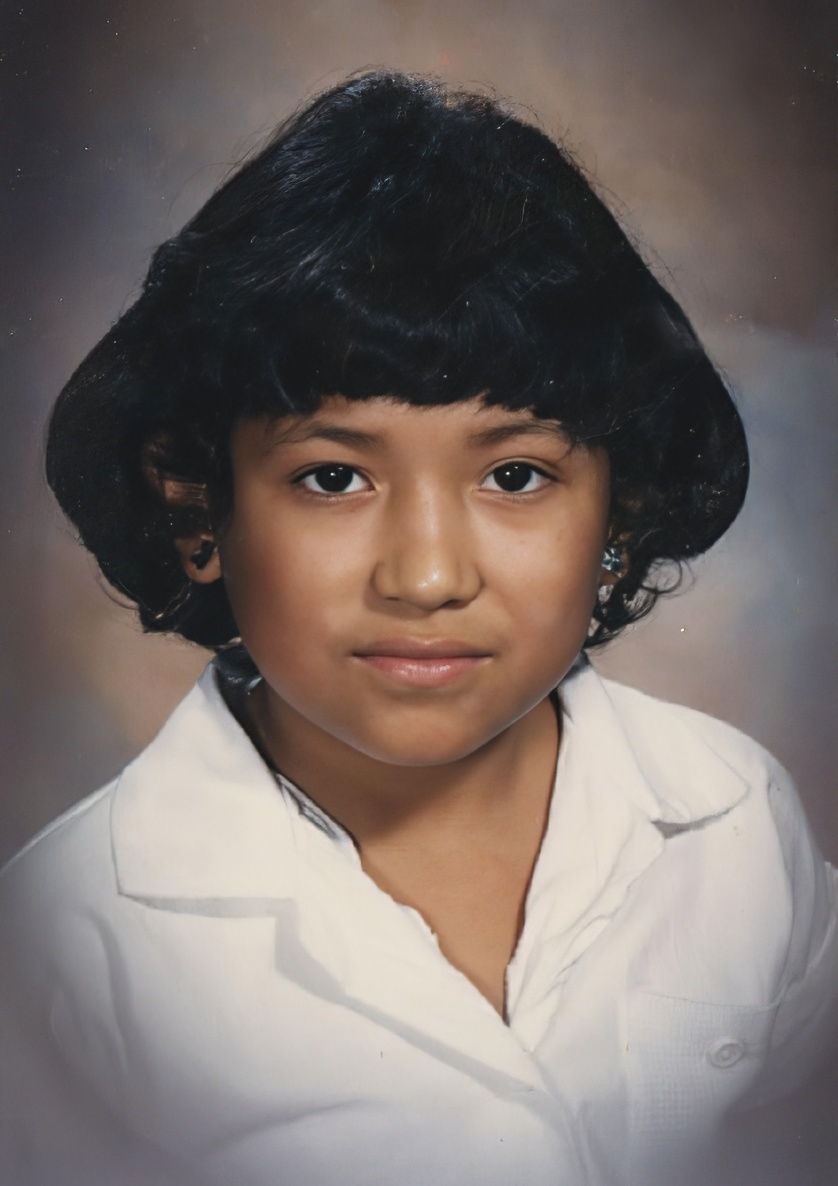
Reyna in fifth grade
ONE EVENING, MILA made spaghetti for dinner. The few times Mrs. Giuliano had made it at her house, I claimed not to be hungry so I wouldn’t have to eat it while I waited for Mago to pick me up. I loved Mrs. Giuliano’s food, except for the spaghetti.
Now Mila was putting a plate full of spaghetti in front of me, and at the sight of those long white strings I felt like running to the bathroom to throw up. I held on tight to my chair and looked away from the plate and tried to think of something beside Pablo and his worms.
In Mexico, most of the children I had known had the same body shape: a big, round belly full of roundworms and really skinny legs and arms. Carlos, Mago, Betty, and I were no exception. But there was one kid, a boy named Pablo, whose abdomen swelled beyond anything we could imagine. He looked as big as a pregnant woman. Abuelita Chinta said Pablo had a serious case of roundworms. I used to have nightmares of his belly exploding and hundreds of white wiggly worms spilling out.
Sometimes Abuelita Chinta would give Mago, Carlos, Betty, and me unripe guavas blended to a pulp. We would drink this concoction unwillingly because sometime later the pains would come. Horrible pains as if our intestines were twisting and twisting like wet clothes being wrung out before going up on the clothesline. We ran to the outhouse and emptied our bowels. No sooner had we come back into the house than we had to run back out again. Once, Carlos started screaming, and when we went to check on him, he was squatting on the ground as a worm wiggled out of him.
Sooner or later the worms would be pooped out. Abuelita Chinta said she was sorry to see us in pain, but we barely had enough to eat as it was, and the parasites were taking away the precious nutrients we ingested.
When we asked her why she wouldn’t give this drink to Pablo, Abuelita Chinta said that no amount of her guava drink could help the poor boy. She told Pablo’s mother that if he didn’t see the doctor soon, he would have serious health issues. When Pablo was nothing but a skeleton with a big belly, his family sold what few possessions they had and took Pablo away to Mexico City. The next time we saw him, his big stomach was gone! He had a scar on his abdomen, and he told us he had to have surgery to get the worms removed. It was a hideous scar. Raised and swollen, the stitches like the legs of a crawling centipede. After that, we hadn’t balked at the remedies Abuelita Chinta would give us. But even though Pablo was better, my nightmares took a long time to go away,
Mila went to the living room to watch a telenovela while Mago, Carlos, and I stayed in the kitchen to eat her spaghetti. I strained to hear the theme song playing in the living room. Mi vida eres tú y solamente tú …
I loved that telenovela. It was called Cristal and was from Venezuela, so the characters spoke with a strange Spanish accent. The story was about a girl whose mother had abandoned her as a baby, so she had grown up in an orphanage. Now, as a young woman, she was on her way to becoming a supermodel, and best of all, she and a rich handsome young man were in love! It was a Cinderella story, one of my favorite fairy tales, except I couldn’t go watch it with Mila because she didn’t like us eating in the living room.
Always, Mila and Papi would eat first, and when they were done, they would call us into the kitchen so that we could eat. I didn’t know why they arranged it like that, but it made me feel bad that we couldn’t have dinner together, as a family. I thought of that, and the new doorknob Papi had installed on their bedroom door, and I wondered if he was trying to tell us something.
“You’re going to have to eat, Nena,” Mago said as she slurped down her spaghetti. “Papi will get angry if you don’t.”
“It’s pretty good,” Carlos said as he raised a strand of spaghetti over his mouth and then sucked it in really fast, making the strand wiggle as it went into his mouth.
I looked back at the spaghetti and the red sauce. I thought of Pablo again and the surgery he had to get the worms removed. I thought of the scar like a crawling centipede and I just couldn’t bring myself to grab my fork and eat.
Papi came out of the bedroom to grab a beer, and noticing my full plate, asked me why I wasn’t eating.
“I’m not very hungry, Papi.”
“Well, Mila made this meal for you and now you’re going to have to eat it. I won’t have you being ungrateful.”
“I can’t eat it, Papi.”
Papi started to yell at me, and pretty soon I felt tears sliding down my cheeks because I didn’t know how to tell him about Pablo. I kept my eyes on the floor while Papi called me an ingrata, and how could I be so willing to throw away food that he had worked so hard to buy?
Mago said, “The spaghetti reminds her of lombrices, Papi.”
“That’s ridiculous,” he said. “Now, eat it!”
I forced myself to grab my fork, but I knew, as I twirled the spaghetti around, that I wouldn’t be able to bring it to my mouth, no matter what. I put the fork down and said, “I can’t, Papi. Please, don’t make me.”
Papi picked up my plate, and I thought he was going to take it away, but the next thing I knew he dumped the spaghetti on my head. I started screaming as the spaghetti slid down my face and over my eyes. All I saw inside my mind was Pablo’s belly exploding, and the worms coming to get me.
Mago and Carlos didn’t move. They sat there staring at me with pity, and I wished they would look away. I wished I could get up and run all the way back to Iguala, back to my grandmother’s arms. I wished, for the first time, that I were back in Mexico and back to being a little orphan. I wanted to be like Cristal, beautiful and loved by a handsome rich man who would take me away from here.
Papi went back into his room with his beer, and while Mago helped me clean up in the bathroom, Mila made me scrambled eggs, even though I told her I wasn’t hungry. Now I would have to eat the eggs because Papi would beat me for sure if I didn’t eat Mila’s food for the second time that night. As I showered, I cried and thought about my sweet grandmother. She would never have dumped a plate of food on my head. And I wouldn’t have had to tell her why I couldn’t eat the spaghetti. She would have known why right away. I thought about the Man Behind the Glass. He, too, wouldn’t have dumped the spaghetti on my head because he was with me all those years, and he had listened to me tell him about my fears and my dreams. But the father in this house didn’t know me. He didn’t know me at all.
And I didn’t know him.