17
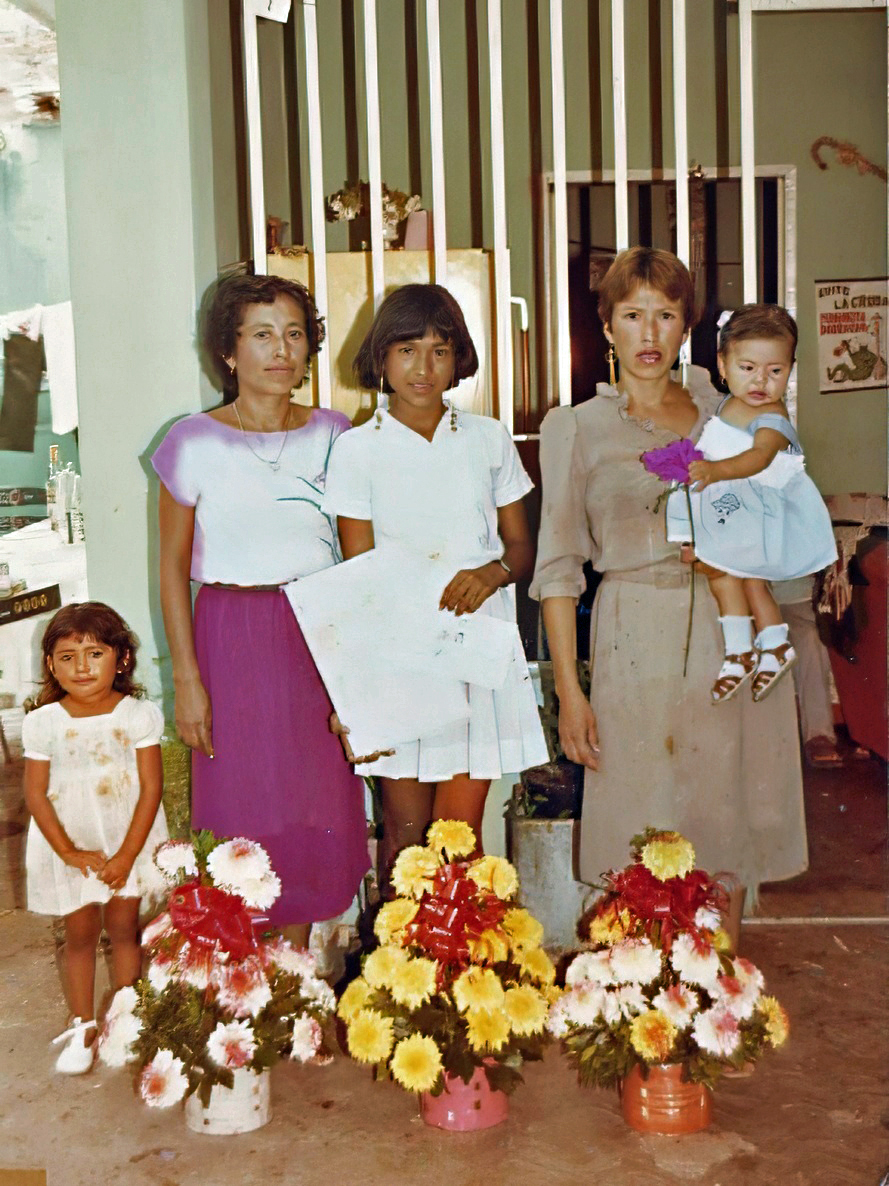
Betty, Mami, Mago, Tía Güera, and Lupita at Mago’s graduation
MAGO AND I stood by the tracks watching the train rumble past us. Mago said, “That train could take us to El Otro Lado.”
“Really?” I asked, taking her hand as we started walking toward downtown. Carlos walked on the tracks, bending down once in a while to pick up bits of gravel.
“You should see, Nena,” Mago said, “how many people at the train station are heading to El Otro Lado. I’ve asked them about the journey, and it doesn’t seem so bad. They ride the train to Mexico City, transfer to another train, and ride it all the way to the border. We could save up some money, buy the train tickets, and go.”
“But how would we find Papi?” Carlos asked, joining us.
“We’ll ask around when we get there,” Mago said.
“My teacher says Los Angeles is very big,” Carlos said, shooting a rock at a bird with his slingshot. He missed.
“But what about Mami?” I said. “Would we leave her here?”
“Why not?” Mago said. “She’s left us again, hasn’t she? She won’t care whether we leave or not.”
“Yeah, but—” I said, ready to defend Mami. I was still thinking about that drawing she had torn into shreds.
“But what?” Mago said.
“I don’t know. I just wish things were different,” I said.
We walked the rest of the way downtown in silence, on our way to Mami’s work.
Not long after the government had finally given away the land Mami so desperately wanted, she decided it would be best if she went to live with Tía Güera. Back then my aunt had lived downtown, a few blocks away from my mother’s work. Mami started staying over at her apartment a day or two during the week. Then it became three days, then four, until finally she packed up her clothes and said she was moving in with my aunt. Since she would get out so late from work, the public minibuses weren’t running by then, and Mami had to take a cab home. “The cab fare is seven times the bus fare. That’s money we can use to buy food,” she would say. “Also, I’m frightened of walking home at night on these dark streets. What if something happened to me?”
“I can walk you home,” Carlos said, holding tightly to his slingshot.
“Mijo, you’re only ten years old. I don’t think a robber would be frightened of you and your slingshot,” Mami said.
We begged her to stay with us. We promised we would be good, but Mami shook her head and said it was for the best.
By then, my memory of Papi had become a wisp of smoke. Sometimes I would forget that I had a father, and whenever I remembered him, the memory of him did not hurt. It did not take the breath out of my body or sting me and fill me with pain like the venom of a scorpion.
But the thought of my mother living apart from me made my body tremble, my teeth clench in my mouth, my eyes burn as they did whenever we had no money to buy gas and I would have to fan the hot coals in the brazier as our meal slowly cooked.
If she hadn’t returned from El Otro Lado, Mago said I would have already forgotten her, the way I’d forgotten Papi. Little children are blessed with short memories. But my mother’s constant comings and goings wouldn’t let me forget her. Instead, they increased my longing for her even more.
She visited us on Sundays, and every time she left us, Carlos, Mago, and I would keep ourselves from running after her. Betty chased after her like a little duckling. We were left behind to comfort our little sister, to hold her while her tears subsided, to make funny faces and stick out our tongues, do cartwheels and handstands, sneak into the neighbor’s yard and steal juicy guavas and mangoes to sweeten the bitter memory of the one who came and went.
Since my grandmother didn’t have a refrigerator, we had to go to el mercado every day to buy the ingredients for that day’s meal. But first we had to stop at Mami’s work so she could give us money.
Whenever we walked there, we would be out of breath and our feet would be hurting. It would take us forty-five minutes to get there and another forty-five to get back. Mago could get there by herself on the combi, but she didn’t like going alone and we couldn’t afford the bus fare for us all, so we walked. Mago thought I should stay home, that it was too far for me to walk, but I wanted to see Mami more often than four days a month and so I would come. And I wouldn’t complain about my feet hurting because if I did Mago would stop bringing me. She had been less patient with me. With us all.
Usually Mago would go in there and wouldn’t even talk to Mami. She would just hold out her hand for the money and then quickly leave the record shop, and all I could do was turn around and wave a quick goodbye to my mother.
But one day, when we went inside, Mami wasn’t alone. Her boss, Don Oscar, was there, and his son was there, too. I knew he was his son because he looked just like Don Oscar, and Mami was always talking about Don Oscar and his family, about the three record shops they owned and the money they had. I saw Mago wiping the dust off her face with her hand. But she couldn’t do anything about the dust that covered her feet.
“Hola, niños, how are you?” Don Oscar said. We said good afternoon to him and his son, who was about Mago’s age. “Mago, your mother tells me you’ve done very well in school. I’m very proud of you.”
“Thank you, señor,” Mago said.
“Mago, I asked Don Oscar to be your godfather for your graduation, and he’s accepted. Isn’t that great news?” Mami said. She came and put an arm around Mago’s shoulders. My sister tried to skirm away from Mami, because even though it was the most amazing news we’d heard in a long time, Mago was still too angry at Mami for leaving us again.
“Thank you, señor,” Mago said.
“We’ll have the graduation party at my sister’s house,” Mami said. “It would be an honor if you and your family joined us, Don Oscar.”
“Of course, of course,” he said.
Mami gave us the money for our shopping, and she even gave us a few extra pesos so that we could buy ourselves a treat. Then we said our goodbyes. We walked out the door, and Mago stopped and turned to look at Oscar Jr. one more time. He smiled at her and she blushed all the way to el mercado.
“I think he likes you,” Carlos said.
She blushed even more. “I don’t think he would like someone like me,” she said.
“Why not? There’s nothing wrong with you,” I said.
“Of course there is. I’m poor.”
I thought about the movie we saw with Mami, of Paquito and his rich father. There was nothing wrong with Paquito except that he was poor. I told Mago I knew what she meant. But still, I thought about all those soap operas Tía Emperatriz liked to watch, the ones where tragically beautiful girls are saved from their miserable poverty by handsome rich men who fall desperately in love with them.
“Oscar can be your hero,” I insisted. “He can save you.”
Mago looked at me and said, “Papi will be my hero. He will save me. Save us all.”

Don Oscar, his wife, and their three children attended Mago’s sixth-grade graduation. They brought her three huge bouquets of flowers. She was the envy of the class because nobody else had gotten wealthy people for godparents. Everyone else’s flower bouquets couldn’t compare to the ones Mago got.
Mago wore her white flag-bearer uniform, which was the nicest outfit she owned. We all stood up and clapped for my sister when her name was called.
The party was held at Tía Güera’s apartment building because it had a nice courtyard. To our surprise, Mami went out of her way to be nice to Mago. She even gave her a set of gold earrings that dangled from her ears. They looked too grown up on my twelve-and-a-half-year-old sister, but that was why Mago loved them—that, and because they were a gift from Mami.
That day was the first time in a long time that Mago didn’t have to be anyone’s mother. She didn’t have to clean or take care of anything or anyone. For the first time, Mago could be a girl. Mami, Abuelita Chinta, and Tía Güera took care of the guests. They served the food and drinks. While the adults talked, we were free to run around the courtyard. We were very shy around Don Oscar’s kids; even though they were our age, they belonged to a different class than us. They had beautiful clothes, they went to private schools, they spoke formal Spanish, and once in a while they giggled at the way we talked. Mago never stopped blushing when Oscar Jr. looked her way.

I didn’t know that thirteen years later, I would return to Iguala during my junior year of college, and I would be invited by Don Oscar to celebrate Christmas with his family. I would find myself wearing clothes as nice as theirs. I would find myself not gawking at their two-story brick house because by then I would have set foot in similar houses in the United States. I would find myself sitting in their living room, and having Oscar Jr. and his sisters shove lyrics of their favorite American songs at me so that I could translate them for them. I would find myself telling them about my college courses after Oscar Jr. had told me about his last year at UNAM, Mexico’s biggest public university. I would return to the U.S. more determined than ever, because even though I had drunk Bailey’s with them, dined and sang English songs with them, my cousin Lupita, Tía Güera’s daughter, was working for them as a maid. And I knew then, as I do now, that could also have been my fate.