16
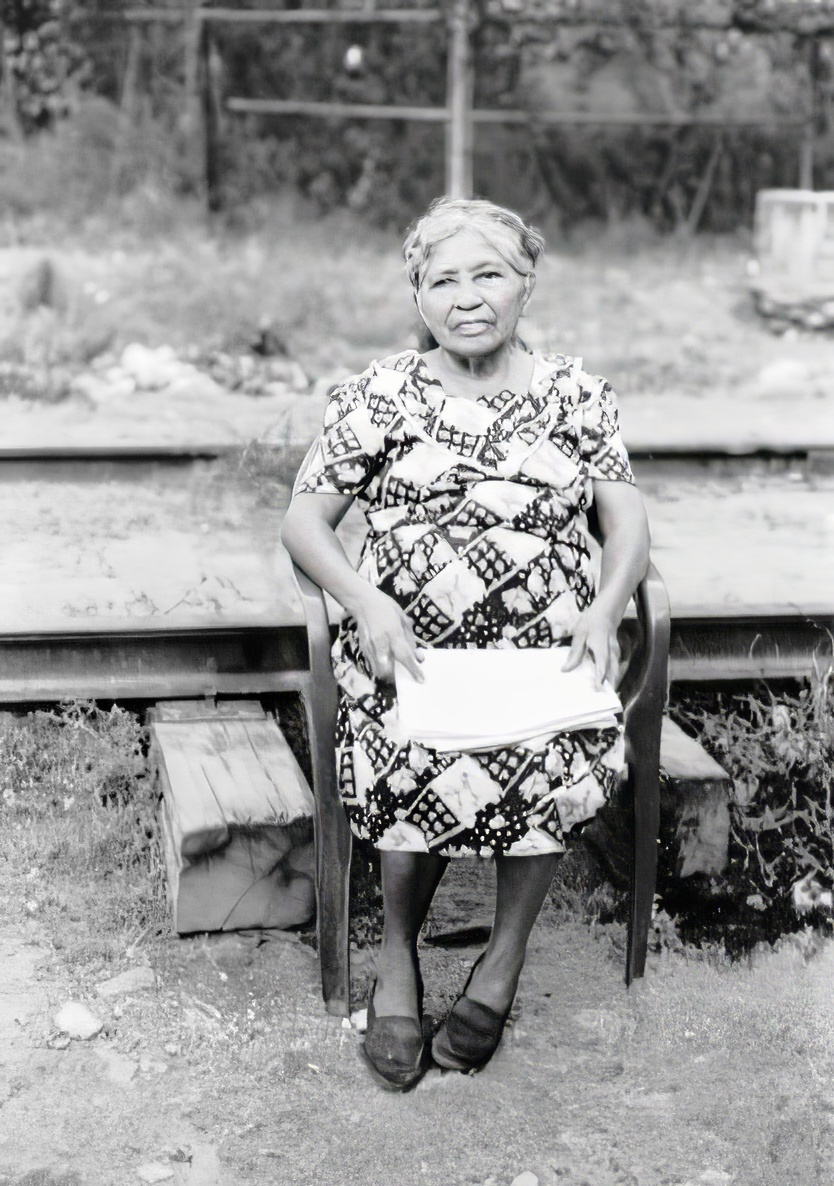
Abuelita Chinta
MAMI’S SISTER, TÍA Güera, would usually come over during the week to visit Abuelita Chinta. She and my grandmother would take two plastic chairs and sit outside the shack. I dreaded my aunt’s visits. She would call me over to delouse my hair. It was excruciating getting deloused by her. She seemed to get too much pleasure out of hunting for the little suckers, and she would pull out whole strands of hair along with the lice. At this rate, I would tell myself, I’m going to go bald!
It was also excruciating to have to listen to her talk. My aunt would do her usual complaints: “Ay, Amá, I don’t have any money to buy food and my husband drinks his wages away.” Or “Ay, Amá, there’s a sharp pain in my stomach that won’t go away, and I think someone is doing witchcraft on me.” Or “Ay, Amá, why is my husband such a drunk? Maybe you can make him a remedy so that he can stop.” Or, “Ay, Amá, how hard life is. Why does my husband stay out all night long, saying he’s working, but then comes home smelling of some other woman’s perfume?”
“Let me make you a tea of flor de azahar,” Abuelita Chinta would say to Tía Güera once she was done listening to my aunt’s complaints. “It’s good for the nerves.” I wanted to ask Abuelita Chinta if she had anything for my poor scalp, which by then would be throbbing with pain.
But one day, just as they were about to go inside the shack, Doña Caro came out of her house and called out to my grandmother.
“Doña Jacinta,” she said as she walked over to us. “Juana called this morning, but you weren’t home.”
Mami would sometimes call us at Doña Caro’s house to tell us she had wired money so that Abuelita Chinta could go pick it up at the bank. The phone calls were rare, but nevertheless, every day we would stop by Doña Caro’s house to check if our mother had called. Abuelita warned us about annoying Doña Caro, but we couldn’t stop ourselves from inquiring about the phone call.
“I’m afraid something awful has happened,” Doña Caro said. “Juana and the wrestler got into a car accident, and he’s dead.”
“And my daughter?” Abuelita Chinta asked. I grabbed her hand and I leaned against her.
“She was in the hospital. She said to tell you she’s coming home.”
“Is Mami really hurt?” I asked Doña Caro.
“Nothing serious, child. Just a cut and some bruises,” she said, then she turned and went back to her house.
For the following days, all we could think about was our mother, and the thought that we had come so close to losing her would keep us up at night.

Years later, my mother would tell me the story of the wrestler, of how she had not meant to fall in love with him, but this is the way things happen sometimes, especially when you’re hurting from a broken heart. He worked next door to the record shop.
He told her, “I only sell car insurance during the day. At night, and on the weekends, I’m a luchador. I dream of one day becoming a great wrestler, like the legendary El Santo.”
That’s when she began to think of him as more than just the man who worked next door. That’s when the small things he did for her—like bringing extra tacos to share with her during lunch, buying her popsicles from La Michoacana across the street, watching the record shop for her when she needed to make a quick run to the bathroom—became much bigger in her eyes. A luchador! There was more to this man, Francisco, than met the eye, after all. But a wrestler? Who would have thought?
She liked the way he stood next to her, as if ready to protect her from any harm that came her way. And being a wrestler, he could protect her from anything. Anyone. When he took her to a wrestling match and won, she decided that Francisco would be the man to save her. From what? She didn’t know. All she knew was that my father had let her go, that he had come after her with a gun, and ever since that day, she’d felt as if she were trying to stay afloat, with nothing to hold on to. Francisco would be her way out of the sorrow and fear that threatened to engulf her every waking hour. When he asked her to go with him to Acapulco, she didn’t think twice about it.
But then, as she lay with her head against the shattered windshield of his car and saw him slumped over the steering wheel, unconscious, she realized that even he, with all his strength, couldn’t save her.

During the two weeks after Mami’s return, I would wake up to the sound of crying. In the thin moonlight streaming through the gaps between the bamboo sticks, I saw her sitting in her bed, trembling as she sobbed. We hadn’t known how to comfort her or what to say, so we stayed away. She stayed away from us too, and only once did she try to hold one of us—my little sister. Yet when she reached for Betty, my sister cried and held her arms out to Mago.
“Why are you crying? I’m your mother,” Mami said. But Betty just cried harder, and Mami had no choice but to give her back to Mago. She didn’t try to hold her again.
“You have to give her time,” Abuelita Chinta said. “You’ve been gone for many months, Juana.”
“I came back, didn’t I?” Mami said. The truth is that she had come back, but would she have done so if the wrestler hadn’t died? Would she have come back if my father hadn’t left her for someone else? We didn’t know the answers to our questions, and we were afraid to ask.

In the morning, Abuelita Chinta gave Mami a cleansing. She sent Carlos to the neighbor’s down the street to buy an egg while she gathered the rest of the items she would need: the bottle of almond oil, a bunch of epazote from her garden, a cigarette. Mami lay down on the bed. Abuelita Chinta sat next to her on the edge and began to rub Mami’s body with the almond oil. My grandmother prayed under her breath as she did this. She took the egg from Carlos and then rubbed it on Mami’s head, being careful not to touch the bandaged area on Mami’s forehead where she had gotten cut. Then she rolled the egg on her chest, arms, hands, legs, and feet so that it would absorb the impurities inside my mother’s body and soul. Mami kept her eyes closed as my grandmother gently tapped the branches of the epazote all over her body.
Finally, Abuelita Chinta lit a cigarette and blew puffs of smoke all over Mami. The smoke settled over Mami like an invisible blanket. The cleansing was so soothing that she fell asleep, and Abuelita Chinta sent us all outside to let our mother rest.
“Hopefully now her soul can be at peace,” Abuelita Chinta said. I crossed myself at the altar on my way out the door and prayed for Mami to wake up without any more sadness weighing her down.

The next day, Mami sent Carlos to the neighbor’s house to buy water from them on credit so that she could bathe. For the first time since she’d been back, she stood in front of the mirror to put on makeup. She pursed her lips, and I imagined that she was kissing Papi through the mirror. With the bright red color on her lips, hot pink cheeks, and dark blue eye shadow, Mami became a different woman, and I could almost see that other mother—the one she was before she left—peeking through.
She combed her black hair with her fingers and wrapped a bandana over her head to cover the area where the doctors shaved her hair to stitch up her cuts. She opened the dresser and took out the nicest dress she had, the burgundy dress she wore that bittersweet day when she picked us up at Abuela Evila’s house after she’d arrived from El Otro Lado. Then she sprayed on perfume that smelled of jasmine.
“Well, wish me luck,” she said to us as she left the house, and the four of us knelt at my grandmother’s altar and prayed for Mami to find a job.

She came back with a smile on her face. Don Oscar, her former boss, had given her back her old job at the record shop, although she would have to work the afternoon shift. “But a job is a job,” Mami said, smiling, “and beggars can’t be choosers.” Even Betty, only three, seemed to know it was a time to celebrate because when Mami reached out for her, Betty jumped into Mami’s outstretched arms.
Mami said, “Let’s go to el zócalo.” We washed our dirty feet and faces as quickly as we could and then went to the main road to catch a taxi. Unlike Abuela Evila, Abuelita Chinta would take us there once in a while. She never made us feel as if we were her prisoners. But we hadn’t been there in years with our mother.
Mami asked the taxi driver to drop us off at my aunt’s house. She lived downtown, close to everything. Tía Güera and my cousin Lupita came with us to el zócalo, and while she and Mami sat on a bench and talked, we played hide-and-seek with the other children. Across the street was the San Francisco Church, and food vendors lined the sidewalk, shaded by the tamarind trees. People sat on the benches located around el zócalo, some reading the papers, others talking, some watching us children play. I thought about how painful it had been to go there with Abuelita Chinta because I would see all those mothers and fathers sitting on the park benches watching their kids play.
How different it felt that day! While I ran and laughed and chased the kids around el monumento a la bandera, I would glance at the bench where my mother was sitting with my aunt, and I would wave at her because I wanted to make sure I was not just imagining her. When she waved back, I felt as if I were flying because it was so good to know that I was not dreaming.

On Mami’s first payday, she came home and said, “Let’s go to a matinee.” I’d never been to the movies, and I was still sad about the day we didn’t get to go see La Niña de la Mochila Azul with Tía Emperatriz, but that day we hurried to put on our best clothes.
We went to the theater, and Mami bought us a bag of popcorn smothered in chile sauce. We sat in the middle section, and we fought over who was going to sit next to Mami, but the fight didn’t last long because Mami said the youngest kids got to sit by her, which meant Betty and me! So I sat on her left, Betty on her right, and Mago and Carlos sat farther out. I knew Mago was mad because she stuck out her tongue at me right before the movie started.
The movie we watched was called Mamá, Soy Paquito. It was about a boy who was very poor and lived with his mom, who worked very hard to take care of him. But one day his mom died, and Paquito was left all alone and everyone treated him badly because he was a little orphan. His father didn’t live too far, but he might as well be living as far away as El Otro Lado for all the good it did to Paquito to have his father so close. His father was very rich. I thought about the distance between me and Papi, and I thought it was the same for Paquito. My father was far away, but Paquito was a world apart from his father because that is the way things are, between the rich and the poor, even if they live side by side.
I cried when Paquito went to his mother’s grave and sang her a song and promised to be a good boy. I glanced at Mami and saw that her eyes were as watery as mine. She reached up to touch her bandana. I wondered if she was thinking what I was thinking. If she had died in that car crash, what would have happened to us?
I leaned my head against Mami’s arm, and she reached out and played with my hair.

Then a few weeks later, Mami came home full of excitement. She said, “The government is giving away land!” and hurried to gather the things she thought we would need to become squatters.
So Mago carried Betty, Carlos carried a rope, I carried a blanket, and Mami led the way with a shovel and a flashlight in her hands.
We hurried to keep pace with Mami as we headed to the river. On the other side of the river was a grove of mangoes and tamarind trees. We came to a big meadow. There were people there already staking out their piece of the land the government was going to give away. Mami chose one of the few available spots, and she had Carlos gather some branches to use as posts. Once they were in the ground, we tied the rope from one post to another to create one big square. Mami walked into the middle of the square, put a blanket down, then sat and smiled. “Here is where we’re going to live,” she said. “I’m going to show your father that I can build my own dream house, too.”
Mago, Carlos, Betty, and I sat next to Mami. All around us were families, who, like us, were there because they also had a dream. They were building tents out of torn sheets, cardboard, branches, and pieces of corrugated metal. Some had a fire going and were cooking a meal out in the open. I caught a whiff of beans, and my stomach growled. We hadn’t brought a single thing to eat.
“So what happens now?” Mago asked.
“We wait,” Mami said. “They didn’t say when exactly the government officials are going to be coming by to give us the deed to the land, but it shouldn’t be long. For now, we can’t go anywhere or we’ll lose our spot.”
I turned to look behind me. The river was only about fifty feet away. I thought of my cousin Catalina. I didn’t want to live this close to the river that cut my cousin’s life short. I thought of La Llorona, and how she always roams rivers, canals, and creeks. I didn’t want to live anywhere close to water.
“I’m hungry,” Betty said.
“Me, too,” Carlos said.
“Me, too,” Mago and I said. Mami shook her head at us.
“Think of this as an adventure,” Mami said. She grabbed a stick and got up. “Here is where my room will go. Where do you kids want your room to be?”
Mago got up and ran to a spot. “Here, over here, so that I can get a nice view of the river.”
Carlos said he wanted his room to face the mountains.
“Do I get my own room, or do I have to share it with Mago?” I asked.
Mami said, “You can have your own room.”
So I got up and walked around and thought about where I wanted my room to be. I chose the spot next to Carlos because I didn’t want a view of the river. But I did love the mountains.
“And here is where the kitchen will be, and the living room,” Mami said, tracing the lines on the dirt with her stick.
But we could not be adventurous for long with an empty stomach. We sat under the hot sun with nothing to eat or drink. Finally, Mami couldn’t take our complaints anymore, and she got up and said, “Let’s go home so you can have your dinner, but only you girls. Carlos, you will stay to guard our land.”
Carlos groaned. “But I’m hungry, too.”
“Don’t you dare go anywhere, not even to use the bathroom. I’ll come back with food and water for you.”
As we headed down to the tracks, I turned to wave goodbye to Carlos. He didn’t see me. He was sitting on the ground scratching the dirt with a stick. I wondered if he was drawing the furniture for his bedroom. He wiped his forehead once and kept on scratching the dirt.

Because he was the only male in our little family, Mami appointed Carlos the head squatter, which meant he was responsible for watching our land. On the days that followed, Mago and I went to school while Carlos stayed by himself down by the river. He built himself a tent using branches, an old blanket, and pieces of cardboard Tío Crece found outside Doña Chefa’s store. As soon as we got back from school, Mago and I rushed over to Carlos with food. By the time we got there, Carlos was about to pee himself. He rushed into the nearest bushes while we laughed.
“Why won’t they hurry up and give us the land?” Carlos asked. “I don’t want to be here much longer.”
“Is it really scary?” I asked him. Carlos had been sleeping out there by himself at night. Mami wouldn’t let Mago or me stay with him because we were girls. Sometimes, Tío Crece would come over with his dog to keep him company, but he never spent the night. He said he might be crazy, but he was not crazy enough to be sleeping out in the open and on the ground where a scorpion, a centipede, or a tarantula could crawl on him and sting him. “I have my hammock at home,” he said.
Mami checked on Carlos as often as possible. She would bring him caramel candies, lollipops covered in chili powder, comic books, and a bag of little green soldiers to help him pass the time.
“Any time now, mijo, just be patient,” Mami would say.
“I’ll be patient, Mami,” Carlos replied. Now that we had our mother back, we wanted to make sure that this time we would keep her with us.

Then Abuelita Chinta said, “Juana, this is ridiculous. It’s been two weeks already. How much longer are you going to keep that boy out there in the middle of nowhere?”
“For as long as necessary,” Mami said. “A thing like this requires sacrifices. You know that, Amá.”
Soon, Carlos got sick with a cough and Abuelita Chinta said it was the midnight chill and the morning dew that was getting into his lungs.
“What will you do if he catches pneumonia?” Abuelita Chinta asked.
“He won’t. Any minute now, we’ll get the deed and we’ll have our own land.”
Mami sat at the kitchen table with us as we did our homework. She asked me for a piece of paper and my coloring pencils. Then, just like a little girl, Mami drew a picture of a house. She even drew sunflowers and trees and a rainbow over the house. She proudly showed us her artwork and then she went over to the wall to hang her picture.
I thought about the three little pigs story, of that brick house that had kept the third pig safe. I wanted so much for Mami’s dream to come true. What if she were right? What if she really could show Papi that she could build a dream house of her own?
“Any day now,” Mami said to no one in particular.

But the next day Carlos was worse. He coughed so much the other squatters complained they couldn’t sleep at night because of his coughing. “Take the boy home,” they would tell Mami. She bought him some cough syrup and a little jar of VapoRub and every day before going to work, she would check on him. Abuelita Chinta watched with worried eyes, until finally she said, “Come on, mijas, let’s resolve this problem once and for all.” We went with our grandmother to the river and by then Carlos was burning up with fever. He was sleeping on the ground on top of his blanket and his arms were wrapped around his legs. He had wet himself and flies buzzed all around.
“Come on, mijo, let’s go home,” Abuelita Chinta said as she picked him up. Even in his feverish state, Carlos refused to get up.
“No, no, no. I want to help Mami with her dream house.”
I wanted to stop my grandmother from ruining our chance at such a house, but at the sight of my brother I knew that the price would be too high if anything happened to him. He was so weak it wasn’t hard for us to pick him up. Between my grandmother, Mago, and me, we took my brother home where my grandmother immediately set out to cure him.
When Mami came home, she ran over to the river to save her land, but by then new squatters had moved in. She came back home in tears.
“I’m sorry, Mami,” Carlos said. He buried his head in the pillow and coughed for a long time.
“Maybe we’ll get it next time,” I said.
Mami didn’t say anything. She yanked her drawing off the wall where she had hung it on a nail and looked at it for a long time. Just as I fell asleep, I thought I heard the sound of paper being torn to shreds.