12
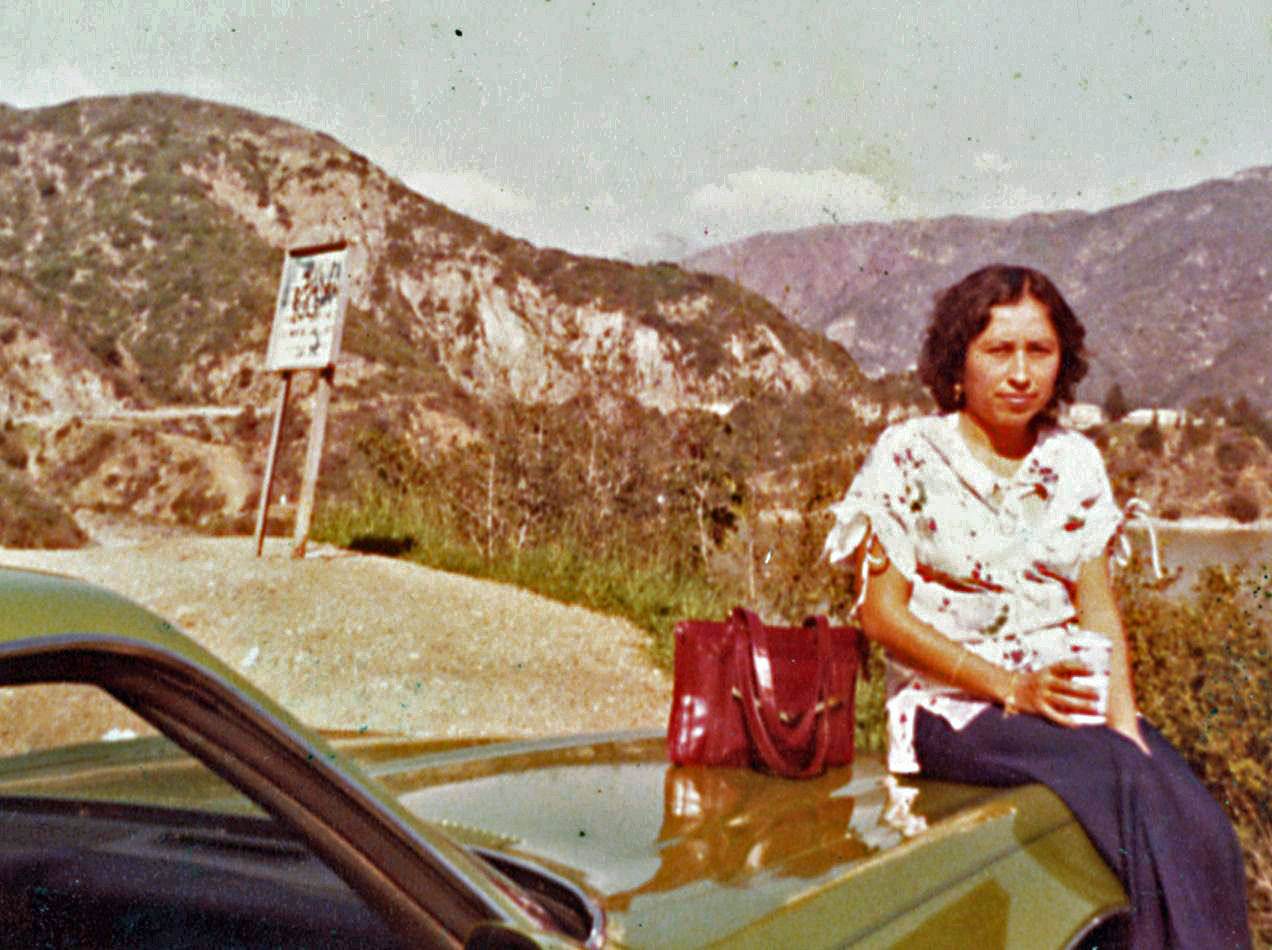
Mami in the United States
TWO AND A half years after my mother went to live in the United States, my father told her that he didn’t love her anymore, and that he no longer wanted to live with her.
“And where am I to go?” my mother asked, holding tight to my little sister because she was the only family my mother had in that strange and beautiful country.
The irony was that in her worst nightmares she had pictured my father leaving her for a golden-haired, blue-eyed gringa. But the woman who stole her husband was a paisana, a Mexican from the state of Zacatecas. What was it about her he liked? my mother had wondered. Was it that she was educated and was a nursing assistant, unlike my mother, who was only allowed a sixth-grade education? Or was it the fact that this woman was a naturalized U.S. citizen and could speak English, unlike my mother, who as hard as she tried, couldn’t seem to make sense of the strange words that rolled off the tongues of Americans? Did my father see that woman and her American privileges as a way to a bigger future, a future that my mother, with her limitations, couldn’t give him?
Whatever it was about that woman, my mother hadn’t been able to stop herself from thinking that perhaps Abuela Evila was right: she just wasn’t good enough for him.
And then came his ultimate betrayal. At the end of the week he tossed her out of the apartment, but did not allow her to take Betty. My mother’s first thought had been to go to the police, but she was afraid of being deported, and if that were to happen, then surely she would never see her daughter again. She wanted to go back to Mexico, back to the place she knew, back to her mother, back to us—her children—away from my father, but she couldn’t leave like this, with no money and no daughter. Everyone would scorn her for coming back worse off than when she left.
Every day she would go to the babysitter’s house to visit my little sister. My father had told the babysitter he would hold her responsible if anything happened to Betty, and because she was terrified of my father, the babysitter never took her eyes off the baby. But when my mother came knocking, the babysitter didn’t have the heart to tell her she couldn’t see her own child, and so she let her into her house. But not once did she let my mother take Betty out.
But on Mother’s Day of 1982, while Mago, Carlos, and I were debating about whether or not to give our art projects to Tía Emperatriz, my mother was rushing to the babysitter’s house because it was her special day and she wanted to spend it with her daughter. Betty reached for her as soon as she saw her. My mother sat in the living room with the baby and looked outside at the beautiful sunlight.
“Let me take her out,” she asked the babysitter. “It’s such a nice day today, and I want to take my little girl to the park and buy her an ice cream.”
“You know I can’t do that, Juana,” the babysitter said. “Natalio will kill me if he finds out I let you see her, let alone take her out.”
“Only an hour,” my mother said. “I only ask for an hour. Please, it’s Mother’s Day today.”
The babysitter finally agreed. “You promise you will bring her back in an hour?”
“Yes, yes, I promise,” my mother said.
And she had not meant to break her promise, but half way back to the babysitter’s house something had bubbled up inside her. Her blood boiled at the thought of that other woman preparing her daughter’s bottles, giving her a bath, tucking her into bed, singing her to sleep. She imagined Betty growing up thinking the other woman was her mother. She became jealous of the woman who had already taken her husband from her, and she swore that she wouldn’t let her take her baby’s love away from her as well. And him, how could he have let go of her in that most frightening place where he knew she was all alone and he and Betty were the only family she had there? So she turned around and walked in the opposite direction, never once looking back.
The events culminated with something so horrible that even now, I still can’t fully believe it. My father, in a moment of rage, his blood boiling with alcohol, went looking for my mother with a gun. Was he planning to shoot her? My father would later say no, his intention had been to scare her. But whatever the truth may have been, someone did get hurt. An innocent bystander had tried to defend my mother when he saw my father bullying her on the sidewalk in front of Tía María Félix’s apartment, where my mother had sought refuge. My father wanted Betty back. My mother refused to hand her over. Betty was crying uncontrollably while both her parents had their shouting match over who got to keep her. My father’s new woman waited in the passenger seat of the car, and her presence enraged my mother even more. It made her hold on to Betty with all her might. The bystander and my father got into a fistfight when he tried to break up my parents’ argument. The gun accidentally went off, and the man was shot.
Luckily for my father, the man did not die. Luckily for my father, he was allowed voluntary deportation, instead of getting thrown in prison. Within a week, he had managed to sneak across the border and resumed his life in the United States as if nothing had ever happened.

The story my mother told us back then did not include as many details, and it wouldn’t be until I was a young woman that I would hear the full story. But still, the thought that Papi had tried to shoot Mami was something so horrible it was almost too much to be believed. It was straight out of a Mexican soap opera!
“She’s exaggerating,” Mago said after we’d heard the abbreviated story. Whether Mami was exaggerating or not, we couldn’t be sure, but either way we became fiercely loyal to her. Even Mago, as doubtful as she was, tried to please Mami and was careful not to mention Papi whenever she was around. Yet it wasn’t long before we discovered that our loyalty and our love wouldn’t be enough. Mami was distant with us, indifferent in many ways. Sometimes, her eyes would widen in horror, and she would shake her head as if trying to rid herself of the memories that haunted her. Then, she would look at us, but not really see us. She was looking for something we—her children—could not give her. We didn’t know yet what exactly that was, but we soon found out.

By November, my mother had given up on selling at La Quinta Castrejón and had found a job at a record shop. She would usually get home around seven, when it was already dark. The road in front of my grandmother’s house was made of dirt and covered with so many potholes and rocks that taxicabs and combis—public minibuses—wouldn’t come near the house. Mami would have to get off at the main road and walk the eight minutes to Abuelita Chinta’s house in the dark since there were no streetlights.
One evening, Abuelita Chinta sent Carlos to wait for Mami at the main road and walk her home. Usually, it was Tío Crece who waited for Mami, but he wasn’t home yet and we were sure he was at the cantina drinking his wages away.
Carlos was terrified of walking across the bridge over the canal in the dark. “La Llorona is out there crying out to her children,” he said.
“Don’t be afraid,” Abuelita Chinta said to Carlos. “Just make sure that when you come to the canal, you pray a Hail Mary and an Our Father. Make the sign of the cross before you walk across the bridge.”
Mago and I sat on Abuelita Chinta’s bed and turned on the radio. We didn’t have a TV, but the radio had some nice programs like Porfirio Cadenas: El Ojo de Vidrío, a soap opera about a highwayman seeking to avenge his father’s death. But my favorite program was storytime, where we got to hear fairy tales like “Cinderella,” “Hansel and Gretel,” and “The Three Little Pigs.”
Mami came home by herself. “Where’s Carlos?” we asked.
“I don’t know. He wasn’t waiting for me tonight,” Mami said.
I peeked out the door. Nothing was out there but the train tracks, the gurgling canal, the lonely whistle of the last train announcing its departure from the station.
“Let’s go look for him,” Mago said.
We made our way to the canal, but we didn’t see anyone coming across the bridge. I sat on the train rail and waited. I listened to the crickets singing their sad songs. The canal gurgled. The wind rustled the branches of the guamúchil trees. The fireflies were playing peekaboo among the bushes, and I wanted to get up and chase them, trap them in my cupped hands and set them free inside Abuelita Chinta’s house where they could glow above us like stars. But I didn’t want to leave Mago’s side because La Llorona might get me if I went out too far.
Finally, we saw a small figure making its way toward us from the other side of the bridge.
“Where were you?” Mago asked.
Carlos walked past us with his head hanging low.
“So where were you?” Mago asked again as we rushed to catch up to him.
“Nowhere.”
“What do you mean, nowhere? We were worried about you.”
“Leave me alone,” he said. He went into the house and didn’t answer Mami when she asked him about his whereabouts. He didn’t want to eat dinner. He went to lie down on his cot and didn’t speak to us for the rest of the evening.

In the morning, Carlos was still in a bad mood. We usually walked to school together, but that day he left without us. He didn’t meet us for lunch. When we came back from school we tried to get him to tell us more jokes about Pepito, but instead he ignored us and stayed out all afternoon playing soccer in the vacant lot with his friends.
“What’s gotten into him?” Mago asked me as she stirred the beans.
“I don’t know,” I said. I took a drink of cool water from the clay pot in the kitchen and ran back outside where my friends were playing jump rope.
I loved Abuelita’s street. In the evening, the rays of the setting sun would paint the dirt road the color of baked clay. All the neighborhood kids came out to play. The train tracks provided lots of fun. We had contests to see who could jump over the most ties or who could balance herself the longest on the tracks. Sometimes we put pieces of scrap metal on the tracks and after the train swished by we would run to pick up our flattened shiny metal. Women would sit outside their homes on wicker chairs, embroidering cloth napkins or reading a magazine while listening to boleros on the radio. In clusters or alone, men returned home from work. Some came from the cornfields covered with sweat and dirt, with their machetes hanging at their sides from strings of rawhide. Others came from the train station, looking like ghosts, covered from head to toe with the powder that seeped out of the cement bags they loaded and unloaded all day long.
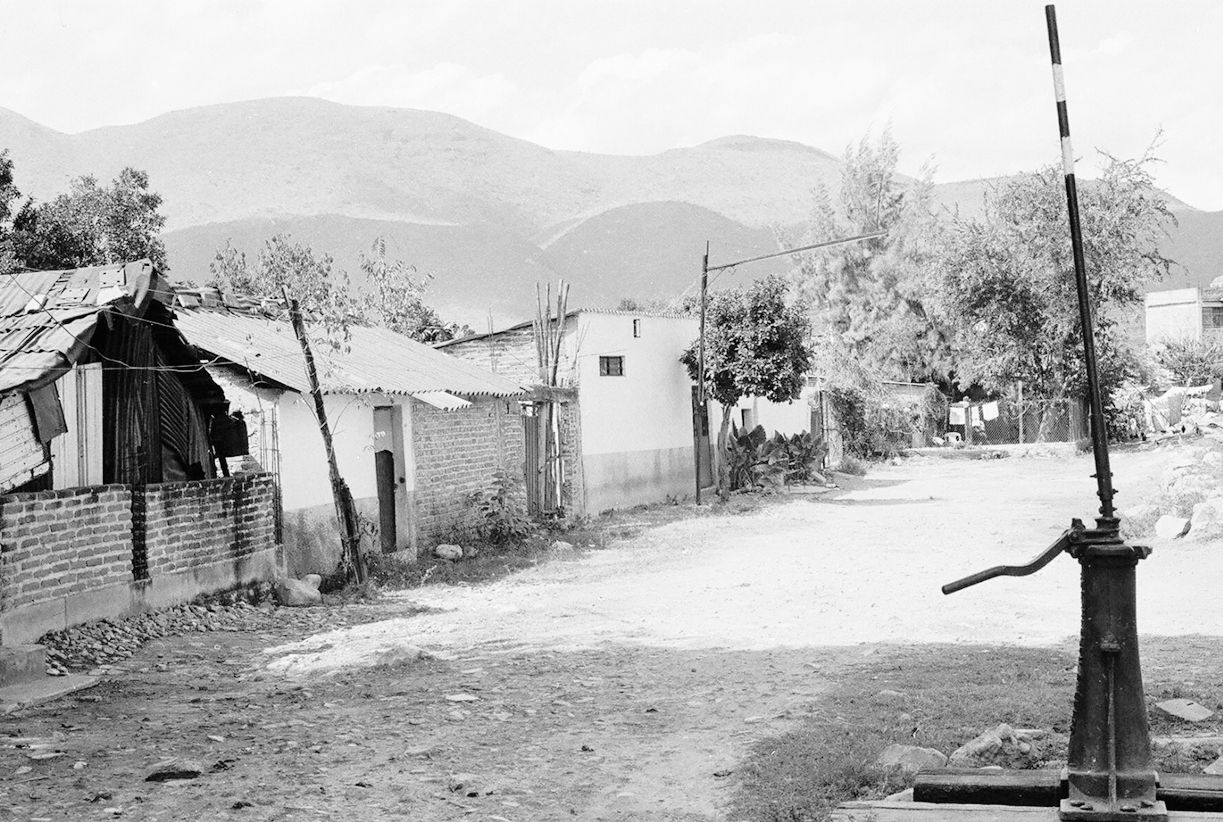
Abuelita Chinta’s street
I would imagine those men’s wives and kids waiting for them at home. I pictured the women clapping balls of dough into tortillas and cooking them in the comal. I could smell the beans boiling, the meat frying, the chiles and tomatoes roasting before being turned into salsa on the molcajete. I could see the fathers washing themselves before sitting down at the table to eat dinner with their wives, sons, and daughters. If Papi hadn’t left, that is how my evenings would have always been, I would tell myself.
While I made mud tortillas with my friends Meche and Cheli, Carlos and his friends would go wait for the evening train, and as soon as it came, they would run after it, grab ahold of it to climb on, and then ride it all the way to the train station, where they then would have to run back for our favorite part of the evening, when Doña Caro’s husband came home.
Don Lino was the only person on our street who owned a vehicle. All of us kids would stop what we were doing as soon as we heard the quiet hum of the motor in the distance.
“Come on, let’s go!” Don Lino’s son, Jimmy, yelled. “Here comes my papi!” We all ran down the road to meet Don Lino and climb on the back of his blue truck, which rocked side to side, groaning as it went. We pretended we were on a ship being tossed in a storm.
When Mami got home, Betty, as usual, ran to her wanting to be picked up.
“Only refried beans and a chunk of cheese?” Mami said. “That’s all we’re eating tonight?”
“There are people who won’t be eating dinner tonight, Juana. Let us be thankful,” Abuelita Chinta said as she scooped the beans into our bowls.
“I can’t believe your father doesn’t send any money for you kids,” Mami said to us. “He’s probably spending it on that woman!”
“Juana, we’ll be okay,” Abuelita Chinta said. “You’re here now with your children. I’m sure that’s enough for them.”
“You’re right, Amá. Things are going to get better really soon.”
I wanted to reach out and hold Mami. I wanted to tell her that I’d rather eat beans for the rest of my life as long as she was with me. But the look she gave me scared me. It was almost as if she hated me.
“You look just like him,” she said to me. I glanced at the Man Behind the Glass, and for the first time, I was not happy about having his features. I didn’t want Mami to look at me like that, a look full of pain, anger, hatred. I wanted to grab the Man Behind the Glass and toss him onto the railroad tracks so the train would shatter him. So that Mami wouldn’t look at him, and look at me, and then think we were one and the same.
Abuelita Chinta set the bowl of beans on the table and ruffled my hair. “Why don’t you kids go buy some sodas for our meal? When you come back, the beans won’t be so hot.”
We took the money and left.

“So what’s the matter with you?” Mago asked Carlos as we were coming back from the store.
“You’re going to get mad if I tell you.”
“Just spit it out.”
We stopped walking. We were already near the house, and we didn’t want to go inside just yet because then we wouldn’t be able to talk.
“Mami has a boyfriend,” Carlos said.
“What?” Mago and I said at the same time.
“I saw her. I saw her with a man.” He told us that the previous night many combis had come and gone, but without Mami. Because he was afraid of standing there in the dark alone, putting himself in danger of getting beaten or killed by some crazy person, he climbed up the tree near the tortilla mill. Minutes later, a taxi pulled up right under the tree and Mami and a man got out. The taxi left, and as soon as it did the man pulled Mami into his arms and kissed her on the mouth.
“They kissed for a long time,” Carlos said. “I didn’t know what to do. I didn’t want Mami to get mad at me. When they were done kissing and hugging each other, the man hailed a taxicab and left. Mami made her way to the bridge, and I wanted to run to her and walk with her, but instead I stayed up in the tree. I didn’t want her to know I had seen her.”
We continued on our way before Mami or Abuelita Chinta came looking for us. What did it mean that Mami had a boyfriend? I wondered.
At dinner, I could see how much Mago was struggling to keep from shouting that we knew Mami’s secret. She had a scowl on her face, and whenever Mami said something to her, Mago just grunted in response.
“¿Qué te pasa?” Mami asked again.
Then Mago couldn’t hold back anymore and said, “Mami, who was that man?”
“What man?”
“The man you were kissing by the main road.”
Since she was holding Betty on her lap, it was hard for me to see the expression on Mami’s face. She buried her face in Betty’s hair, as if hiding from our accusing eyes.
“Well, since you already know, I might as well tell you,” she said finally. “He sells car insurance next to the record shop. But at heart he’s a wrestler. He does Lucha Libre on the weekends and he’s very good—”
“Who cares? What is he to you?”
“Don’t talk like that to me, Mago,” Mami said, looking over Betty’s head. “Anyway, I might as well tell you now. I’m going away with him.”
“What?” we all yelled. Betty started to whimper at hearing our angry voices.
“Juana, what are you saying?” Abuelita Chinta said.
“Francisco has gotten a contract to fight in Acapulco, and he asked me to go with him. I’ve accepted.”
“But you can’t go!” Mago yelled. She got up so suddenly, her chair toppled over. “You can’t!”
“I won’t be gone for long. Now sit down and stop yelling at me.”
“You said that the last time,” Carlos said. “And you were gone two and a half years.”
“Mami, don’t leave us again,” I said as I rushed to her side.
“And what about us?” Mago said. “What’s going to happen to us?”
“You’ll stay with your abuelita. She’ll watch over you.”
“Juana, you can’t do this,” Abuelita Chinta said. “It isn’t right.”
“When Papi hears of this, that you’re leaving us again—” Mago said.
“Don’t you dare bring up your father. There’s nothing between us anymore. Don’t you kids understand that? He tried to kill me.”
“You’re making that up,” Mago said. “He wouldn’t have done that. And if he did, maybe, maybe it was all your fault!”
Mami stood up and headed over to Mago, ready to beat her. Abuelita Chinta quickly got in between them. “Juana, you need to think things through.”
“I have, Amá,” Mami said. “And I’ve made my decision.”

When Mami left, she didn’t even have the courage to tell us. When we got home from school the next day, we found Betty in tears. Abuelita Chinta told us that our mother had just left with the wrestler. “They’ve gone to catch a taxi over by La Quinta Castrejón,” she said.
Betty’s sobs were deafening. Mago, who had always shown her dislike for Betty in many ways, was the one who picked her up and held her. Carlos and I bolted out the door, hoping that Mami and the wrestler might still be waiting by the main road. At seven years old, I found myself running to catch up to my mother and beg her not to leave me for the second time in my life. Carlos ran faster than I did, and by the time I got to the main road, he was bent over, crying. There was no sign of Mami anywhere.